How Grover Norquist’s Pledge Blocks Real Deficit Cuts
Eli Lehrer has an incisive piece on this page about Tom Coburn’s “Gang of Six” tax proposals. I believe however that the proposals deserve a warmer endorsement than Eli offers.
An important cause of America’s long-term debt problem is the intellectual cul-de-sac into which Republicans have driven themselves. Republicans have accepted a total ban on any kind of tax increase as party orthodoxy. And they have submitted to the authority of Grover Norquist of Americans for Tax Reform to determine what constitutes a “tax increase.”
Norquist takes the view that any action that increases the revenue column of the federal government must be deemed a tax increase – and that such increases are only permissible if they are offset by an equivalent cut to the spending column.
The trouble is that a lot of federal spending – especially the spending done by Republicans – takes the form of tax remission.
The federal government offers a tax credit of up to $9,500 for the purchase of plug-in electric cars. How exactly is that different from writing a check to every plug-in buyer? Yet canceling this program would count as a tax increase under Grover Norquist’s test.
Adopt a child and you can qualify for a tax credit of up to $13,100. You can even get credit for the cost of meals and lodging while traveling in a foreign country to receive the child. You can say a lot of things about this measure. But is it a “tax cut”? Hardly.
Enrolled in college or university? You can deduct up to $4,000 of qualified tuition expenses.
Over 65? Or disabled? Adjusted gross taxable income of less than $17,500? Tax credit for you.
And so on. The point is not that these tax expenditures are all necessarily ill-advised. (It’s genuinely more expensive to be disabled, and public money to help the disabled cope with the costs imposed on them by nature or accident seems a reasonable response by a civilized society.) The point is: they are expenditures, disguised as tax cuts.
This point – so obvious with the smaller tax expenditures – is true also of many of the larger tax expenditures, even if familiarity blinds us to the fact. Mortgage interest deductibility and the tax exclusion of employer-provided fringe benefits: these are subsidies too, no less subsidies for being widely rather than narrowly used.
Yet on the Norquist system and by the Norquist rule, the US cannot address these subsidies contained in the tax code unless and until they are simultaneously matched exactly with other subsidies and benefits that happened to have been framed as outlays. Economically, the rule makes little sense. Politically, it has the job of making deficit reduction twice as difficult as it needs to be. With consequences that …. well let’s leave that for a second post.
By: David Frum, Frum Forum, April 25, 2011
“An Inherent Relationship”: A Primer on Class Struggle
When we study Marx in my graduate social theory course, it never fails that at least one student will say (approximately), “Class struggle didn’t escalate in the way Marx expected. In modern capitalist societies class struggle has disappeared. So isn’t it clear that Marx was wrong and his ideas are of little value today?”
I respond by challenging the premise that class struggle has disappeared. On the contrary, I say that class struggle is going on all the time in every major institution of society. One just has to learn how to recognize it.
One needn’t embrace the labor theory of value to understand that employers try to increase profits by keeping wages down and getting as much work as possible out of their employees. As the saying goes, every successful capitalist knows what a Marxist knows; they just apply the knowledge differently.
Workers’ desire for better pay and benefits, safe working conditions, and control over their own time puts them at odds with employers. Class struggle in this sense hasn’t gone away. In fact, it’s inherent in the relationship between capitalist employer and employee. What varies is how aggressively and overtly each side fights for its interests.
Where else does class struggle occur? We can find class struggle wherever three things are at stake: the balance of power between capitalists and workers, the legitimacy of capitalism, and profits.
The most important arena outside the workplace is government, because it’s here that the rules of the game are made, interpreted, and enforced. When we look at how capitalists try to use government to protect and advance their interests — and at how other groups resist — we are looking at class struggle.
Capitalists want laws that weaken and cheapen labor. This means laws that make it harder for workers to organize unions; laws that make it easier to export production to other countries; laws that make it easier to import workers from other countries; laws and fiscal policies that keep unemployment high, so that workers will feel lucky just to have jobs, even with low pay and poor benefits.
Capitalists want tax codes that allow them to pay as little tax as possible; laws that allow them to externalize the costs of production (e.g., the health damage caused by pollution); laws that allow them to swallow competitors and grow huge and more powerful; and laws that allow them to use their wealth to dominate the political process. Workers, when guided by their economic interests, generally want the opposite.
I should note that by “workers,” I mean everyone who earns a wage or a salary and does not derive wealth from controlling the labor of others. By this definition, most of us are workers, though some are more privileged than others. This definition also implies that whenever we resist the creation and enforcement of laws that give capitalists more power to exploit people and the environment, we are engaged in class struggle, whether we call it that or not.
There are many other things capitalists want from government. They want public subsidy of the infrastructure on which profitability depends; they want wealth transferred to them via military spending; they want militarily-enforced access to foreign markets, raw materials, and labor; and they want suppression of dissent when it becomes economically disruptive. So we can include popular resistance to corporate welfare, military spending, imperialist wars, and government authoritarianism as further instances of class struggle.
Class struggle goes on in other realms. In goes on in K-12 education, for example, when business tries to influence what students are taught about everything from nutrition to the virtues of free enterprise; when U.S. labor history is excluded from the required curriculum; and when teachers’ unions are blamed for problems of student achievement that are in fact consequences of the maldistribution of income and wealth in U.S. society.
It goes on in higher education when corporations lavish funds on commercially viable research; when capitalist-backed pundits attack professors for teaching students to think critically about capitalism; and when they give money in exchange for putting their names on buildings and schools. Class struggle also goes on in higher education when pro-capitalist business schools are exempted from criticism for being ideological and free-market economists are lauded as objective scientists.
In media discourse, class struggle goes on when we’re told that the criminal behavior of capitalist firms is a bad-apple problem rather than a rotten-barrel problem. It goes on when we’re told that the economy is improving when wages are stagnant, unemployment is high, and jobs continue to be moved overseas. It goes on when we’re told that U.S. wars and occupations are motivated by humanitarian rather than economic and geopolitical concerns.
Class struggle goes on in the cultural realm when books, films, and songs vaunt the myth that economic inequality is a result of natural differences in talent and motivation. It goes on when books, films, and songs celebrate militarism and violence. It also goes on when writers, filmmakers, songwriters, and other artists challenge these myths and celebrations.
It goes on, too, in the realm of religion. When economic exploitation is justified as divinely ordained, when the oppressed are appeased by promises of justice in an afterlife, and when human capacities for rational thought are stunted by superstition, capitalism is reinforced. Class struggle is also evident when religious teachings are used, antithetically to capitalism, to affirm values of equality, compassion, and cooperation.
I began with the claim that Marx’s contemporary relevance becomes clear once one learns to see the pervasiveness of class struggle. But apart from courses in social theory, reading Marx is optional. In the real world, the important thing is learning to see the myriad ways that capitalists try to advance their interests at the expense of everyone else. This doesn’t mean that everything in social life can be reduced to class struggle, but that everything in social life should be examined to see if and how it involves a playing-out of class interests.
There is fierce resistance to thinking along these lines, precisely because class analysis threatens to unite the great majority of working people who are otherwise divided in a fight over crumbs. Class analysis also threatens to break down the nationalism upon which capitalists depend to raise armies to help exploit the people and resources of other countries. Even unions, supposed agents of workers, often resist class analysis because it exposes the limits of accommodationism.
Resistance to thinking about class struggle is powerful, but the power of class analysis is hard to resist, once one grasps it. Suddenly, seemingly odd or unrelated capitalist stratagems begin to make sense. To take a current example, why would capitalists bankroll candidates and politicians to destroy public sector unions? Why do capitalists care so much about the public sector?
It’s not because they want to balance budgets, create jobs, improve government efficiency, or achieve any of the goals publicly touted by governors like Scott Walker, Chris Christie, Rick Snyder, or John Kasich. It’s because of the profit and power they can gain by destroying the last remaining organizations that fight for the interests of working people in the political sphere, and by making sure that private-sector workers can’t look to the public sector for examples of how to win better pay and benefits.
Other parts of the agenda being pursued by corporate-backed governors and other elected officials also make sense as elements of class struggle.
Selling off utilities, forests, and roads is not about saving taxpayers money. It’s about giving capitalists control of these assets so they can be used to generate profits. Cutting social services is about ensuring that workers depend on low-wage jobs for survival. Capitalists’ goal, as always, is a greater share of wealth for them and a smaller share for the rest of us. Clear away the befogging rhetoric, the rhetoric that masks class struggle, and it becomes clear that the bottom line is the bottom line.
If class struggle is hard to see, it’s not only because of mystifying ideology. It’s because the struggle has been a rout for the last thirty years. But a more visible class struggle could be at hand. The side that’s been losing has begun to fight back more aggressively, as we’ve seen most notably in Wisconsin. To see what’s at stake in this fight and what a real victory might look like, it will help to call the fight by its proper name.
By: Michael Schwalbe, Professor of Sociology, North Carolina State University, Originally Published March 31, 2011, CommonDreams.org
‘Government Shutdown Prevention Act’ Undermines Democracy
Legal training is not a requirement to serve in Congress, although many of the members are, and have been, lawyers. Nor is it necessary for a House or Senate member to have served in another government post, although many have, and their experience at forging alliances and compromises has been helpful. We no longer have literacy tests for voters, a technique southern states used until the 1960s, effectively to disenfranchise African-American voters.
Yet, it might not be a bad idea to require incoming members of Congress to take a basic test in civics.
How else, other than an alarming misunderstanding of the basic of American government, to explain the effort of House Republicans to shut the Senate out of the budget process? Their sanctimoniously titled “Government Shutdown Prevention Act” would do just that, deeming that if the Senate failed to pass a measure to keep the government running amid the current budget dispute, that the House-passed version would become law.
The idea is bizarre on so many levels—not least because the Senate would actually have to pass the Government Shutdown Prevention Act for the House to assume a dictatorial role in one of the three branches of the world’s greatest democracy. The current fashion of anti-intellectualism in politics aside, do the House Republicans not understand the elementary-school fundamentals of how a bill becomes a law.
The freshman GOP lawmakers are annoyed with the Democratic-controlled Senate, this time for failing to cave in on the dramatic cuts the House Republicans want in the budget. Join the club, folks: The House has long been irritated by the Senate. Ask the House Democrats, who approved more than 300 bills in the last Congress that ended up dying in a Senate that failed to pass them or even consider them.
But the rudimentary lesson of lawmaking (FYI—a bill has to be passed by both the House and the Senate, then signed by the president, to become law. If the president vetoes a bill, each chamber of Congress must summon a two-thirds majority to override the veto) are nowhere near as important as the lesson about getting things done in a country of diverse interests. The Tea Party crowd ran campaigns of anger and frustration, blaming Congress for its failure to get balanced budgets and myriad other things. There’s a reason for that, and it’s not because members are stupid (they’re not, and some of them are absolutely brilliant) or lazy (they work longer hours than most Americans imagine) or weak. It’s because this is a country of wildly divergent attitudes and perspectives, reflected in the lawmakers those citizens send to Congress. The Tea Partyers believe they were sent to Washington with a mission, and they likely were. So were Nancy Pelosi and other liberal members whose constituents have drastically different perspectives than those in the Tea Party team’s districts. And their views are no less valid.
Legislating requires compromise, and compromise is hard, especially during times of economic stress. Being a congressman is a difficult job, forcing them to balance their districts’ needs with the national interest. The new members signed up for this job. They should do it.
By: Susan Milligan, U.S. News and World Report, April 1, 2011
What Does The Tea Party Want?….The New Litmus Test
Jim VandeHei and Mike Allen argue that the Tea Party redefined the purpose of the GOP as opposition to spending:
The Republican Party is undergoing a messy but unmistakable 20-month transformation from fanatically anti-Obama to fanatically anti-spending, providing top party officials a new and intriguing playbook for recapturing the White House in 2012.
To understand the current evolution, flash back to late spring of 2009. The GOP was disoriented and adrift, its leadership void filled by the bombastic voices of Palin, Beck and Rush Limbaugh. There was no common conservative cause, beyond fear and loathing of Obama. No wonder swing voters were so down on them.
But the tea party, treated at first by the media as exotics, forced Republicans to focus almost exclusively on the size of government. By the time the 2010 elections rolled around, tea party activists and most independent voters were completely aligned on the need to cut, cut, cut.
Midterm election results showed that this approach offers the GOP its best – and maybe only – hope of keeping the interests of independents and tea party activists aligned enough to beat Obama.
The new litmus tests for GOP presidential hopefuls are support for repealing “Obamacare” and taking a cleaver to government spending. If a presidential candidate could harness the smaller-government conservatism, temper it enough to avoid a blatant overreach and articulate a vision for a prosperous future for the country, it’s not hard to imagine swing voters finding such a person appealing.
There’s a superficial appeal to this story. But the evidence that Tea Party activists want to cut spending — at least actual spending programs — is sparse. Polls show that Tea Party supports overwhelmingly oppose cuts to Social Security and Medicare. The main thrust of Tea Party opinion is not the belief that Obama has spent too much money, but the belief that Obama has spent too much money on people unlike them:
More than half say the policies of the administration favor the poor, and 25 percent think that the administration favors blacks over whites — compared with 11 percent of the general public.
They are more likely than the general public, and Republicans, to say that too much has been made of the problems facing black people.
Here’s another cut, showing the Tea Party’s greater comfort with inequality of opportunity and stronger belief that the government devotes too many resources to minorities:
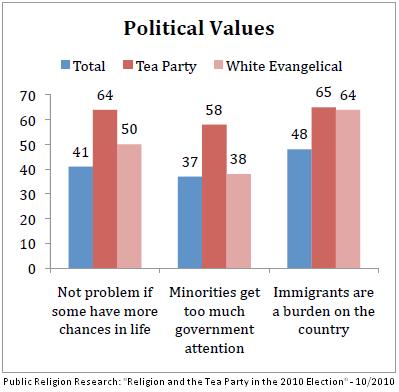
It’s a revolt against the composition of government much more than the level.
Now, it’s true that Republicans aren’t exactly translating this blueprint into action, but they’re not exactly flouting it, either. There is always a generalized antipathy toward spending amongst Republican and swing voters, but it disappears when the subject turns to actual government programs. Usually Republicans decide to just cut taxes for the rich instead. Here’s is the one part of the article proposing a defined policy change:
Even Ralph Reed, the Republican operative most tapped in to evangelicals, reflected the new GOP mindset when he gave this surprising wish list for the next presidential race: “In a perfect world, I’d like to hear the Republican nominee run on a platform that takes the capital gains tax to zero over five years.” Reed, who summoned several of the presidential candidates to Iowa for his Faith & Freedom Coalition this week, made it clear that Christian conservatives will still need to be catered to, but added that his side will understand the nominee’s need to focus on swing voters.
So an article putatively about the GOP redefining itself as an anti-spending party has one actual programmatic detail, and it’s: a zeroing out of the capital gains tax. In the name of appealing to swing voters — who, in fact, oppose tax cuts for the rich. Meet the new boss…
By: Jonathan Chait, The New Republic, March 14, 2011
The Right Wing Can’t Survive Without Stoking Anger
What’s going to be fascinating to watch in the weeks and months ahead is how the Right adjusts to the new “kinder, gentler” rhetorical environment everyone – but them – is demanding.
If you have been a student of the new Right you understand that the gains they’ve made in American politics have come in direct proportion to a rising level of anger. Some of that anger was there just waiting for affirmation, but much more of it has been ginned up by rightwing talkers like Limbaugh, Beck and FOX News.
The anti-government mantra now hammered home 24/7/365 by these demagogic forces provided both cover and opportunity for rightwing politicians in Congress. It did so by rounding up the lower-common denominator types at the grassroots level by affirming their unease and distrust of a changing nation and world they simply cannot understand, much less accept.
Money and votes followed; money from corporate sources that always fund efforts to neuter government regulations and regulators, and votes from a class of voters only Barnum and Bailey could appreciate.
But, what if now the voices stoking all this rightwing blind fury are forced to clean up their acts? And, gasp, forced to stick to provable facts rather than the ones they manufacture to fuel more anger? What then?
Of course no one gives up a “good thing” if they can avoid it, and initially the Right will try blunt any trajectory towards tolerance and moderation.
Then there are the genuinely loony members of Congress who rode the Right’s Anger Express to elected office. You know – like this one.
What I expect to see and hear in the days and weeks just ahead is a new — and frankly jarring — argument from the Right; civility in politics is a liberal plot. A plot against who? Well against the Right, of course. There’s nothing a zealot likes more than to claim the cloak of persecution. It’s always the last refuge of scoundrels, be it demagogic politicians or Christians, Jews, Muslims or Scientologists. Call them on their nonsense and they scream “persecution.”
In this case the Right is going to be forced to take a position that unmasks them once and for all. Without their patented violent, hate-inciting rhetoric, the Right has nothing to offer America. Nothing.
Which explains why they’re going to fight — not for civility — bit for more incivility.
Imagine that.
By: Stephen Pizzo-Guest Columnist; The BuzzFlash Blog, January 13, 2011
Share This Blog


 Unknown Feed
- An error has occurred; the feed is probably down. Try again later.
 mykeystrokes.com

You must be logged in to post a comment.