Conservative radio host Laura Ingraham is outraged — outraaaged! — that President Obama met with some MSNBC anchors at the White House on Tuesday, according to her daily newsletter:
“Rachel Maddow, Al Sharpton, Lawrence O’Donnell, and Ed Schultz all stopped by the White House to discuss the President’s fiscal cliff proposal. Can anyone even imagine how the press would have reacted if Fox News hosts and conservative personalities had stopped by the Bush White House to discuss policy? They would have been rightly outraged.”
Yes, let’s all put on our imagination hats and try as hard as we can to imagine what that meeting would look like. George W. Bush would be seated in an Oval Office chair, doing jazz hands in front of a bust of Winston Churchill. On his left, Fox News host Sean Hannity would be pensively smelling his hand on a couch with conservative personality Michael Medved. On his right, conservative personalities Neil Boortz and Mike Gallagher would be sharing another couch. And, just for imagination’s sake, let’s put conservative personality Laura Ingraham in there, too, right next to the president. Now, obviously, such a scene never actually transpired, but — wait, what? Oh. It did.

After Media Matters revealed Ingraham’s hypocrisy to the world, a producer responded with the classic “Ingraham didn’t actually write the newsletter, and also, the two things are totally different because I said so” defense.
During Laura’s brief radio hiatus, the Daily Fix is written by staff. Although I didn’t know Laura had visited the Bush White House with other conservative radio hosts, the circumstances of her meeting the president were quite different. Laura did not go to the White House to advise the president, but was simply briefed on policy for perhaps an hour.
For what it’s worth, the MSNBC hosts didn’t “advise” Obama. They were, uh, briefed on policy:
“This afternoon at the White House, the President met with influential progressives to talk about the importance of preventing a tax increase on middle class families, strengthening our economy and adopting a balanced approach to deficit reduction,” Earnest said in a statement Tuesday.
As embarrassing as this whole episode is for Team Ingraham, they’re not the only ones who should have done a little research before going into full fauxtrage mode about the MSNBC meeting. Take the hosts of Fox & Friends (please!), for example, who overreacted in typical fashion. “I’m shocked by that,” Brian Kilmeade said. “To invite five talk show hosts in, all from the same channel? That’s outrageous.” Mike Huckabee, who has a show on Fox News, claimed yesterday that the sit-down with Obama destroyed any “illusion whatsoever that there’s objectivity going on at MSNBC.”
By: Dan Amira, Daily Intel, December 6, 2012
December 7, 2012
Posted by raemd95 |
Politics | Conservatives, Economic Policy, Fox and Friends, Fox News Channel, George W. Bush, GOP, Laura Ingraham, media, MSNBC |
1 Comment
For most of its history ALEC has operated in the background, but its influence recently drew the spotlight when its promotion of “Stand Your Ground” laws came to light in the wake of the killing of Trayvon Martin in Florida. Faced with the potential of consumer boycotts, corporate sponsors such as McDonald’s and Pepsi withdrew their support. Henceforth, the organization announced, it would concentrate on state economic policy.
State legislators who might look to the organization for leadership on economic policies should be wary of following ALEC’s lead in this arena. A startlingly candid report, “Selling Snake Oil to the States,” just released by the Iowa Policy Project and the Washington-based Good Jobs First, shows that ALEC’s recommendations for producing economic growth in the states are essentially worthless.
This is a strong claim, but the researchers support their conclusion neatly by putting under the microscope the implicit predictions in the 2007 edition of Rich States, Poor States, the volume written by economist Arthur Laffer and the source of the ALEC-Laffer State Economic Competitiveness Index.
In brief, the authors take ALEC’s 2007 ranking of states based upon the states’ adherence to its recommendations, and seeing whether indeed the states that were predicted to prosper were doing so five years later.
None of ALEC’s predictors of economic growth—elimination or reduction of progressive taxation, reduced commitments to public services, tightening of social safety net programs, or reduced union influence—showed any relationship to economic prosperity.
In fact, if anything the ALEC formula for prosperity had an inverse relationship. As the authors put it:
…states that were rated higher on ALEC’s Economic Outlook Ranking in 2007…have actually been doing worse economically in the years since, while the less a state conformed with ALEC’s policies the better off it was.
Looking at median family income specifically:
Once again, actual results are the opposite of the ALEC claim. The more a state’s policies mirrored the ALEC low-tax/regressive taxation/limited government agenda, the lower the median family income; this is true for every year from 2007 through 2011; Figure 5 below shows the results just for 2011. The relationship is not only negative each year, it also became worse over time: the better a state did on the ALEC Outlook Ranking, the more family income declined from 2007 to 2011. The correlation, -.30, is statistically significant.
The authors of the report remind us that the only way to accelerate economic growth is to pursue policies that increase or maintain productivity, such as investing in roads, bridges and schools, and insuring an educated workforce and a healthy population.
One report can hardly be expected fully to turn back the simplistic analysis that ALEC has been promoting for understanding state economic development. But this one should provide a strong counter-weight to the notion that states can prosper by following the low road of tax cuts and limited support for the public sector.
By: Michael Lipsky, The American Prospect, December 3, 2012
December 4, 2012
Posted by raemd95 |
Politics | ALEC, Arthur Laffer, Economic Growth, Economic Policy, Family Income, Stand Your Ground Laws, States, Tax cuts |
Leave a comment
I decided to support Barack Obama pretty early in the Democratic primary, around spring of 2007. But unlike so many of his supporters, I never experienced a kind of emotional response to his candidacy. I never felt his election would change everything about American politics or government, that it would lead us out of the darkness. Nothing Obama did or said ever made me well up with tears.
Possibly for that same reason, I have never felt even a bit of the crushing sense of disappointment that at various times has enveloped so many Obama voters. I supported Obama because I judged him to have a keen analytical mind, grasping both the possibilities and the limits of activist government, and possessed of excellent communicative talents. I thought he would nudge government policy in an incrementally better direction. I consider his presidency an overwhelming success.
I can understand why somebody who never shared Obama’s goals would vote against his reelection. If you think the tax code already punishes the rich too heavily, that it’s not government’s role to subsidize health insurance for those who can’t obtain it, that the military shouldn’t have to let gays serve openly, and so on, then Obama’s presidency has been a disaster, but you probably didn’t vote for him last time. For anybody who voted for Obama in 2008 and had even the vaguest sense of his platform, the notion that he has fallen short of some plausible performance threshold seems to me unfathomable.
Obama’s résumé of accomplishments is broad and deep, running the gamut from economic to social to foreign policy. The general thrust of his reforms, especially in economic policy, has been a combination of politically radical and ideologically moderate. The combination has confused liberals into thinking of Obamaism as a series of sad half-measures, and conservatives to deem it socialism, but the truth is neither. Obama’s agenda has generally hewed to the consensus of mainstream economists and policy experts. What makes the agenda radical is that, historically, vast realms of policy had been shaped by special interests for their own benefit. Plans to rationalize those things, to write laws that make sense, molder on think-tank shelves for years, even generations. They are often boring. But then Obama, in a frenetic burst of activity, made many of them happen all at once.
Bipartisan panels of economists had long urged Medicare to reform its payment methods to curb perverse incentives by hospitals and doctors to run up costs as high as possible; Obama overcame fierce resistance in Congress in order to craft, as part of Obamacare, a revolution in paying for quality rather than quantity. He eliminated billions of dollars in useless subsidies to banks funneling (at no risk) government loans to college students. By dangling federal public-education grants, Obama unleashed a wave of public-school reform, over the objections of the most recalcitrant elements of the teachers union movement. And he forced Wall Street to accept financial regulations that, while weaker than ideal, were far tougher than anybody considered possible to get through Congress.
It is noteworthy that four of the best decisions that Obama made during his presidency ran against the advice of much of his own administration. Numerous Democrats in Congress and the White House urged him to throw in the towel on health-care reform, but he was one of very few voices in his administration determined to see it through. Many of his own advisers, both economists steeped in free-market models and advisers anxious about a bailout-weary public, argued against his decision to extend credit to, and restructure, the auto industry. On Libya, Obama’s staff presented him with options either to posture ineffectually or do nothing; he alone forced them to draw up an option that would prevent a massacre. And Obama overruled some cautious advisers and decided to kill Osama bin Laden.
The latter three decisions are all highly popular now, but all of them carried the risk of inflicting a mortal political wound, like Bill Clinton’s health-care failure and Jimmy Carter’s attempted raid into Iran. (George W. Bush, presented with a similar option, did not strike bin Laden.) In making these calls, Obama displayed judgment and nerve.
A year ago, I wrote about the pervasive disillusionment felt by Obama’s supporters. It is a sentiment that has shadowed every Democratic president since Franklin Roosevelt, and even Roosevelt provoked long bouts of agony and disillusionment among his supporters. All were seen by many Democrats at the time as failures, weaklings, or unprincipled deal-makers. It’s true that all of them, including Obama, have made terrible errors. What this tells us, though, is that we need some realistic baseline against which to measure them.
Obama can boast a record of accomplishment that bests any president since Roosevelt, and has fewer demerits on his record than any of them, including Roosevelt. The only president that comes close in gross positive accomplishment is Lyndon Johnson, whose successes were overwhelmed by his failures to such a degree that he abandoned his reelection campaign. The immediacy of the political moment can — and usually does — blind us. (In the aftermath of September 11, 2001, the wide and even bipartisan sentiment prevailed that George W. Bush was exactly the right sort of person we would want to have as president at that moment.)
The sense among Obama’s wavering supporters that he has failed rests upon a two-part indictment. The first and most potent is that he has presided over a weak economy. This line of attack on Obama became inevitable starting on approximately September 14, 2008, when the U.S. financial system imploded. The economists Carmen Reinhart and Kenneth Rogoff have established that financial crises wreak vastly deeper harm than regular recessions. Financial crises freak out consumers, and they freak out political elites in a way that creates a panicked stampede toward exactly the wrong sorts of policies (like reducing short-term deficits) that in turn makes the crisis even worse.
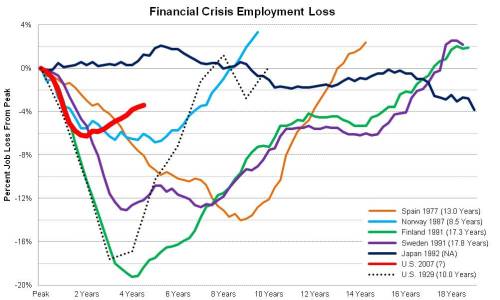
This panic has impeded Obama’s recovery measures. But the fact remains that, by the standards of a financial crisis, the United States suffered through a relatively shallow trough and has enjoyed a fairly rapid recovery. (Here is a chart laying out the comparison between the United States and other comparably afflicted economies.) Obama managed to stabilize the financial system and, through the stimulus, avert a total collapse in consumer demand.
But while America has suffered less since 2008 than other victims of a financial crisis, it has suffered. Obama’s notable success in containing the damage has not redounded to his benefit for another, even more historically durable reason: Voters tend to blame or credit incumbent politicians for the state of their lives utterly regardless of responsibility. This is not even limited to things like the economy, where politicians can affect the outcome. Voters reward or punish incumbents based on the weather or the success of local sports teams. Mitt Romney’s campaign theme attempting to assign all blame to Obama for the state of the economy is a clever manipulation of this long-standing form of irrationality. In 2004, Romney dismissed any attempt to blame George W. Bush for the decline of jobs under his watch as “poppycock.” In his most condescending tone, Romney explained that of course outside forces were to blame — those outside forces being the vastly milder 2001 recession — and that attempting to hold Bush responsible for the economic record of his term was sheer stupidity. Now Romney has made that very theme the central basis of his presidential campaign.
The second indictment of Obama is that he failed to redeem the broader vision of trans-partisan governance he campaigned on. The reason this happened is that the Republicans’ leadership in Congress grasped early on that its path to returning to power required Obama to fail, and that they could help bring this about by denying his initiatives any support. In a meeting before Obama’s inauguration reported by Time’s Michael Grunwald, the House Republican leadership instructed their members on exactly this strategy. GOP Senate Minority Leader Mitch McConnell has followed the same strategy. GOP House members and senators have admitted, some of them publicly, that their leadership prevailed upon them not to negotiate with Obama.
Partisan strife between Congress and the president has gone on for decades. In the past, members of Congress often opposed the president’s agenda, but they also believed that the voters would punish them if they failed to show accomplishments, and so they carefully balanced their substantive opposition with a sense of political self-preservation. What makes the Republican opposition different is that it rests upon a novel, and probably true, insight. Most Americans pay little attention to the details of policy. They rely upon a broad heuristic — if something has touched off an ugly and protracted battle, it is probably bad, but if both sides agree on it, it is probably good. Even many Sunday political talk-show chatterers and other blowhards use the same basic thought process. And so, as McConnell actually said out loud, “if the proponents of the bill were able to say it was bipartisan, it tended to convey to the public that this is O.K., they must have figured it out.” McConnell, in keeping with his Bond-villain habit of boasting openly about his nefarious intentions, actually announced in a prepared speech that his top political priority was to make Obama a one-term president.
The Republican strategy is perfectly clear and not even very well hidden. Yet many of us don’t accept it as a reality because it does not feel true. We instinctively hold the president, not Congress, responsible, another finding political scientists have measured. The hunger to attribute all outcomes to the president is so deep that the political elite take it on faith. Bob Woodward, who is justly famed as a reporter but whose opinions are interesting only as a barometer of Washington establishmentarianism, blamed Obama because Republicans turned down an extraordinarily favorable budget deal. “Presidents work their will — or should work their will,” Woodward declared, “on the important matters of national business.”
How can a president “work his will” in such a way as to force autonomous members of the opposite party controlling a co-equal branch of government to sacrifice their own calculated self-interest? It is a form of magical thinking, but a pervasive one. Which is exactly why the Republican strategy — making Obama’s promise to transcend partisanship fail by withholding cooperation — has worked.
Whether this strategy succeeds in its ultimate goal — returning the GOP to power in 2013 — depends on the election. In an unusual way, the success of Obama’s first term hangs in large part on his reelection bid, as a President Romney would probably kill his grandest achievement of providing health insurance to those Americans too sick or poor to acquire it in the marketplace. So any evaluation of Obama’s term before the election must be provisional.
What can be said without equivocation is that Obama has proven himself morally, intellectually, temperamentally, and strategically. In my lifetime, or my parents’, he is easily the best president. On his own terms, and not merely as a contrast to an unacceptable alternative, he overwhelmingly deserves reelection.
By: Jonathan Chait, Daily Intel, October 31, 2012
November 1, 2012
Posted by raemd95 |
Election 2012 | Barack Obama, Congress, Economic Policy, Foreign Policy, Health Reform, Mitch McConnell, Politics, Republicans, Wall Street |
5 Comments
Former Secretary of State Colin Powell endorsed President Barack Obama for re-election this morning, crossing party lines — and setting off an ugly reaction from the right wing.
Powell, a retired four-star general who served as Chairman of the Joint Chiefs of Staff in the George H.W. Bush administration before becoming George W. Bush’s top diplomat, told CBS’s “This Morning” that “I voted for [Obama] in 2008, and I plan to stick with him in 2012. I’ll be voting for he [sic] and for Vice President Joe Biden next month.”
Powell credited President Obama for stabilizing the financial system, ending the war in Iraq, and beginning to end the war in Afghanistan. By contrast, Powell criticized Romney’s economic plans and expressed concern that Romney is a “moving target” on foreign policy.
“The governor who was speaking on Monday night at the debate was saying things that were quite different from what he said earlier,” Powell said. “So I’m not quite sure which Governor Romney we would be getting in terms of foreign policy.”
“Sometimes I don’t sense that he has thought through these issues as thoroughly as he should have,” Powell added. “And he gets advice from his campaign staff that he then has to adjust and modify as he goes along.”
Predictably, many on the right could not accept that Powell — who maintains that he is still a Republican despite endorsing both of Obama’s presidential runs — could have serious policy reasons for supporting the president. Instead, the fringe came up with the same answer that they embrace to explain almost every Obama-related event: it’s all about race.
A brief scan of right wing message boards and media figures reveals the ugly strain of racism that lurks barely beneath the surface of many hyper-partisan criticisms of the president. Note that no Caucasian is ever labeled as a racist for endorsing a white candidate.
Some mainstream Republicans were also critical of Powell’s endorsement. Arizona Senator John McCain went on Brian Kilmeade’s radio show this morning and slammed Powell’s decision, saying “General Powell, you disappoint us and you have harmed your legacy even further by defending what is clearly the most feckless foreign policy in my lifetime.”
This is an especially interesting critique, given that Powell is the man who stood before the United Nations in 2003 and made the disastrously faulty case for an invasion of Iraq. Powell considers the incident to be a “blot” on his record that will always be “painful” to him. If anyone would understand the value of restraint — which McCain and his colleagues in the Republican foreign policy establishment tend to consider “feckless” — it would be a man like Powell, who has seen firsthand what type of damage Romney and his foreign policy team can do.
By: Henry Decker, The National Memo, October 25, 2012
October 26, 2012
Posted by raemd95 |
Election 2012 | Afghanistan, Colin Powell, Economic Policy, Foreign Policy, GOP, Iraq War, John McCain, Mitt Romney, Racism |
Leave a comment
The so-called “mainstream media” (aka The New York Times) is constantly being assailed by Republicans and the right for their supposedly liberal slant. Yet another convenient right-wing lie.
Take, for example, Saturday’s above-the-fold NY Times story, entitled (in the print edition that arrived at my home this morning): “Romney Recalled as Leader Who Savors Details.”
What?
It’s mainly a puff piece, aglow with Romney’s supposed managerial prowess. Coming just a bit more than three weeks before Election Day, it attempts to confirm Romney’s central selling point – that he can run the government better than Obama.
Nowhere does the Times bother to mention that Romney’s campaign has been devoid of any detail at all — details about his economic plan, his budget plan, his plan for what to replace Obamacare with, his plan to replace Dodd-Frank, or even details about the taxes he’s paid.
When he was governor of Massachusetts, the citizens of the Commonwealth had no idea what he was doing (I can attest because I was there, and as much in the dark as most people). He kept the details of his governing to himself and his staff. And he spent most of his last two years in office laying the groundwork for his run for the presidency.
Romney has always savored details when it helps him make money. But when it comes to running or holding office he’s been a standout for avoiding all details and keeping the public in the dark.
By: Robert Reich, Robert Reich Blog, October 20, 2012
October 22, 2012
Posted by raemd95 |
Election 2012 | Economic Policy, Health Reform, media, Mitt Romney, Politics, Republicans, Right Wing, Tax Policy, Tax Returns |
1 Comment


 Unknown Feed
 mykeystrokes.com
You must be logged in to post a comment.