“The Right Defends A New Jim Crow”: 50 Years Since The Civil Rights Act, Wingnuts Still Don’t Get It
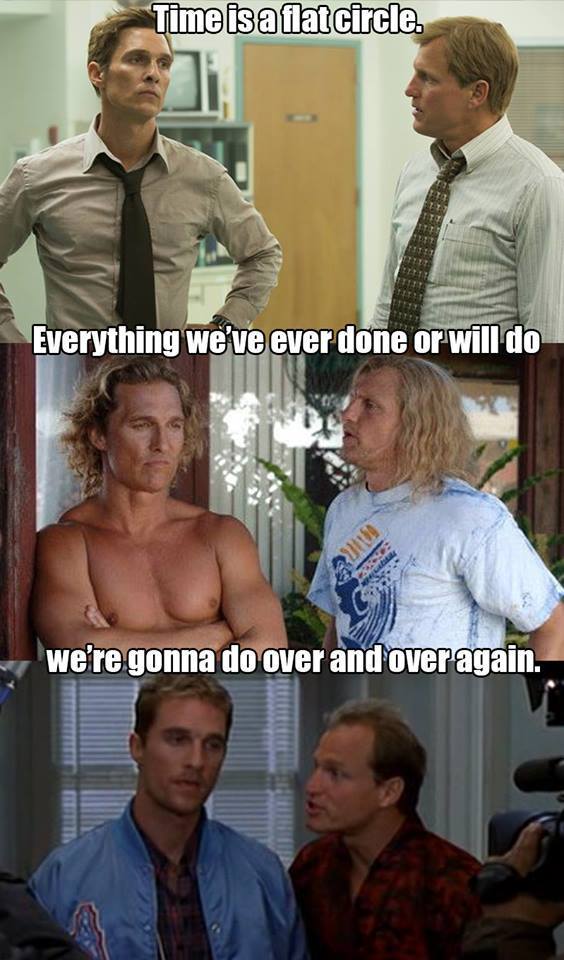
Watching the debate over Arizona’s SB 1062 (better known as the state’s anti-gay Jim Crow law) unfold this past week, I couldn’t help but think of the already iconic line from Matthew McConaughey’s “True Detective” character Rust Cohle: “Time is a flat circle.” As is always the case with the nihilistic and willfully esoteric Cohle, it’s not entirely clear what he’s trying to say with the metaphor, but we get the gist: Like Nietzsche’s “eternal return,” Cohle’s flat circle theory holds that all of us are destined to relive every moment of our conscious lives, forever. It’s as if we all were stuck in the late Harold Ramis’ “Groundhog Day,” but instead of repeating a single day, we repeat our entire lives.
Beyond the fact that, like many others, obsessing over “True Detective” has increasingly become the chief way I spend my free time, Arizona’s brief foray into the politics of segregation reminded me of the flat circle quote because I had recently seen Bryan Cranston’s Broadway debut, “All the Way,” in which the “Breaking Bad” star plays former president Lyndon B. Johnson during the historic period between Kennedy’s assassination and Johnson’s reelection, a time when the 36th president was working feverishly to ensure the passage of the Civil Rights Act of 1964. The play is good and Cranston is great, but what was most striking throughout was how much Johnson’s opponents then sounded like SB 1062’s supporters today. It was, as Cohle would say, some “heavy shit.”
The similarities weren’t merely superficial, either. Sure, the play, written by Pulitzer prize-winning playwright Robert Schenkkan (who obviously did his homework), was littered with hysterical charges of “fascism” and “socialism” and “big government” from no-name Dixiecrats that most of us never knew or were happy to forget. And of course these moments brought to mind much of the anti-Obamacare rhetoric that has emanated from conservatives during the past five years. But the parallels went deeper than that. It wasn’t just the language that sounded so familiar, but the logic behind it, too. Whether conservatives were defending Jim Crow proper or the Southwest’s latest variant, their worldview, all these years later, was disturbingly unchanged.
To explain what I mean, allow me to cite two of conservatism’s leading lights: Kentucky Sen. Rand Paul and all-around media mogul Glenn Beck.
As the opposition to SB 1062 increased in fervency and numbers, the usually loquacious Paul was, unlike his fellow Senate Republican John McCain (who opposed the bill), deafeningly mute. Anyone familiar with Paul’s history knows why: Because the obvious presidential aspirant wanted to avoid reminding people of the unfortunate 2010 interview with Rachel Maddow in which he stated that, even today, he would not support the government-run dismantling of Jim Crow. “I don’t want to be associated with those people,” Paul said, referring to white supremacists who’d bar blacks from their restaurants, “but I also don’t want to limit their speech in any way…” Paul’s orthodox libertarianism told him that the freedom to discriminate was too valuable, too sacred, to let the federal government stand in its way. Like Sen. Barry Goldwater did in 1964, when he voted against the Civil Rights Act, Paul argued that the Constitution had no room for anti-discrimination.
Roughly four years later, Glenn Beck made a similar argument, this time in defense of SB 1062. After doing his best impression of Hamlet, grappling aloud with his competing interest to not be a bigot while on the other hand maintaining allegiance to his understanding of liberty, Beck cut to the chase, telling his coworkers that he could only support Arizona’s bill, because “freedom is ugly.” Like Paul, Beck was sure to make clear that he held no sympathy for anyone who would ban LGBTQ people from their premises. But also like Paul, Beck had no choice but to conclude that the freedom to ostracize and discriminate was, in part, what the American experiment was all about. “I don’t like that world,” Beck said, “but that’s freedom! That’s freedom! Freedom is ugly. It’s ugly.”
High-profile though they may be, Beck and Paul are hardly the only conservatives who still cling to a vision of freedom that many Americans wrongly thought was swept into Reagan’s “ash-heap of history” decades before. Tucker Carlson — who, if Paul is to be Goldwater, we must describe as today’s version of the braying, segregationist Dixiecrats — was adamant in his defense of SB 1062, saying on Fox News that opponents of the bill were advocating for “fascism” and had gone “too far” in their quest to prevent state-sanctioned bigotry. “Everybody in America is terrified to tell the truth,” Carlson warned, “which is, this is insane, this is not tolerance, this is fascism.” Tellingly, when his sparring partner, Fox’s house liberal, Alan Colmes, asked Carlson whether he would have supported the Civil Rights Act, the editor of the Daily Caller could only respond by saying, “Don’t bring [that] into this,” with a sneer.
Even conservatives who are more intellectually inclined than Beck, Paul and Carlson put forward a defense of SB 1062 that could easily and quickly be adopted to oppose the federal government’s dismantling of Jim Crow. Ilya Shapiro of Cato, libertarianism’s premiere think tank and ostensible guardian of liberty for all, wrote, “I have no problem with SB 1062.” Repeating an argument that was offered by Goldwater, Paul, Beck and Carlson, Shapiro maintained that those who would be discriminated against, were SB 1062 to pass, should simply trust that the free market would punish bigots and, eventually, guarantee their liberty. “[P]rivate individuals should be able to make their own decisions on whom to do business with and how – on religious or any other grounds,” Shapiro wrote. “Those who disagree can take their custom elsewhere and encourage others to do the same.”
The fact that this very same logic recently undergirded a century of Jim Crow seemed to escape Shapiro. Either that or he, like W. James Antle III of the American Conservative, was content to dismiss comparisons to Jim Crow on the grounds that Arizona is not the Jim Crow South and 2014 is not the mid-’60s. “People often argue for or against the civil-rights laws of the 1960s on the basis of abstract principles,” Antle wrote, “but they were in fact a reaction to a very specific set of circumstances.” (This is an argument that, more than anything else, raises the question as to whether this is the first time Antle’s come into contact with an analogy.) Perhaps Shapiro, like Antle, was content to support the bill not because it wouldn’t give the government’s imprimatur to homophobia, but because such an outcome is, in their minds, “not very likely.” After all, what’s a little discrimination in the grand scheme of things?
If we put all these and many other conservative defenses of SB 1062 together, it’s hard not to reach a clear and unsettling conclusion: While conservatives themselves have largely given up the racism that coursed through a previous generation’s defense of Jim Crow, conservatism itself has learned no enduring lesson from the Civil Rights Movement and has made no ideological adjustments as a result. Indeed, National Review’s Kevin Williamson recently declared that Goldwater’s brief against the Civil Rights Act “has been proved correct” for worrying that “expanding the federal mandate … would lead to cumbrous and byzantine federal micromanagement of social affairs.” Going further, National Review’s editors, writing on the 50-year anniversary of the March on Washington (which NR at the time opposed) would only concede that the magazine was wrong to oppose the Civil Rights Movement because its principles “weren’t wrong, exactly” but were instead “tragically misapplied.”
For all of her many flaws, Jan Brewer decided on Wednesday to refrain from applying her conservative “principles” in such a “tragic” manner, opting instead to veto the bill and maybe — just maybe — push her party that much closer to joining the rest of us in the 21st century. And while many conservatives received the veto as a crushing disappointment, or even a step toward “slavery,” I’d caution my right-wing fellow citizens against slipping into outright despair. If the events in Arizona have taught us nothing else, they’ve shown that time is indeed a flat circle; future right-wingers will have plenty of chances to keep getting this most basic question of freedom terribly, terribly wrong.
By: Elias Isquith, Salaon, March 1, 2014
“Ohio’s War On Voting Intensifies”: The Kind Of Moves Official’s Make When They Want Fewer Voters
In advance of the 2012 elections, Ohio Secretary of State Jon Husted (R) launched an aggressive campaign against early voting, most notably targeting Sunday voting, for reasons he struggled to explain. The efforts ultimately failed, however, when federal appeals courts intervened to protect Ohioans voting rights against Husted’s policy.
Zachary Roth has been keeping a close eye on developments in the Buckeye State, where Husted is apparently picking up where he left off two years ago.
Ohio Secretary of State Jon Husted announced Tuesday he is cutting early voting on Sundays and weekday evenings, dealing another blow to the voting rights effort in the nation’s most pivotal swing state.
Husted’s change would spell doom for a voting method that’s popular among African-Americans in Ohio and elsewhere. Many churches and community groups lead “Souls to the Polls” drives after church on the Sunday before the election.
There’s little doubt that cuts to early voting target blacks disproportionately. In 2008, black voters were 56% of all weekend voters in Cuyahoga County, Ohio’s largest, even though they made up just 28% of the county’s population.
Mike Brickner, a spokesperson for the Ohio American Civil Liberties Union, told msnbc, “By completely eliminating Sundays from the early voting schedule, Secretary Husted has effectively quashed successful Souls to the Polls programs that brought voters directly from church to early voting sites.”
In the larger context, it’s worth keeping two angles in mind. First, there’s simply no reason to impose these new voting restrictions on Ohio. Second, this is only part of an even broader campaign against voting rights launched by Republican officials in the state.
On the former, those who support voting restrictions usually argue the measures are necessary to prevent “voter fraud.” The argument is a rather transparent fig leaf – the fraud scourge is generally limited to the imaginations of conservative activists – but that’s their story and they’re sticking to it.
But going after early voting is something else entirely because it has nothing to do with the fear of fraud. If an Ohioan can legally cast a ballot, it shouldn’t matter whether he or she votes on Election Day Tuesday or the Sunday before. The only reason to close the early-voting window is to discourage participation – it’s the kind of move an official makes if he or she wants fewer voters.
As for the larger “war on voting,” Ohio Republicans have kept their foot on the gas. Just last week, GOP policymakers in the state ended the so-called “Golden Week,” when Ohioans can register and vote on the same day, while at the same time, making it harder for voters to receive absentee ballots.
As we discussed last week, Ohio’s recent voting history matters. A decade ago, during the 2004 elections, the state struggled badly with long voting lines, so state policymakers decided to make things better. And in 2008, Ohio’s voting system worked quite well and voters enjoyed a much smoother process.
So smooth, in fact, that Ohio Republicans have worked in recent years to reverse the progress.
A month ago, President Obama’s non-partisan commission on voting issued a detailed report, urging state and local election officials to make it easier for Americans to access their own democracy.
Perhaps Ohio Republicans missed the message?
By: Steve Benen, the Maddow Blog, February 26, 2014
“Disrespect, Race And Obama”: This Is Not President Obama’s Doing, But The Simple Result Of His Being
In an interview with the BBC this week, Oprah Winfrey said of President Obama: “There is a level of disrespect for the office that occurs. And that occurs, in some cases, and maybe even many cases, because he’s African-American.”
With that remark, Winfrey touched on an issue that many Americans have wrestled with: To what extent does this president’s race animate those loyal to him and those opposed? Is race a primary motivator or a subordinate, more elusive one, tainting motivations but not driving them?
To some degree, the answers lie with the questioners. There are different perceptions of racial realities. What some see as slights, others see as innocent opposition. But there are some objective truths here. Racism is a virus that is growing clever at avoiding detection. Race consciousness is real. Racial assumptions and prejudices are real. And racism is real. But these realities can operate without articulation and beneath awareness. For those reasons, some can see racism where it is absent, and others can willfully ignore any possibility that it could ever be present.
To wit, Rush Limbaugh responded to Winfrey’s comments in his usual acerbic way, lacking all nuance:
“If black people in this country are so mistreated and so disrespected, how in the name of Sam Hill did you happen? Would somebody explain that to me? If there’s a level of disrespect simply because he’s black, then how, Oprah, have you managed to become the — at one time — most popular and certainly wealthiest television personality? How does that happen?”
No one has ever accused Limbaugh of being a complex thinker, but the intellectual deficiency required to achieve that level of arrogance and ignorance is staggering.
Anyone with even a child’s grasp of race understands that for many minorities success isn’t synonymous with the absence of obstacles, but often requires the overcoming of obstacles. Furthermore, being willing to be entertained by someone isn’t the same as being willing to be led by them.
And finally, affinity and racial animosity can dwell together in the same soul. You can like and even admire a person of another race while simultaneously disparaging the race as a whole. One can even be attracted to persons of different races and still harbor racial animus toward their group. Generations of sexual predation and miscegenation during and after slavery in this country have taught us that.
Alas, simpletons have simple understandings of complex concepts.
But it is reactions like Limbaugh’s that lead many of the president’s supporters to believe that racial sensitivity is in retreat and racial hostility is on the rise.
To be sure, the Internet is rife with examples of derogatory, overtly racial comments and imagery referring to the president and his family. But the question remains: Are we seeing an increase in racial hostility or simply an elevation — or uncovering — of it? And are those racist attitudes isolated or do they represent a serious problem?
Much of the discussion about the president, his opposition and his race has centered on the Tea Party, fairly or not.
In one take on race and the Tea Party that went horribly wrong this week, Washington Post opinion writer Richard Cohen wrote:
“Today’s G.O.P. is not racist, as Harry Belafonte alleged about the Tea Party, but it is deeply troubled — about the expansion of government, about immigration, about secularism, about the mainstreaming of what used to be the avant-garde. People with conventional views must repress a gag reflex when considering the mayor-elect of New York — a white man married to a black woman and with two biracial children. (Should I mention that Bill de Blasio’s wife, Chirlane McCray, used to be a lesbian?) This family represents the cultural changes that have enveloped parts — but not all — of America. To cultural conservatives, this doesn’t look like their country at all.”
What exactly are “conventional views” in this context? They appear to refer specifically to opinions about the color of people’s skin.
Cohen seemed to want to recast racial intolerance — and sexual identity discomfort — in a more humane light: as an extension of traditional values rather than as an artifact of traditional bigotry. In addition, Cohen’s attempt to absolve the entirety of the Tea Party without proof fails in the same way that blanket condemnations do. Overreach is always the enemy.
I don’t know what role, if any, race plays in the feelings of Tea Party supporters. It is impossible to know the heart of another person (unless they unambiguously reveal themselves), let alone the hearts of millions.
But nerves are raw, antennas are up and race has become a lightning rod in the Obama era. c.
By: Charles M. Blow, Op-Ed Columnist, The New York Times, November 15, 2013
“Denying And Ignoring The Realities”: For Some, The Name “Obama” Has Become A Code Word
Racial tensions in the United States have changed since Obama’s election as president, and for the worse. As judicial opinions since 2008 have revealed, both the word “Obama” and the president’s image have become tools for harassing and otherwise discriminating, in the workplace and in places of public accommodation, against blacks and against whites in romantic relationships with blacks.
For instance, while at a company picnic, one white employee sat down next to his co-workers, held a watermelon slice in his hand, and asserted, “I’m going to sit down to eat my ‘Obama fruit.’” In a different court case, a plaintiff complained that the company’s C.E.O. once said he had a “gift for you for all the Obama people outside” — while handing a rifle to another employee. In yet another case, a white employee derided an African co-worker, calling the co-worker “boy,” threatening his life and telling him he should take Obama back to Africa to vote for him.
For other individuals, President Obama’s election has become a basis for denying and ignoring the realities of racism, both conscious and unconscious, in our country. Soon after Obama’s election, conservatives such as Gregory Coleman, a Texas lawyer, argued that the election demonstrated the obsolescence of the Voting Rights Act of 1965 — a point reiterated by the U.S. Supreme Court in its June decision invalidating a section of the act.
In fact, the results from three experiments by Stanford University researchers suggest that endorsing Obama enables some whites to feel more comfortable in favoring other whites at the expense of blacks. The Stanford researchers contended that, for these whites, supporting Obama seemed to reduce their fears about appearing racially prejudiced, giving them the “moral credentials” to exhibit favoritism toward other whites.
At least one case showed this phenomenon affecting the legal process. After admitting that he based his decision in a criminal matter upon the race of the defendant, a white juror later denied his admission. His decision could not have been racially motivated, he argued. Why he was incapable of racial bias? Because, he said, he voted for Obama.
By: Angela Onwuachi-Willig, The Charles and Marion Kierscht Professor of Law at the University of Iowa College of Law, Opinion Pages, The New York Times, November 20, 2013
“A Market Of Systematic Discrimination”: President Obama Shouldn’t Apologize For Blowing Up The Terrible Individual Market
Last night, NBC’s Chuck Todd asked President Obama about the people losing their health insurance despite his promise that “anyone who likes their plan can keep it.” (See the video and read the transcript here.)
“I am sorry that they are finding themselves in this situation based on assurances they got from me,” Obama replied.
The answer is a bit of a dodge. People aren’t finding themselves in this situation based on the president’s promises. They’re finding themselves in this situation based on his policy. And Obama isn’t apologizing for the policy.
“Before the law was passed, a lot of these plans, people thought they had insurance coverage,” he said. “And then they’d find out that they had huge out of pocket expenses. Or women were being charged more than men. If you had preexisting conditions, you just couldn’t get it at all.”
Obama was wrong to promise that everyone who liked their insurance could keep it. For a small minority of Americans, that flatly isn’t true. But the real sin would’ve been leaving the individual insurance market alone.
The individual market — which serves five percent of the population, and which is where the disruptions are happening — is a horror show. It’s a market where healthy people benefit from systematic discrimination against the sick, where young people benefit from systematic discrimination against the old, where men benefit from systematic discrimination against women, and where insurers benefit from systematic discrimination against the uninformed.
The result, all too often, is a market where the people who need insurance most can’t get it, and the people who do get insurance find it doesn’t cover them when it’s most necessary. All that is why the individual market shows much lower levels of satisfaction than, well, every other insurance market:

(Graph by Jon Cohn)
Those numbers, of course, don’t include the people who couldn’t get insurance because they were deemed too sick. Consumer Reports put it unusually bluntly:
Individual insurance is a nightmare for consumers: more costly than the equivalent job-based coverage, and for those in less-than-perfect health, unaffordable at best and unavailable at worst. Moreover, the lack of effective consumer protections in most states allows insurers to sell plans with ‘affordable’ premiums whose skimpy coverage can leave people who get very sick with the added burden of ruinous medical debt.
Jonathan Cohn puts a human face on it:
One from my files was about a South Floridian mother of two named Jacqueline Reuss. She had what she thought was a comprehensive policy, but it didn’t cover the tests her doctors ordered when they found a growth and feared it was ovarian cancer. The reason? Her insurer decided, belatedly, that a previous episode of “dysfunctional uterine bleeding”—basically, an irregular menstrual period—was a pre-existing condition that disqualified her from coverage for future gynecological problems. She was fine medically. The growth was benign. But she had a $15,000 bill (on top of her other medical expenses) and no way to get new insurance.
This is a market that desperately needs to be fixed. And Obamacare goes a way toward fixing it. It basically makes the individual market more like the group markets. That means that the sick don’t get charged more than the well, and the old aren’t charged more than three times as much as the young, and women aren’t charged more than men, and insurance plans that don’t actually cover you when you get sick no longer exist. But the transition disrupts today’s arrangements.
(Interestingly, recent Republican plans have focused on disrupting the employer market by ending, limiting, or restructuring the tax exclusion for employer-based plans. There’s an extremely good case to be made that that needs to be done, but it means much more disruption for a much larger number of people. Obamacare’s focus on disrupting the individual market — and only the individual market — is a more modest approach to health-care reform.)
There’s been an outpouring of sympathy for the people in the individual market who will see their plans changed. As well there should be. Some of them will be better off, but some won’t be.
But, worryingly, the impassioned defense of the beneficiaries of the status quo isn’t leavened with sympathy for the people suffering now. The people who can’t buy health insurance for any price, or can’t get it at a price they can afford, or do get it only to find themselves bankrupted by medical expenses anyway have been left out of the sudden outpouring of concern.
If people have a better way to fix the individual market — one that has no losers — then it’s time for them to propose it. But it’s very strange to sympathize with the people who’ve benefited from the noxious practices of the individual market while dismissing the sick people who’ve been victimized by it.
Obama is rightly taking flack for making a promise he wasn’t going to keep, and he’s right to apologize for it. But he shouldn’t apologize for blowing up the individual market. It needed to be done.
By: Ezra Klein and Evan Soltas, WonkBook, The Washington Post, November
Share This Blog


 Unknown Feed
- An error has occurred; the feed is probably down. Try again later.
 mykeystrokes.com