GOP Presidential Contenders Compete To Win Over “The Political Army Of The Lord”
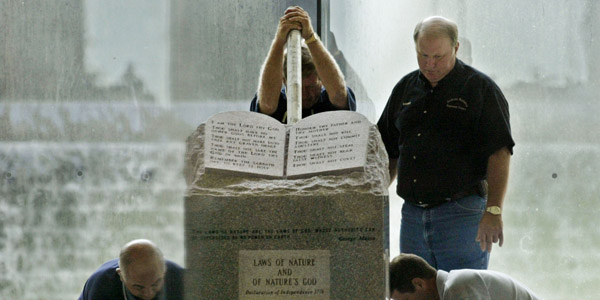
Workers remove a monument of the Ten Commandments from the rotunda of the Alabama Judicial Building after Superior Court Justice Roy Moore refused to take it down in 2003
So you can add another car to the crazy train that is the 2012 Republican presidential nominating contest. No, I’m not talking about last week’s sensation, Donald Trump. He’s a pretty conventional figure compared to the latest would-be president, former Alabama Supreme Court Chief Justice Roy Moore, who is currently barnstorming through Iowa after announcing an exploratory committee.
You may remember Judge Moore as the man who was forced from his judicial post after refusing to remove a gigantic monument to the Ten Commandments from his courthouse. He was also known for abrasive comments from the bench about homosexuality as contrary to God’s will, which in Moore’s opinion was dispositive. A martyr for theocrats everywhere, Moore spent some time hauling his monument around Alabama before launching two notably unsuccessful gubernatorial races — coming in a bad second in 2006’s Republican primary and a bad fourth in 2010 — and becoming a minor fixture at tea party events.
Moore was undoubtedly drawn to Iowa by that state’s furor over same-sex marriage, decreed legal by a 2009 state Supreme Court ruling. Iowa’s powerful Christian Right movement has made overturning that decision Job One, beginning with a successful effort in 2010 to remove three of the seven jurists responsible for it. It’s one of the few places left where Republicans don’t try to ignore the whole issue of gay rights as a divisive loser of an issue (which is why presidential wannabees like Tim Pawlenty have anachronistically come out against the repeal of “don’t ask, don’t tell). For Moore, it must have felt more like “home” than home.
Before writing off Moore as a kook trying to horn in on the spotlight of a presidential race, consider the company he’s keeping on his tour of the first-in-the-nation-caucuses state: former state legislator Danny Carroll. Carroll was co-chairman (with three-time gubernatorial candidate Bob Vander Plaats) of Mike Huckabee’s successful 2008 Caucus campaign, and more recently, signed on as a lobbyist for Vander Plaats’ new Christian Right umbrella group, The Family Leader. He’s a reasonably big deal in Iowa GOP circles, and by no means someone who howls at the moon.
For all I know, Carroll sees something in the crusty Alabama judge that others haven’t seen. Or maybe Judge Moore is a convenient stalking horse for Huckabee, designed to keep The Faithful loose and out of anyone else’s camp, in case Huck ultimately decides to run.
Regardless of Carroll’s (or Moore’s) personal motives, it’s likely the national Republican chattering class will dismiss the Judge’s campaign as a joke even worse than Trump’s. Or, it may be said, there is now such a crowd on the far right that opportunities are opening up for more moderate possibilities like Romney, T-Paw or an establishment-backed candidate-yet-to-be-named.
But I’d like to suggest another theory: the Christian/tea party right in Iowa is big enough, powerful enough, and politically sophisticated enough to hold its own caucus-within-a-caucus (well, caucuses, to be technical about it), an intramural contest to determine which candidate will actually represent the cause when Iowa Republicans make their final commitments before Caucus Night. Proven zealots like Michele Bachmann, Herman Cain, and now Moore, will joust with more suspect supplicants like T-Paw, Newt Gingrich — and maybe even Donald Trump! — over the next few months, with someone emerging as the designated favorite of the political army of the Lord. That is arguably what happened in Iowa in 2008, when Huckabee and Sen. Sam Brownback fought to become the Christian Right alternative to Mitt Romney, with Huckabee becoming The Man only after he out-organized Brownback at the State Party Straw Poll in Ames during the summer.
Moore’s candidacy may not ultimately have any direct influence on what happens next winter in Iowa, when conservative evangelicals and conservative Catholics get together to shape the 2012 Republican nominating process.
But he could indeed intensify the competition for Christian Right voters. And just as importantly, he could definitely serve as a symbol of the ideological and psychological gap between rigorous conservative activists and the mainstream political commentariat. Most of the latter think Moore is a crazy person. But most of the Iowa audiences before which Moore speaks will consider him an authentic if polarizing voice expressing the Word of God. That’s a pretty big gulf in perception, but also a pretty good reflection of the real differences Americans experience in how they view their leaders.
By: Ed Kilgore, Managing Editor of The Democratic Strategist and Senior Editor, Progressive Policy Institute. Article published in The Atlantic, April 20, 2011: Photo by Tami Chappell (Reuters)
John Boehner Thinks We’re “Broke” But He’s Willing To Splurge
When the Obama administration announced that it no longer considers the Defense of Marriage Act constitutional, and would stop defending the law against court challenges, officials told Congress it could step in and defend DOMA if it wants to. Soon after, Speaker John Boehner (R-Ohio) said the House would gladly to just that.
Yesterday, Boehner’s office announced it has hired former Bush Solicitor General Paul Clement to defend the discriminatory law, which seems like a wise choice. Clement is an accomplished attorney with extensive experience who’ll no doubt do a capable job.
But Clement is also a very well paid D.C. attorney, and House Minority Leader Nancy Pelosi (D-Calif.) would like to know what Boehner expects this little culture-war endeavor to cost. For that matter, Pelosi found it curious that the Speaker hired an attorney to represent the House, but hasn’t shared the contract with other congressional leaders.
Today, the picture started coming together.
House Republicans plan to pay former Solicitor General Paul Clement and his legal team from King & Spaulding as much as $500,000 of taxpayer money to uphold the Defense of Marriage Act (DOMA) on behalf of House of Representatives, according to a document obtained by the Huffington Post.
“The General Counsel agrees to pay the Contractor for all contractual services rendered a sum not to exceed $500,000.00,” the Contract for Legal Services obtained by The Huffington Post says. The cap could be raised “by written agreement between the parties with the approval” of the House, the document states.
The hourly rate that King & Spaulding will be receiving is $520 per hour — which could actually be considered a deal. Some reports say that the firm’s top attorneys receive as much as $900 per hour.
Pelosi spokesperson Drew Hammill told Amanda Terkel, “The hypocrisy of this legal boondoggle is mind-blowing. Speaker Boehner is spending half a million dollars of taxpayer money to defend discrimination. If Republicans were really interested in cutting spending, this should be at the top of the list.”
That seems more than fair. After all, Boehner has been running around for months, falsely claiming, “We’re broke.” It’s how he justifies proposed cuts in critical areas like education, medical research, infrastructure, job training, and homeland security, even if it makes the jobs crisis much worse.
But if we’re actually broke, shouldn’t House Republicans want to save $500,000 of our money, and not give it to one high-priced lawyer to defend an anti-gay law?
By: Steve Benen, Washington Monthly, Political Animal, April 19, 2011
Gaming the System: At The Supreme Court, Could Legal Precedent Be Less Important Than Popular Opinion?
Articles of faith, as a rule, don’t change every few months. And yet, just nine months ago, it was an article of faith among court watchers that President Obama’s health care reform plan would be upheld at the Supreme Court by a margin of 7-2 or 8-1. Today it is an equally powerful article of faith that everything rests in the hands of Justice Anthony Kennedy in what will surely be a 5-4 decision. What changed between last March and last Monday?
To review: When the first lawsuits were filed challenging the law in March 2010, the conventional wisdom was that they were little more than a Tea Party stunt. “Several constitutional law experts said this week that it is somewhere between unlikely and hard-to-imagine that the Supreme Court would strike down the new healthcare law,” wrote David Savage at the Los Angeles Times. He quoted George Washington University law professor Orin Kerr, a former Kennedy clerk, saying that “there is a less than 1 percent chance that the courts will invalidate the individual mandate.” In Newsweek in September 2010, Stuart Taylor quoted Walter Dellinger, acting solicitor general under President Clinton, predicting an 8-1 vote at the high court, and Tom Goldstein, another prominent court watcher and litigator, calling for a vote of 7-2.
Fast forward to this week. As my colleague David Weigel put it Monday: “The fate of health care reform is where it was yesterday—in the hands of Supreme Court Justice Anthony Kennedy.” The Wall Street Journal agreed, sighing, “As with so many contentious issues in American life, destiny appears to have appointed [Kennedy] the ultimate arbiter of the constitutionality of the linchpin of this new law: the individual mandate.” Now, the composition of the court has not changed since last year. Nor has the meaning of the Commerce Clause, or the decades of precedents interpreting that doctrine, or the words of the Affordable Care Act itself. The only thing that has shifted between the filing of the Obama health care suits and Judge Roger Vinson’s decision finding the entire bill unconstitutional is the odds. We went from “a less than 1 percent chance” of the suits succeeding to their success being determined by a coin flip in Anthony Kennedy’s chambers.
Putting aside the question of whether it matters what court watchers think—or whether the new odds should make any difference—it’s astounding to witness the conventional wisdom shift so dramatically and so rapidly. It took years for court watchers to take challenges to the collective-rights theory of the Second Amendment seriously. It’s taken just weeks for them to come to believe that the fate of the health care law may be decided by a single vote.
To those in the business of making predictions about the Supreme Court justices, one thing that did change was a smoke signal sent up by Justices Clarence Thomas and Antonin Scalia last month in a passionate dissent from the court’s refusal to hear a case from the 9th Circuit Court of Appeals. Alderman v. United States involved the right of the federal government to criminalize a violent felon’s purchase of body armor. And as Andrew Cohen explained it, the two justices weren’t obligated to publish a lengthy dissent, spelling out—complete with references to Hershey’s Kisses (the new broccoli?)—their view that the Commerce Clause does not allow the federal government to make such a regulation. Their small treatise on the limits of the Commerce Clause’s power, Cohen wrote, “confirms to the world that no more than seven votes on the Supreme Court are still in play over the constitutionality of the federal health care measure.”
Court watchers have long argued that Scalia cannot possibly square his vote (indeed his own words) in the 2005 case of Gonzales v. Raich with a vote to strike down health care reform. Once they read the Thomas/Scalia dissent in Alderman, they had to swallow hard. In Raich, Scalia agreed that Congress could regulate marijuana that was neither purchased nor sold in any market but grown for medicinal reasons at home. “The authority to enact laws necessary and proper for the regulation of interstate commerce is not limited to laws governing intrastate activities that substantially affect interstate commerce,” Scalia wrote. “Where necessary to make a regulation of interstate commerce effective, Congress may regulate even those intrastate activities that do not themselves substantially affect interstate commerce.” He added that “Congress may regulate even noneconomic local activity if that regulation is a necessary part of a more general regulation of interstate commerce.”
These words matter a lot to supporters of health care reform. But it’s no longer clear how much they matter to Justice Scalia.
Simon Lazarus has a thoughtful post about all the ways in which the court’s more conservative justices—not just Scalia but also Kennedy and Chief Justice Roberts—”will have to twist their prior decisions and statements into pretzels in order to rule the individual mandate or other ACA provisions unconstitutional.” Reading Raich against the Alderman dissent, I am not sure all the justices are terribly bothered at the prospect of performing such gymnastics. Supreme Court reporters like to believe that the justices are invariably hemmed in and pinned down by their prior decisions, and in a perfect world they might be. But if we learned anything at all from Bush v. Gore, it’s that in landmark cases with huge symbolic stakes, justices on both sides of the aisle can get all kinds of creative.
If that is the case, then in the coming months we should pay less attention to the words of Raich and more to the political scientists and judicial behavior theorists who have a lot to say about how justices decide cases. What really changed between last March and this week is that in making predictions about what happens to health care reform, we have almost entirely stopped talking about the law or the Constitution and begun to think solely in terms of strategic judicial behavior.
Court watchers on both sides of the debate seem to agree that Vinson’s opinion was rooted more in his convictions about the need to restrain federal overreaching than in the court’s modern Commerce Clause precedents. The question now seems to be less about whether the justices can find a way to strike down the law if they so choose—they can—than whether they have the political stomach to do it.
I am not an expert on judicial stomachs. But it seems to me that once you start thinking strategically about how health care reform will fare at the Supreme Court, pretty soon you arrive at some serious questions about the continued legitimacy of the court, judicial responses to public sentiment, and other matters that have far more to do with social psychology than Wickard v. Filburn.
Everyone would like to believe that the kind of constitutional issues presented in these health care suits are clear and specific. But they are precisely the sort of wide-open normative inquiries that may tempt even great and fair jurists to have a little extra-textual fun. “American constitutional lawyers, whether practitioners, academics or judges, seem to feel relatively few genuine constraints in the kinds of arguments they are willing to make or endorse,” professor Sanford Levinson has written. “It is, I am convinced, harder to recognize a frivolous argument in constitutional law than in any other area of legal analysis.”
If the odds of success for the health care challenges have tilted in recent months, it’s not because the suits themselves have somehow gained more merit. It’s because the public mood and the tone of the political discourse have shifted dramatically—emboldening some federal judges willing to support a constitutional idea whose time, in their view, has finally come. Whether this sea change will affect the Supreme Court remains to be seen. At least on paper, the Supreme Court is immune to whatever the odds makers are saying about the law’s chances. If recent weeks have shown us anything, however, it’s that what’s on paper doesn’t matter as much as we think it does in the nation’s courts.
By: Dahlia Lithwick, Slate, February 2, 2011
Commerce Clause Conundrum–Will The Hudson Ruling Stand?
In declaring unconstitutional the new requirement for Americans to buy health insurance, federal Judge Henry Hudson rests his decision on one of the most widely applied clauses in the Constitution.
Does his interpretation hold up?
Hudson ruled Monday that the Commerce Clause does not give Congress the authority to make people buy something. The Clause itself serves as the basis for a vast swath of federal regulatory statute, and it states, simply, that:
The Congress shall have Power … To regulate Commerce with foreign Nations, and among the several States, and with the Indian Tribes
The Commerce Clause has been interpreted quite broadly over the years, to the point where “interstate” holds little distinctive meaning in the eyes of judges. Courts have so thoroughly established the precedent that one economic action by one person, even if it happens only within one state, can affect the broader economy of any good in question, that the Commerce Clause generally applies to all economic activity.
Hudson’s problem with the federal government’s argument is that this is a novel application of the Commerce Clause, in that it actually forces people to buy something.
Earlier in this opinion, the Court concluded that Congress lacked power under the Commerce Clause, or associated Necessary and Proper Clause, to compel and individual to involuntarily engage in a private commercial transaction, as contemplated by the Minimum Essential Coverage Provision [i.e., the requirement to buy insurance]. The absence of constitutionally viable exercise of this enumerated power is fatal to the accompanying sanction for noncompliance. …
A thorough survey of pertinent constitutional case law has yielded no reported decisions from any federal appellate courts extending the Commerce Clause or General Welfare Clause to encompass regulation of a person’s decision not to purchase a product, notwithstanding its effect on interstate commerce or role in a global regulatory scheme. The unchecked expansion of congressional power to the limits suggested by the Minimum Essential Coverage Provision would invite unbridled exercise of federal police powers. At its core, this dispute is not simply about regulating the business of insurance–or crafting a scheme of universal health insurance coverage–it’s about an individual’s right to choose to participate.
There are more ins and outs, including whether or not the individual mandate is enforced by a “tax” or a “penalty,” but that’s the crux of Hudson’s ruling: a lack of precedent for forcing people into commercial engagement.
There is, however, some precedent.
As Georgetown constitutional law professor Louis Michael Seidman pointed out, the 1964 Civil Rights Act forced businesses into economic engagement when it outlawed racial discrimination in business. Some restaurants didn’t want to engage in commerce with black people, but the federal government forced them to (coincidentally, this was the portion of the law to which Sen.-elect Rand Paul objected).
In another case, Wickard v. Filburn, the federal government tried to penalize a farmer for growing wheat on his own property simply for him and his family to eat. He wasn’t selling it. But the federal government wanted to drive up the price of wheat, and the Supreme Court ruled that the government was within its powers to penalize him for this noncommercial activity and force him, instead, to buy his wheat from the interstate wheat economy, which Congress governs. That decision was handed down in 1942, but the Supreme Court reaffirmed it (cited it to support the logic of a ruling) in 2005, in its ruling on the Raich medical marijuana case.
Judges can decide on their own how directly those ruling apply, and the Supreme Court can always go back on previous decisions if the justices feel it appropriate.
But those are the relevant decisions in which a vaguely similar issue was confronted, in case you were wondering if there’s any historical context for the issue that’s now being forced.
By: Chris Good, Associate Editor –The Atlantic, December 13, 2010
Share This Blog


 Unknown Feed
- An error has occurred; the feed is probably down. Try again later.
 mykeystrokes.com
You must be logged in to post a comment.