By: E. J. Dionne, Jr, Opinion Writer, The Washington Post, February 5, 2012
U. S. Supreme Court Stays Montana Decision Undermining Citizens United
Late last year, the Montana Supreme Court handed down a decision that was widely viewed as openly defying the U.S. Supreme Court’s election-buying decision in Citizens United. Last night, the U.S. Supremes issued an entirely unsurprising order staying that decision. As a result, Montana will now face the same epidemic of corporate and other wealthy donor money that infected the other 49 states in the wake of the Citizens Uniteddecision.
There are, however, two possible silver linings in last night’s decision. The first is that the Supreme Court did not agree to the corporate parties’ request in this case to simply reverse the Montana decision without a full hearing or even necessarily an opinion. Yesterday’s order suspends the Montana decision “pending the timely filing and disposition of a petition for a writ of certiorari,” meaning that there is still a possibility that the Court could give the case a full hearing that would almost certainly raise the question of whether Citizens United should be overruled.
The second silver lining is a separate statement from Justices Ginsburg and Breyer attached to yesterday’s order:
Montana’s experience, and experience elsewhere since this Court’s decision in Citizens United v. Federal Election Comm’n make it exceedingly difficult to maintain that independent expenditures by corporations “do not give rise to corruption or the appearance of corruption.” A petition for certiorari will give the Court an opportunity to consider whether, in light of the huge sums currently deployed to buy candidates’ allegiance, Citizens United should continue to hold sway. Because lower courts are bound to follow this Court’s decisions until they are withdrawn or modified, however, I vote to grant the stay.
This statement suggests that there are at least two votes on the Supreme Court eager to reconsider one of the modern Supreme Court’s most erroneous opinions just two years after it was decided. Such a swift reversal would very unusual, if not entirely unprecedented. In light of the massive influx of corporate and wealthy donor money flooding our democracy and threatening to elect a generation of candidates personally beholden to wealthy benefactors, however, this kind of swift admission of error by the justices is entirely necessary.
By: Ian Millhiser, Think Progress, February 18, 2012
“Rmoney”: Mitt Is The Lobbyists’ Candidate
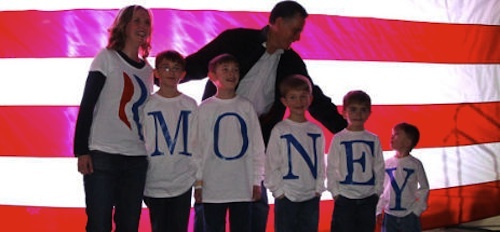
When you think of Mitt Romney, you probably think of a tall, robotic fellow with no discernible strong beliefs or stances (at least, none that can survive longer than a week at a time). That’s terribly unfair, and you should be ashamed for thinking it. He may have started out as an empty husk devoid of strong personal beliefs, but thanks to a crack team of industry insiders, he now is quite filled with opinions. Coincidentally, they happen to be the opinions of an army of top lobbyists in Washington, and the companies they lobby for. Funny how that works.
[Mitt Romney’s] kitchen cabinet includes some of the most prominent Republican lobbyists in Washington, including Charles R. Black Jr., the chairman of Prime Policy Group and a lobbyist for Walmart and AT&T; Wayne L. Berman, who is chairman of Ogilvy Government Relations and represents Pfizer, the drug manufacturer; and Vin Weber, the managing partner for Clark & Weinstock. […]Other lobbyists serve on one of Mr. Romney’s policy advisory teams, have hosted fund-raisers for his campaign or have joined the many influential Republicans whose endorsements Mr. Romney’s campaign has hailed.
Want to know what Mitt Romney’s true policies are? Well, you should have attended Mitt Romney’s $10,000-and-up policy round table, where industry lobbyists led “discussions” on what his policies towards those industries should be:
Mr. Romney’s campaign held an elaborate “policy round table” fund-raiser at a Washington hotel, featuring panel discussions run by lobbyists and former cabinet officials or members of Congress.James Talent, a former senator who runs the lobbying and public affairs firm Mercury Public Affairs, led a panel on infrastructure, according to an invitation. William Hansen, a former deputy secretary of education who is president of the lobbying firm Chartwell Education Group, led the education panel.
Wow. I can’t imagine why anyone would be cynical about American politics these days, can you?
The entertaining thing about this story is just how many large companies are represented. Among those specifically mentioned (and kudos to the three reporters for linking the lobbyists with actual clients, which is rather important information for readers) are Walmart, AT&T, Pfizer (drugs), Microsoft, Altria (tobacco), General Dynamics, Dominion (power), Barclays (finance), Allegheny (steel) and Peabody Energy (coal). Lobbyists are cutting the checks; lobbyists are bundling other people’s checks; lobbyists are holding the panel discussions about how the candidate can best serve the specific industries they represent; lobbyists make up the inner circle of “policy makers,” advising the candidate as to what his own core positions should be.
As for the candidate himself, he’s almost irrelevant at this point. You might as well nominate a bunny named Mr. Buttons: If you surround it with the exact same lobbyist-advisors, you’ll end up with the exact same policies. Sigh, if only we could teach that bunny to hold a pen—but for now we’ll have to settle for our current crop of Republican candidates, all of whom have near-identical policy prescriptions, all of which favor the exact same subset of people and the exact same handful of industries. Go figure.
I’ve given up on the notion that we can keep lobbyists from capturing our politics. I’ve also given up on the notion that we can prevent interests like the oil sector or our current handful of top financial companies from tailoring the American government specifically to serve their needs. Want more profits? Want less environmental protections? Want to crush some emerging industry that threatens to make yours less profitable? Just buy a few congressman, or a senator, or a president. At a few million here and there, it’s cheaper than advertising, and the results are far more secure.
So I’m in the Bill Maher camp on this one. Lobbyists and industries want to buy our politicians? Fine, I give up, let them. Just pass a law saying the candidate has to wear those corporate logos on their jackets whenever they appear on the campaign trail or when they are in office. The more money is contributed, the bigger the logo has to be. Top presidential candidates will look like military dictators-in-training, with badges and medals and ribbons sticking out from them in every direction, and just from looking at them we’ll be able to tell who they serve, and in what proportions. That would certainly be more educational than any rhetoric coming from the candidates themselves.
By: Hunter, Daily Kos, February 15, 2012
“We The People,” Not “We The Rich”: The Citizens United Catastrophe
We have seen the world created by the Supreme Court’sCitizens United decision, and it doesn’t work. Oh, yes, it works nicely for the wealthiest and most powerful people in the country, especially if they want to shroud their efforts to influence politics behind shell corporations. It just doesn’t happen to work if you think we are a democracy and not a plutocracy.
Two years ago, Citizens United tore down a century’s worth of law aimed at reducing the amount of corruption in our electoral system. It will go down as one of the most naive decisions ever rendered by the court.
The strongest case against judicial activism — against “legislating from the bench,” as former President George W. Bush liked to say — is that judges are not accountable for the new systems they put in place, whether by accident or design.
The Citizens United justices were not required to think through the practical consequences of sweeping aside decades of work by legislators, going back to the passage of the landmark Tillman Act in 1907, who sought to prevent untoward influence-peddling and indirect bribery.
If ever a court majority legislated from the bench (with Bush’s own appointees leading the way), it was the bunch that voted for Citizens United. Did a single justice in the majority even imagine a world of super PACs and phony corporations set up for the sole purpose of disguising a donor’s identity? Did they think that a presidential candidacy might be kept alive largely through the generosity of a Las Vegas gambling magnate with important financial interests in China? Did they consider that the democratizing gains made in the last presidential campaign through the rise of small online contributors might be wiped out by the brute force of millionaires and billionaires determined to have their way?
“The appearance of influence or access, furthermore, will not cause the electorate to lose faith in our democracy.” Those were Justice Anthony Kennedy’s words in his majority opinion. How did he know that? Did he consult the electorate? Did he think this would be true just because he said it?
Justice John Paul Stevens’ observation in his dissent reads far better than Kennedy’s in light of subsequent events. “A democracy cannot function effectively,” he wrote, “when its constituent members believe laws are being bought and sold.”
But ascribing an outrageous decision to naivetéis actually the most sympathetic way of looking at what the court did in Citizens United. A more troubling interpretation is that a conservative majority knew exactly what it was doing: that it set out to remake our political system by fiat in order to strengthen the hand of corporations and the wealthy. Seen this way, Citizens United was an attempt by five justices to push future electoral outcomes in a direction that would entrench their approach to governance.
In fact, this decision should be seen as part of a larger initiative by moneyed conservatives to rig the electoral system against their opponents. How else to explain conservative legislation in state after state to obstruct access to the ballot by lower-income voters — particularly members of minority groups — though voter identification laws, shortened voting periods and restrictions on voter registration campaigns?
Conservatives are strengthening the hand of the rich at one end of the system and weakening the voting power of the poor at the other. As veteran journalist Elizabeth Drew noted in an important New York Review of Books article, “little attention is being paid to the fact that our system of electing a president is under siege.”
Those who doubt that Citizens United (combined with a comatose Federal Election Commission) has created a new political world with broader openings for corruption should consult reports last week by Nicholas Confessore and Michael Luo in the New York Times and by T.W. Farnam in The Washington Post. Both accounts show how American politics has become a bazaar for the very wealthy and for increasingly aggressive corporations. We might consider having candidates wear corporate logos. This would be more honest than pretending that tens of millions in cash will have no impact on how we will be governed.
In the short run, Congress should do all it can within the limits of Citizens United to contain the damage it is causing. In the long run, we have to hope that a future Supreme Court will overturn this monstrosity, remembering that the first words of our Constitution are “We the People,” not “We the Rich.”
“Compassion Deficit”: Mitt Romney, His Own Worst Enemy
If Mitt Romney has a big problem in the Republican primary, it’s himself. The former Massachusetts governor can’t seem to keep his foot out of his mouth, and has—through misstatements—portrayed himself as a cold and heartless shill for the 1 percent. Here are some of the greatest hits:
- “Corporations are people, my friend.”
- “I’m running for office for Pete’s sake!”
- “I like being able to fire people.”
- “I should tell my story. I’m also unemployed.”
When heard in their full context, most of these aren’t as bad as they sound. But, as John Kerry learned in 2004, voters aren’t that attuned to the context of politicians, especially when they say things that leave a bad first impression.
On CNN last night, Romney deepened this problem with another tone deaf comment which, fairly or not, will reinforce the image that he is a defender of the wealthy:
“I’m not concerned with the very poor. We have a safety net there. If it needs repair, I’ll fix it. I’m not concerned about the very rich, they’re doing just fine. I’m concerned about the very heart of the America, the 90 percent, 95 percent of Americans who right now are struggling.” [Emphasis mine]
It’s clear that Romney isn’t dismissing the “very poor” as much as he’s expressing confidence in the existing safety net for those mired in poverty. If that net isn’t strong enough, Romney notes, he’ll fix it as president. But the phrasing is incredibly awkward, and when voters hear this, they’ll latch on to the first sentence to the exclusion of the rest. And of course, Democrats are certain to use this in attack ads throughout the general election. Though, given Romney’s relationship with truth in advertising, that isn’t as unfair as it sounds.
It should be said that, if we go by his proposed policies, Romney doesn’t actually care much about the poor. The former Massachusetts governor has consistently voiced support for the draconian budget cuts of Rep. Paul Ryan, which would cripple the safety net and deprive low-income Americans of valuable assistance. What’s more, he plans deep cuts to taxes on capital gains geared toward the rich, who are most likely to collect income on investment. Like many on the right, his preferred economic policies would redistribute income to the wealthy, and destroy our fiscal future with a massive long-term deficit.
By: Jamelle Bouie, The American Prospect, February 1, 2012
“A Huge Benefit For The Rich”: Warren Buffett Is Right
The revelation that Mitt Romney received an income of $21 million in 2010 and paid just 13.9 percent of that in federal income taxes has highlighted an enormous problem in our tax code. Income from investments (or income that is manipulated to appear to come from investments) is taxed at lower rates than income from work. And this is a huge benefit for the rich.
Technically, the breaks that Romney enjoys are available to anyone with investment income, but the vast majority of this type of income goes to the rich. We recently calculated that about a third of taxpayers with incomes exceeding $10 million get the majority of their income from investments and consequently pay an average effective tax rate of 15.3 percent.
We then looked at taxpayers with incomes between $60,000 and $65,000 and found that just over 2 percent get the majority of their incomes from investments. In fact, over 90 percent of the $60,000-$65,000 group get less than a tenth of their income from investments, and consequently pay an average effective tax rate of 21.3 percent. That’s a higher effective tax rate than those multimillionaires who get most of their income from investments.
How do multimillionaires justify their low effective tax rates? Many, like Warren Buffett, admit that there is no justification at all, and have asked the president and Congress to reform the tax code. Buffett finds it offensive that he pays federal taxes at a lower effective rate than his secretary does.
Others argue that special breaks for investment income are necessary to encourage investment. This is absurd, given that people with money invest in order to profit and that is motivation enough. But this argument is even more absurd in the case of wealthy fund managers like Romney, who use a loophole to characterize even their income from work as investment income to enjoy the lower tax rates. (This is the loophole for “carried interest.”)
Still others, including Romney himself, argue that much of their income represents corporate profits that have already been subject to the corporate income tax of 35 percent before they were paid out as stock dividends. This is nonsense. At least a third of Romney’s income took the form of “carried interest,” which is actually compensation for his work in managing other people’s money, and this is certainly not corporate profits.
Even in the unlikely event that all of the rest of Romney’s income did come from corporate stock dividends or gains on the sales of those stocks, there’s no reason to think that the corporations involved paid 35 percent of their profits in corporate income taxes. We recently studied most of the Fortune 500 corporations that have been profitable for each of the last three years and found that their average effective tax rate over the three-year period was just 18.5 percent. Thirty of these companies paid nothing at all.
Warren Buffett is right. People like him, and Mitt Romney, should pay more to support the society that made their fabulous fortunes possible.
By: Scott Wamhoff, Legislative Director of Citizens for Tax Justice, Published in U. S. News and World Report, January 31, 2012
Share This Blog


 Unknown Feed
- An error has occurred; the feed is probably down. Try again later.
 mykeystrokes.com
You must be logged in to post a comment.