Congress Passes Socialized Medicine and Mandates Health Insurance -In 1798
The ink was barely dry on the PPACA when the first of many lawsuits to block the mandated health insurance provisions of the law was filed in a Florida District Court.
The pleadings, in part, read –
The Constitution nowhere authorizes the United States to mandate, either directly or under threat of penalty, that all citizens and legal residents have qualifying health care coverage.
It turns out, the Founding Fathers would beg to disagree.
In July of 1798, Congress passed – and President John Adams signed – “An Act for the Relief of Sick and Disabled Seamen.” The law authorized the creation of a government operated marine hospital service and mandated that privately employed sailors be required to purchase health care insurance.
Keep in mind that the 5th Congress did not really need to struggle over the intentions of the drafters of the Constitutions in creating this Act as many of its members were the drafters of the Constitution.
And when the Bill came to the desk of President John Adams for signature, I think it’s safe to assume that the man in that chair had a pretty good grasp on what the framers had in mind.
Here’s how it happened.
During the early years of our union, the nation’s leaders realized that foreign trade would be essential to the young country’s ability to create a viable economy. To make it work, they relied on the nation’s private merchant ships – and the sailors that made them go – to be the instruments of this trade.
The problem was that a merchant mariner’s job was a difficult and dangerous undertaking in those days. Sailors were constantly hurting themselves, picking up weird tropical diseases, etc.
The troublesome reductions in manpower caused by back strains, twisted ankles and strange diseases often left a ship’s captain without enough sailors to get underway – a problem both bad for business and a strain on the nation’s economy.
But those were the days when members of Congress still used their collective heads to solve problems – not create them.
Realizing that a healthy maritime workforce was essential to the ability of our private merchant ships to engage in foreign trade, Congress and the President resolved to do something about it.
Enter “An Act for The Relief of Sick and Disabled Seamen”.
I encourage you to read the law as, in those days, legislation was short, to the point and fairly easy to understand.
The law did a number of fascinating things.
First, it created the Marine Hospital Service, a series of hospitals built and operated by the federal government to treat injured and ailing privately employed sailors. This government provided healthcare service was to be paid for by a mandatory tax on the maritime sailors (a little more than 1% of a sailor’s wages), the same to be withheld from a sailor’s pay and turned over to the government by the ship’s owner. The payment of this tax for health care was not optional. If a sailor wanted to work, he had to pay up.
This is pretty much how it works today in the European nations that conduct socialized medical programs for its citizens – although 1% of wages doesn’t quite cut it any longer.
The law was not only the first time the United States created a socialized medical program (The Marine Hospital Service) but was also the first to mandate that privately employed citizens be legally required to make payments to pay for health care services. Upon passage of the law, ships were no longer permitted to sail in and out of our ports if the health care tax had not been collected by the ship owners and paid over to the government – thus the creation of the first payroll tax in our nation’s history.
When a sick or injured sailor needed medical assistance, the government would confirm that his payments had been collected and turned over by his employer and would then give the sailor a voucher entitling him to admission to the hospital where he would be treated for whatever ailed him.
While a few of the healthcare facilities accepting the government voucher were privately operated, the majority of the treatment was given out at the federal maritime hospitals that were built and operated by the government in the nation’s largest ports.
As the nation grew and expanded, the system was also expanded to cover sailors working the private vessels sailing the Mississippi and Ohio rivers.
The program eventually became the Public Health Service, a government operated health service that exists to this day under the supervision of the Surgeon General.
So much for the claim that “The Constitution nowhere authorizes the United States to mandate, either directly or under threat of penalty….”
As for Congress’ understanding of the limits of the Constitution at the time the Act was passed, it is worth noting that Thomas Jefferson was the President of the Senate during the 5th Congress while Jonathan Dayton, the youngest man to sign the United States Constitution, was the Speaker of the House.
While I’m sure a number of readers are scratching their heads in the effort to find the distinction between the circumstances of 1798 and today, I think you’ll find it difficult.
Yes, the law at that time required only merchant sailors to purchase health care coverage. Thus, one could argue that nobody was forcing anyone to become a merchant sailor and, therefore, they were not required to purchase health care coverage unless they chose to pursue a career at sea.
However, this is no different than what we are looking at today.
Each of us has the option to turn down employment that would require us to purchase private health insurance under the health care reform law.
Would that be practical? Of course not – just as it would have been impractical for a man seeking employment as a merchant sailor in 1798 to turn down a job on a ship because he would be required by law to purchase health care coverage.
What’s more, a constitutional challenge to the legality of mandated health care cannot exist based on the number of people who are required to purchase the coverage – it must necessarily be based on whether any American can be so required.
Clearly, the nation’s founders serving in the 5th Congress, and there were many of them, believed that mandated health insurance coverage was permitted within the limits established by our Constitution.
The moral to the story is that the political right-wing has to stop pretending they have the blessings of the Founding Fathers as their excuse to oppose whatever this president has to offer.
History makes it abundantly clear that they do not.
By: Rick Ungar, The Policy Page, Forbes-Originally Posted January 17, 2011
Mark Pauly, Father of the Individual Mandate: “Either We Have To Have A Mandate Or Make Insurance Free For Everyone”
In 1991, economist Mark Pauly was the lead author of a Health Affairs paper attempting to persuade President George H.W. Bush and his administration to adopt a universal health-care proposal that would keep the government from eventually taking over the sector. “Our view is that excessive government intervention will make matters worse,” wrote Pauly and his co-authors. “Our strategy, therefore, is to design a scheme that limits governmental rules and incentives to the extent necessary to achieve the objectives.”At the heart of that strategy was the individual mandate, which would go on to be promoted by congressional Republicans, the Heritage Foundation, and Massachusetts Gov. Mitt Romney before being adopted by Democrats and becoming a bete noire of conservatives. I spoke to Pauly earlier this afternoon, and an edited transcript of our conversation follows.
Tell me about your involvement in the development of the individual mandate.
I was involved in developing a plan for the George H.W. Bush administration. I wasn’t a member of the administration, but part of a team of academics who believe the administration needed good proposals to look at. We did it because we were concerned about the specter of single payer insurance, which isn’t market-oriented, and we didn’t think was a good idea. One feature was the individual mandate. The purpose of it was to round up the stragglers who wouldn’t be brought in by subsidies. We weren’t focused on bringing in high risks, which is what they’re focused on now. We published the plan in Health Affairs in 1991. The Heritage Foundation was working on something similar at the time.
What was the reaction like after you released it?
There was some interest from Republicans. I don’t recall whether they formally wrote a bill or just floated it as an idea [It did make it into a bill — Ezra], but Democrats in Congress said it was “dead on arrival.” So that was the end of my 15 minutes.
Was the constitutionality of the provision a question, either in your deliberations or after it was released?
I don’t remember that being raised at all. The way it was viewed by the Congressional Budget Office in 1994 was, effectively, as a tax. You either paid the tax and got insurance that way or went and got it another way. So I’ve been surprised at that argument. But I’m not an expert on the Constitution. My fix would be to simply say raise everyone’s taxes by what a health insurance policy would cost — Congress definitely has the power to do that — and then tell people that if they obtain insurance, they’ll get a tax break of the same amount. So instead of a penalty, it’s a perfectly legal tax break. But this seems to me to angelic pinhead density arguments about whether it’s a payment to do something or not to do something.
That gets to one of the central questions in this argument, which is whether the individual mandate is a penalty for economic inactivity or whether it’s part of a broader system of regulations affecting a market for health care that we’re all participating in, whether we’re buying insurance that day or not.
I see it in the latter way. We thought it was a good idea to do everything possible to encourage people to get insurance. Subsidies will probably pick up the great bulk of the population. But the point of the mandate was that there are a few Evil Knievals who won’t buy it and this would bring them into the system. In our version, the penalty was effectively equal to the premium of a policy. You paid the penalty and you got the insurance. That’s one of my puzzlements here: In the new law, the actual level of the penalty is quite small compared to the price of a policy. It’s only about 20 percent of the cost of a policy.
Do you think the mandate is severable from the larger bill?
I think you could do that. I’d want to take some other things out of the bill, too. But the main part I favor and the part that deals with the uninsured are these subsidies for lower-middle-income people. The great bulk of them would take insurance with those breaks. That won’t go away. The mandate props up community rating, which I’m not a fan of. So I’d throw overboard both the mandate and the community rating. Then I’d add high-risk pools.
You say the mandate was developed as a way to avoid single-payer health care. As I see the evolution of this issue, Richard Nixon countered single-payer with an employer mandate, then Clinton co-opted the employer mandate and Republicans moved to an individual mandate, and then Obama co-opted the individual mandate. But there’s nowhere else to go, as far as I can tell. If the individual mandate dies, it seems to me that the eventual universal coverage solution will rely heavily on government programs — we’ll have single payer in fact even if we don’t have it in name.
I think there’s a slippery slope in that direction. I have mixed feelings about the mechanics of the current bill. Our idea was to have tax credits and very little additional government control over insurance markets, and the legislation has an awful lot of that. I believe you could achieve almost the same reduction of the uninsured with the subsidies and without the mandate. But CBO says that you leave about 40 percent of the uninsured population without coverage in that scenario. If we want to close that gap, then either we have to have a mandate or make insurance free for everyone and run by the government.
Interview By: Ezra Klein and posted in The Washington Post, February 1, 2011
Judge Vinson’s Health Care Smackdown: What’s A Tea Party Without Tea Leaves?
In his spare time, U.S. District Judge Roger Vinson, the author of Monday’s sweeping ruling gutting as “a bridge too far” the entirety of the Patient Protection and Affordable Care Act, apparently serves as the president of the board of directors of the American Camellia Society, an industrious group that evidently appreciates and nurtures a tiny, colorful corner of God’s Green Earth. The camellia is known around the world not just as a plant that produces beautiful flowers — it is the state flower of Alabama, for example — but also as a plant that produces tea leaves. And what’s a Tea Party, after all, without a healthy supply of tea leaves?
It cannot be a coincidence, then, that Judge Vinson, the Reagan appointee who has chosen reverence to the camellia as a hobby, would choose to compare (unfavorably, even) the Obama Administration’s complicated (and increasingly endangered) effort to bring health insurance to 30 million Americans with the efforts of King George III and the British East India Company to tax the tea the colonials quoffed.
“It is difficult to imagine,” Judge Vinson wrote in his 78-page ruling, “that a nation which began, at least in part, as the result of opposition to a British mandate giving the East India Company a monopoly and imposing a nominal tax on all tea sold in America would have set out to create a government with the power to force people to buy tea in the first place.”
Tea Party analogy? Check. Head-scratching analysis? Check. Judge Vinson wrote:
“… the mere status of being without health insurance, in and of itself, has absolutely no impact whatsoever on interstate commerce (not ‘slight,’ ‘trivial,’ or ‘indirect,’ but no impact whatsoever) — at least not any more so than the status of being without any particular good or service. If impact on interstate commerce were to be expressed and calculated mathematically, the status of being uninsured would necessarily be represented by zero. Of course, any other figure multiplied by zero is also zero. Consequently, the impact must be zero, and of no effect on interstate commerce.
The uninsured can only be said to have a substantial effect on interstate commerce in the manner as described by the defendants: (i) if they get sick or injured; (ii) if they are still uninsured at that specific point in time; (iii) if they seek medical care for that sickness or injury; (iv) if they are unable to pay for the medical care received; and (v) if they are unable or unwilling to make payment arrangements directly with the health care provider, or with assistance of family, friends, and charitable groups, and the costs are thereafter shifted to others.”
Got that? The uninsured can only have a “substantial effect on interstate commerce” — and thus be regulated by Congress — if they are subject to the precise conditions which exist today all over the country, and which prompted the Act in the first place. The judge acknowledges this point, to his credit, saying that the Congress would of course have the power to regulate the millions of people who meet his five criteria above. But he then concludes: “But, to cast the net wide enough to reach everyone in the present, with the expectation that they will (or could) take those steps in the future, goes beyond the existing ‘outer limits’ of the Commerce Clause” (emphasis in original).
I suspect there will be a million words of legal and political analysis over the logic and viability of that conclusion.
Unsolicited and simplistic recommendations for the legislative branch? Also check. Judge Vinson wrote: “If Congress intends to implement health care reform — and there would appear to be widespread agreement across the political spectrum that reform is needed — it should do a comprehensive examination of the Act and make a legislative determination as to which of its hundreds of provisions and sections will work as intended without the individual mandate, and which will not.” In other words: Try again, Congress, and good luck with that!
Painfully half-hearted expression of regret for kicking the entire Affordable Care Act to the curb? Check. Judge Vinson wrote: “I must reluctantly conclude that Congress exceeded the bounds of its authority in passing the Act with the individual mandate. That is not to say, of course, that Congress is without power to address the problems and inequities in our health care system. The health care market is more than one sixth of the national economy, and without doubt Congress has the power to reform and regulate this market. That has not been disputed in this case. The principal dispute has been about how Congress chose to exercise that power here” (emphasis added).
I am sure that others, including some of my colleagues here at the Atlantic, will be spending time in the coming hours and days further parsing the ruling. For me, for now, it’s enough to say that Judge Vinson delivered for opponents of the Act precisely what he had promised them one month ago in open court in the motion hearing; a epic, hero-to-a-cause ruling that somehow makes U.S. District Judge Henry Hudson’s ruling last month in Virginia, which also struck down the “individual mandate,” seem like a relative exercise in judicial restraint. And that’s saying something.
Two federal trial judges (Democratic appointees both) have declared the law valid. Now two federal trial judges (Republican appointees both) have declared the law invalid. Ultimately, the United States Supreme Court — and by that I mean swing-voter Justice Anthony Kennedy, who also is a Reagan appointee — will decide. But no matter what happens from here on in, Judge Vinson, lover of flowers and tea-leaf-reader by choice, has just ensured himself at least one more day in the sun.
By: Andrew Cohen -The Atlantic-January 31, 2011: Andrew Cohen has served as chief legal analyst and legal editor for CBS News and won a Murrow Award as one of the nation’s leading legal analysts and commentators.
The Importance of the Individual Mandate — Evidence from Massachusetts
The most contentious aspect of the Patient Protection and Affordable Care Act (ACA) is the individual mandate requiring that most documented U.S. residents obtain health insurance or pay a tax penalty. Many experts have long advocated a mandate as a central pillar of private-sector–based health care reform. Others, however, have argued that a mandate is not necessary for successful reform.
Proponents of the mandate argue that it is necessary to reduce adverse selection in a reformed nongroup insurance market. Adverse selection occurs when a larger fraction of relatively unhealthy people than healthy people purchase health insurance. It is analogous to the purchase of car insurance only by high-risk drivers (or worse, only by drivers who have just had an accident). However, one of the most popular aspects of the ACA may encourage such adverse selection, since the law prohibits health insurers from discriminating against applicants on the basis of health, either by charging higher premiums for sick people or by excluding preexisting conditions from coverage. Absent other reforms, such regulations would theoretically increase premiums for healthy people and lead them to exit the nongroup insurance market, which would cause premiums to rise even more. Informal support for this hypothesis comes from the fact that the five U.S. states with such regulations (known as “community rating”) are among the states with the highest nongroup insurance premiums.1
Opponents of the mandate counter that community rating may work as long as there are large subsidies that attract healthier enrollees to the insurance pool. Such subsidies include the tax credits that the ACA authorizes for people with incomes between 133 and 400% of the federal poverty level. (The federal poverty level for a family of four is about $22,000 per year.) States with community rating do not generally offer such large subsidies, so we can’t use their experience to predict the effects of national reform minus the mandate. But understanding whether the mandate matters, even with large subsidies in place, is critical for assessing its role in reform.
The early experience with health care reform efforts in Massachusetts may offer some lessons. Massachusetts made heavily subsidized insurance available to residents with incomes below 300% of the federal poverty level for nearly a year before mandating insurance coverage. By examining the characteristics of the subsidized insurance pool before and after the mandate went into effect, we assessed how much of an additive effect the mandate had over that of simply offering subsidized, community-rated insurance.
As part of the Massachusetts reform, the Commonwealth Care program provided free insurance to people with incomes below the federal poverty level from October 2006 onward and for those with incomes below 150% of the federal poverty level from July 2007 onward. In both cases, the state automatically enrolled people who were eligible for free coverage; people in higher income groups could enroll but had to pay premiums. We therefore examined the behavior of Massachusetts residents with incomes between 150 and 300% of the poverty level, who were eligible for subsidies and had to pay insurance premiums that were meaningful but much smaller than those mandated by the ACA.
Using claims data from the Massachusetts Commonwealth Connector, we measured the health mix of the population enrolling in Commonwealth Care according to average age, average monthly health care expenditures, and the proportion of enrollees with a chronic illness. We identified enrollees as having a chronic illness if within the first 12 months after enrollment they had an office visit at which a diagnosis of hypertension, high cholesterol level, diabetes, asthma, arthritis, an affective disorder, or gastritis was recorded.2 Relying on only the first 12 months of claims ensured that our estimates of rates of chronic illness for earlier enrollees, whose claims data covered a longer period, were similar to estimates for later enrollees.
We examined these data for the period from March 2007 (the date of the first available reliable information on people with incomes in the relevant range) through June 2008 (the last month for which we could calculate our 12-month measure of chronic illness). In each month, we measured the health of the enrollees who joined the program.
We assessed the characteristics of these enrollees before, during, and after the phasing in of the mandate. Technically, the mandate went into effect on July 1, 2007. The Connector began a massive public outreach campaign in May 2007, and the number of hits on its Web site peaked around July 1. The penalty, however, was assessed on the basis of insurance coverage as of December 31, 2007. That is, people who purchased insurance in November that began in December did not have to pay the penalty, even if they had been uninsured beyond July 1. The penalty for 2007 was the loss of the individual state income tax exemption, a relatively modest $219. It increased to about $900 in 2008 and was prorated on the basis of the number of months of coverage during the year.

Characteristics of New Enrollees in Commonwealth Care, According to Enrollment Period

Number of Enrollees in Commonwealth Care, According to Chronic-Illness Status
It seems possible that even without the mandate, people with the highest health care costs would enroll first and healthier people would enroll over time. But data on the health status of new enrollees suggest that that was not the case (see graph). At the beginning of the mandate’s phase-in in mid-2007, there was a greater increase in the number of healthy enrollees than in the number of enrollees with chronic illness. When the mandate became fully effective at the end of 2007, there was an enormous increase in the number of healthy enrollees and a far smaller bump in the enrollment of people with chronic illness. The gap then shrank to premandate levels as the remaining uninsured residents complied with the mandate, but clearly the mandate brought many more healthy people than nonhealthy ones into the risk pool. The large jump in healthy enrollees that occurred when the program became fully effective suggests that enrollment by the healthy was not simply slower than enrollment by the unhealthy, but rather that the mandate had a causal role in improving risk selection.
Whether the Massachusetts experience can be generalized to the rest of the country depends in part on the relative sizes of the subsidies provided: the higher the subsidies, the smaller the role for an individual mandate. Under Commonwealth Care, adults with incomes between 150 and 200% of the poverty level were asked to contribute $35 per month. Under the ACA, their monthly contribution would be $51 to $107. At 200 to 250% of the poverty level, the monthly contributions are $70 in Massachusetts and $107 to $171 under the ACA; at 250 to 300% of the poverty level, the contributions are $105 in Massachusetts and $171 to $242 under the ACA. The larger subsidies in Massachusetts would be expected to have a greater effect in inducing healthy people to obtain insurance than the ACA’s smaller subsidies — which suggests that mandating coverage might well play an even larger role in encouraging the healthy to participate in health insurance markets nationally than it has in Massachusetts.
By: Amitabh Chandra, Ph.D., Jonathan Gruber, Ph.D., and Robin McKnight, Ph.D.-New England Journal of Medicine | This article (10.1056/NEJMp1013067) was published on January 12, 2011, at NEJM.org.
Source Information
From the John F. Kennedy School of Government, Harvard University (A.C.), and the Massachusetts Institute of Technology (J.G.) — both in Cambridge, MA; and Wellesley College, Wellesley, MA (R.M.).
References
- Rosenbaum S, Gruber J. Buying health care, the individual mandate, and the Constitution. N Engl J Med 2010;363:401-403Full Text | Web of Science | Medline
- Goldman DP, Joyce GF, Escarce JJ, et al. Pharmacy benefits and the use of drugs by the chronically ill. JAMA 2004;291:2344-2350CrossRef | Web of Science | Medline
When Opposition to Health-Care Reform Stops Being Polite and Starts Getting Scary
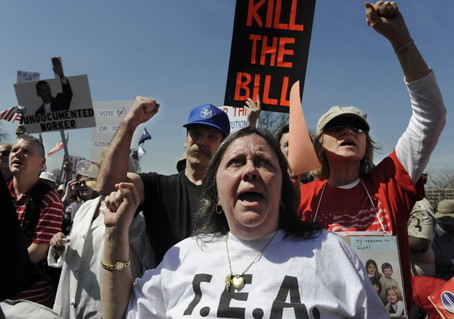
When do you cross the line?
In the Wyoming state legislature, 10 congressmen and three senators have co-sponsored “The Health Care Choice and Protection Act.” The intent? To make it a felony to implement the health-care reform law — which is, you’ll remember, the official law of the land. Here’s the relevant bit:
Enforcement of federal laws prohibited; offenses and penalties.
Any official, agent, employee or public servant of the state of Wyoming as defined in W.S. 6-5-101, who enforces or attempts to enforce an act, order, law, statute, rule or regulation of the government of the United States in violation of this article shall be guilty of a felony punishable by a fine of not more than five thousand dollars ($5,000.00), imprisonment in the county jail for not more than two (2) years, or both.
Any official, agent or employee of the United States government or any employee of a corporation providing services to the United States government that enforces or attempts to enforce an act, order, law, statute, rule or regulation of the government of the United States in violation of this article shall be guilty of a felony punishable by imprisonment for not more than five (5) years, a fine of not more than five thousand dollars ($5,000.00), or both.
There’s not much use in worrying about something like this as it wouldn’t survive two seconds in a court of law. But the sentiments are worth considering: The argument is that this legislation isn’t just policy that the authors disagree with, but rather a deeply, profoundly, un-American threat to liberty. It’s so un-American, in fact, that a plain reading of the Constitution makes clear that the Wyoming legislature, which has sworn to protect and defend the document, must “adopt and enact any and all measures as may be necessary within the borders of Wyoming to prevent the enforcement of the Patient Protection and Affordable Care Act and the Health Care and Education Reconciliation Act of 2010.”
Many of my friends on the right have legitimate technocratic differences with the Affordable Care Act. But many of the politicians they’ve stood with have not made a legitimate case against the bill. Rather, they’ve taken a bill that echoes past legislation Republicans have introduced and called it, as Sen. Jon Kyl did, “a stunning threat to liberty.” They’ve told their supporters, as Sen, Chuck Grassley did, that they’re right to fear that the health-care bill “determines if you’re going to pull the plug on grandma.” This is not merely legislation that they have some technical or philosophical disagreements with. It is, in the words of Speaker John Boehner, “a monstrosity.”
Given the extremism of the rhetoric at the top, is it any wonder that there is incredible fear trickling down to the grass roots? If those are the stakes, then of course criminalizing any implementation of the bill makes sense. Frankly, if those are the stakes, then violent resistance might be required.
Those aren’t the stakes, of course. They’re just the words. And words slip sometimes. Things come out too angry, or too quickly, or too sharply. I’ve had my share of experience with this. But words matter. And the Republican Party hasn’t been slipping up: It’s been engaged in a concerted campaign to scare the population into opposing health-care reform. That may be good politics, but it can have bad consequences.
By: Ezra Klein-Washington Post-January 7, 2011: Photo By: Melina Mara-Washington Post
Share This Blog


 Unknown Feed
- An error has occurred; the feed is probably down. Try again later.
 mykeystrokes.com
You must be logged in to post a comment.