What Does The Tea Party Want?….The New Litmus Test
Jim VandeHei and Mike Allen argue that the Tea Party redefined the purpose of the GOP as opposition to spending:
The Republican Party is undergoing a messy but unmistakable 20-month transformation from fanatically anti-Obama to fanatically anti-spending, providing top party officials a new and intriguing playbook for recapturing the White House in 2012.
To understand the current evolution, flash back to late spring of 2009. The GOP was disoriented and adrift, its leadership void filled by the bombastic voices of Palin, Beck and Rush Limbaugh. There was no common conservative cause, beyond fear and loathing of Obama. No wonder swing voters were so down on them.
But the tea party, treated at first by the media as exotics, forced Republicans to focus almost exclusively on the size of government. By the time the 2010 elections rolled around, tea party activists and most independent voters were completely aligned on the need to cut, cut, cut.
Midterm election results showed that this approach offers the GOP its best – and maybe only – hope of keeping the interests of independents and tea party activists aligned enough to beat Obama.
The new litmus tests for GOP presidential hopefuls are support for repealing “Obamacare” and taking a cleaver to government spending. If a presidential candidate could harness the smaller-government conservatism, temper it enough to avoid a blatant overreach and articulate a vision for a prosperous future for the country, it’s not hard to imagine swing voters finding such a person appealing.
There’s a superficial appeal to this story. But the evidence that Tea Party activists want to cut spending — at least actual spending programs — is sparse. Polls show that Tea Party supports overwhelmingly oppose cuts to Social Security and Medicare. The main thrust of Tea Party opinion is not the belief that Obama has spent too much money, but the belief that Obama has spent too much money on people unlike them:
More than half say the policies of the administration favor the poor, and 25 percent think that the administration favors blacks over whites — compared with 11 percent of the general public.
They are more likely than the general public, and Republicans, to say that too much has been made of the problems facing black people.
Here’s another cut, showing the Tea Party’s greater comfort with inequality of opportunity and stronger belief that the government devotes too many resources to minorities:
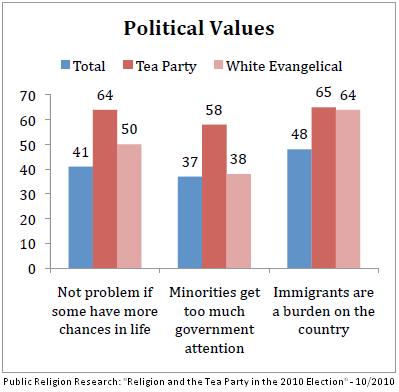
It’s a revolt against the composition of government much more than the level.
Now, it’s true that Republicans aren’t exactly translating this blueprint into action, but they’re not exactly flouting it, either. There is always a generalized antipathy toward spending amongst Republican and swing voters, but it disappears when the subject turns to actual government programs. Usually Republicans decide to just cut taxes for the rich instead. Here’s is the one part of the article proposing a defined policy change:
Even Ralph Reed, the Republican operative most tapped in to evangelicals, reflected the new GOP mindset when he gave this surprising wish list for the next presidential race: “In a perfect world, I’d like to hear the Republican nominee run on a platform that takes the capital gains tax to zero over five years.” Reed, who summoned several of the presidential candidates to Iowa for his Faith & Freedom Coalition this week, made it clear that Christian conservatives will still need to be catered to, but added that his side will understand the nominee’s need to focus on swing voters.
So an article putatively about the GOP redefining itself as an anti-spending party has one actual programmatic detail, and it’s: a zeroing out of the capital gains tax. In the name of appealing to swing voters — who, in fact, oppose tax cuts for the rich. Meet the new boss…
By: Jonathan Chait, The New Republic, March 14, 2011
McCarthyism Revisited: Peter King’s Modern-day Witch Hunt
“There is nothing radical or un-American in holding these hearings,” Rep. Peter King (R-N.Y.) claimed Thursday as he launched his McCarthyite probe of American Muslims. He could not have been more wrong. If King is looking for threats to our freedoms and values, a mirror would be the place to start.
Here’s why. Imagine a young man, a Muslim, who changes in troubling ways. His two best friends become concerned, then alarmed, as the young man abandons Western dress, displays a newfound religiosity and begins to echo jihadist rhetoric about the decadence of American society. Both friends suspect that the young man has become radicalized and might even attempt some kind of terrorist attack.
One friend is Muslim, the other Christian. Does the Muslim friend have a greater responsibility than the Christian to contact the authorities? By the logic of King’s witch hunt, he does.
The Homeland Security Committee hearings that King has convened are billed as an inquiry into “The Extent of Radicalization in the American Muslim Community and That Community’s Response.” In other words, King suspects that the Muslim community is somehow complicit. Individuals of one faith are implicated; individuals of another faith are not.
As Rep. Keith Ellison (D-Minn.), one of two Muslims in Congress, said in his moving testimony, King’s premise assigns “collective blame” to American Muslims. “Demanding a community response . . . asserts that the entire community bears responsibility,” Ellison said.
In his pugnacious opening statement, King noted that his plan to hold these hearings had been criticized by “special-interest groups and the media,” which he said had gone into “paroxysms of rage and hysteria” at the prospect. “To back down would be a craven surrender to political correctness,” he said. In case someone missed the point, King later said it was our duty to “put aside political correctness and define who our enemy truly is.”
King asserted that “this committee cannot live in denial.” He then went straight there – into denial – by paying no heed to the witness best situated to answer the committee’s question.
Los Angeles County Sheriff Lee Baca testified in opposition to King’s premise, citing figures demonstrating that radical, extremist acts of crime are committed by non-Muslims as well, and that seven of the past 10 known terrorist plots involving al-Qaeda have been foiled in part by information provided by Muslim Americans. Baca said his officers have good, productive relationships with Muslim leaders and citizens. Law enforcement officials from other jurisdictions where there are large Muslim communities could have given similar testimony, had they been invited.
King is trying to peddle the hooey that moderate Muslims do not speak out against extremism. It took Rep. Sheila Jackson Lee (D-Tex.) to note the irony that among the committee’s witnesses were two devout Muslims – one Syrian American, the other Somali American – who were there to speak out, quite loudly, against extremism.
King, in effect, was demanding to know why he didn’t see what was taking place before his eyes. Perhaps he was distracted by the need to maintain constant vigilance for any hint of political correctness.
That’s really what King’s grandstanding is all about. The purpose of these hearings isn’t to gather information. If it were, officials of the FBI and the Department of Homeland Security would have been asked to testify. In addition to inviting Minneapolis-based Abdirizak Bihi, a Somali American whose nephew was recruited by the terrorist organization al-Shabab, King could have brought in police from the Twin Cities to testify about cooperation by the Somali immigrant community.
King’s intent is theatrical, not substantive; he’s not trying to elicit facts, he’s inviting catcalls – and cheers.
It should not be so, but Islamophobia is a powerful force in American politics. There are those who will applaud King for associating the phrase “American Muslim community” with the phrase “who our enemy truly is.”
But decency is a powerful force, too. The hearing’s indelible moment came when Ellison broke down in tears. He was telling the story of Mohammad Salman Hamdani, a young Muslim who rushed into the World Trade Center to try to rescue victims just before the towers collapsed. His remains were found in the rubble.
Hamdani was not just a Muslim, Ellison said, fighting to choke out words that no one could dismiss as politically correct. He was “an American who gave everything for his fellow Americans.”
By: Eugene Robinson, Op-Ed Columnist, The Washington Post, March 10, 2011
Should Rep. Peter King Investigate The Catholic Church?
Rep. Peter King, the Long Island congressman who for years supported the Irish Republican Army as it waged a terror campaign to eject the British from Northern Ireland, says that track record has no bearing on his controversial decision to hold hearings this week on what he calls the “radicalization” of Islam in America.
The two examples are different, he argues, and the main reason is that unlike radical Muslims, the I.R.A. never launched attacks in the United States. (That made sense, since Irish-Americans were sending crucial material support to the I.R.A.)
“I understand why people who are misinformed might see a parallel. The fact is, the I.R.A. never attacked the United States. And my loyalty is to the United States,” King, the Republican chairman of the House Homeland Security Committee, told The New York Times.
Okay, so how about investigating the Roman Catholic Church, another religious community — like Islam — and one to which the Irish-Catholic congressman also professes great loyalty?
As Washington Post columnist Richard Cohen pointed out on Tuesday, if Congress is going to start investigating religious groups whose members have attacked Americans, that could be bad news for the Catholic Church given the extent of the clergy sexual abuse scandal. (And Cohen’s piece was published hours before the latest shocker, the mass suspension of 21 priests in the Archdiocese of Philadelphia following a grand jury probe — the second since 2005 — of the sexual abuse of children by clergy in the city.)
Bill Donohue of the Catholic League jumped on Cohen — as is his wont — for citing an exaggerated figure of 100,000 possible victims of clergy abuse, noting, correctly, that the figure is more like 12,000 (though this crime is notoriously under reported). Donohue did not, however, dispute Cohen’s central premise about the problematic nature of King’s investigation of Islam, and a toll of thousands of children abused over five decades is hardly what the lawyers might call exculpatory evidence.
Little wonder that former Oklahoma Gov. Frank Keating, a Republican, onetime FBI agent and federal prosecutor, and devout Catholic, likened some bishops to the Mafia when he was named in 2002 to be the first head of a lay oversight board to keep the hierarchy honest in its abuse-prevention policies.
Such characterizations got Keating forced out by the bishops after a year in the post, and his resignation letter still minced no words: “To resist grand jury subpoenas, to suppress the names of offending clerics, to deny, to obfuscate, to explain away; that is the model of a criminal organization, not my church.”
Of course, a congressional investigation of the Catholic Church would be met with howls of protests from the likes of Donohue and most certainly Peter King, and rightly so.
The point is that the religious community that Muslims today most clearly resemble is the Roman Catholic Church, and it was thus as recently as King’s own youth, when John F. Kennedy barely won election due to concerns that one could not be a “good Catholic” and a “good American.”
Indeed, during the campaign Kennedy famously had to assure Protestant pastors that he would never take orders from the Vatican (a pronouncement many conservative Christians today now hold against Kennedy and his Catholic heirs in the Democratic Party — sometimes you can’t win for losing).
King’s hearing set for Thursday has been compared to the internment of Japanese-Americans during World War II, while others speculated that they would be akin to holding congressional hearings on the role of Christianity in promoting violence against gays or abortion providers.
But the Islamic-Catholic analogy is most apt.
Like Muslims in America today, Catholics were seen as foreign-born immigrants who were subject to a foreign ruler, namely the Pope in Rome, who did not recognize religious freedom and democratic governance.
The latter charges were actually true, more or less, until the reforms of the 1960s, though American Catholics took little notice of such teachings, much as American Muslims would stare blankly if asked about the latest fatwa from some imam in Iran.
(In 1928, New York Gov. Al Smith, the first Catholic nominated as a presidential candidate, was challenged by a prominent Episcopal layman to explain how he could expect to uphold the Constitution if elected while at the same time accepting the teaching in papal encyclicals. “What the hell is an encyclical?” Smith reportedly asked. He still got creamed by Herbert Hoover.)
During the 19th century a major political party was founded to combat Catholic influence, and Catholic students were unable to attend public schools without having to imbibe Protestant teachings. Catholics were subject to outbursts of popular violence, and when the pope donated a stone for the construction of the Washington Monument in 1854, an anti-Catholic mob threw it into the Potomac River. Thomas Nast’s famous 1875 cartoon, “The American River Ganges,” showed St. Peter’s Basilica in the background with mitred Catholic bishops as crocodiles attacking the United States to devour the nation’s schoolchildren.
Such sentiments were all too common, as were efforts — as Paul Moses noted in Commonweal magazine — to stop the construction of Catholic churches in U.S. cities, almost a mirror image of the fierce arguments last year against construction of the so-called “ground zero” mosque, also known as the Islamic center in Lower Manhattan.
It was King, in fact, who had a key role in fomenting opposition to the Islamic center, saying early last year that it was “particularly offensive” because “so many Muslim leaders have failed to speak out against radical Islam, against the attacks” of 9/11.
Those arguments laid the ground work for King’s subsequent charges that American Muslims and their leaders are not cooperating with authorities to thwart terrorist plots and that 80 percent of mosques in America are controlled by radical imams. Even though King has provided no evidence for the charges — and the latest research counters his claims — he is going ahead with a hearing to “test” his hypothesis.
King continued his line of argumentation on the eve of the hearing, telling the Associated Press that radical Islam is a distinct threat that must be investigated regardless of whose sensibilities are offended.
“You have a violent enemy from overseas which threatens us and which is recruiting people from a community living in our country,” King said. He could have been talking about his own Catholic community in the 1800s.
It is also interesting to note that Catholics often reacted to such denigration by trying to prove they were more patriotic than the Founding Fathers which, as Notre Dame church historians R. Scott Appleby and John T. McGreevy have pointed out, sometimes led to excesses like Sen. Joseph McCarthy’s anti-communist hearings of the 1950s.
That’s a historical parallel Peter King may also want to remember.
By: David Gibson, Religion Reporter, Politics Daily, March 9, 2011
What Wisconsin Democrats Can Teach Washington Democrats
Consider the contrast between two groups of Democrats, in Wisconsin and in the nation’s capital.
Washington Democrats, including President Obama, have allowed conservative Republicans to dominate the budget debate so far. As long as the argument is over who will cut more from federal spending, conservatives win. Voters may think the GOP is going too far, but when it comes to dollar amounts, they know Republicans will always cut more.
In Wisconsin, by contrast, 14 Democrats in the state Senate defined the political argument on their own terms – and they are winning it.
By leaving Madison rather than providing a quorum to pass Gov. Scott Walker’s assault on collective bargaining for public employees, the Wisconsin 14 took a big risk. Yet to the surprise of establishment politicians, voters have sided with the itinerant senators and the unions against a Republican governor who has been successfully portrayed as an inflexible ideologue. And in using questionable tactics to force the antiunion provision through the Senate on Wednesday, Republicans may win a procedural round but lose further ground in public opinion.
Here’s the key to the Wisconsin battle: For the first time in a long time, blue-collar Republicans – once known as Reagan Democrats – have been encouraged to remember what they think is wrong with conservative ideology. Working-class voters, including many Republicans, want no part of Walker’s war.
A nationwide Pew Research Center survey released last week, for example, showed Americans siding with the unions over Walker by a margin of 42 percent to 31 percent. Walker’s 31 percent was well below the GOP’s typical base vote because 17 percent of self-described Republicans picked the unions over their party’s governor.
At my request, Pew broke the numbers down by education and income and, sure enough, Walker won support from fewer than half of Republicans in two overlapping groups: those with incomes under $50,000 and those who did not attend college. Walker’s strongest support came from the wealthier and those with college educations, i.e., country club Republicans.
Republicans cannot afford to hemorrhage blue-collar voters. In a seminal article in the Weekly Standard six years ago, conservative writers Reihan Salam and Ross Douthat observed: “This is the Republican Party of today – an increasingly working-class party, dependent for its power on supermajorities of the white working-class vote, and a party whose constituents are surprisingly comfortable with bad-but-popular liberal ideas like raising the minimum wage, expanding clumsy environmental regulations, or hiking taxes on the wealthy to fund a health care entitlement.”
Put aside that I favor the policies Douthat and Salam criticize. Their electoral point is dead on. In 2010, working-class whites gave Republicans a 30-point lead over Democrats in House races. That’s why the Wisconsin fight is so dangerous to the conservative cause: Many working-class Republicans still have warm feelings toward unions, and Walker has contrived to remind them of this.
Which brings us to the Washington Democrats. Up to now, the only thing clear about the budget fight is that Democrats want to cut less from discretionary spending than Republicans do. Quietly, many Democrats acknowledge that they have been losing this argument.
Thus the importance of a speech on Wednesday by Sen. Charles E. Schumer, a New York Democrat, intended to “reset the debate.” As Schumer noted, the current battle, focused on “one tiny portion of the budget,” evades the real causes of long-term budget deficits.
Schumer dared to put new revenue on the table – including some tax increases that are popular among the sorts of blue-collar voters who are turning against Walker. Schumer, for example, spoke of Obama’s proposal to end subsidies for oil and gas companies and for higher taxes on “millionaires and billionaires.” Yes, closing the deficit will require more revenue over the long run. But right now, the debate with the House isn’t focusing on revenue at all.
Schumer, who spoke at the Center for American Progress, also suggested cuts to agriculture subsidies and in unnecessary defense programs. He proposed changes in Medicare and Medicaid incentives that would save money, including reform of how both programs pay for prescription drugs. The broad debate Schumer called for would be a big improvement on the current petty argument, which he rightly described as “quicksand.”
To this point, Washington Democrats have been too afraid and divided to engage compellingly on the fundamentals of what government is there to do and how the burdens of deficit reduction should be apportioned. Wisconsin Democrats have shown that the only way to win arguments is to take risks on behalf of what you believe. Are Washington Democrats prepared to learn this lesson?
By: E. J. Dionne, Op-Ed Colunist, The Washington Post, March 10, 2011
Share This Blog


 Unknown Feed
- An error has occurred; the feed is probably down. Try again later.


You must be logged in to post a comment.