“Promises, Promises”: The Elusive Policy That’s Always On The Horizon
In 2009, as Democrats advanced the Affordable Care Act, congressional Republicans promised to produce an alternative plan to prove to the public that the GOP approach was superior. It sounded very nice.
But Republicans, working in secret, missed their own deadline. Then they missed another. Eventually, GOP lawmakers threw together a half-hearted package, which was a bit of a joke. As Matt Yglesias noted at the time, the Republican approach to reform sought to create a system that “works better for people who don’t need health care services, and much worse for people who actually are sick or who become sick in the future. It’s basically a health un-insurance policy.” The CBO found that the plan would leave “about 52 million” Americans without access to basic medical care.
Four-and-a-half years later, we find ourselves in a surprisingly similar situation. For reasons they sometimes struggle to explain, congressional Republicans still hate “Obamacare,” and just as importantly, are still working in secret on an alternative reform plan that will prove their superior policymaking skills. One of these days, they keep saying. Just you watch. It’ll be **awesome.
Except, of course, the elusive policy is always just out of reach. It sits at the horizon, but it never draws closer.
Suddenly, a House vote on a Republican alternative to Obamacare seems less likely.
Speaker John Boehner (R-Ohio) declined to commit to an alternative measure coming up for a vote this year but said GOP leadership is going to “continue to having conversations with our members” about items like tax reform and replacing President Barack Obama’s signature domestic legislation.
And what about the recent promises from House Republican leaders that they will present an ACA alternative – and vote on it – sometime in 2014? “We’re going to continue to go through a lot of ideas,” Boehner said yesterday, using the most non-committal language possible.
By any fair standard, this is quickly becoming a rather ignominious fiasco.
Jon Chait published a gem this week, highlighting the recent Republican rhetoric.
* On Jan. 30, House Majority Leader Eric Cantor (R-VA.) vowed, “This year, we will rally around an alternative to ObamaCare and pass it on the floor of the House.”
* On Feb. 21, Cantor said Republicans are working “to finalize our Obamacare replacement plan.”
* On Feb. 24, Cantor’s office said it’s prepared to “begin” working on the party’s alternative.
* On Feb. 27, Boehner said he’s prepared to “have conversations” with Republicans about what might be in an alternative policy.
Notice the pattern? Over the course of four weeks, we’ve gone from a guaranteed vote on an alternative to descending assurances about whether an alternative will ever even exist. Chait explained:
Lots of people treat the Republican Party’s inability to unify around an alternative health-care plan, four years after the passage of the Affordable Care Act, as some kind of homework assignment they keep procrastinating on. But the problem isn’t that Cantor and Boehner and Ryan would rather lay around on the sofa drinking beer and playing video games than write their health-care plan already.
It’s that there’s no plan out there that is both ideologically acceptable to conservatives and politically defensible.
Quite right. Republicans could present an alternative policy that they love, but it’ll quickly be torn to shreds, make the party look foolish, and make clear that the GOP is not to be trusted with health care policy. Indeed, it would very likely scare the American mainstream to be reminded what Republicans would do if the power over the system were in their hands.
On other hand, Republicans could present a half-way credible policy, but it would have to require some regulations and public investments, which necessarily means the party’s base would find it abhorrent.
And so we get … nothing. Years of promises later, the GOP can’t meet its own commitment to the public, not because Republicans are lazy, but because it’s a post-policy party.
They sure are great at complaining, though, aren’t they?
By: Steve Benen, The Maddow Blog, February 28, 2014
“The Right Defends A New Jim Crow”: 50 Years Since The Civil Rights Act, Wingnuts Still Don’t Get It
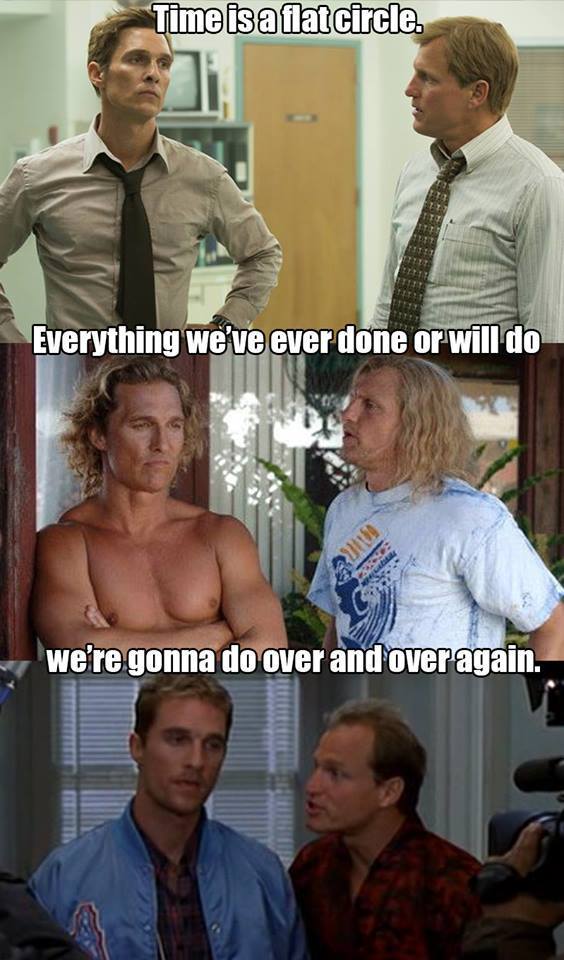
Watching the debate over Arizona’s SB 1062 (better known as the state’s anti-gay Jim Crow law) unfold this past week, I couldn’t help but think of the already iconic line from Matthew McConaughey’s “True Detective” character Rust Cohle: “Time is a flat circle.” As is always the case with the nihilistic and willfully esoteric Cohle, it’s not entirely clear what he’s trying to say with the metaphor, but we get the gist: Like Nietzsche’s “eternal return,” Cohle’s flat circle theory holds that all of us are destined to relive every moment of our conscious lives, forever. It’s as if we all were stuck in the late Harold Ramis’ “Groundhog Day,” but instead of repeating a single day, we repeat our entire lives.
Beyond the fact that, like many others, obsessing over “True Detective” has increasingly become the chief way I spend my free time, Arizona’s brief foray into the politics of segregation reminded me of the flat circle quote because I had recently seen Bryan Cranston’s Broadway debut, “All the Way,” in which the “Breaking Bad” star plays former president Lyndon B. Johnson during the historic period between Kennedy’s assassination and Johnson’s reelection, a time when the 36th president was working feverishly to ensure the passage of the Civil Rights Act of 1964. The play is good and Cranston is great, but what was most striking throughout was how much Johnson’s opponents then sounded like SB 1062’s supporters today. It was, as Cohle would say, some “heavy shit.”
The similarities weren’t merely superficial, either. Sure, the play, written by Pulitzer prize-winning playwright Robert Schenkkan (who obviously did his homework), was littered with hysterical charges of “fascism” and “socialism” and “big government” from no-name Dixiecrats that most of us never knew or were happy to forget. And of course these moments brought to mind much of the anti-Obamacare rhetoric that has emanated from conservatives during the past five years. But the parallels went deeper than that. It wasn’t just the language that sounded so familiar, but the logic behind it, too. Whether conservatives were defending Jim Crow proper or the Southwest’s latest variant, their worldview, all these years later, was disturbingly unchanged.
To explain what I mean, allow me to cite two of conservatism’s leading lights: Kentucky Sen. Rand Paul and all-around media mogul Glenn Beck.
As the opposition to SB 1062 increased in fervency and numbers, the usually loquacious Paul was, unlike his fellow Senate Republican John McCain (who opposed the bill), deafeningly mute. Anyone familiar with Paul’s history knows why: Because the obvious presidential aspirant wanted to avoid reminding people of the unfortunate 2010 interview with Rachel Maddow in which he stated that, even today, he would not support the government-run dismantling of Jim Crow. “I don’t want to be associated with those people,” Paul said, referring to white supremacists who’d bar blacks from their restaurants, “but I also don’t want to limit their speech in any way…” Paul’s orthodox libertarianism told him that the freedom to discriminate was too valuable, too sacred, to let the federal government stand in its way. Like Sen. Barry Goldwater did in 1964, when he voted against the Civil Rights Act, Paul argued that the Constitution had no room for anti-discrimination.
Roughly four years later, Glenn Beck made a similar argument, this time in defense of SB 1062. After doing his best impression of Hamlet, grappling aloud with his competing interest to not be a bigot while on the other hand maintaining allegiance to his understanding of liberty, Beck cut to the chase, telling his coworkers that he could only support Arizona’s bill, because “freedom is ugly.” Like Paul, Beck was sure to make clear that he held no sympathy for anyone who would ban LGBTQ people from their premises. But also like Paul, Beck had no choice but to conclude that the freedom to ostracize and discriminate was, in part, what the American experiment was all about. “I don’t like that world,” Beck said, “but that’s freedom! That’s freedom! Freedom is ugly. It’s ugly.”
High-profile though they may be, Beck and Paul are hardly the only conservatives who still cling to a vision of freedom that many Americans wrongly thought was swept into Reagan’s “ash-heap of history” decades before. Tucker Carlson — who, if Paul is to be Goldwater, we must describe as today’s version of the braying, segregationist Dixiecrats — was adamant in his defense of SB 1062, saying on Fox News that opponents of the bill were advocating for “fascism” and had gone “too far” in their quest to prevent state-sanctioned bigotry. “Everybody in America is terrified to tell the truth,” Carlson warned, “which is, this is insane, this is not tolerance, this is fascism.” Tellingly, when his sparring partner, Fox’s house liberal, Alan Colmes, asked Carlson whether he would have supported the Civil Rights Act, the editor of the Daily Caller could only respond by saying, “Don’t bring [that] into this,” with a sneer.
Even conservatives who are more intellectually inclined than Beck, Paul and Carlson put forward a defense of SB 1062 that could easily and quickly be adopted to oppose the federal government’s dismantling of Jim Crow. Ilya Shapiro of Cato, libertarianism’s premiere think tank and ostensible guardian of liberty for all, wrote, “I have no problem with SB 1062.” Repeating an argument that was offered by Goldwater, Paul, Beck and Carlson, Shapiro maintained that those who would be discriminated against, were SB 1062 to pass, should simply trust that the free market would punish bigots and, eventually, guarantee their liberty. “[P]rivate individuals should be able to make their own decisions on whom to do business with and how – on religious or any other grounds,” Shapiro wrote. “Those who disagree can take their custom elsewhere and encourage others to do the same.”
The fact that this very same logic recently undergirded a century of Jim Crow seemed to escape Shapiro. Either that or he, like W. James Antle III of the American Conservative, was content to dismiss comparisons to Jim Crow on the grounds that Arizona is not the Jim Crow South and 2014 is not the mid-’60s. “People often argue for or against the civil-rights laws of the 1960s on the basis of abstract principles,” Antle wrote, “but they were in fact a reaction to a very specific set of circumstances.” (This is an argument that, more than anything else, raises the question as to whether this is the first time Antle’s come into contact with an analogy.) Perhaps Shapiro, like Antle, was content to support the bill not because it wouldn’t give the government’s imprimatur to homophobia, but because such an outcome is, in their minds, “not very likely.” After all, what’s a little discrimination in the grand scheme of things?
If we put all these and many other conservative defenses of SB 1062 together, it’s hard not to reach a clear and unsettling conclusion: While conservatives themselves have largely given up the racism that coursed through a previous generation’s defense of Jim Crow, conservatism itself has learned no enduring lesson from the Civil Rights Movement and has made no ideological adjustments as a result. Indeed, National Review’s Kevin Williamson recently declared that Goldwater’s brief against the Civil Rights Act “has been proved correct” for worrying that “expanding the federal mandate … would lead to cumbrous and byzantine federal micromanagement of social affairs.” Going further, National Review’s editors, writing on the 50-year anniversary of the March on Washington (which NR at the time opposed) would only concede that the magazine was wrong to oppose the Civil Rights Movement because its principles “weren’t wrong, exactly” but were instead “tragically misapplied.”
For all of her many flaws, Jan Brewer decided on Wednesday to refrain from applying her conservative “principles” in such a “tragic” manner, opting instead to veto the bill and maybe — just maybe — push her party that much closer to joining the rest of us in the 21st century. And while many conservatives received the veto as a crushing disappointment, or even a step toward “slavery,” I’d caution my right-wing fellow citizens against slipping into outright despair. If the events in Arizona have taught us nothing else, they’ve shown that time is indeed a flat circle; future right-wingers will have plenty of chances to keep getting this most basic question of freedom terribly, terribly wrong.
By: Elias Isquith, Salaon, March 1, 2014
“GOP Like The Dog That Chases A Car”: Republican’s Can’t Do Better Than ObamaCare No Matter What They Would Like You To Believe
We are all familiar with the spectacle of a dog frantically chasing a car, which strikes us as stupid because, after all, what on Earth would the dog do with the car if it actually caught it?
That’s basically what we’re witnessing with the Republicans’ monomaniacal war on the Affordable Care Act:
The GOP’s message may well evolve between now and November, but the most tangible early indicator — advertising spending by conservative groups against Democratic candidates — shows how intensely it is focusing on the health-care law.
“It has been the predominant focus of both our grass roots and our advertising efforts,” said Tim Phillips, president of Americans for Prosperity, the primary political operation of a donor network backed by billionaire industrialist brothers Charles and David Koch.
Of the roughly $30 million the group has spent on ads since August, Phillips said, at least 95 percent has gone toward spots about the health-care law.
Democrats have been tracking that spending to help gauge what their candidates will be facing.
In Senate races, where control of the chamber is on the line, all but $240,000 of the $21.2 million that super PACs are spending on television advertising has gone into attacks centered on the health-care law, said Matt Canter, deputy executive director of the Democratic Senatorial Campaign Committee. The exceptions were ad buys in three states that criticized Democratic senators for supporting President Obama’s judicial nominees.
There is a lot of polling data about ObamaCare, and you can pick and choose which numbers you want to focus on. I like the fact that 57% of self-proclaimed independents think we should either keep the law as it is or make improvements to it, versus 33% who think it should be scrapped. I don’t like that 29% of voters say that they have been negatively impacted by the law versus 17% who say that they have benefitted.
Overall, you could fairly say that the law is slowly becoming less unpopular. This is a victory in itself, considering how much money the Republicans have spent on trashing the law, and how little money the Democrats have spent defending it. If the law were to become popular, the Republicans’ entire midterm strategy would collapse.
As I’ve noted in recent days, the Republicans are so focused on using ObamaCare as a weapon in the midterms that they don’t want to take on tax or immigration reform because either issue would divide their caucus and take the country’s focus off their war on health coverage.
But, I think the public is going to notice that they are like the dog that chases the car. If you elect them to dismantle ObamaCare, they will have no solutions. They can’t do better than ObamaCare no matter what they would like you to believe. Their proposed reforms would cost more money, insure less people, and take away plans from people who like their plans. Everything they claim not to like about the law, they would make worse.
So, while I am nervous about the differential in firepower and resources being dedicated to arguing about ObamaCare, I think the Republicans are putting all their eggs in one basket full of lies and distortion and that we ought to be able to outflank such a clumsy, plodding, charge.
By: Martin Longman, Ten Miles Square, Washington Monthly, February 27, 2014
“When The Pot Calls The Kettle Lazy”: Thanks To Boehner’s ‘Leadership’, Capitol Hill Has Set New Benchmarks For Ineptitude
House Speaker John Boehner (R-Ohio) hosted a lively press conference with Capitol Hill reporters yesterday – the “boner” joke won’t be forgotten anytime soon – but there was something in his opening statement that was so audacious, I’m surprised it was largely ignored.
“You know, back in 2012 the president chose politics over governing. He took the year off, got little done, and this year I’m beginning to see the same pattern of behavior. We’ve seen more and more that the president has no interest in doing the big things that he got elected to do.”
Boehner added that President Obama intends to “pack it in for the year” and “just wait for the election.”
There’s hypocritical rhetoric. There’s breathtaking hypocritical rhetoric. Then there’s rhetoric so hypocritical that it ruptures the space-time continuum.
Reasonable people can debate the merits of competing proposals or policy strategies, but for Speaker Boehner to suggest President Obama is uninterested in governing, lacks ambition, and intends to do nothing for the rest of the 2014 is so head-spinning that it’s genuinely alarming Boehner was able to say the words out loud without laughing hysterically.
Let’s briefly review reality in case it still matters. John Boehner claimed the Speaker’s gavel three years ago, and since that time, he’s racked up zero major legislative accomplishments. While Obama has at times been desperate to get something, anything, done with this Congress, Boehner has tried and failed to lead House Republicans towards anything resembling governing.
The result has been the least productive Congress since clerks started keeping track several generations ago. Thanks to Boehner’s “leadership,” Capitol Hill is establishing new benchmarks for ineptitude, giving the “do-nothing Congress” phrase an updated definition to reflect levels of ineffectiveness few thought possible before 2011.
And yet the Speaker wants to complain that Obama “got little done” after Republicans took control of the House majority.
As for the president having “no interest” in doing “big things,” this is the exact opposite of our version of reality. Obama it appears is preoccupied with doing big things – the Speaker should have listened a little closer to the State of the Union address being delivered a few feet in front of him – while Boehner has said it’s time for Americans to start expecting less. Indeed, House Republicans leaders have been quite explicit on this point, saying the GOP does not like and does not want big policy breakthroughs.
Finally, the very idea that the president intends to coast through the rest of 2014 without doing any actual work buries the needle on the Irony-o-meter because it’s House Republicans who’ve already announced, more than once, that they intend to coast through the rest of 2014 without doing any actual work.
We’ve become all too familiar with the GOP’s reliance on the “I’m rubber, you’re glue” game, but this is ridiculous.
I have no idea whether Boehner actually believes what he said yesterday. But whether the rest of us should believe his comments is clear.
By: Steve Benen, The Maddow Blog, February 28, 2014
“Counting Dollars And Cents”: For Whatever Reason, Jan Brewer Does The Right Thing
The writing was on the wall all week. Arizona Gov. Jan Brewer had no choice but to veto SB 1062, which would have let businesses discriminate against gay patrons (and presumably others) on religious grounds. The veto was demanded by businesses: from the NFL, sponsors of the Arizona-bound 2015 Super Bowl, to Apple to American Airlines to JPMorgan Chase. Even GOP lawmakers who voted for the bill began quailing and taking back their votes shortly after casting them.
Brewer, who has shown independence from her Tea Party base before, particularly on accepting Medicaid expansion, proved to be up to this challenge, too.
The Arizona Tea Party governor vetoed the bill, she said, because of its “unexpected and unintended consequences. The legislation seeks to protect businesses,” she wrote, “yet the business community overwhelmingly opposes the proposed law.” The bill, she said, “could create more problems than it purports to solve.”
Indeed. The proposed Arizona law shows how quickly America’s corporate leaders, and even some Republicans, have counted dollars and counted votes and realized that power lies with gay people and their straight allies who can’t stand anti-gay bigotry – and won’t patronize those who are selling it.
Even as Arizona Republican politicians like Sens. John McCain and Jeff Flake declared their enduring fealty to the sanctity of man-woman marriage, they could oppose SB 1062 because of the business backlash. This is a stunning turnaround from 10 years ago, when Karl Rove encouraged Republicans to put anti-gay-marriage measures on state ballots to turn out the right and buoy George W. Bush’s reelection against John Kerry in 2004. There was no downside for Rove 10 years ago.
That was the same year that San Francisco Mayor Gavin Newsom became persona non grata even to some Democrats for legalizing gay marriage in San Francisco. From Dianne Feinstein to Barney Frank, Newsom got pummeled for promoting too much gay freedom too soon. But just 10 years later, a far-right governor of a changing but still conservative state thinks she has to veto this gay Jim Crow law that businesses are smart enough to oppose.
Let’s celebrate. But let’s also look plainly at how Democrats have won the culture war but are still fighting a grim conflict over economic populism – including, sometimes, against other Democrats. I look forward to the day when businesses lobby for a hike in the minimum wage and universal preschool and higher tax rates for those at the very top, and Republicans like Jan Brewer face the fact that they have to relent. It may be a long time coming. But let this victory remind us what a difference even 10 years can make, on an issue that was once a loser for Democrats. May we catch up on issues of poverty, income inequality and economic opportunity just as quickly.
By: Joan Walsh, Editor at Large, Salon, February 27, 2014
Share This Blog


 Unknown Feed
- An error has occurred; the feed is probably down. Try again later.