Health Care Lawsuits: Separating Law From Spin

"Now if we can just fool the Courts"
If a public figure walks on water at noon, by 3 p.m. a dozen talking heads will be explaining that he can’t swim. That’s politics. But we can hope that federal judges won’t think in sound bites.
The current lawsuits challenging the Affordable Care Act raise this question insistently. I return to this lawsuit in yet another column because I believe this case will dominate both constitutional law and political discourse over at least the next 12 months–and because I believe its stakes far transcend its immediate consequences, important though they will be. I think that if our federal courts are willing to sign on to the challengers’ jejune theory of this case, not only we but our children will spend years dealing the malign consequences of the mistake. Nothing less than the ability of the United States to function as a modern nation may be at stake.
So far, in two of the pending lawsuits, opponents of the law have succeeded in spinning the judges, framing the lawsuits as posing the question whether (as Virginia argued) the federal government can “impose a penalty for what amounts to passive inactivity.”
We know the talk-radio answer to this question: Tyranny! Death panels! Black helicopters! Praise the Lord and pass the ammunition!
But the judicial answer, it seems to me, should be two-fold.
The first, and most important, answer a judge should give is, “I dunno. Find a case where the government does that and get back to me.” Because that description of the Affordable Care Act is simply inaccurate.
The second answer, which a judge shouldn’t give but a Con Law jock like me can, is, “Why ever not?”
I will get to that one later; but first, let’s deal with the canard that the Act somehow “penalizes inactivity.”
Here’s how Judge Henry Hudson put it in his decision in Cuccinelli v. Sebelius: The Act “requires that every United States citizen, other than those falling within specified exceptions, maintain a minimum level of health insurance.”
This snappy apothegm is the logical equivalent of saying that the Defense Appropriations Act “requires that every United States citizen, other than those who leave the country, engage in accepting a minimum level of protection by the United States military.” The provisions of the Health Care Act provide a benefit. The majority of Americans, who already have health coverage (and seem, by and large, to regard this coverage as worth bargaining for) will simply see improvements in their existing health care benefits, such as an end to lifetime benefit limits and the right to include older adult children on their policies. A significant number of others who are currently uninsured will become eligible for government-funded health insurance.
There will remain a small but significant number of Americans who can afford health care insurance but choose not to buy it. But contrary to the sound bite above, even they are not required to “maintain a minimum level of health insurance.” If they wish to keep their uninsured status, they may do so by paying an addition to their income tax bills–ranging from as little as $695 for an individual taxpayer to $2085 for a family of six or more. The claim that the government is “forcing individuals to buy a commercial product” is worse than spin; it is simply false.
In fact, even the choice of procuring insurance or paying a tax is put not to “every United States citizen,” or even “every United States citizen not already covered by insurance,” but only to those who earn enough income to qualify as taxpayers. “A small fraction of fewer than half of United States citizens,” though accurate, is much less thrilling to say, even for a judge, than “every citizen.”
This brings us to the contention that the act somehow regulates “inactivity.” Let’s you and I test this proposition: why don’t you just remain totally inactive in 2014, when the Act first takes effect.
Quit your job and get rid of your investments. The government will not regulate you. (True, it may offer you government-financed health care; but again, that is a benefit, not a regulation or punishment.)
But if you decide actually to work (I recommend that, by the way), you are not being “inactive.” You are taking part in commerce. The Constitution gives Congress plenary authority “to regulate commerce with foreign nations, and among the several States, and with the Indian Tribes.”
A system of regulation might easily include requiring you to pay taxes if you choose to burden commerce; willful refusal to maintain adequate health coverage for yourself and your family is such a burden. To claim otherwise doesn’t pass the straight-face test.
Conservatives like to prate about “individual responsibility” when it is a question of forcing the poor to work; asking the solvent to pay for themselves seems quite in line with these conservative values.
And as to the idea that Congress can only regulate “activity,” here again, verbal formulae are obscuring the practical truth. The Constitution does not say anything about “activity”; that’s a gloss that the Rehnquist Court put on it. Nor does it refer to “interstate commerce,” which to some (apparently including Justice Thomas) means men in knee breeches handing trinkets across state lines. The Constitution says that Congress may “regulate commerce . . . among the several states.”
Chief Justice Marshall (who was a ratifier, though not a Framer, of the Constitution) wrote in 1824 that “among” means “intermingled with,” not “between.” Marshall wrote that Congress’s commerce power reaches everything except that small set of matters “which are completely within a particular state, which do not affect other states, and with which it is not necessary to interfere, for the purpose of executing some of the general powers of the government.” Health care, and the citizen’s economic relationship with it, most assuredly affect all the states, and individual decisions about insurance are an important part of that effect–just as a farmer’s decision to raise private wheat are a part of agriculture’s effect on commerce.
I am somewhat mystified why the state plaintiffs even have standing to appear. In order for them to be injured, the Act would have to infringe some power that is reserved by the Constitution to the states. Judge Hudson placed great emphasis on an obscure 1922 precedent called Bailey v. Drexel Furniture, in which a laissez-faire majority of the Supreme Court invalidated a federal tax on products produced by child labor. The tax, the Court reasoned, was an attempt to prevent exploitation of children in factories and mills; such labor regulations were “a purely state activity.”
The Court has long since given up the idea that “labor laws” are solely state matters. But assume that in the formal sense Drexel is good law. So what? The tax, or penalty, in the Affordable Health Care Act doesn’t regulate any “purely state activity.” If it pretended to regulate commerce but was actually aimed at preventing divorce, or imposing a national zoning code, or requiring homeowners to maintain tasteful wallpaper, there might–might–be a Tenth Amendment issue. But not here: In the guise of regulating commerce, the Act regulates . . . commerce.
Here’s the nub of the objectors’ argument–it is not that this isn’t a regulation of commerce, but that the Commerce Power isn’t strong enough to regulate an entire national market. That kind of limitation on the Commerce Power finds no support in, well, the Constitution.
The doctrine under which the Act is being assailed quite simply constitutes a threat to most of the significant advances in federal law of the past 100 years: federal pension programs, national wildernesses and parks, consumer protection, environmental regulation, and most particularly statutory guarantees of civil rights.
It’s not coincidental that right now Ron Paul laments the Civil Rights Act and that Haley Barbour speaks fondly the segregated South, that anti-immigrant extremists target birthright citizenship, or that right-wingers seek to wreck the Constitution with an old-South style amendment letting states repeal federal laws. A decision to void the Act would furnish a powerful precedent for those who would “restore” a libertarian dreamland that never existed, and that for most of us would quickly become a nightmare.
The great achievement of the Framers–the one they clearly thought most important–was the creation of a national Congress with plenary powers in the spheres assigned to it. Trying to wreck Congress is warring on the Constitution.
That’s not to say that Congress can regulate commerce by unconstitutional means. But the prohibitions on means are in the Constitution, not in the fevered brain of Cuccinelli & McCollum. If a new health care act were to restrict free speech, or impose ex post facto laws, or authorize bills of attainder, or deny due process, the courts should certainly step in.
But that’s not what is at issue here.
Stripped of spin, the state plaintiffs are arguing that Congress can’t use its commerce power to actually regulate commerce. If the courts buy this nonsense, they may fatally damage the power of Congress to manage a modern commercial economy. Repairing that mistake would involve far greater sacrifices than having to pay a tax.
By: Garrett Epps- former reporter for The Washington Post-Original article-The Atlantic, December 30, 2010
Commerce Clause Conundrum–Will The Hudson Ruling Stand?
In declaring unconstitutional the new requirement for Americans to buy health insurance, federal Judge Henry Hudson rests his decision on one of the most widely applied clauses in the Constitution.
Does his interpretation hold up?
Hudson ruled Monday that the Commerce Clause does not give Congress the authority to make people buy something. The Clause itself serves as the basis for a vast swath of federal regulatory statute, and it states, simply, that:
The Congress shall have Power … To regulate Commerce with foreign Nations, and among the several States, and with the Indian Tribes
The Commerce Clause has been interpreted quite broadly over the years, to the point where “interstate” holds little distinctive meaning in the eyes of judges. Courts have so thoroughly established the precedent that one economic action by one person, even if it happens only within one state, can affect the broader economy of any good in question, that the Commerce Clause generally applies to all economic activity.
Hudson’s problem with the federal government’s argument is that this is a novel application of the Commerce Clause, in that it actually forces people to buy something.
Earlier in this opinion, the Court concluded that Congress lacked power under the Commerce Clause, or associated Necessary and Proper Clause, to compel and individual to involuntarily engage in a private commercial transaction, as contemplated by the Minimum Essential Coverage Provision [i.e., the requirement to buy insurance]. The absence of constitutionally viable exercise of this enumerated power is fatal to the accompanying sanction for noncompliance. …
A thorough survey of pertinent constitutional case law has yielded no reported decisions from any federal appellate courts extending the Commerce Clause or General Welfare Clause to encompass regulation of a person’s decision not to purchase a product, notwithstanding its effect on interstate commerce or role in a global regulatory scheme. The unchecked expansion of congressional power to the limits suggested by the Minimum Essential Coverage Provision would invite unbridled exercise of federal police powers. At its core, this dispute is not simply about regulating the business of insurance–or crafting a scheme of universal health insurance coverage–it’s about an individual’s right to choose to participate.
There are more ins and outs, including whether or not the individual mandate is enforced by a “tax” or a “penalty,” but that’s the crux of Hudson’s ruling: a lack of precedent for forcing people into commercial engagement.
There is, however, some precedent.
As Georgetown constitutional law professor Louis Michael Seidman pointed out, the 1964 Civil Rights Act forced businesses into economic engagement when it outlawed racial discrimination in business. Some restaurants didn’t want to engage in commerce with black people, but the federal government forced them to (coincidentally, this was the portion of the law to which Sen.-elect Rand Paul objected).
In another case, Wickard v. Filburn, the federal government tried to penalize a farmer for growing wheat on his own property simply for him and his family to eat. He wasn’t selling it. But the federal government wanted to drive up the price of wheat, and the Supreme Court ruled that the government was within its powers to penalize him for this noncommercial activity and force him, instead, to buy his wheat from the interstate wheat economy, which Congress governs. That decision was handed down in 1942, but the Supreme Court reaffirmed it (cited it to support the logic of a ruling) in 2005, in its ruling on the Raich medical marijuana case.
Judges can decide on their own how directly those ruling apply, and the Supreme Court can always go back on previous decisions if the justices feel it appropriate.
But those are the relevant decisions in which a vaguely similar issue was confronted, in case you were wondering if there’s any historical context for the issue that’s now being forced.
By: Chris Good, Associate Editor –The Atlantic, December 13, 2010
How To Fight The Tax Cut Wars
The next big fight in Congress revolves around extending the Bush tax cuts. Unlike issues like climate change or stimulus, where the public does not accept the Democrats’ basic analysis of the problem, on the tax cuts the Democrats hold the whip hand. The question is whether they emerge with a political win, a public policy win, or both.
Let’s review a few basic facts about the Bush tax cuts. When Republicans took control of government in 2001, their top priority was reducing tax rates on high income earners. Since tax cuts for the rich were unpopular, they had to pair those cuts with middle-class tax cuts in order to make them politically salable. That’s how they pressured Democrats into supporting them. By packaging the whole thing together, they could accuse Democrats of opposing tax cuts for the middle class if they voted no.
Now, ten years later — and what a decade of bountiful economic growth we’ve enjoyed with the energies of investors and entrepreneurs finally unleashed from restrictive Clinton-era tax rates! — the Bush tax cuts are scheduled to expire. Republicans want to extend the whole thing. Democrats just want to extend the parts that benefit people who earn less than $250,000 a year.
Now, here’s the underlying dynamic. Raising taxes on the middle class is unpopular. But raising taxes on the rich is wildly popular. The truth is that neither party cares very much about the portion of the Bush tax cuts that benefit the middle class. Republicans just threw that in to sell the upper-bracket tax cuts, which is what they care about. Democrats might prefer a more progressive tax code with lower middle-class taxes, but most of them would rather have the revenue instead. But Democrats promised not to raise taxes on people earning less than $250,000 a year — a promise they felt they had to make in order to win. And they can’t break that promise without suffering political consequences.
Republicans, on the other hand, don’t want to pass an extension of the middle-class Bush tax cuts without the upper-bracket tax cuts. That would leave the federal tax code more progressive than it was under Bill Clinton — you’d have a combination of Clinton-era tax rates on the rich and Bush-era tax rates on the middle class. Conservatives have been fretting about such a result for more than a year, warning ominously about a country in which half the population pays no income tax. (They’d still pay other taxes, but the central Republican goal is to minimize the progressivity of the tax code.)
So we’re down to a game of chicken. Here’s why the Democrats hold the whip hand. They can pass an extension of the middle-class Bush tax cuts through the House. If Republicans let the bill pass, then they’ve lost their leverage to extend the unpopular Bush upper-income tax cuts. If they filibuster it, then Democrats can blame them for raising taxes on middle-class Americans. It would let Democrats out of their pledge. (Hey, they tried to keep the middle-class tax cuts.) Then nothing would pass, and we’d instantly revert to Clinton-era rates across the board.
What kind of effect would that have on the deficit? A huge one:
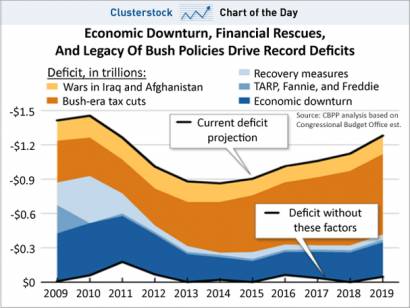
That dark orange stripe is the portion of the deficit attributable to the Bush tax cuts. That would be wiped out. Ending the tax cuts would basically solve the medium-term deficit problem.
The key factor here is that, just as Republicans got to frame the debate in 2001 by combining the tax cuts into an up or down vote, Democrats can frame the debate now by separating the policies Republicans pretend to care about from the ones they actually care about. Republicans want to have a vote on the whole collection of Bush-era tax cuts. Democrats shouldn’t give it to them. You hold a separate vote on the middle class portion and dare them to oppose it.
This seems to be the plan:
“The Senate will move first, and it will be a test to see whether Republicans filibuster” to block the bill in a bid to also win tax cuts for higher earners, said Rep. Chris Van Hollen of Maryland, head of the House Democrats’ re-election effort.
“If you can’t get it out of the Senate, then you take it to the election,” Mr. Van Hollen said in a recent interview. “You say to the American people that Republicans want to continue to hold middle-class tax relief hostage for an extension of tax breaks for [the well-to-do]. That will be the debate.”
Republicans have followed a strategy of opposing nearly everything the Democrats do. It’s worked very well. But the peculiar dynamic of this debate puts the Republicans in a position where they can’t win, and obstructing the Democrats is probably their worst move.
By: Jonathan Chait, Senior Editor, The New Republic-July 26, 2010
Let’s Repeal 2010

Gail Collins-Photo:Tony Cenicola/The New York Times
This has been a bad summer for almost everybody — celebrities, shrimpers, Washington insiders, Tea Party outsiders, people who prefer pleasant weather. So far, my list of who did well only includes the Spanish soccer team and Paul the prophetic octopus. Plus, according to Senator Jim Bunning, George Steinbrenner. The Kentucky Republican praised the Yankee owner in the Senate Finance Committee for being “smart enough to die in 2010,” when the estate tax is temporarily suspended.
This week, Congress passed the huge reform of the financial industry that it had been working on for nearly two years. You’d think there would have been cheering from coast to coast, but the left was disheartened to discover that contrary to all previous precedent, Congress had passed a bill that was imperfect.
“Ending debate on the bill is finishing before the job is done,” said Senator Russ Feingold of Wisconsin, the only Democrat to vote no.
Great idea. I think I speak for us all when I say that there is absolutely nothing I would like better than additional talking in the Senate. It always seems to make things better. Meanwhile, down in the House, John Boehner, the Republican leader, raised the ante, calling for repeal.
Who says that Boehner just hangs out at bars and tanning parlors and doesn’t work hard? The man is tireless! Everybody else was exhausted, but he wanted to start over.
“There are common sense things we should do to plug the holes in the regulatory system … and to bring more transparency to financial transactions. Because transparency is like sunlight and sunlight is the best disinfectant,” he said.
This is an exciting new analogy for Boehner. Just a couple of weeks ago he was leading the opposition to a bill that would require groups that pay for political attack ads to reveal their true identities. Boehner called it a “back-room deal to shred our Constitution.” In this case, transparency was a dangerous concept that would strip away all protective covering and allow vicious ultraviolet rays to stream through the window and burn away our precious freedoms.
Most Republicans are not joining Boehner in his call to repeal the financial reform bill because they are too busy calling for the repeal of health care reform. “The bill should be scrapped and replaced with much better ideas,” said Mario Rubio, the Republican Senate candidate in Florida.
Rubio’s own idea is to eliminate the requirement that healthy people have insurance, but keep the part that says insurance companies have to cover people with pre-existing conditions. This sounds like the ideal solution — no one would have to buy insurance until they got sick, and then they could make the companies sell them a whole bunch of coverage. I don’t know why nobody thought of this before.
With all these great ideas around — debate more, start over, don’t clean the windows — it’s a wonder that Washington hasn’t become the image of Athens in the age of Pericles. But instead, all Barack Obama’s critics have been able to do is make the country feel gloomy about Barack Obama. He’s passed more major legislation than anybody since Franklin Roosevelt and he’s got popularity ratings that look more like Martin Van Buren’s.
This week, there was an enormous outcry at the news that the president was going to take his wife and children to Maine for the weekend. This is the third time he and his family went away for a weekend since the gulf oil crisis. Three weekends in three months!
“Presidents are certainly entitled to vacation, just like everybody else, but there is a fine line as to when presidents should do it, what they should and where they should do it,” a former member of George W. Bush’s staff told CNN. The staff member in question, Brad Blakeman, was in charge of appointments and scheduling. Surely there is nobody better qualified to discuss this important subject than the man who helped the previous president get out of town for a third of his entire time in office.
The Republicans have now set up a site called “Golf or Gulf” that lists all the things Obama has been doing for the last three months when he could have been sitting around worrying about the oil spill. He had Paul McCartney over to the White House. And he played golf 10 times!
Let’s repeal the oil spill and start all over. The right way to handle the disaster, it appears from the many, many critiques, would have been to:
— Call all the oil company executives together to come up with a plan.
— Denounce all the oil companies.
— Apologize to the oil companies.
— Tell Paul McCartney he cannot sing in the White House until all the pelicans are clean.
By GAIL COLLINS-Op-Ed Columnist/NYT
Published: July 16, 2010
Who Does Health-care Reform Help?
Jon Cohn spent part of Saturday wandering through the patches of protesters on Capitol Hill. What surprised him, however, was that the protests seemed less about health-care reform than about redistribution itself. To the protesters, Jon says, health-care reform is “about having their money taken for the sake of somebody else’s security. When they hear stories of people left bankrupt or sick because of uninsurance, they are more likely to see a lack of personal responsibility and virtue than a lack of good fortune.”
I see this a lot in my inbox, too. So it’s worth taking a moment to talk about whom health-care reform is really meant to help. There are three major subsidies operating in the health-care system. The first, and most obvious, is Medicare, which covers the elderly. Then there’s Medicaid, which covers some of the very poor. But then there’s the one that people normally forget: The tax break for employer-sponsored health-care insurance. At $250 billion a year, it’s much more expensive than health-care reform, and it subsidizes people with good jobs that offer health-care benefits.
Health-care reform is focused on another group: the working class. People with jobs, but not jobs that are good enough to offer them health-care benefits. People with paychecks, but who aren’t making quite enough money to bear the cost of insurance. People who’re buying insurance on their own, which means they don’t get the good deals that big employers get, and they don’t get a giant tax break to help them out. But these aren’t lazy people, or layabouts. These are people who’ve been left behind in the system. We spend a lot more money to give a lot more help to a lot of folks who need it less than this group does.
That accounts, at least, for the spending side of health-care reform. The new rules on insurers go to help another group: People with bad luck. A preexisting condition is not the fault of the individual. What it means is that they got sick or injured at some point in the past, they get their insurance on their own rather than as part of a bigger group (like an employer’s pool, or Medicare), and they’re not being fraudulent in their dealings with the insurer. When someone who has coverage and then gets sick finds their policy rescinded, that’s also usually not their fault. They had the bad luck to get sick, and the bad luck to have an insurer looking for a loophole to deny them coverage, and then the bad luck to have their insurer actually find one.
These are the folks health-care reform is meant to help. The fact that they can’t afford insurance, though, isn’t evidence of some abdication of personal responsibility. It is evidence that they’re not old, or very poor, or employed by a large corporation that offers health-care insurance. Sickness and health might be capricious, but access to health care doesn’t have to be. It isn’t in other countries, and if Democrats win the vote tonight, it won’t be in ours, either.
By: Ezra Klein | March 21, 2010; 12:18 PM ET
Share This Blog


 Unknown Feed
- An error has occurred; the feed is probably down. Try again later.


You must be logged in to post a comment.