The Importance of the Individual Mandate — Evidence from Massachusetts
The most contentious aspect of the Patient Protection and Affordable Care Act (ACA) is the individual mandate requiring that most documented U.S. residents obtain health insurance or pay a tax penalty. Many experts have long advocated a mandate as a central pillar of private-sector–based health care reform. Others, however, have argued that a mandate is not necessary for successful reform.
Proponents of the mandate argue that it is necessary to reduce adverse selection in a reformed nongroup insurance market. Adverse selection occurs when a larger fraction of relatively unhealthy people than healthy people purchase health insurance. It is analogous to the purchase of car insurance only by high-risk drivers (or worse, only by drivers who have just had an accident). However, one of the most popular aspects of the ACA may encourage such adverse selection, since the law prohibits health insurers from discriminating against applicants on the basis of health, either by charging higher premiums for sick people or by excluding preexisting conditions from coverage. Absent other reforms, such regulations would theoretically increase premiums for healthy people and lead them to exit the nongroup insurance market, which would cause premiums to rise even more. Informal support for this hypothesis comes from the fact that the five U.S. states with such regulations (known as “community rating”) are among the states with the highest nongroup insurance premiums.1
Opponents of the mandate counter that community rating may work as long as there are large subsidies that attract healthier enrollees to the insurance pool. Such subsidies include the tax credits that the ACA authorizes for people with incomes between 133 and 400% of the federal poverty level. (The federal poverty level for a family of four is about $22,000 per year.) States with community rating do not generally offer such large subsidies, so we can’t use their experience to predict the effects of national reform minus the mandate. But understanding whether the mandate matters, even with large subsidies in place, is critical for assessing its role in reform.
The early experience with health care reform efforts in Massachusetts may offer some lessons. Massachusetts made heavily subsidized insurance available to residents with incomes below 300% of the federal poverty level for nearly a year before mandating insurance coverage. By examining the characteristics of the subsidized insurance pool before and after the mandate went into effect, we assessed how much of an additive effect the mandate had over that of simply offering subsidized, community-rated insurance.
As part of the Massachusetts reform, the Commonwealth Care program provided free insurance to people with incomes below the federal poverty level from October 2006 onward and for those with incomes below 150% of the federal poverty level from July 2007 onward. In both cases, the state automatically enrolled people who were eligible for free coverage; people in higher income groups could enroll but had to pay premiums. We therefore examined the behavior of Massachusetts residents with incomes between 150 and 300% of the poverty level, who were eligible for subsidies and had to pay insurance premiums that were meaningful but much smaller than those mandated by the ACA.
Using claims data from the Massachusetts Commonwealth Connector, we measured the health mix of the population enrolling in Commonwealth Care according to average age, average monthly health care expenditures, and the proportion of enrollees with a chronic illness. We identified enrollees as having a chronic illness if within the first 12 months after enrollment they had an office visit at which a diagnosis of hypertension, high cholesterol level, diabetes, asthma, arthritis, an affective disorder, or gastritis was recorded.2 Relying on only the first 12 months of claims ensured that our estimates of rates of chronic illness for earlier enrollees, whose claims data covered a longer period, were similar to estimates for later enrollees.
We examined these data for the period from March 2007 (the date of the first available reliable information on people with incomes in the relevant range) through June 2008 (the last month for which we could calculate our 12-month measure of chronic illness). In each month, we measured the health of the enrollees who joined the program.
We assessed the characteristics of these enrollees before, during, and after the phasing in of the mandate. Technically, the mandate went into effect on July 1, 2007. The Connector began a massive public outreach campaign in May 2007, and the number of hits on its Web site peaked around July 1. The penalty, however, was assessed on the basis of insurance coverage as of December 31, 2007. That is, people who purchased insurance in November that began in December did not have to pay the penalty, even if they had been uninsured beyond July 1. The penalty for 2007 was the loss of the individual state income tax exemption, a relatively modest $219. It increased to about $900 in 2008 and was prorated on the basis of the number of months of coverage during the year.

Characteristics of New Enrollees in Commonwealth Care, According to Enrollment Period

Number of Enrollees in Commonwealth Care, According to Chronic-Illness Status
It seems possible that even without the mandate, people with the highest health care costs would enroll first and healthier people would enroll over time. But data on the health status of new enrollees suggest that that was not the case (see graph). At the beginning of the mandate’s phase-in in mid-2007, there was a greater increase in the number of healthy enrollees than in the number of enrollees with chronic illness. When the mandate became fully effective at the end of 2007, there was an enormous increase in the number of healthy enrollees and a far smaller bump in the enrollment of people with chronic illness. The gap then shrank to premandate levels as the remaining uninsured residents complied with the mandate, but clearly the mandate brought many more healthy people than nonhealthy ones into the risk pool. The large jump in healthy enrollees that occurred when the program became fully effective suggests that enrollment by the healthy was not simply slower than enrollment by the unhealthy, but rather that the mandate had a causal role in improving risk selection.
Whether the Massachusetts experience can be generalized to the rest of the country depends in part on the relative sizes of the subsidies provided: the higher the subsidies, the smaller the role for an individual mandate. Under Commonwealth Care, adults with incomes between 150 and 200% of the poverty level were asked to contribute $35 per month. Under the ACA, their monthly contribution would be $51 to $107. At 200 to 250% of the poverty level, the monthly contributions are $70 in Massachusetts and $107 to $171 under the ACA; at 250 to 300% of the poverty level, the contributions are $105 in Massachusetts and $171 to $242 under the ACA. The larger subsidies in Massachusetts would be expected to have a greater effect in inducing healthy people to obtain insurance than the ACA’s smaller subsidies — which suggests that mandating coverage might well play an even larger role in encouraging the healthy to participate in health insurance markets nationally than it has in Massachusetts.
By: Amitabh Chandra, Ph.D., Jonathan Gruber, Ph.D., and Robin McKnight, Ph.D.-New England Journal of Medicine | This article (10.1056/NEJMp1013067) was published on January 12, 2011, at NEJM.org.
Source Information
From the John F. Kennedy School of Government, Harvard University (A.C.), and the Massachusetts Institute of Technology (J.G.) — both in Cambridge, MA; and Wellesley College, Wellesley, MA (R.M.).
References
- Rosenbaum S, Gruber J. Buying health care, the individual mandate, and the Constitution. N Engl J Med 2010;363:401-403Full Text | Web of Science | Medline
- Goldman DP, Joyce GF, Escarce JJ, et al. Pharmacy benefits and the use of drugs by the chronically ill. JAMA 2004;291:2344-2350CrossRef | Web of Science | Medline
Health Reform at Work Today and Tomorrow: Improvements That Began Last Year Will Continue
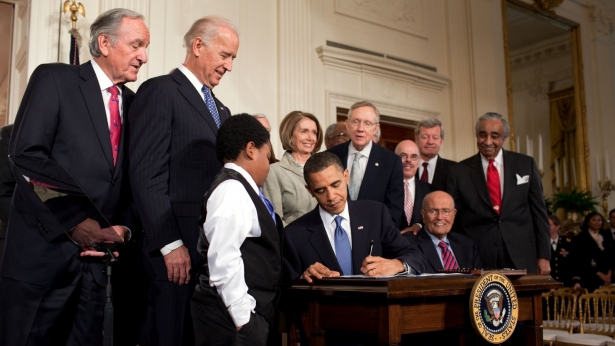
President Barack Obama is applauded as he signs the health care reform bill, on March 23, 2010, in the East Room of the White House in Washington. The bill includes many benefits for Americans who have health insurance today and those who have struggled to find and maintain health coverage.
2010 was a momentous year for the American health care system. In March, Congress passed—and President Barack Obama signed—landmark legislation that reforms the health insurance market, provides all Americans with affordable access to health coverage, and reduces the growth of health care costs.
The Department of Health and Human Services and other parts of the executive branch have begun to implement the new law in the subsequent 10 months. The Affordable Care Act, or ACA, includes many benefits for Americans who have health insurance today and those who have struggled to find and maintain health coverage. Many of these benefits came on-line in 2010.
Signature achievements include:
- Establishing pre-existing condition insurance plans in every state so that individuals with health problems who cannot find coverage in the regular market have a reliable source of coverage
- Requiring employer-sponsored health plans to offer coverage to the young-adult children of policyholders
- Helping employers with unpredictable health care spending for retired workers
- Providing more than 1 million rebate checks to Medicare enrollees who incurred high out-of-pocket prescription drug spending in 2010
- Prohibiting health insurance plans from denying coverage to children with pre-existing conditions
- Protecting individuals with high health care costs from the financial risk of absurdly low annual and lifetime limits on their benefits
- Prohibiting health insurance plans from rescinding coverage when a policyholder gets sick
These changes bring a new degree of stability and security to millions of Americans’ health coverage. And even more improvements are around the corner. Beginning this month, seniors will enjoy meaningful new benefits and significant improvements in their prescription drug coverage, while individuals and businesses will receive premium rebates from their insurance company when the insurers incur excessive administrative costs.
Specific improvements in 2011 include:
- Closing the Medicare prescription drug coverage gap. Seniors and people with disabilities who obtain prescription drug coverage through Medicare Part D will enjoy a new discount on brand-name and generic prescription drugs when they hit the so-called “doughnut hole” in their Part D benefits. Since the beginning of the program, enrollees have hit a gap in coverage when their total drug spending—including out-of-pocket costs and expenses covered by their Medicare Part D plan—exceeds a preset limit (currently $2,830). Patients then pay the total cost of their prescription drugs, without help from their drug plan, until their total drug expenses hit an upper limit and coverage kicks in again. With the new discount, people with drug spending high enough to hit the coverage gap will save almost $500 on average this year, while people with very high drug costs will save more than $1,500.
- Launching new prevention benefits for Medicare enrollees. Good coverage of preventive services helps seniors and other Medicare enrollees better manage their health. New benefits include coverage without cost-sharing for recommended preventive services (those that receive an “A” or “B” rating from the U.S. Preventive Services Task Force) and new coverage for a personal prevention plan.
- Increasing access to primary care. Medicare will pay primary care providers a 10 percent bonus payment, which offers a new incentive for physicians, nurses, and others to provide primary care services.
- Requiring insurers to provide high value for premium dollars. Beginning in 2011, insurers will pay rebates to policyholders—individuals and employers—when plan spending on clinical services falls below 80 percent of premium revenue in the individual and small group market, and 85 percent of premium revenue in the large group market.
Looking ahead, ACA provisions that will touch real people every day will continue coming on-line through 2011. These include providing more consumer information on healthy food choices by requiring chain restaurants and vending machines to provide nutritional data no later than March, and improving long-term care by sending enhanced federal Medicaid payments to support new state investments in community-based long-term care services starting in October. Tangible improvements will continue beyond this year, such as fully closing the coverage gap in Medicare Part D and improving Medicaid coverage for preventive care.
The Affordable Care Act’s most striking impact will come in 2014 when new health insurance exchanges launch, premium subsidies become available, and Medicaid coverage expands to include all low-income individuals regardless of family composition, age, or disability status.
These headline-grabbing changes in our health care system may be a few years down the road. But millions of Americans are already benefiting from the Affordable Care Act—and millions more will receive better care in the near future thanks to the changes in the new law.
By Karen Davenport | January 13, 2011-Center For American Progress. Photo: AP/Charles Dharapak
The Right Wing Can’t Survive Without Stoking Anger
What’s going to be fascinating to watch in the weeks and months ahead is how the Right adjusts to the new “kinder, gentler” rhetorical environment everyone – but them – is demanding.
If you have been a student of the new Right you understand that the gains they’ve made in American politics have come in direct proportion to a rising level of anger. Some of that anger was there just waiting for affirmation, but much more of it has been ginned up by rightwing talkers like Limbaugh, Beck and FOX News.
The anti-government mantra now hammered home 24/7/365 by these demagogic forces provided both cover and opportunity for rightwing politicians in Congress. It did so by rounding up the lower-common denominator types at the grassroots level by affirming their unease and distrust of a changing nation and world they simply cannot understand, much less accept.
Money and votes followed; money from corporate sources that always fund efforts to neuter government regulations and regulators, and votes from a class of voters only Barnum and Bailey could appreciate.
But, what if now the voices stoking all this rightwing blind fury are forced to clean up their acts? And, gasp, forced to stick to provable facts rather than the ones they manufacture to fuel more anger? What then?
Of course no one gives up a “good thing” if they can avoid it, and initially the Right will try blunt any trajectory towards tolerance and moderation.
Then there are the genuinely loony members of Congress who rode the Right’s Anger Express to elected office. You know – like this one.
What I expect to see and hear in the days and weeks just ahead is a new — and frankly jarring — argument from the Right; civility in politics is a liberal plot. A plot against who? Well against the Right, of course. There’s nothing a zealot likes more than to claim the cloak of persecution. It’s always the last refuge of scoundrels, be it demagogic politicians or Christians, Jews, Muslims or Scientologists. Call them on their nonsense and they scream “persecution.”
In this case the Right is going to be forced to take a position that unmasks them once and for all. Without their patented violent, hate-inciting rhetoric, the Right has nothing to offer America. Nothing.
Which explains why they’re going to fight — not for civility — bit for more incivility.
Imagine that.
By: Stephen Pizzo-Guest Columnist; The BuzzFlash Blog, January 13, 2011
The Conservative Constitution of the United States

TeaParty Sacred Text?
Article I
Congress shall have only the powers literally, specifically and expressly granted herein, and no others. That means definitely, without question, absolutely, no regulation of the Health Insurance or Financial Services industries. The Senate of the United States shall be composed of two Senators from each State, elected not directly by the People, but by other people whom the People have elected to better represent the People.
Any law enacted by Congress and signed by the President may be overturned by the vote of three or more States if they find it burdensome, offensive, annoying or in any way touching on Health Insurance, Property Rights or Guns.
Congress shall have no power to raise Taxes except on February 29, and then only if all the People of the United States approve such a measure unanimously, in writing and in English.
Congress shall balance the Federal Budget, preferably by eliminating the Departments of Labor, Energy, Education and State.
The preceding provision shall not apply to spending for the Department of Defense, appropriations for which shall increase three times as quickly as the growth in gross domestic product and upon the approval of House leadership in conference with Boeing, Halliburton, the Ashcroft Group and Kissinger Associates.
Arizona shall have the power to regulate Immigration.
Article II
No person except a natural-born Citizen who can produce video, photographic or eyewitness evidence of birth in a non-island American State shall be eligible to the Office of President.
The President shall faithfully execute the laws, except when, as Commander in Chief, he decides he’d really rather not.
The President shall not negotiate any Treaty without first receiving a signed and notarized note granting him permission, personally executed by every member of the Senate and the House, all 50 Governors and the editorial board of the Weekly Standard. Suspected Terrorists shall be taken to Guantanamo and drawn and quartered in a public ceremony. Trials are optional, but if they occur, must be conducted in a Military Tribunal in which coerced statements are admissible so long as they support a Guilty verdict.
1. Congress shall make no law abridging the Freedom of Speech, except where citizens desecrate the Flag of the United States; respecting an establishment of Religion, except to support Christian schools, religious apparitions in food products and the display of crosses and creches in public places; or abridging the free exercise of Religion, except to block the construction of mosques in sensitive areas as determined by Florida Pastors or the Fox News Channel.
2. The right to bear Semi-Automatic Weapons, AK-47s or Bazookas shall not be infringed by background checks, safety locks, age limits or common sense.
3. The right of Corporations, Hedge Funds, Business Leaders and Lobbyists to spend endless cash on campaigns and influence-purchasing shall not be infringed. The so-called right of Unions to associate shall be denied as fundamentally un-American and contrary to the agenda of the Chamber of Commerce.
4. Marriage and the benefits thereof shall be restricted to the Union of a Man and a Woman, consecrated in a Christian house of worship, with vows to expose any and all progeny to daily viewings of Bill O’Reilly.
5. All persons born or naturalized in the United States are Citizens of the United States of Real America only if their parents, grandparents and great-grandparents were Citizens, and only if they pledge opposition to Health Insurance Reform or New Taxation. Any Citizen convicted of providing material support to Terrorist organizations, wearing clothing bearing images created by Shepard Fairey, or displaying Nancy Pelosi bumper stickers shall be stripped of Citizenship.
6. Aliens, of this world or another, shall have none of the rights guaranteed herein to Citizens.
7. Corporations shall have all of the rights guaranteed herein to Citizens, and then some.
8. No White Male shall be denied equal protection of the law through Affirmative Action or otherwise. In keeping with the intent of the Framers, as discerned by the Honorable Justice Antonin Scalia, distinctions on the basis of sex shall not be deemed to deny equal protection.
9. The right to be uninsured and make other people pay the costs of one’s Health Care shall not be infringed under any circumstances.
10. Congress shall make no law limiting Americans’ right to warm the Planet by using all the energy they darn well please.
11. The Unborn shall have the rights to life, to vote, to bear arms, to practice Religion except in a mosque in Lower Manhattan (see First Amendment) and to make campaign contributions, but once the child is born, it shall have no rights if it is an Alien (see Sixth Amendment).
12. No one may be required to do anything He or She does not want to do. Ever.
Done in Convention by the Unanimous Consent of the Members present the Sixth Day of January in the Year of our Lord Two Thousand and Eleven. In witness whereof We have hereunto subscribed our names, [REDACTED]
By: David Cole who teaches Constitutional Law at Georgetown University and is the legal affairs correspondent for the Nation : Published, Washington Post-January 6, 2011
Climate of Hate: Who Could Not Have Seen This Coming?
When you heard the terrible news from Arizona, were you completely surprised? Or were you, at some level, expecting something like this atrocity to happen?
Put me in the latter category. I’ve had a sick feeling in the pit of my stomach ever since the final stages of the 2008 campaign. I remembered the upsurge in political hatred after Bill Clinton’s election in 1992 — an upsurge that culminated in the Oklahoma City bombing. And you could see, just by watching the crowds at McCain-Palin rallies, that it was ready to happen again. The Department of Homeland Security reached the same conclusion: in April 2009 an internal report warned that right-wing extremism was on the rise, with a growing potential for violence.
Conservatives denounced that report. But there has, in fact, been a rising tide of threats and vandalism aimed at elected officials, including both Judge John Roll, who was killed Saturday, and Representative Gabrielle Giffords. One of these days, someone was bound to take it to the next level. And now someone has.
It’s true that the shooter in Arizona appears to have been mentally troubled. But that doesn’t mean that his act can or should be treated as an isolated event, having nothing to do with the national climate.
Last spring Politico.com reported on a surge in threats against members of Congress, which were already up by 300 percent. A number of the people making those threats had a history of mental illness — but something about the current state of America has been causing far more disturbed people than before to act out their illness by threatening, or actually engaging in, political violence.
And there’s not much question what has changed. As Clarence Dupnik, the sheriff responsible for dealing with the Arizona shootings, put it, it’s “the vitriolic rhetoric that we hear day in and day out from people in the radio business and some people in the TV business.” The vast majority of those who listen to that toxic rhetoric stop short of actual violence, but some, inevitably, cross that line.
It’s important to be clear here about the nature of our sickness. It’s not a general lack of “civility,” the favorite term of pundits who want to wish away fundamental policy disagreements. Politeness may be a virtue, but there’s a big difference between bad manners and calls, explicit or implicit, for violence; insults aren’t the same as incitement.
The point is that there’s room in a democracy for people who ridicule and denounce those who disagree with them; there isn’t any place for eliminationist rhetoric, for suggestions that those on the other side of a debate must be removed from that debate by whatever means necessary.
And it’s the saturation of our political discourse — and especially our airwaves — with eliminationist rhetoric that lies behind the rising tide of violence.
Where’s that toxic rhetoric coming from? Let’s not make a false pretense of balance: it’s coming, overwhelmingly, from the right. It’s hard to imagine a Democratic member of Congress urging constituents to be “armed and dangerous” without being ostracized; but Representative Michele Bachmann, who did just that, is a rising star in the G.O.P.
And there’s a huge contrast in the media. Listen to Rachel Maddow or Keith Olbermann, and you’ll hear a lot of caustic remarks and mockery aimed at Republicans. But you won’t hear jokes about shooting government officials or beheading a journalist at The Washington Post. Listen to Glenn Beck or Bill O’Reilly, and you will.
Of course, the likes of Mr. Beck and Mr. O’Reilly are responding to popular demand. Citizens of other democracies may marvel at the American psyche, at the way efforts by mildly liberal presidents to expand health coverage are met with cries of tyranny and talk of armed resistance. Still, that’s what happens whenever a Democrat occupies the White House, and there’s a market for anyone willing to stoke that anger.
But even if hate is what many want to hear, that doesn’t excuse those who pander to that desire. They should be shunned by all decent people.
Unfortunately, that hasn’t been happening: the purveyors of hate have been treated with respect, even deference, by the G.O.P. establishment. As David Frum, the former Bush speechwriter, has put it, “Republicans originally thought that Fox worked for us and now we’re discovering we work for Fox.”
So will the Arizona massacre make our discourse less toxic? It’s really up to G.O.P. leaders. Will they accept the reality of what’s happening to America, and take a stand against eliminationist rhetoric? Or will they try to dismiss the massacre as the mere act of a deranged individual, and go on as before?
If Arizona promotes some real soul-searching, it could prove a turning point. If it doesn’t, Saturday’s atrocity will be just the beginning.
By: Paul Krugman: Op-Ed Columnist, New York Times-January 10,2011
Share This Blog


 Unknown Feed
- An error has occurred; the feed is probably down. Try again later.


You must be logged in to post a comment.