On Wednesday, we’ll begin talking about whether whoever gets elected has a “mandate.” We’ll talk about it even more if Barack Obama is re-elected, because when a new president takes office we accept that he’ll be doing all kinds of new things, changing course on almost every policy, replacing all the members of the other party who populate the executive branch with members of his own party, etc. With a re-elected president, on the other hand, there’s a real question about where he goes from here and how much he can try to accomplish. There’s a fundamental problem with the mandate idea, however, that makes it almost meaningless in today’s Washington.
The mandate notion assumes that the larger the president’s margin of victory, the greater the proportion of the public has signed on to his policy agenda. That’s not completely unreasonable, though in practice most voters have only the vaguest notion of what the person they’re voting for wants to do. But the idea of the mandate is about Congress more than anything else. There’s a chain of responsibility: The public gives the president its nod; he puts his agenda forth in the form of executive actions, appointments, and legislation; and Congress approves those actions because the public has said with its presidential vote that it wants them. If Congress stands in the way of a president who won a mandate, then the public will rise up and punish them, while if they stand in the way of a president who didn’t win as much of a mandate (because he won without a popular vote majority, for instance), then the public will approve.
You can see the problem in this logic. For this chain to operate, members of Congress have to be either temperamentally inclined to go along with whatever they perceive as the broad public will, or forced to do so because they fear the political consequences. But if Obama wins and is left with a Republican House, he’ll be facing members of Congress who don’t really care what the public thinks or whom it allegedly gave a mandate to.
Although a few of the nuttiest Tea Partiers may lose their seats on Tuesday, we’re going to be looking at a Republican caucus pretty much the same as it is now. The two most important things to know about them are that 1) they are true believers, and 2) they’re mostly elected in safe conservative districts, so they don’t fear retribution at the polls for being obstructionist.
When I say they’re true believers, I mean not only that they have their own extremely conservative agenda, but also that many of them feel that Obama is an illegitimate president whose agenda will send America tumbling toward a nightmarish socialist dystopia. They see implacable opposition to anything and everything Obama wants to do as a moral obligation. To them, it matters not a whit whether he wins by one vote or by 20 million votes. Their behavior will be the same either way.
That isn’t to say there aren’t also people within the Republican party in general and in the House in particular who have a firmer grip on reality. Speaker John Boehner is one of them; he knows that their reputation as mindless obstructionists has done his party real harm, and if he had the power to dictate his caucus’ actions he would probably have them dial the opposition back a bit and find ways to look more cooperative without giving away too much. But he doesn’t have that power. Every time he needs to get their votes on something important it’s a struggle. Many House Republicans would be happy to see him go. His second-in-command, Eric Cantor, is just waiting for the right opportunity to plunge a knife in Boehner’s back and take his job.
So I can guarantee you that no matter what the specific margin is, if Obama wins on Tuesday, Republicans will act as though he has no mandate. They’ll also be saying so at every opportunity, and they may be helped by some in the media; just look at this story from Politico, which says explicitly that even if Obama wins a majority of Americans’ votes, he won’t have a mandate because not enough of those Americans will be white.
The best thing for Obama to do—which I suspect he would do regardless—is to find whatever creative ways are necessary to work around the House and accomplish all the policy goals he can. While in the past some presidents have been criticized for acting as though they have a mandate they didn’t earn (Democrats said this about George W. Bush after the 2000 election), the public only cares about whether your policies are good or bad. No voter is going to say, “I’m glad that now I can get insurance despite being a cancer survivor, but I’m just not sure whether Obama exceeded his mandate by making it so I can do that.” Getting re-elected is all the mandate he needs.
By: Paul Waldman, Contributing Editor, The American Prospect, November 5, 2012
November 6, 2012
Posted by raemd95 |
Election 2012 | Barack Obama, Congress, Eric Cantor, John Boehner, Mandates, media, Politics, Republicans, Teaparty |
1 Comment
Yesterday in Springfield, Ohio, the crowd listening to Barack Obama booed when the President brought up Mitt Romney and the Republican Congress. That prompted Obama to say:
“No, no, no — don’t boo, vote. Vote! Voting is the best revenge.”
Romney promptly pretended to be very outraged by this. He told his supporters:
“Yesterday, the President said something you may have heard by now. That I think surprised a lot of people. Speaking to an audience, he said, ‘voting is the best revenge.’ He told his supporters — voting for revenge. Vote for revenge? Let me tell you what I’d like to tell you. Vote for love of country.”
Romney picked up that refrain a second time:
“Did you see what President Obama said today? He asked his supporters to vote for revenge — for revenge…Instead, I ask the American people to vote for love of country.”
Of course, Obama was only encouraging people to vote. He was telling them that the real way to express opposition to GOP policies is to vote against them, rather than to merely boo them.
And guess what: You may have forgotten about this one, but this isn’t the first time Romney has attacked Obama for encouraging people to get more engaged in the political process. In September, Romney blasted Obama for saying that “you can’t change Washington from the inside.” That September quote from Obama, however, also constituted urging people to get more involved in politics:
“The most important lesson I’ve learned is that you can’t change Washington from the inside. You can only change it from the outside. And that’s how the big accomplishments, like health care, got done, was because we mobilized the American people to speak out…something that I’d really like to concentrate on in my second term is being in a much more constant conversation with the American people, so they can put pressure on Congress to move some of these issues forward.”
Romney pretended to be very outraged about that, too, just as he is doing with regard to Obama’s perfectly innocuous “revenge” quote.
The important thing to remember here is that the GOP argument for a Romney victory rests explicitly on the hope that those who turned out to vote for Obama last time won’t be quite as engaged this time around. Republicans are hoping the electorate is not as diverse as it was in 2008, and they are arguing that the GOP base’s enthusiasm is much higher than that of core Dem constituencies. The Romney camp seems to think it will help whip GOP base voters into a frenzy — and perhaps boost turnout — if Romney casts the way Obama is urging Democratic base voters to get more involved in the process as something sininster and threatening. This is beyond idiotic; it is insulting to people’s intelligence.
The Post editorial board, in a widely cited piece, has claimed that the one constant about the Romney campaign has been that it is driven by “contempt for the electorate.” To make this case, the editorial cites Romney’s nonstop flip flops, his evasions about his own proposals, his refusal to share basic information about his finances and bundlers, and his monumental Jeep falsehood and all his other big lies. It’s fitting that Romney’s closing argument rests heavily on one last sustained expression of that contempt for the electorate — one focused squarely on a call for more engagement in the political process, i.e., on something that is fundamental to democracy itself.
By: Greg Sargent, The Washington Post Plum Line, November 4, 2012
November 5, 2012
Posted by raemd95 |
Election 2012 | Congress, Electorate, GOP, Mitt Romney, Ohio, Politics, Republicans, Voters |
5 Comments
If President Obama is re-elected, health care coverage will expand dramatically, taxes on the wealthy will go up and Wall Street will face tougher regulation. If Mitt Romney wins instead, health coverage will shrink substantially, taxes on the wealthy will fall to levels not seen in 80 years and financial regulation will be rolled back.
Given the starkness of this difference, you might have expected to see people from both sides of the political divide urging voters to cast their ballots based on the issues. Lately, however, I’ve seen a growing number of Romney supporters making a quite different argument. Vote for Mr. Romney, they say, because if he loses, Republicans will destroy the economy.
O.K., they don’t quite put it that way. The argument is phrased in terms of “partisan gridlock,” as if both parties were equally extreme. But they aren’t. This is, in reality, all about appeasing the hard men of the Republican Party.
If you want an example of what I’m talking about, consider the remarkable — in a bad way — editorial in which The Des Moines Register endorsed Mr. Romney. The paper acknowledged that Mr. Obama’s signature economic policy, the 2009 stimulus, was the right thing to do. It also acknowledged that Mr. Obama tried hard to reach out across the partisan divide, but was rebuffed.
Yet it endorsed his opponent anyway, offering some half-hearted support for Romneynomics, but mainly asserting that Mr. Romney would be able to work with Democrats in a way that Mr. Obama has not been able to work with Republicans. Why? Well, the paper claims — as many of those making this argument do — that, in office, Mr. Romney would be far more centrist than anything he has said in the campaign would indicate. (And the notion that he has been lying all along is supposed to be a point in his favor?) But mostly it just takes it for granted that Democrats would be more reasonable.
Is this a good argument?
The starting point for many “vote for Romney or else” statements is the notion that a re-elected President Obama wouldn’t be able to accomplish anything in his second term. What this misses is the fact that he has already accomplished a great deal, in the form of health reform and financial reform — reforms that will go into effect if, and only if, he is re-elected.
But would Mr. Obama be able to negotiate a Grand Bargain on the budget? Probably not — but so what? America isn’t facing any kind of short-run fiscal crisis, except in the fevered imagination of a few Beltway insiders. If you’re worried about the long-run imbalance between spending and revenue, well, that’s an issue that will have to be resolved eventually, but not right away. Furthermore, I’d argue that any alleged Grand Bargain would be worthless as long as the G.O.P. remained as extreme as it is, because the next Republican president, following the lead of George W. Bush, would just squander the gains on tax cuts and unfunded wars.
So we shouldn’t worry about the ability of a re-elected Obama to get things done. On the other hand, it’s reasonable to worry that Republicans will do their best to make America ungovernable during a second Obama term. After all, they have been doing that ever since Mr. Obama took office.
During the first two years of Mr. Obama’s presidency, when Democrats controlled both houses of Congress, Republicans offered scorched-earth opposition to anything and everything he proposed. Among other things, they engaged in an unprecedented number of filibusters, turning the Senate — for the first time — into a chamber in which nothing can pass without 60 votes.
And, when Republicans took control of the House, they became even more extreme. The 2011 debt ceiling standoff was a first in American history: An opposition party declared itself willing to undermine the full faith and credit of the U.S. government, with incalculable economic effects, unless it got its way. And the looming fight over the “fiscal cliff” is more of the same. Once again, the G.O.P. is threatening to inflict large damage on the economy unless Mr. Obama gives it something — an extension of tax cuts for the wealthy — that it lacks the votes to pass through normal constitutional processes.
Would a Democratic Senate offer equally extreme opposition to a President Romney? No, it wouldn’t. So, yes, there is a case that “partisan gridlock” would be less damaging if Mr. Romney won.
But are we ready to become a country in which “Nice country you got here. Shame if something were to happen to it” becomes a winning political argument? I hope not. By all means, vote for Mr. Romney if you think he offers the better policies. But arguing for Mr. Romney on the grounds that he could get things done veers dangerously close to accepting protection-racket politics, which have no place in American life.
By: Paul Krugman, Op-Ed Columnist, The New York Times, November 1, 2012
November 4, 2012
Posted by raemd95 |
Election 2012 | Bipartisanship, Congress, GOP, Grand Bargain, Gridlock, Mitt Romney, Politics, Republicans, Tax cuts |
2 Comments
I decided to support Barack Obama pretty early in the Democratic primary, around spring of 2007. But unlike so many of his supporters, I never experienced a kind of emotional response to his candidacy. I never felt his election would change everything about American politics or government, that it would lead us out of the darkness. Nothing Obama did or said ever made me well up with tears.
Possibly for that same reason, I have never felt even a bit of the crushing sense of disappointment that at various times has enveloped so many Obama voters. I supported Obama because I judged him to have a keen analytical mind, grasping both the possibilities and the limits of activist government, and possessed of excellent communicative talents. I thought he would nudge government policy in an incrementally better direction. I consider his presidency an overwhelming success.
I can understand why somebody who never shared Obama’s goals would vote against his reelection. If you think the tax code already punishes the rich too heavily, that it’s not government’s role to subsidize health insurance for those who can’t obtain it, that the military shouldn’t have to let gays serve openly, and so on, then Obama’s presidency has been a disaster, but you probably didn’t vote for him last time. For anybody who voted for Obama in 2008 and had even the vaguest sense of his platform, the notion that he has fallen short of some plausible performance threshold seems to me unfathomable.
Obama’s résumé of accomplishments is broad and deep, running the gamut from economic to social to foreign policy. The general thrust of his reforms, especially in economic policy, has been a combination of politically radical and ideologically moderate. The combination has confused liberals into thinking of Obamaism as a series of sad half-measures, and conservatives to deem it socialism, but the truth is neither. Obama’s agenda has generally hewed to the consensus of mainstream economists and policy experts. What makes the agenda radical is that, historically, vast realms of policy had been shaped by special interests for their own benefit. Plans to rationalize those things, to write laws that make sense, molder on think-tank shelves for years, even generations. They are often boring. But then Obama, in a frenetic burst of activity, made many of them happen all at once.
Bipartisan panels of economists had long urged Medicare to reform its payment methods to curb perverse incentives by hospitals and doctors to run up costs as high as possible; Obama overcame fierce resistance in Congress in order to craft, as part of Obamacare, a revolution in paying for quality rather than quantity. He eliminated billions of dollars in useless subsidies to banks funneling (at no risk) government loans to college students. By dangling federal public-education grants, Obama unleashed a wave of public-school reform, over the objections of the most recalcitrant elements of the teachers union movement. And he forced Wall Street to accept financial regulations that, while weaker than ideal, were far tougher than anybody considered possible to get through Congress.
It is noteworthy that four of the best decisions that Obama made during his presidency ran against the advice of much of his own administration. Numerous Democrats in Congress and the White House urged him to throw in the towel on health-care reform, but he was one of very few voices in his administration determined to see it through. Many of his own advisers, both economists steeped in free-market models and advisers anxious about a bailout-weary public, argued against his decision to extend credit to, and restructure, the auto industry. On Libya, Obama’s staff presented him with options either to posture ineffectually or do nothing; he alone forced them to draw up an option that would prevent a massacre. And Obama overruled some cautious advisers and decided to kill Osama bin Laden.
The latter three decisions are all highly popular now, but all of them carried the risk of inflicting a mortal political wound, like Bill Clinton’s health-care failure and Jimmy Carter’s attempted raid into Iran. (George W. Bush, presented with a similar option, did not strike bin Laden.) In making these calls, Obama displayed judgment and nerve.
A year ago, I wrote about the pervasive disillusionment felt by Obama’s supporters. It is a sentiment that has shadowed every Democratic president since Franklin Roosevelt, and even Roosevelt provoked long bouts of agony and disillusionment among his supporters. All were seen by many Democrats at the time as failures, weaklings, or unprincipled deal-makers. It’s true that all of them, including Obama, have made terrible errors. What this tells us, though, is that we need some realistic baseline against which to measure them.
Obama can boast a record of accomplishment that bests any president since Roosevelt, and has fewer demerits on his record than any of them, including Roosevelt. The only president that comes close in gross positive accomplishment is Lyndon Johnson, whose successes were overwhelmed by his failures to such a degree that he abandoned his reelection campaign. The immediacy of the political moment can — and usually does — blind us. (In the aftermath of September 11, 2001, the wide and even bipartisan sentiment prevailed that George W. Bush was exactly the right sort of person we would want to have as president at that moment.)
The sense among Obama’s wavering supporters that he has failed rests upon a two-part indictment. The first and most potent is that he has presided over a weak economy. This line of attack on Obama became inevitable starting on approximately September 14, 2008, when the U.S. financial system imploded. The economists Carmen Reinhart and Kenneth Rogoff have established that financial crises wreak vastly deeper harm than regular recessions. Financial crises freak out consumers, and they freak out political elites in a way that creates a panicked stampede toward exactly the wrong sorts of policies (like reducing short-term deficits) that in turn makes the crisis even worse.
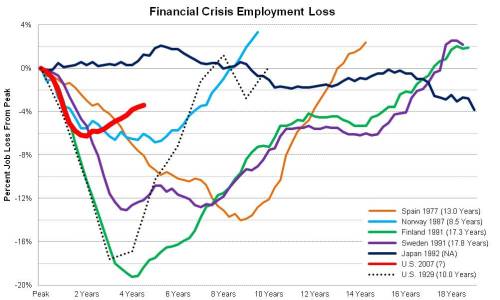
This panic has impeded Obama’s recovery measures. But the fact remains that, by the standards of a financial crisis, the United States suffered through a relatively shallow trough and has enjoyed a fairly rapid recovery. (Here is a chart laying out the comparison between the United States and other comparably afflicted economies.) Obama managed to stabilize the financial system and, through the stimulus, avert a total collapse in consumer demand.
But while America has suffered less since 2008 than other victims of a financial crisis, it has suffered. Obama’s notable success in containing the damage has not redounded to his benefit for another, even more historically durable reason: Voters tend to blame or credit incumbent politicians for the state of their lives utterly regardless of responsibility. This is not even limited to things like the economy, where politicians can affect the outcome. Voters reward or punish incumbents based on the weather or the success of local sports teams. Mitt Romney’s campaign theme attempting to assign all blame to Obama for the state of the economy is a clever manipulation of this long-standing form of irrationality. In 2004, Romney dismissed any attempt to blame George W. Bush for the decline of jobs under his watch as “poppycock.” In his most condescending tone, Romney explained that of course outside forces were to blame — those outside forces being the vastly milder 2001 recession — and that attempting to hold Bush responsible for the economic record of his term was sheer stupidity. Now Romney has made that very theme the central basis of his presidential campaign.
The second indictment of Obama is that he failed to redeem the broader vision of trans-partisan governance he campaigned on. The reason this happened is that the Republicans’ leadership in Congress grasped early on that its path to returning to power required Obama to fail, and that they could help bring this about by denying his initiatives any support. In a meeting before Obama’s inauguration reported by Time’s Michael Grunwald, the House Republican leadership instructed their members on exactly this strategy. GOP Senate Minority Leader Mitch McConnell has followed the same strategy. GOP House members and senators have admitted, some of them publicly, that their leadership prevailed upon them not to negotiate with Obama.
Partisan strife between Congress and the president has gone on for decades. In the past, members of Congress often opposed the president’s agenda, but they also believed that the voters would punish them if they failed to show accomplishments, and so they carefully balanced their substantive opposition with a sense of political self-preservation. What makes the Republican opposition different is that it rests upon a novel, and probably true, insight. Most Americans pay little attention to the details of policy. They rely upon a broad heuristic — if something has touched off an ugly and protracted battle, it is probably bad, but if both sides agree on it, it is probably good. Even many Sunday political talk-show chatterers and other blowhards use the same basic thought process. And so, as McConnell actually said out loud, “if the proponents of the bill were able to say it was bipartisan, it tended to convey to the public that this is O.K., they must have figured it out.” McConnell, in keeping with his Bond-villain habit of boasting openly about his nefarious intentions, actually announced in a prepared speech that his top political priority was to make Obama a one-term president.
The Republican strategy is perfectly clear and not even very well hidden. Yet many of us don’t accept it as a reality because it does not feel true. We instinctively hold the president, not Congress, responsible, another finding political scientists have measured. The hunger to attribute all outcomes to the president is so deep that the political elite take it on faith. Bob Woodward, who is justly famed as a reporter but whose opinions are interesting only as a barometer of Washington establishmentarianism, blamed Obama because Republicans turned down an extraordinarily favorable budget deal. “Presidents work their will — or should work their will,” Woodward declared, “on the important matters of national business.”
How can a president “work his will” in such a way as to force autonomous members of the opposite party controlling a co-equal branch of government to sacrifice their own calculated self-interest? It is a form of magical thinking, but a pervasive one. Which is exactly why the Republican strategy — making Obama’s promise to transcend partisanship fail by withholding cooperation — has worked.
Whether this strategy succeeds in its ultimate goal — returning the GOP to power in 2013 — depends on the election. In an unusual way, the success of Obama’s first term hangs in large part on his reelection bid, as a President Romney would probably kill his grandest achievement of providing health insurance to those Americans too sick or poor to acquire it in the marketplace. So any evaluation of Obama’s term before the election must be provisional.
What can be said without equivocation is that Obama has proven himself morally, intellectually, temperamentally, and strategically. In my lifetime, or my parents’, he is easily the best president. On his own terms, and not merely as a contrast to an unacceptable alternative, he overwhelmingly deserves reelection.
By: Jonathan Chait, Daily Intel, October 31, 2012
November 1, 2012
Posted by raemd95 |
Election 2012 | Barack Obama, Congress, Economic Policy, Foreign Policy, Health Reform, Mitch McConnell, Politics, Republicans, Wall Street |
5 Comments
What is potentially the most dramatic of all electoral subplots seems to be building with virtually no public comment: even as Mitt Romney postures to swing voters as the newly re-emerged Moderate From Massachusetts, the shackles of a Republican congressional majority that once guaranteed the slippery Mitt couldn’t violate his various blood oaths to the conservative movement may not be so tight any more.
Richard Mourdock has taken another big step towards throwing away a safe Senate seat in Indiana. Todd Akin is showing no signs of recovery in Missouri. The latest polls are showing Tim Murphy beginning to overcome Linda McMahon’s money in Connecticut, and Elizabeth Warren building a consistent lead in Massachusetts. Angus King again looks safe in Maine. Sure, GOPers could run the table of close races in Montana, North Dakota, Virginia and Nevada, but overall, prospects for Senate control are looking grim.
So the conservative game-plan, articulated many months ago by Grover Norquist, whereby a newly elected GOP congressional majority would pass the Ryan Budget via reconciliation procedures and present about a decade or two worth of demolition work to a newly elected President Romney, who had promised to sign it–doesn’t look quite so healthy. And this scenario hasn’t been discussed much because pretty much everybody figured an election in which Mitt won would surely produce a Republican Senate, given the GOP’s massive advantages in the landscape of that chamber in this particular cycle.
With Election Day just 13 days off, it’s far too late for conservatives to publicly demand fresh Vows of Total Submission from Romney–vows he’s already made, for one thing, but that most conservatives didn’t really think they’d need with a Republican Congress. They’ll have to grin and pretend to admire the Moderate Mitt talk, barren as it actually is. But you have to figure that behind the scenes there’s some serious don’t-you-dare-cross-us talk going on, whether or not Romney has any intention of using a Democratic Senate as an excuse to go back on his promises to let the conservative movement run wild in 2013 in exchange for tolerating his nomination.
It’s an interesting dynamic to watch, though one that is obviously of academic interest if Mitt loses and conservatives quickly consign him to the ashbin of failed RINOs.
By: Ed Kilgore, Contributing Writer, Washington Monthly Political Animal, October 24, 2012
October 26, 2012
Posted by raemd95 |
Election 2012 | Congress, Conservatives, Grover Norquist, Mitt Romney, Politics, Republicans, Richard Mourdock, Swing Voters, Todd Akin |
Leave a comment


 Unknown Feed
 mykeystrokes.com