Remembering Dr. King
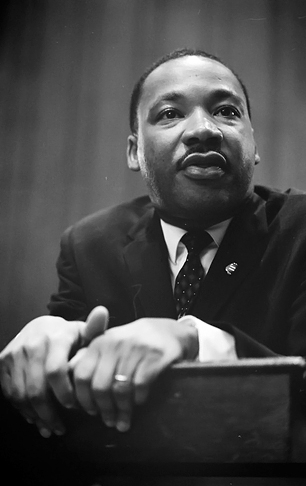
Dr. Martin Luther King, Jr (BuyenLarge/Getty Images)
I was surprised by his assassination. I didn’t see the Poor People’s Campaign as the threat to Washington and the Establishment that I now see it was. We feared for Dr. King’s life more in the early Sixties, through 1963, than we did by 1968. Up through 1965, there was a civil-rights-related death every couple of months, though most of them didn’t make headlines. By the end of ’65, there was a lull in the killings, and I thought perhaps we were finally beyond all that.
In his last year, we worried about Dr. King’s health. He was working eighteen to twenty hours a day. He would stay up all night reading, talking, clowning – whatever he felt like doing – and then wake up at five-thirty raring to go. His wife used to say that he had a war on sleep.
We would tell him that it looked like he was going to be around for a long time, and he couldn’t possibly keep this pace up, because he was close to forty. But if you said anything, he’d brush you off. I could never argue with him anyway. He was a preacher. And whenever we argued, he’d get to preaching. You never won an argument because he would take off on flights of oratory, and you’d forget your point trying to listen to him.
The year he died was the year he felt he had to establish the agenda for America’s future. For fifteen years he’d been struggling with the issues of racism, poverty and war. He refused to be just a civil rights leader. He was a sensitive lover of people who saw his primary responsibility in the black community. By 1968, though, it was clear to him that the black community could not concern itself with civil rights issues alone. The country was spending billions of dollars in Vietnam, and he saw racism and war becoming ever more tied up into one big problem for this country.
It was a time of increasing desperation for him. The SCLC had a fraction of the budget it should have had, about $700,000, and a small staff of fifty people, trying to take on the problems of the urban North, as well as the South, which still had large pockets of resistance. Not only weren’t we getting any aid from the federal government, but we had legions of FBI agents tracking us down, harassing us, trying to disrupt the work we were doing – work which I thought was the only thing that was giving America a fighting chance to survive.
The dangerous times when we were together were always the times he was most humorous. For years we couldn’t go anywhere without FBI men following us around. Dr. King was philosophical about it and very friendly toward them. Every now and then, we would leave a meeting through another entrance – not to escape the car that trailed us, but to sneak up on them. Dr. King would say hello, introduce us and (we always gave them the benefit of the doubt) thank them for the “protection” they were giving us.
I think he would have been quite content to be pastor of the Riverside Church, maybe teach at a university or a seminary. He wanted to teach the philosophy of religion, which was the subject of his Ph.D. He turned down a chance for the presidency of the NAACP when he first came to Montgomery in 1954, because he wasn’t sure he wanted to become that involved in the growing civil rights movement.
But when the bus boycott came in ’55, he was pressed into action. He had to respond. He was just twenty-six, and he never had the time to be the fun-loving man that he really was. He made the cover of Time magazine only a couple of years after he finished his degree, and then he was a celebrity.
From that time on he felt the burden of the country, his people and the world on his shoulders. He accepted it, but he always said he would have liked to do something else. He felt responsible for America’s future and its survival because he said that nobody understands nonviolence except black Americans, and if America was going to learn to live with the rest of the world, we’d have to help her find a nonmilitary course. In his Nobel Peace Prize speech, in fact, Dr. King said that the choice was nonviolence or nonexistence. I think back sometimes to what this country would have been like without Dr. King. The South was an armed camp in the Forties and Fifties. The GI bill and better job opportunities had created the beginnings of a black middle class, and they were not going to tolerate oppression any further. The white forces of reaction were trying to resist the advance of this new black middle class.
Every black family in the South had a gun. My father was probably the least violent man I know, and yet there were at least four guns in our household. Had there been no Martin Luther King Jr., the southern part of the United States would have looked like Northern Ireland or Lebanon.
And yet Martin saw that blacks and whites did not hate each other. They were being forced down through history on a collision course. Martin Luther King straightened out that course. He made it possible for blacks and whites to move in a parallel course of development and work together by using the tactic and methodology of nonviolence. He did not blame the white man for the problems that blacks were having. He saw blacks and whites caught up in a situation that they didn’t create, that they inherited. He saw nonviolence as a means for bringing people to realize that they could work their way together out of the situation.
Dr. King never understood why J. Edgar Hoover couldn’t comprehend what he was doing. If you read Hoover’s FBI reports on the March on Washington speech, you realize that he never saw Dr. King’s vision of a New America. He saw a powerful, radical political voice trying to destroy the nation.
I didn’t know then, but I now think that there lies the indirect responsibility for his assassination. I don’t know if it can ever be pinned down, but there are so many client groups that did dirty jobs around and for official people. I think now that Dr. King’s assassination was directly related to the fear that officialdom had of his bringing large numbers of poor people to the nation’s capital, setting up tents, demanding some response from them.
By: Andrew Young, Rolling Stone, January 13, 2012. (This story is from the December 1, 1977 issue of Rolling Stone). Writing in 1977, the famed civil rights activist Andrew Young reflects on the life and legacy of Martin Luther King.
The GOP’s Blatant Racism
In the British original of The Office the main protagonist, David Brent (US reincarnation: Michael Scott), wistfully recalls a tender moment during his favorite war film, The Dam Busters, involving the hero pilot, Wing Commander Guy Gibson. “Before he goes into battle, he’s playin’ with his dog,” says Brent.
“Nigger,” says his sidekick, Gareth (Dwight in the States), recalling with glee the name of the dog.
Brent flinches, eager to mitigate the slur. “Yeah!… it was the ’40s,” he says, “before racism was bad.”
The problem with the illusion of a postracial society is that at almost any moment the systemic nature of racism, its legacy, methods and impulses, might have to be rediscovered and restated as though for the first time. If the problem has gone away, those who point it out or claim to experience it are, by definition, living in the past. Those who witness it in action must be imagining things. Those who practice it are either misunderstood or maligned.
So it has been these past few weeks with Republicans on the stump, campaigning as though in a time “before racism was bad,” when Rick Perry’s family had a hunting lodge known as Niggerhead and white people could just run their mouth without consequences. In Sioux City, Iowa, Rick Santorum was asked a question about foreign influence on the economy. As he meandered incoherently through his answer, he came out with this gem:
“I don’t want to make black people’s lives better by giving them somebody else’s money; I want to give them the opportunity to go out and earn the money.”
“Right,” said one audience member, as another woman nodded.
“And provide for themselves and their families,” Santorum added, to applause. “The best way to do that is to get the manufacturing sector of the economy rolling again.”
The black population of Sioux City is 2.9 percent. In Woodbury County, in which Sioux City sits, 13 percent of the people are on food stamps, an increase of 26 percent since 2007, with nine times as many whites as blacks using them.
Just a few days later, in Plymouth, New Hampshire, Newt Gingrich told a crowd, “I will go to the NAACP convention and explain to the African-American community why they should demand paychecks…[instead of] food stamps.” African-Americans make up 0.8 percent of Plymouth’s population. Food stamp use in Grafton County is 6 percent—a 48 percent increase since 2007.
And then there’s Ron Paul, who would like to repeal civil rights legislation and who once claimed that “order was only restored in LA [after the Rodney King riots] when it came time for the blacks to pick up their welfare checks.” Or at least newsletters bearing his name did—newsletters he paid for and once defended. Paul now claims that they had nothing to do with him.
The point here is not to accuse the GOP hopefuls of racism. That would be too predictable and has been done with great effect elsewhere, prompting denials that are beyond pathetic. Ron Paul, it turns out, has been passing as Malcolm X. “I’m the only one up here and the only one [including] in the Democratic Party that understands true racism in this country is in the judicial system,” he said. Santorum’s defense, on the other hand, is that he temporarily lost the ability to speak English. The best he could come up with, after several attempts, was that he really said “blah” people.
Neither is the point to show how Republicans leverage racial anxiety for electoral effect. According to the Agriculture Department, more whites use food stamps than blacks and Latinos combined. By coloring poverty and food insecurity black, even in areas where few black people exist, Republicans hope to spin food stamps as a racial entitlement program, diverting attention from their attempts to balance the budget on the stomachs of the poor. Republicans want to slash spending on food stamps by around 20 percent and in June voted to cut the WIC (Women, Infants and Children) program, which provides assistance to poor pregnant women, mothers and children, by 10 percent. All of this is important. But efforts to encourage whites to identify with their race rather than their class, as though the two could be separated and then ranked, is an age-old ploy perfected first by Southern Democrats.
No, what feels new here is the collapse of the broad consensus about racial discourse in electoral politics since the ’60s. The Nixon Strategy dictated that racism would continue to be an integral part of electoral campaigns, but those who used it would work in code. Reagan visited Philadelphia, Mississippi, where three civil rights workers were murdered, to talk about “states’ rights” and went on to trash “welfare queens”; George W. Bush spoke at Bob Jones University; his dad had “Willie” Horton (the architect of that ad is now on Team Romney). The point was to frame a politics that scapegoated blacks in a manner that racists would recognize but that would also provide plausible deniability against accusations of racism.
Today it seems as though Republicans who might be put off by racist rhetoric are in short supply, as though the presence of a black president has left them blind to their own sophism. No candidate’s polling numbers nose-dived after his remarks; there was precious little in the way of mainstream media frenzy—as recently as 2006, George Allen’s “Macaca moment” cost him his Senate seat. There is no parsing these statements. They are what they are. We are back to the days when conservatives feel comfortable calling a spade a spade. Some commentators have described it as a dog whistle: a call set to a tone that rallies some without disturbing others—a special frequency for the inducted. But this is no dog whistle. This is Wing Commander Gibson taking his mutt for a walk and calling him loudly and fondly by name.
By: Gary Younge, The Nation, January 10, 2012
Iowa And Beyond: “Common Sense” Racism And The Tea Party GOP
The 2012 Republican presidential field, a hydra which self-destructively feeds on itself, had one more battle royale in Iowa. Fighting to a standstill, Romney, Gingrich, Santorum, and Paul bloodied each other. While the Tea Party GOP is still a house divided, their leading candidates share a common, uniting, go to issue: hating on the blacks makes for good politics; it pays substantial political dividends.
As Iowa demonstrated, be it Gingrich’s yearning to have lazy black and brown kids pick up mops and brooms as janitors in work houses, Romney’s nativist Klan inspired opines to keep “America America,” Santorum’s appeals to a belief that African Americans find sustenance by stealing from hardworking white people, or Ron Paul’s assertion that the Civil Rights Act (with its bringing down of Jim and Jane Crow) was an unfair intrusion on white people’s “liberty” and “freedom,” the Tea Party GOP remains addicted to the crack rock of dog whistle politics.
Decades after the founding of the Southern Strategy in the 1960s, the old school remains the true school. Ultimately for conservatives, demagoguing the negroes can still help stir up support among the white populist faithful.
Precision matters here. Research on public opinion and political behavior has demonstrated that not all conservatives are racist. However, racists are much more likely to be conservative–and to identify as Republicans.
Social scientists, historians, psychologists and others have developed an extensive vocabulary to talk about the lived politics of the color line. These terms include such notable phrases as symbolic racism, white racial resentment, the white racial frame, in-group and out-group anxiety, ethnocentrism, prejudice, realistic group conflict, colorblind racism, systems of structured inequality, racial formation, and front stage vs. backstage racism.
In thinking through the politics of race at work in the white conservative political imagination, this seemingly disparate terminology is connected by a common thread. Race and racial ideologies are ways of seeing the world, of locating people and individuals relative to one another, and are a cognitive map for making sense of social relationships. While shocking to outsiders, the type of racism played with so casually by Gingrich, Romney, Santorum, Paul and other conservatives is a type of “common sense” for their public.
For example, the audiences that cheer Romney’s speeches about a country that is lost, one led by an anti-American usurper, are not necessarily “bad people.” They are motivated by a sense of belonging, and made to feel special by virtue of being “real Americans,” part of a special tribe anointed with unique insight and wisdom by their oracles.
Likewise, those who embrace Gingrich’s habit of stereotyping “inner city blacks” as lazy, unmotivated, and criminal, probably identify as “compassionate conservatives,” or “good Christians.” There is no intended malice on their part. To them, “everyone knows” that these observations about black and brown people are “true.”
Rick Santorum’s Iowa speech on the nature of black people’s greed and degeneracy is an especially instructive example of this broader pattern:
“It just keeps expanding – I was in Indianola a few months ago and I was talking to someone who works in the department of public welfare here, and she told me that the state of Iowa is going to get fined if they don’t sign up more people under the Medicaid program,” Santorum said. “They’re just pushing harder and harder to get more and more of you dependent upon them so they can get your vote. That’s what the bottom line is.”He added: “I don’t want to make black people’s lives better by giving them somebody else’s money; I want to give them the opportunity to go out and earn the money.” “And provide for themselves and their families,” Santorum added, to applause. “The best way to do that is to get the manufacturing sector of the economy rolling again.”
“Right,” responded one audience member, as another woman can be seen nodding.
There are several elements at work here.
First, poverty in America is racialized. The image in the public imagination is of black welfare queens, or illegal aliens birthing “anchor babies” who live off of the government tit, profiting from food stamps and the generosity of the American people. The white poor rarely, if ever, enter the picture. Second, black people are in a parasitic relationship with white Americans (Santorum’s “someone” else). In sum, black people are “lazy,” and a dependent class, unable to take care of their families except for the generosity and benevolence of white people.
The most powerful part of Santorum’s appeal to his white audience in Iowa is the implication that black people are receiving some type of “reparations.” For Santorum and the Tea Party GOP, blacks are plagued by “bad culture” and are existentially prone to poverty. Therefore, in a country where labor, capitalism, and citizenship are inexorably connected, blacks are outside of the political community.
In the age of Fox News and the Right-wing echo chamber, one cannot forget how the conservative imagination is constituted as a dream world: it is a mature fulfillment of some of the most sophisticated propaganda in the post World War 2 period.
In this imagination, it does not matter that whites are the majority of America’s poor.
It does not matter that most people on public assistance and welfare in Iowa are white.
It does not matter that there is a deep history which explains how conservatives have spun a fiction about black and brown poverty while ignoring structural economic inequality, and how many of the policies endorsed by the Tea Party GOP in the name of economic austerity and punishing people of color (who are coded as “the poor” or “unproductive citizens”), also disproportionately harm the white working and middle classes.
This local type of common sense helps to explain the feelings of defense, denial, and injury that many white conservatives exhibit when challenged about the racism of the Tea Party GOP and the Right-wing establishment. While the leadership and media elites from which they take their cues skillfully play the race baiting game, rank and file Fox News conservatives simply feel aggrieved at the suggestion that anyone would take their common sense understandings of the world to be racist, bigoted, or based on false understandings about the nature of racism and white privilege in the Age of Obama.
In the same way that a fish does not know that it is wet, the politics of nativism, an authoritarian-like embrace of the politics of us and them, and a fear of the Other, are so central to contemporary white populist conservatism, that they are taken-for-granted assumptions about the nature of the world.
Moreover, politics is essentially about the creation of an imagined community. The stump speeches about evil liberals who hate America, the cheering of dying cancer patients who lack insurance, the booing of gay soldiers, and the numerous fictions about the economy, science, the Constitution, and public policy more generally are taken as divine gospel. These fictions are standing priors for contemporary conservatives which help to mark out the boundaries of their political world.
During an election year, and as a function of a highly polarized 24 hour news environment, it is a given that the incumbent president will be the target of vicious attacks by the out party. By implication, the election of Barack Obama, America’s first black president, has amplified all of these tensions. The election of a member of the racial out-group has made the stakes especially high for white conservatism. Obama is anathema to the Tea Party GOP soul, the living embodiment of a world turned upside down, for no man who looks like him could ever be leader of the free world, where whiteness is inseparable from being “American.”
By implication, there is a short line from the white racial appeals of Gingrich, Santorum, Paul, Romney and others directly to President Obama. He has been called “the food stamp president” and a “ghetto crackhead.” Obama is stained by the Birthers who say he is not an American citizen. The appeals to American exceptionalism are naked arguments that a black man like Obama cannot help but be outside of the “normal” political culture of this country. It has also been implied that President Obama is a perpetual “they,” a member of a marginalized group who by association is lazy, anti-white, unqualified, and an “affirmative action baby” that somehow managed to steal a presidential election and win the popular vote.
Many may laugh at such a formulation. However, the Tea Party GOP, Iowa voters, and others who clamor to participate in the Republican primaries, would take such claims as common sense knowledge. For people of color, the outsider, the Other, and those who are not (in their eyes) “quintessentially American” (and thus have to prove their authenticity to the white conservative gaze), this is not your country.
You people may have built and improved this country, but it is not yours. For the Tea Party GOP and the populist conservatism of the present moment, you people are just guests. They will remind you people of that fact at every moment.
Why? Because it is common sense. Didn’t you know that?
By: Chauncey DeVega, Open Salon Blog, January 4, 2012
“Prenatal Nondiscrimination Act of 2011”: Republicans Color The Abortion Debate
Rep. Trent Franks established his credentials as a civil rights leader last year when the Arizona Republican argued that, because of high abortion rates in black communities, African Americans were better off under slavery.
But the congressman doesn’t just talk the talk. On Tuesday, he chaired a House Judiciary subcommittee hearing on legislation he is introducing that would protect African American women from themselves — by making it harder for them to have abortions.
“In 1847, Frederick Douglass said, ‘Right is of no sex, truth is of no color, God is the father of us all and all are brethren,’ ” Franks proclaimed as he announced what he calls the “Susan B. Anthony and Frederick Douglass Prenatal Nondiscrimination Act of 2011.”
Drawing a line from the Civil War to the suffragist movement to defeating Hitler to the civil rights era, Franks determined that “there is one glaring exception” in the march toward equality. “Forty to 50 percent of all African American babies, virtually one in two, are killed before they are born,” he said. “This is the greatest cause of death for the African Americans.” Franks called the anti-abortion fight “the civil rights struggle that will define our generation.”
Rep. John Conyers (D-Mich.), who, unlike Franks, is African American and a veteran of the civil rights movement, took a different historical view. “I’ve studied Frederick Douglass more than you,” said Conyers. “I’ve never heard or read him say anything about prenatal nondiscrimination.”
Orwellian naming aside, the House Republicans’ civil rights gambit (which follows passage of a similar bill in Franks’s Arizona and marks an attempt to get an abortion bill to the House floor before year’s end) points to an interesting tactic among conservatives: They have taken on a new, and somewhat suspect, interest in the poor and in the non-white. To justify their social policies, they have stolen the language of victimization from the left. In other words, they are practicing the same identity politics they have long decried.
Newt Gingrich, now threatening Mitt Romney for the Republican presidential nomination, tried a similar argument when he argued for the elimination of “truly stupid” child labor laws and suggested that students could replace the janitors in their schools. He further explained that he was trying to help children in poor neighborhoods who have “no habits of working.”
Developer Donald Trump, who owns a Virginia country club that counts Gingrich as a member, announced this week that he would join with Gingrich to help “kids in very, very poor schools” — by extending his “Apprentice” TV reality show concept to all of 10 lucky kids. “We’re going to be picking 10 young wonderful children, and we’re going to make them apprenti,” Trump said. “We’re going to have a little fun with it.”
This “fun” might sound less patronizing if these conservatives displayed a similar concern for the well-being of the poor and the non-white during debates over budget cuts. But, whatever the motives, lawmakers and conservative activists were not bashful when they held a pre-hearing news conference Tuesday, standing beside posters directed at Latinos and African Americans (“black children are an endangered species”).
“It is horrific that in America today, babies are being killed based on their race and based on their sex,” protested Penny Nance of Concerned Women for America. Other participants in the news conference suggested that Planned Parenthood is “excited to take money specifically earmarked to kill a black baby” and linked abortion-rights advocates to eugenics, euthanasia and the Holocaust.
These conservatives raise a good point about the troubling implications of abortion based on gender selection — although the problem exists mostly in places such as China, beyond the reach of the House Judiciary Committee. Harder to follow is the logic behind the argument that African American women are racially discriminating against their own unborn children.
“As John Quincy Adams so eloquently stated,” Rep. Louie Gohmert (R-Tex.) said, “how can we expect God to keep blessing America when we’re treating brothers and sisters this way simply because of their race?”
“This morning, you can walk into a clinic and get an abortion if you find out your child is African American,” said Patrick Mahoney, a conservative activist.
If you find out your child is African American? So a black woman would have an abortion because she discovers — surprise! — that her fetus is also black?
Before the audience had a chance to digest that, Mahoney began shouting about how abortion is “lynching” — frightening a child in the front row, who cried out and hugged his mother.
By: Dana Milbank, Opinion Writer, The Washington Post, December 7, 2011
Regressive Politics: Why Herman Cain Scares Me
When Herman Cain said he was on the GOP panel of candidates for the presidency for comic relief, I laughed, because I thought “this guy’s a joke.” But he isn’t. The polls show he is gaining more and more acceptance and popularity among those on the right; and, the facts show, this man is dangerous.
Let’s start with Mr. Cain’s racism. I believe he is a bigot.
From saying that a Muslim would have to go through certain requirements to ensure he or she isn’t a terrorist to work for him, to stating that communities should be able to ban mosques from their cities and towns, Cain has made several bigoted statements.
I am sure that the Reverend Dr. Martin Luther King Jr. would roll in his grave listening to Mr. Cain’s remarks. And Mr. Cain forgets where he came from. He grew up in the segregated, racist South. Has Mr. Cain looked in the mirror lately?
Or how about glancing at our Constitution? Dr. King gave his life for to ensure the civil rights for all Americans, Muslims included. And how about that First Amendment? You remember that one, something about religious freedom for all?! Hmmm.
Having a Muslim prove he isn’t a terrorist is as bigoted as requiring a black man (like Cain) prove he isn’t lazy, living on welfare, and father to numerous children with different mothers. Both are disgusting negative stereotypes and are not true.
Oh yes, I know, Mr. Cain apologized to the Muslim community; like Mel Gibson apologized to the Jewish community. An apology doesn’t change one’s heart nor one’s prejudices.
And speaking of bigotry, how about toward his own community, African-Americans?
His 9-9-9 plan makes me want to call 9-1-1!
This plan benefits the rich and places the tax burden on the middle and lower income families in America; the African-American community would be hit especially hard.
Let’s look at a few of the problems with the 9-9-9 plan, shall we?
- Capital Gains: This would ensure that a large portion of the rich’s income would essentially go untaxed. Middle and lower income families do not have the resources to invest and benefit from this tax break.
- Cutting the federal budget by 70 percent: The federal government is one of the largest employers in the United States. How many people would lose their jobs as a result of this?
- Does the 9 percent apply to purchasing homes? Stocks? What about businesses?
- Where’s the math to prove that this would work?
- When it comes to sales tax, this would amount to a tax increase for the middle, lower, and poorer income levels in America.
Herman Cain says on his website that he has top economists and well known people who back the 9-9-9 plan and can speak to its merit; yet he refuses to list them.
A vote for Herman Cain, in my opinion, is a vote for moving backward. Back before our civil rights laws, perhaps even before the First Amendment, as Mr. Cain has repeatedly dodged the question regarding former Gov. Mitt Romney’s Mormon religion being a cult or not Christian.
The bottom line is, if you want to be commander in chief of this country, you need to be able to make decisions to benefit all of this country: black, white and yes, Muslim. Oh, and Mr. Perry, that means Mormons as well.
By: Leslie Marshall, U. S. News and Woeld Report, October 12, 2011
Share This Blog


 Unknown Feed
- An error has occurred; the feed is probably down. Try again later.
 mykeystrokes.com
You must be logged in to post a comment.