Sen Orrin Hatch’s Desire To Raise Middle-Class Taxes
I think the pressure is starting to get to Sen. Orrin Hatch (R-Utah). He saw what happened to his former colleague, Bob Bennett, in a GOP primary in 2010, and Hatch is starting to panic that he’ll meet the same fate.
But when the heat is on, some rise to the occasion, showing poise and grace. Some, like Hatch, just fall apart.
Sen. Orrin Hatch (R-Utah) voted against beginning debate on a measure that would have the Senate declare the rich should share the pain of debt reduction Thursday, a day after arguing that it’s the poor and middle class who need to do more.
“I hear how they’re so caring for the poor and so forth,” Hatch said in remarks on the Senate floor Wednesday, in reference to Democrats. “The poor need jobs! And they also need to share some of the responsibility.”
Hatch went on to say he finds it outrageous that so many millions of Americans don’t pay income taxes, adding, “And that’s going up by the way because of our friend down in the White House and his allies.”
Just so we’re clear, Hatch is incensed because President Obama and his allies aren’t taxing the middle class enough.
This comes up from time to time, and I continue to find it fascinating. Specifically, when conservatives complain about too many Americans not paying federal income taxes, they tend to overlook relevant details — such as the fact that these same Americans still pay sales taxes, state taxes, local taxes, Social Security taxes, Medicare/Medicaid taxes, and in many instances, property taxes.
It’s not as if these folks are getting away with something — the existing tax structure leaves them out of the income tax system because they don’t make enough money to qualify.
Moreover, the GOP has a natural revulsion to any tax system, but there’s an eerie comfort with a regressive agenda that showers additional wealth on the rich while asking for more from lower-income workers.
While we’re at it, let’s also not forget that Hatch is the ranking member on the Senate Finance Committee, and would be in a position to serve as chairman if he wins reelection and Republicans take the Senate next year. At that point, he could use his power to punish working people more directly.
Hatch has always been a conservative Republican, but he’d developed a reputation over the years for idiosyncratic positions. Despite being firmly on the right — at least as “the right” was defined in, say, the ’90s — Hatch supported stem-cell research, co-sponsored the DREAM Act, and partnered with Ted Kennedy to pass the State Children’s Health Insurance Program, bringing health coverage to low-income kids. Centrist Democrats hoping to craft a major bipartisan deal would immediately reach out to Hatch.
Needless to say, those days are over.
By: Steve Benen, Contributing Writer, Washington Monthly-Political Animal, July 9, 2011
Remember The Health-Care Reform Debate?: How The Landscape Has Changed
As a participant in the great health-care wars of 2010, it’s been — I don’t know: Amusing? Depressing? Annoying? Vindicating? — to watch Rep. Paul Ryan’s budget run over every principle or concern that Republicans considered so life-or-death a mere 400 days ago. A partial list:
Big changes need to be bipartisan changes. “The only bipartisanship we’ve seen on [the health-care] bill is in opposition to it,” said Eric Cantor, now the House majority leader. “When the stakes are this high – reforming 20 percent of the U.S. economy – there must be constructive conversations and negotiations from Republicans and Democrats in both houses of Congress,” wroteformer representative Tom Davis. The Ryan budget, which is unquestionably a more ambitious document than the Affordable Care Act, passed the House with no Democratic votes and four Republicans voting no. The only thing bipartisan was the opposition, etc. This appears to have given no Republicans anywhere any pause.
Polls matter. In March 2010, John Boehner was very, very upset that Democrats were working to pass a health-care law that a slight plurality opposed in polls. “President Obama made clear he is willing to say and do anything to defy the will of the people and force his job-killing health care plan through Congress,” he thundered. Last week, Speaker Boehner and the Republicans passed Ryan’s budget. How do its elements poll? Much, much worsethan the Affordable Care Act.
The Affordable Care Act’s Medicare cuts will devastate hospitals! Last fall, Ryan’s health-policy guru was saying,“The official Medicare actuaries have determined that approximately 15 percent of hospitals will be driven out of business in less than ten years if these cuts go through and called the cuts ‘clearly unworkable and almost certain to be overridden by Congress.’” Now those same cuts are in Ryan’s budget. C’est la vie, I guess (that’s French for “only Democratic cuts hurt hospitals”).
The Affordable Care Act’s savings don’t begin quickly enough! When the tax on expensive employer-provided insurance plans was pushed back to 2018, conservatives were outraged. “The odds are high that the excise tax will never actually happen,” wrote David Brooks. “There is no reason to think that the Congress of 2018 will be any braver than the Congress of today.” It was a fair argument: Cost savings that begin in the future are less certain than cost savings that begin now. So when does, say, Ryan’s voucherization of Medicare begin? Not 2012. And no, it’s not 2018. It’s 2022.
There’s no reform in the Affordable Care Act. “It would take Sherlock Holmes armed with the latest GPS technology and a pack of bloodhounds to find ‘reform’ in the $2.5 trillion version of the health-care bill we are supposed to vote on in the next few days,” then-Sen. Judd Gregg wrote. But apparently Holmes got his iPhone out, because now the Affordable Care Act is chock-full of reforms. In fact, it’s the model Republicans are following. “It’s exactly like Obamacare,” Sen. John Cornyn saidof the Ryan plan. “It is. It’s exactly like it.” And he meant that as a compliment!
The Congressional Budget Office will score anything you tell it to. “Garbage in, garbage out,” Sen. John McCain said. “Can you really rely on the numbers that the Congressional Budget Office comes out with?” asked Fox’s Steve Doocy. Now, of course, Republicans are touting CBO’s estimates of Ryan’s savings.
First, “do no harm.” That was former Republican National Committee Chairman Michael Steele’s big applause line. “Republicans want reform that should, first, do no harm, especially to our seniors,” he wrote in The Washington Post. Cantor said the Affordable Care Act would “cut Medicare for our seniors and increase premiums for many Virginians.” Say what you will about Ryan’s budget, but going from paying 25-30 percent of your Medicare costs to 70 percent cuts your Medicare while increasing your premiums. Steele also said that “we need to protect Medicare and not cut it in the name of ‘health-insurance reform.’ ” Instead, it’s getting cut in the name of tax cuts. To be fair, Ramesh Ponnuru saw this one coming, so I can’t say conservatives were denying it at the time.
I’m sure I’ve forgotten a couple, but that’s what the comment section is for. The natural next question is whether Democrats have been similarly hypocritical in their opposition to Ryan’s plan. So far as I can tell, we’ve not seen it: Democrats think the plan puts too much of a burden on the backs of seniors and the poor — two things they worried about constantly during the Affordable Care Act — and cuts too many taxes for the rich. They also note that the Congressional Budget Office says privatizing Medicare will make it more expensive — the same finding that led to liberal advocacy for a public option. But if I’m missing something here, I imagine it, too, will come up in comments.
By: Ezra Klein, The Washington Post, April 21, 2011
Why Are People Acting Like Health Care Reform Never Happened?
Ezra Klein, responding to the widespread perception that Paul Ryan has a plan to tackle medical cost inflation and Democrats don’t, points out that this is the opposite of the truth:
The Affordable Care Act’s central hope is that Medicare can lead the health-care system to pay for value, cut down on overtreatment, and cut out treatments that simply don’t work. The law develops Accountable Care Organizations, in which Medicare pays one provider to coordinate all of your care successfully, rather than paying many doctors and providers to add to your care no matter the cost or outcome, as is the current practice. It also begins experimenting with bundled payments, in which Medicare pays one lump-sum for all care related to the successful treatment of a condition rather than paying for every piece of care separately. To help these reforms succeed, and to help all doctors make more cost-effective treatment decisions, the law accelerates research on which drugs and treatments are most effective, and creates and funds the Patient-Centered Outcomes Research Institute to disseminate the data.
If those initiatives work, they head over to the Independent Payment Advisory Board (IPAB), which can implement cost-controlling reforms across Medicare without congressional approval — an effort to make continuous reform the default for Medicare, even if Congress is gridlocked or focused on other matters. And if they don’t work, then it’s up to the Center for Medicare and Medicaid Innovation, a funded body that will be continually testing payment and practice reforms, to keep searching and experimenting, and when it hits on successful ideas, handing them to the IPAB to implement throughout the system.
The law also goes after bad and wasted care: It cuts payments to hospitals with high rates of re-admission, as that tends to signal care isn’t being delivered well, or isn’t being follow up on effectively. It cuts payments to hospitals for care related to infections caught in the hospitals. It develops new plans to help Medicare base its purchasing decisions on value, and new programs to help Medicaid move patients with chronic illnesses into systems that rely on the sort of maintenance-based care that’s been shown to successfully lower costs and improve outcomes.
Keep in mind that the Congressional Budget Office made the very conservative decision not to assign savings to these measures, on the assumption that since they had never been tried before, there was no way of measuring how well they would work, so it gave them no financial savings value. And the Affordable Care Act also included a limit on the tax deduction for expensive health insurance, a powerful cost-saving tool that the CBO did score.
But to zoom out for a second, what Klein’s identifying here is part of a larger phenomenon. It’s not just that the debate about health care costs seems to take place as if the ACA never happened. The entire political debate seems to take place as if the ACA never happened. Moderate liberal Jacob Weisberg lamented liberal opposition to Paul Ryan as advocating government health care for the old but nobody else — when of course we now have government-provided health insurance for everybody else (except illegal immigrants.)
The deficit hawks embrace Paul Ryan’s plan as a starting point of a debate about deficit. (David Brooks today: “Because he had the courage to take the initiative, Paul Ryan’s budget plan will be the starting point for future discussions.”) But of course the ACA was not just a starting point but an enormous stride forward. Ryan proposes to undo much of it. Yet he is the courageous leader, and his critics passive observers.
What happened? The details of the ACA’s cost-containment are wonky, and few people paid attention to them. Staunch liberals either didn’t care about cost containment, or devoted their energy to agitating for more sweeping alternatives. Moderate liberals supported the measure, but, taking their cue from policy wonks, took the very honest posture of conceding that some parts might not work as planned, and thus contributed to a massive asymmetry of passion. Centrists simply assumed that any deficit plan that wasn’t a grand bipartisan deal could not be a real deficit plan, since their fundamental premise is that a grand bipartisan deal is the only way to address the deficit. And the whole health care issue was sucked into the vortex of an unhinged debate, so that millions of conservatives understand the whole package as nothing more than an assault on freedom, with little or no grasp of the particulars.
The end result of all this is a debate around an issue with a peculiar backwards character.
By: Jonathan Chait, The New Republic, April 4, 2011
McCain: I Was a ‘Maverick,’ Now I’m a ‘Partisan’
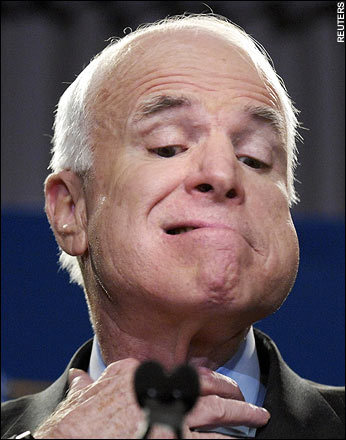
John McCain "the partisan"-even hard for him to swallow!
Arizona Sen. John McCain, trying to fend off a primary challenger trying to outflank him on the right, also found himself trying Sunday to put straight whether he was a “maverick” or not.
McCain’s “maverick” reputation and his past willingness to work with Democrats on issues like the environment, campaign finance reform and immigration before his run for President in 2008 often frustrated or angered fellow Republicans and he has lately made it appear like it’s a moniker he’d like people to forget.
McCain startled many political observers when he told Newsweek magazine “I never considered myself a maverick” — even as Sarah Palin was describing him that way in a campaign appearance late last month in Arizona for her old running mate.
When he appeared on Fox News Sunday, host Chris Wallace pressed McCain on the point, playing a 2008 campaign ad that called him “the original maverick” and showing McCain saying, ” If you want real reform and if you want change, send a team of mavericks. And what maverick really means, what this team of maverick really means, is we understand who we work for.”
Hayworth labels himself the “consistent conservative” on his campaign web site and he has had fun poking McCain over the “maverick” quote. Hayworth told the Politico, “To the extent that he can encourage amnesia in the electorate, that’s what he’s aiming to do.”
A Rasmussen Reports poll conducted April 13 showed that Hayworth had pulled within 5 points of McCain, with McCain leading him 47 percent to 42 percent among likely Republican voters. The margin of error was 4 points. The primary is August 24.
By: Bruce Drake, Contributing Editor-Politics Daily, April 18, 2010
In Search of Plan “C” for Health Care Reform?….Stick With Plan “A”
The Washington Post has an editorial this morning that doesn’t exactly oppose the President’s health reform proposals, but gives the President a rap on the knuckles for not being more aggressive controlling costs. They are particularly aggrieved that the President proposes to delay the implementation of the “Cadillac tax” on high-cost health plans to 2018.
“Count us among the worriers. The tax is key for two reasons. It would raise revenue needed to pay subsidies to the currently uninsured; Mr. Obama chose the politically easier option of extending the Medicare tax to unearned income of the wealthy, thus making it more difficult down the road to prevent Medicare from going bankrupt. And, by discouraging expensive plans, such a tax would be the single most effective tool to reduce the cost growth that threatens the nation’s well-being”.
This editorial is one of the more exasperating documents to appear during health reform.
I happen to favor the “Cadillac tax,” though I wish it were more explicitly limited to affluent taxpayers. This is a sensitive issue. Workers have made wage concessions to expand or to preserve generous health benefits that might be affected by the new policy. I see nothing inherently wrong with giving unions and firms more time to adjust collective bargaining agreements in light of new tax policies.
Especially perverse is the Post’s criticism of proposals to raise Medicare taxes on the wealthy. Viewed outside the context of health reform, this provision provides one needed corrective to the regressive tax cuts enacted during the Bush years. The idea that it is simple political expediency to raise taxes on capital income of the wealthy comes as a great surprise to anyone who has followed American tax policy over (say) the past 30 years. Three other issues are especially irksome in the Post’s editorial.
First, President Obama proposes many features designed to reduce the level and growth of medical spending. He has gotten little political credit for these complex and controversial measures, but they are there.
Insurance exchanges will reduce administrative and marketing costs in the markets for individual and small-group coverage. This idea enjoys wide Democratic and Republican support. The President would reduce significant overpayments to Medicare advantage plans. He supports bundled payment models and other innovations designed to improve quality and cost-effectiveness of care. He supports greater use of comparative effectiveness research to provide an evidence-base for improved resource allocation decisions.
Over considerable opposition from within his own party, the President supports an Independent Medicare Advisory Board modeled after the commission that recommends military base closings. The Congressional Budget Office gave the President little credit for this in the scoring numbers. Yet this change could have a potentially revolutionary impact on Medicare policy–which is exactly why so many pharmaceutical and medical device manufacturers, many medical specialties, and many elected politicians are unhappy with this measure.
Some of these measures are buried in the fine print. Others were included despite deep opposition from self-avowed fiscal conservatives whose concern for the federal budget precisely stops at the boundaries of their own states or their own favored constituencies. (The most powerful cost-control measure, a strong public option, was brought down by Republicans, insurers, and virtually the entire supply-side of the medical economy, but that is another story.)
These obvious realities underscore the second reason why the Post’s argument is so irksome. Although the House and Senate bills include many specific elements favored by (for example) officials in the last Bush administration, Republicans have made a basic strategic decision to filibuster and to vote in lockstep against the signature policy initiative of the Obama Presidency.
As a result, President Obama needed to corral every single Democratic vote to pass the signature measure of his presidency. The President was willing to deal on tort reform and other difficult matters. Although the gang of six talked interminably, no Republicans were willing to deal.
Proposed piecemeal, the cost-control measures already contained in the President’s proposal would command little public or interest-group support. These measures would command little enthusiasm from a Congress freed from the fiscal constraints required to pass a comprehensive bill that simultaneously provides critical benefits to millions of people.
The Post seems oblivious to the fact that defeat of the President’s comprehensive reform would damage any future cost-control effort. Interest groups that oppose specific measures–certainly including the “Cadillac tax” –would cite this defeat in discouraging politicians from supporting similar efforts. They would cite the success of crudely demagogic “death panel” rhetoric to deter serious measures to improve the quality and economy of Medicare services.
Progressive politicians desperate to help millions of uninsured people would learn from this episode that the smart move is to propose a politically attractive package of benefits without offsetting spending reductions or taxes to pay for it. I would hardly blame them.
Then there is the third reason. The Post writes: “We think that it is not asking too much, given the dire fiscal straits, for Washington to show that it can swallow distasteful medicine while, and not after, it passes out the candy.”
No candy is being distributed here. The bill whose survival is at stake is not some pork-barrel agriculture or weapons bill. After decades of failure, this bill would provide critical protection for 50 million uninsured people. It would help millions of others facing medical bankruptcy because they are underinsured or because they have serious illnesses leading them to exceed lifetime insurance caps that would be immediately ended under the President’s proposal.
This very morning, our local Catholic church presented an appeal from a family whose infant son was diagnosed with Hemophagocytic Lymphohistiocytosis, a rare and deadly disease. As the costs of his care approach $1 million, the family has established a website appealing for help. They have no plan B. There is no plan B for states, either, which desperately need this bill to avoid even more dire fiscal difficulties than are projected for the federal government.
The President has spent the past year, and has risked much of his presidency, to address these critical needs. After this bill is passed, he and the Congress should pursue further serious cost-containment efforts. The current bill provides the best platform to do this.
There is a moral urgency to passing this bill. The President, House and Senate leaders might have done more to cut costs if they had even secured one or two moderate Republican votes. They had to cut some messy deals to get this done. There were good reasons to do so. Against heavy odds and several decades of failed efforts, President Obama and his allies are close to getting this done. By fetishing a single imperfect aspect of the President’s proposal, the Post mischaracterizes the policy dilemma. The Post also misses the magnitude of what is at stake.
By: Harold Pollack- the Helen Ross Professor of Social Service Administration at the University of Chicago and a Special Correspondent for The Treatment-The New Republic, March 7, 2010
Share This Blog


 Unknown Feed
- An error has occurred; the feed is probably down. Try again later.
 mykeystrokes.com
You must be logged in to post a comment.