The Republican Threat To Voting
Less than a year before the 2012 presidential voting begins, Republican legislatures and governors across the country are rewriting voting laws to make it much harder for the young, the poor and African-Americans — groups that typically vote Democratic — to cast a ballot.
Spreading fear of a nonexistent flood of voter fraud, they are demanding that citizens be required to show a government-issued identification before they are allowed to vote. Republicans have been pushing these changes for years, but now more than two-thirds of the states have adopted or are considering such laws. The Advancement Project, an advocacy group of civil rights lawyers, correctly describes the push as “the largest legislative effort to scale back voting rights in a century.”
Anyone who has stood on the long lines at a motor vehicle office knows that it isn’t easy to get such documents. For working people, it could mean giving up a day’s wages.
A survey by the Brennan Center for Justice at New York University School of Law found that 11 percent of citizens, 21 million people, do not have a current photo ID. That fraction increases to 15 percent of low-income voting-age citizens, 18 percent of young eligible voters and 25 percent of black eligible voters. Those demographic groups tend to vote Democratic, and Republicans are imposing requirements that they know many will be unable to meet.
Kansas’ new law was drafted by its secretary of state, Kris Kobach, who also wrote Arizona’s anti-immigrant law. Voters will be required to show a photo ID at the polls. Before they can register, Kansans will have to produce a proof of citizenship, such as a birth certificate.
Tough luck if you don’t happen to have one in your pocket when you’re at the county fair and you pass the voter registration booth. Or when the League of Women Voters brings its High School Registration Project to your school cafeteria. Or when you show up at your dorm at the University of Kansas without your birth certificate. Sorry, you won’t be voting in Lawrence, and probably not at all.
That’s fine with Gov. Sam Brownback, who said he signed the bill because it’s necessary to “ensure the sanctity of the vote.” Actually, Kansas has had only one prosecution for voter fraud in the last six years. But because of that vast threat to Kansas democracy, an estimated 620,000 Kansas residents who lack a government ID now stand to lose their right to vote.
Eight states already had photo ID laws. Now more than 30 other states are joining the bandwagon of disenfranchisement, as Republicans outdo each other to propose bills with new voting barriers. The Wisconsin bill refuses to recognize college photo ID cards, even if they are issued by a state university, thus cutting off many students at the University of Wisconsin and other campuses. The Texas bill, so vital that Gov. Rick Perry declared it emergency legislation, would also reject student IDs, but would allow anyone with a handgun license to vote.
A Florida bill would curtail early voting periods, which have proved popular and brought in new voters, and would limit address changes at the polls. “I’m going to call this bill for what it is, good-old-fashioned voter suppression,” Ben Wilcox of the League of Women Voters told The Florida Times-Union.
Many of these bills were inspired by the American Legislative Exchange Council, a business-backed conservative group, which has circulated voter ID proposals in scores of state legislatures. The Supreme Court, unfortunately, has already upheld Indiana’s voter ID requirement, in a 2008 decision that helped unleash the stampede of new bills. Most of the bills have yet to pass, and many may not meet the various balancing tests required by the Supreme Court. There is still time for voters who care about democracy in their states to speak out against lawmakers who do not.
By: The New York Times, Editorial, April 26, 2011
Insuring The Elderly, Insuring The Poor
Democrats, Republicans and Independents all believe the government is responsible for providing health care to the elderly. Democrats and independents, but not Republicans, believe the government should also provide health care to the poor:

All groups are more likely to favor guaranteed health care for the elderly than for the poor. But the dropoff between the two policies is very different. Democrats by a plus 77% margin favor covering the elderly, but only favor covering the poor by a 52% margin. That’s a 25 percentage point gap between covering the elderly and covering the poor. For independents, the falloff is a very similar 28 percentage points. For Republicans, the falloff is 61 percentage points, from a +15 point margin for covering the elderly to a -46 point margin for covering the poor.
The best way to understand this is by grasping the link between ethnocentrism and support for universal entitlements and both opposition to means-tested entitlements. Ethnocentric attitudes among whites, controlling for all other beliefs, correlate with support for universal programs and with opposition to programs for the poor. White racial conservatives favor programs that benefit people like them — and hey, everybody gets old — and oppose programs for people unlike them — the poor being disproportionately non-white, and even more proportionately so in the white imagination.
How The Right Brought The Trump Birther Madness On Itself
GOP primary voters should reward substance, rather than pols who masterfully exploit hot button issues. So why are so many Republicans embracing Donald Trump? They’ve been trained to elevate politicians based on the “tough” rhetoric they use rather than the record they’ve amassed. And to rally around anyone seen as being disrespected by the dread mainstream media.
The talk radio right bears much of the blame for these pathologies. Caught up in the Tea Party excitement, guys like Mark Levin used their platforms to act as apologists for Republicans like Sarah Palin and Christine O’Donnell. Didn’t they fire up the base? Weren’t they unafraid to zing President Obama? As Donald Trump rises in the polls, however, Levin is having second thoughts. The right is suddenly foolish to embrace demagogues with thin resumes and incoherent political philosophies. For all their differences, folks like Ross Douthat, David Frum, Reihan Salam, David Brooks, Daniel Larison, and many others have long been urging the GOP to pick its champions based on substance. You’ll never hear any of them urge that Donald Trump be taken seriously.
Meanwhile, Sarah Palin is defending Trump. Will Levin call out the woman whose political judgment he has frequently touted? Rush Limbaugh is inviting Trump on his show for softball interviews, and telling callers to his program that the celebrity billionaire ought to be taken “half-seriously.” Having announced that taking Trump at all seriously is idiocy of the highest order, will Levin openly criticize his fellow talk radio host? Or does this bully lack the courage to go after anyone with a bigger audience than his? Remember that the next time he tries to tell you that the reformers embody what’s wrong with the right. Like all bullies, his targets aren’t chosen based on desert.
In failing to call out the people most responsible for the right’s pathologies, Mark Levin is not alone. As Adam Serwer notes:
Trump’s candidacy is largely a problem of the GOP’s own making. It’s a symptom of circumstances Republicans have spent the last two years tacitly cultivating as an asset. Republican leaders have at best refused to tamp down the most outlandish right-wing conspiracy-mongering about the president and at worst have actively enabled it. The result: A substantial portion of their base believes a complete myth about the president’s birth certificate, and Republicans are stuck with a candidate shameless enough to exploit the issue without resorting to the usual euphemisms more respectable Republicans tend to employ when hinting at the president’s supposed cultural otherness. I don’t know how you solve a problem like Donald Trump, but I know it’s a problem the Republican Party brought on itself.
Indeed, half of the Iowa GOP are birthers. It’s so much of a problem that Ann Coulter and Karl Rove are out there assuring everyone that President Obama was in fact born in the United States. In doing so, they frame Birtherism as a trap liberals are setting. They’re implicitly criticizing all the mainstream voices on the right who’ve flirted with Birtherism, but are uninclined to name names, or to come right out and state that what those conservatives did has come back to bite the right.
Some of us have long insisted that the conservative movement was going to pay for its embrace of demagoguery, anti-intellectualism, bombast in place of substance, and shameless pandering. For our trouble, we’ve been dismissed by talk radio hosts and conservative bloggers, who took an ends-justify-the-means approach to the 2010 primaries and opposition to President Obama generally. Lo and behold, the conservative movement is now paying a price, exactly as predicted. The GOP has a weak field for 2012, and although Donald Trump isn’t going to win the nomination, his early status as a front-runner is an unwelcome distraction and may end up pulling other candidates toward the sort of absurd populism that will hurt them in a general election.
Even Mark Levin, Ann Coulter and Karl Rove now see these pathologies on the right, and the dangers they pose. So are they going to criticize the most prominent conservatives who brought these conditions about? Nope. There is never direct intra-movement criticism of Rush Limbaugh or Roger Ailes. There is never any appreciation of the pathologies encouraged by everyone who supported Sarah Palin. Instead we get self-righteous criticism that is too little, too late, and a cowardly refusal to confront the culpable parties in a way that would prevent this sort of thing from happening again.
By: Conor Friedersdorf, The Atlantic, April 21, 2011
GOP Presidential Contenders Compete To Win Over “The Political Army Of The Lord”
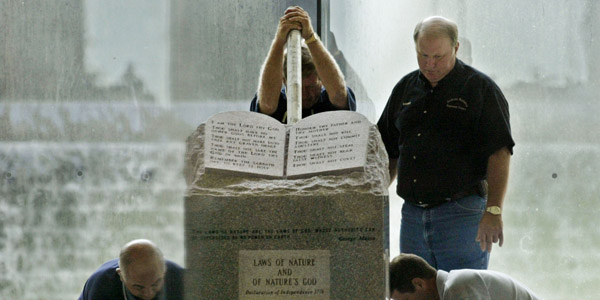
Workers remove a monument of the Ten Commandments from the rotunda of the Alabama Judicial Building after Superior Court Justice Roy Moore refused to take it down in 2003
So you can add another car to the crazy train that is the 2012 Republican presidential nominating contest. No, I’m not talking about last week’s sensation, Donald Trump. He’s a pretty conventional figure compared to the latest would-be president, former Alabama Supreme Court Chief Justice Roy Moore, who is currently barnstorming through Iowa after announcing an exploratory committee.
You may remember Judge Moore as the man who was forced from his judicial post after refusing to remove a gigantic monument to the Ten Commandments from his courthouse. He was also known for abrasive comments from the bench about homosexuality as contrary to God’s will, which in Moore’s opinion was dispositive. A martyr for theocrats everywhere, Moore spent some time hauling his monument around Alabama before launching two notably unsuccessful gubernatorial races — coming in a bad second in 2006’s Republican primary and a bad fourth in 2010 — and becoming a minor fixture at tea party events.
Moore was undoubtedly drawn to Iowa by that state’s furor over same-sex marriage, decreed legal by a 2009 state Supreme Court ruling. Iowa’s powerful Christian Right movement has made overturning that decision Job One, beginning with a successful effort in 2010 to remove three of the seven jurists responsible for it. It’s one of the few places left where Republicans don’t try to ignore the whole issue of gay rights as a divisive loser of an issue (which is why presidential wannabees like Tim Pawlenty have anachronistically come out against the repeal of “don’t ask, don’t tell). For Moore, it must have felt more like “home” than home.
Before writing off Moore as a kook trying to horn in on the spotlight of a presidential race, consider the company he’s keeping on his tour of the first-in-the-nation-caucuses state: former state legislator Danny Carroll. Carroll was co-chairman (with three-time gubernatorial candidate Bob Vander Plaats) of Mike Huckabee’s successful 2008 Caucus campaign, and more recently, signed on as a lobbyist for Vander Plaats’ new Christian Right umbrella group, The Family Leader. He’s a reasonably big deal in Iowa GOP circles, and by no means someone who howls at the moon.
For all I know, Carroll sees something in the crusty Alabama judge that others haven’t seen. Or maybe Judge Moore is a convenient stalking horse for Huckabee, designed to keep The Faithful loose and out of anyone else’s camp, in case Huck ultimately decides to run.
Regardless of Carroll’s (or Moore’s) personal motives, it’s likely the national Republican chattering class will dismiss the Judge’s campaign as a joke even worse than Trump’s. Or, it may be said, there is now such a crowd on the far right that opportunities are opening up for more moderate possibilities like Romney, T-Paw or an establishment-backed candidate-yet-to-be-named.
But I’d like to suggest another theory: the Christian/tea party right in Iowa is big enough, powerful enough, and politically sophisticated enough to hold its own caucus-within-a-caucus (well, caucuses, to be technical about it), an intramural contest to determine which candidate will actually represent the cause when Iowa Republicans make their final commitments before Caucus Night. Proven zealots like Michele Bachmann, Herman Cain, and now Moore, will joust with more suspect supplicants like T-Paw, Newt Gingrich — and maybe even Donald Trump! — over the next few months, with someone emerging as the designated favorite of the political army of the Lord. That is arguably what happened in Iowa in 2008, when Huckabee and Sen. Sam Brownback fought to become the Christian Right alternative to Mitt Romney, with Huckabee becoming The Man only after he out-organized Brownback at the State Party Straw Poll in Ames during the summer.
Moore’s candidacy may not ultimately have any direct influence on what happens next winter in Iowa, when conservative evangelicals and conservative Catholics get together to shape the 2012 Republican nominating process.
But he could indeed intensify the competition for Christian Right voters. And just as importantly, he could definitely serve as a symbol of the ideological and psychological gap between rigorous conservative activists and the mainstream political commentariat. Most of the latter think Moore is a crazy person. But most of the Iowa audiences before which Moore speaks will consider him an authentic if polarizing voice expressing the Word of God. That’s a pretty big gulf in perception, but also a pretty good reflection of the real differences Americans experience in how they view their leaders.
By: Ed Kilgore, Managing Editor of The Democratic Strategist and Senior Editor, Progressive Policy Institute. Article published in The Atlantic, April 20, 2011: Photo by Tami Chappell (Reuters)
Share This Blog


 Unknown Feed
- An error has occurred; the feed is probably down. Try again later.
 mykeystrokes.com
You must be logged in to post a comment.