Few Heard At Wisconsin Budget “Hearing” In Milwaukee, But School Choice Advocate Denounces Walker’s Subsidy For Rich
At Monday’s public hearing in Milwaukee on Governor Walker’s budget, Wisconsin Republicans once again resorted to anti-participatory tactics to avoid criticism of their far-right agenda. Despite these efforts, strong criticisms were squeezed-in by longtime Milwaukee school choice advocate Howard Fuller, calling GOP efforts to lift income limits on school vouchers an “outrageous” program “that subsidizes rich people.”
Republicans Regulate Milwaukee Hearing
Milwaukee’s hearing at State Fair Park was the third of four statewide sessions on Walker’s proposed budget by the Republican-controlled Joint Finance Committee, and controversy arose well before the hearing began. According to the Milwaukee Journal-Sentinel, two of Milwaukee’s congresswomen, Rep. Tamara Grigsby and Sen. Lena Taylor, were concerned that many working people would be excluded because the hearing was scheduled to end at 6pm. The two arranged to hold informal sessions until 9pm to allow people to voice their opinion, then notified Joint Finance co-chairs Rep. Robin Vos (R-Burlington) and Sen. Alberta Darling (R- River Falls) about their plans.
Sen. Darling reportedly approved the Grigsby-Taylor informal hearing and Rep. Vos “said he would think about it.” However, Taylor soon received notice from State Fair Park that Vos had reserved the facility until midnight, meaning the Dems’ hearing could not take place, and Milwaukee’s working population could not have their voices heard.
According to Taylor, “This isn’t open government. This is not democracy. This is shameful.”
Beer City Blockage the Latest in a Series
Vos and Darling were unabashed about their intention to suppress opposition, with Darling telling the Journal-Sentinel “we had to take precautions so that what happened at the Capitol wouldn’t happen at State Fair Park.”
“The hearings are going to be done when we say they’re done,” Vos said.
This is only the latest in a series of Wisconsin GOP efforts to limit scrutiny and stifle dissent. On February 11, Governor Walker sought to limit deliberation on his budget repair bill by introducing it on a Friday and ordering a vote on a Tuesday (Senate Democrats thwarted these plans by leaving the state). The Walker Administration violated the constitutionally-guaranteed right of public access to the state capitol in late February, and a judge ordered it re-opened; the administration violated that order in March and a hearing on that violation is pending. On March 11, Republicans forced the union-busting budget repair bill through the Senate with minimal notice, breaking state Open Meetings laws and possibly violating the constitution’s public access guarantees.
Hearing Limits Input from Milwaukee’s Particularly-Affected Populations of Color
This latest step towards suppression is especially egregious considering Milwaukee is not only the state’s largest city, but has the most people of color, a population that will be particularly affected by Walker’s budget and budget repair bill. The plans eliminate funding for a new program to track and remedy racial profiling (the first step towards confronting Wisconsin’s atrocious record of racial disparities in incarceration); will limit eligibility for medical assistance; kicks legal immigrants off food assistance; and eliminates funding for a program that provided civil legal services to low income residents. Walker is also expected to cut $300 million from Milwaukee Public Schools (MPS), severely limiting education quality for the district teaching the greatest number of students (and students of color) in the state.
With Republican legislators keeping the Milwaukee hearing short, only speakers who signed up before 12:30pm had their voices heard. Hundreds of people were denied the ability to speak, and as the hearing ended at 6:30pm, there were shouts of “let us speak” and the now-familiar “shame” directed at those lawmakers.
Howard Fuller Heard on Education
While many Milwaukee residents were not heard on Monday, at least one prominent voice spoke strongly against Walker’s plans for Milwaukee schools.
In addition to cutting $300 million from Milwaukee’s public schools (and eliminating teacher’s unions), Walker’s budget reinforces existing inequalities by expanding the “school choice” program, which allows students to opt-out of public schools and use a taxpayer-funded voucher for private school tuition. The voucher program has been criticized not only because it directs money away from public schools, but because private schools can pick-and-choose their students, often selecting those who come from an advantaged background and leaving the rest to suffer in under-funded public schools.
Milwaukee became the country’s first publicly-funded school voucher program in 1990, and it grew under the tenure of MPS Superintendent Howard Fuller. He currently directs an institute at Marquette University that authorizes schools trying to get into Milwaukee’s choice program. Howard has collaborated with Republican lawmakers in the past, many of whom support so-called “school choice” out of belief in free market principles of competition and privatization. While many on the left fear defunding public education, some urban advocates like Fuller have supported vouchers to give promising low-income students a better chance at long-term success by providing education options that would not otherwise be available.
But Fuller, who is now regarded as the nation’s most influential African-American spokesman for “school choice,” strongly criticized Walker’s plans to remove income eligibility caps for the private school voucher program. “Please don’t make it true that you were using the poor just to eventually make this available to the rich,” Fuller said. “If [lifting income eligibility] is done, I will become an opponent of this.”
“I never got into this to give someone like me $6,500 to send their kid to Marquette High School (tuition $15,000 per year). . . This is where I get off the train, I’m not going to go anywhere in America and fight for a program that subsidizes rich people.”
By: Brenda Fischer, Center for Media and Democracy, April 12, 2011
When Opposition to Health-Care Reform Stops Being Polite and Starts Getting Scary
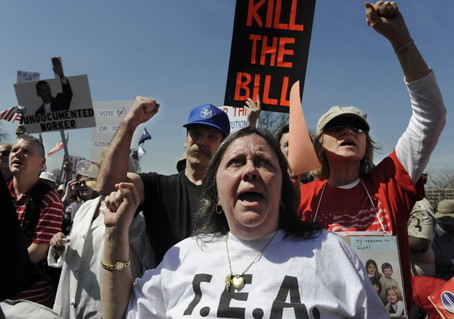
When do you cross the line?
In the Wyoming state legislature, 10 congressmen and three senators have co-sponsored “The Health Care Choice and Protection Act.” The intent? To make it a felony to implement the health-care reform law — which is, you’ll remember, the official law of the land. Here’s the relevant bit:
Enforcement of federal laws prohibited; offenses and penalties.
Any official, agent, employee or public servant of the state of Wyoming as defined in W.S. 6-5-101, who enforces or attempts to enforce an act, order, law, statute, rule or regulation of the government of the United States in violation of this article shall be guilty of a felony punishable by a fine of not more than five thousand dollars ($5,000.00), imprisonment in the county jail for not more than two (2) years, or both.
Any official, agent or employee of the United States government or any employee of a corporation providing services to the United States government that enforces or attempts to enforce an act, order, law, statute, rule or regulation of the government of the United States in violation of this article shall be guilty of a felony punishable by imprisonment for not more than five (5) years, a fine of not more than five thousand dollars ($5,000.00), or both.
There’s not much use in worrying about something like this as it wouldn’t survive two seconds in a court of law. But the sentiments are worth considering: The argument is that this legislation isn’t just policy that the authors disagree with, but rather a deeply, profoundly, un-American threat to liberty. It’s so un-American, in fact, that a plain reading of the Constitution makes clear that the Wyoming legislature, which has sworn to protect and defend the document, must “adopt and enact any and all measures as may be necessary within the borders of Wyoming to prevent the enforcement of the Patient Protection and Affordable Care Act and the Health Care and Education Reconciliation Act of 2010.”
Many of my friends on the right have legitimate technocratic differences with the Affordable Care Act. But many of the politicians they’ve stood with have not made a legitimate case against the bill. Rather, they’ve taken a bill that echoes past legislation Republicans have introduced and called it, as Sen. Jon Kyl did, “a stunning threat to liberty.” They’ve told their supporters, as Sen, Chuck Grassley did, that they’re right to fear that the health-care bill “determines if you’re going to pull the plug on grandma.” This is not merely legislation that they have some technical or philosophical disagreements with. It is, in the words of Speaker John Boehner, “a monstrosity.”
Given the extremism of the rhetoric at the top, is it any wonder that there is incredible fear trickling down to the grass roots? If those are the stakes, then of course criminalizing any implementation of the bill makes sense. Frankly, if those are the stakes, then violent resistance might be required.
Those aren’t the stakes, of course. They’re just the words. And words slip sometimes. Things come out too angry, or too quickly, or too sharply. I’ve had my share of experience with this. But words matter. And the Republican Party hasn’t been slipping up: It’s been engaged in a concerted campaign to scare the population into opposing health-care reform. That may be good politics, but it can have bad consequences.
By: Ezra Klein-Washington Post-January 7, 2011: Photo By: Melina Mara-Washington Post
Different Congress, Same Crap: Get Ready for a GOP Rerun
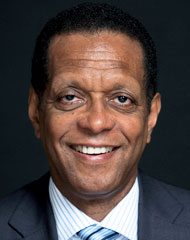
Bob Herbert-Op Ed Columnist, NYT
In any event, the G.O.P. has taken its place once again as the House majority and is vowing to do what it does best, which is make somebody miserable — in this case, President Obama. Representative Darrell Issa, the California Republican who is now chairman of the Oversight and Government Reform Committee, said recently on the Rush Limbaugh program that Mr. Obama was “one of the most corrupt presidents in modern times.” He backed off a little on Sunday, saying that what he really thinks is that Mr. Obama is presiding over “one of the most corrupt administrations.”
This is the attitude of a man who has the power of subpoena and plans to conduct hundreds of hearings into the administration’s activities.
The mantra for Mr. Issa and the rest of the newly empowered Republicans in the House, including the new Budget Committee chairman, Paul Ryan of Wisconsin, is to cut spending and shrink government. But what’s really coming are patented G.O.P. efforts to spread misery beyond Mr. Obama and the Democrats to ordinary Americans struggling in what are still very difficult times.
It was ever thus. The fundamental mission of the G.O.P. is to shovel ever more money to those who are already rich. That’s why you got all that disgracefully phony rhetoric from Republicans about attacking budget deficits and embracing austerity while at the same time they were fighting like mad people to pile up the better part of a trillion dollars in new debt by extending the Bush tax cuts.
This is a party that has mastered the art of taking from the poor and the middle class and giving to the rich. We should at least be clear about this and stop being repeatedly hoodwinked — like Charlie Brown trying to kick Lucy’s football — by G.O.P. claims of fiscal responsibility.
There’s a reason the G.O.P. reveres Ronald Reagan and it’s not because of his fiscal probity. As Garry Wills wrote in “Reagan’s America”:
“Reagan nearly tripled the deficit in his eight years, and never made a realistic proposal for cutting it. As the biographer Lou Cannon noted, it was unfair for critics to say that Reagan was trying to balance the budget on the backs of the poor, since ‘he never seriously attempted to balance the budget at all.’ ”
We’ll see and hear a lot of populist foolishness from the Republicans as 2011 and 2012 unfold, but their underlying motivation is always the same. They are about making the rich richer. Thus it was not at all surprising to read on Politico that the new head of the House Energy and Commerce Committee, Fred Upton of Michigan, had hired a former big-time lobbyist for the hospital and pharmaceuticals industries to oversee health care issues.
I remember President Bush going on television in September 2008, looking almost dazed as he said to the American people, “Our entire economy is in danger.”
Have we forgotten already who put us in such grave peril? Republicans benefit from the fact that memories are short and statutes of limitations shorter. It was the Republican leader in the House, Tom DeLay, who insisted against all reason and all the evidence of history that “nothing is more important in the face of war than cutting taxes.”
But that’s all water under the bridge. The Republicans are back in control of the House, ready to run interference for the rich as recklessly and belligerently as ever.
By: BOB HERBERT-Op-Ed Columnist, New York Times-Published January 3, 2011
Voters Are About to be Disillusioned With the GOP

The Puppet Master and his Minions
But going forward, now that they control the House and aspire to gain control of the Senate and the executive branch in the next election, Republicans will be forced to work for an actual agenda. And as Paul Waldman nicely explains in The American Prospect, this can produce a great pivot in the political climate of the country, very fast:
As a long history of public-opinion research has made clear — and as events continue to remind us — Americans are “symbolic conservatives” but “operational liberals.” In other words, they like the idea of limited government, but they also like just about everything government does. Good things happen to the party that can successfully pander to both impulses, which is why we saw so many ads from Republicans…condemning Democrats for passing a big-government health-care plan because it would … curtail the growth of Medicare.Perhaps they’re just being cautious as they get used to their new majority, but in the last week, Republicans have steadfastly refused to say what their professed desire to limit government would actually entail. Press them hard on what they want to cut, and they’ll answer “earmarks,” which would be fine were it not for the fact that a) earmarks do not appropriate new money; they merely direct money that has already been appropriated, and b) the value of all earmarks amounts to less than 1 percent of the federal budget….
If there’s one thing Republicans have been clear about, it’s their desire to repeal the Affordable Care Act. Even here, though, they don’t want to get too specific. As you’ve no doubt heard many times, a bare majority of the public opposes “health-care reform” (or “Obamacare”), while substantial majorities favor almost all the major provisions of the law. Once again, Republicans can win the vague, general argument but not the specific one. Faced with the impossibility of repealing the entire act (which Obama would veto), Republicans have said they’ll try to dismantle it piece by piece. Try that, however, and they’re suddenly attacking not “health-care reform” but those particular things people like.
That isn’t to say Republicans will inevitably be punished for attempting to repeal the ACA. Pushing repeal will only be dangerous for them if Democrats make it so. Republicans will suffer if they’re attacked aggressively for wanting to reopen the Medicare prescription-drug “doughnut hole,” for wanting to kick young people off their parents’ insurance, or for wanting to give the insurance companies the ability to deny coverage to children with pre-existing conditions. Those are all provisions of the ACA that have already gone into effect. The Democrats are hardly guaranteed to win the battle of ACA, but they have a shot if they make the right arguments.
Waldman goes on to note that House Republicans will have to write a budget resolution, and moreover, are virtually promising a budget showdown with the president, probably forcing a shutdown of the federal government. There’s no particular reason to assume that tactic will fare any better than it did when Newt Gingrich tried it back in the ’90s. But that scenario, too, will force Republicans–and attentive voters generally–to make some sheep-and-goat distinctions between government programs and services that are essential and those that are not. It’s when those two judgments begin to diverge, as they undoubtedly will, that the GOP will begin to pay a high price for consciously promising an austerity budget that somehow won’t upset their own voters. Campaigning on a Big Lie–Big Government is a terrible threat to your liberties and your pocketbook, but Big Government doesn’t involve anything that you care about, dear voter–can cause a real boomerang when the lies have to be turned into an agenda.
BY: Ed Kilgore, The New Republic, November 11, 2010
Share This Blog


 Unknown Feed
- An error has occurred; the feed is probably down. Try again later.
 mykeystrokes.com
You must be logged in to post a comment.