In This Fantasy Budget Deficit And Debt Fight, the Tea Party Refuses To Take ‘Yes’ For An Answer
Suppose I told you that I knew of a simple way to alleviate the budget deficit problem, and that it would require Congress not to do anything at all. You’d conclude that this was the poor start to a late April Fools’ column.
But unhappily the April Fools’ joke unfolding in the nation’s capital is the fantasy budget and spending debate itself. It’s rooted in an unreality that is about to crash into an unyielding real world, possibly in the form of a government shutdown.
The Congressional Budget Office, a nonpartisan fiscal scorekeeper, projects the budget deficit will be $1.5 trillion this year, or 9.8 percent of gross domestic product. In order to achieve budget stability and sustainability, according to economists, that figure should be around 3 percent of GDP. But here’s the good news: The CBO projects that the deficit will “drop markedly over the next few years as a share of output and average 3.1 percent of GDP from 2014 to 2021.” We’re saved! And it gets better: “Those projections . . . are based on the assumption that tax and spending policies unfold as specified in current law.”
In other words, all Congress has to do is what they seem ideally suited to these days—nothing. Ah, but there’s the rub. CBO continues that its projections “understate the budget deficits that would occur if many policies currently in place were continued, rather than allowed to expire as scheduled under current law.” Those policies include the Bush tax cuts. They also include annual spending punts that enjoy broad bipartisan support, like preventing the Alternative Minimum Tax’s bracket creep from snagging the middle class, and the “doc fix,” which pushes back a scheduled cut in Medicare payments.
So the solution isn’t so simple. But lawmakers wishing to do more than talk about dealing with the deficit could demand offsets for these policy changes. Instead, we’re reminded of the reality that even the toughest self-styled budget hawks–including Budget Committee Chairman Paul Ryan, who describes dealing with the deficit as a “moral imperative” but advocates extending the Bush tax cuts in full in perpetuity at a cost of nearly $4 trillion–are actually strutting budget peacocks more concerned with perception than results, or fiscal results anyway.
Take, for example, the Republican Study Committee, the hawkiest of the GOP budgetary birds of prey and enforcers of the party’s economic dogma. Going by reputation, they should be able to proffer a budget plan to bring the deficit into line. But the Concord Coalition, a group focused on eliminating the deficit, last month used CBO numbers to examine a scenario under which the Study Committee got its tax-and-spending wish list, which includes an extension of the Bush tax cuts, repeal of the Obama healthcare law (which CBO scores as a money-saver, meaning that repeal adds to the deficit), and $2.7 trillion saved in a spending freeze and cuts. The result? “Under this scenario, the resulting deficits would be $2.1 trillion larger over 10 years,” according to Concord, which concludes, “A budget that uses honest numbers and reflects Republicans’ current policy preferences will result in large continuing deficits.”
But nevertheless, and in the face of six recent years of GOP control over both the White House and Congress, Republicans have won the budget perception battle, and soundly. A poll released last week by Democracy Corps, a group of prominent liberal pollsters including Stan Greenberg and James Carville, found that independent voters are “still hesitant to trust Democrats on spending.”
Meanwhile the debate in Washington has focused almost entirely on spending cuts, even though polls show that voters are more concerned about jobs and the economy than the budget and the deficit—and even though most economists agree that the GOP’s proposed spending cuts would set back the recovery.
But the clearest example of the GOP having the Democrats on the run can be found in the current negotiations aimed at averting a government shutdown in a week. House Republican leaders originally wanted $32 billion in spending cuts for this year; that figure prompted a conservative backlash that ended with the House passing $61 billion in cuts. Now, according to press reports, negotiators have settled on $33 billion in cuts. In other words, the GOP, which controls one of three players in this negotiation, has already achieved its original budgetary goal. In this regard, House Speaker John Boehner seems to have (intentionally or not) used his Tea Party wing as a perfect foil to pull the debate to the right.
But judging by last Thursday’s Tea Party demonstration on the Hill—aimed at the GOP, mind you—conservatives don’t seem capable of banking their win and moving on to the next fight. They see anything less than total victory as an abject surrender.
And in that sense reality is about to intrude upon their budgetary-political fantasy land. The reality is that while voters like spending cuts in the abstract, polls show they object to the particulars of the GOP agenda. That reality is already taking hold at the state level where, Politico reported last week, the wave of newly elected governors trying to get tough on budgets have seen their approval ratings collapse.
And the experience of state governments also provides an insight into the possible winners and losers in a government shutdown. A pair of political scientists published a paper last year looking at the effects of such budgetary breakdowns (167 of them since 1988) at the state level, reports the Washington Post’s Ezra Klein. The study found that voters tend to punish legislators while rewarding the executive. So a shutdown would benefit President Obama while hurting lawmakers in both parties.
So if members of Congress let the government shut down on Friday, they will be the real April fools.
By: Robert Schlesinger, U.S. News and World Report, April 6, 2011
Mad Men and Mad Women: Republicans And Social Engineering
Republicans hate social engineering, unless they’re doing it.
Wishing they had the power to repeal the repeal of “don’t ask, don’t tell” and get back to the repressed “Mad Men” world they crave, some conservative lawmakers grumpily quizzed upbeat military brass on Friday.
“We’re starting to try to conform the military to a behavior, and I remember going through the military, we took behaviors and we formed it to the military,” said Representative Allen West of Florida, warning ominously (and weirdly) that “this could be the camel getting his nose under the tent.”
The House Armed Services subcommittee hearing was led by Joe Wilson, the oh-so-subtle Republican congressman from South Carolina famous for yelling “You lie!” at President Obama. Wilson started off the hearing by saying that the legislation to let gays stop lying while they risk dying was rushed through in an “undemocratic” lame-duck session.
Two top Pentagon officials testified that the transition was going swimmingly, yet Republicans scoffed. Representative Austin Scott of Georgia demanded the price tag. Clifford Stanley, an under secretary of defense, replied that the training materials cost only $10,000.
Scott harrumphed, “If something was done at D.O.D. for $10,000, I would like to know what it was.” He said that hundreds of thousands had been spent training a soldier in his district to disarm I.E.D.’s, but the soldier wouldn’t re-enlist because of the “social policy.”
The Democrat Chellie Pingree of Maine jumped in to note that the cost of purging gays between 2004 and 2009 was $193.3 million: “It’s not only unconscionable … but the costs are horrendous.”
Scott persisted in looking for trouble, even after Vice Adm. William Gortney, director of the joint staff, said the Pentagon had seen no problems so far.
The congressman asked the admiral if he had ever dismissed anyone. Gortney said he had dismissed a young sailor who acknowledged being gay after “don’t ask, don’t tell” first passed.
“Did you discharge him from the service because he was gay?” Scott asked. “Or because he violated the standard of conduct?”
“Because he was gay,” Gortney said.
“He did not violate the standard of conduct before he was dismissed?” Scott pressed.
“He did not,” Gortney said.
“Well,” Scott said, once more at a loss, “that’s not the answer I thought you would give, to be honest with you.”
Gortney assured him there were “very few cases” of gays’ being dismissed for violating the standard of conduct.
After the Republican rout in November, the story line took hold that because of the recession and Tea Partiers’ fervent focus on the debt as a moral matter, divisive social issues were going on the back burner. But lo and behold, social issues have roared back. Many in the Tea Party have joined that chain-smoking, cocktail-quaffing Mad Man John Boehner in the martini party to put a retro focus on wedge issues, from gays to abortion.
Like Boehner, who complained that Democratic leaders were “snuffing out the America that I grew up in,” some Tea Partiers are jumping in a time machine. They can’t stop themselves from linking social issues to the budget.
“This pulls the mask back a little bit on the Tea Party movement,” said Representative Chris Van Hollen, a Democrat from Maryland. “Adding riders against Planned Parenthood and gutting the environmental laws indicate that the Tea Party is focused on imposing a right-wing ideological agenda on the country and using the budget as a vehicle.”
Whether it’s upholding the Defense of Marriage Act, trying to defund Planned Parenthood, or aiming cuts at the Environmental Protection Agency, the National Endowment for the Arts, NPR and even AARP, House Republicans are in a lather that occludes their pledges to monomaniacally work on the economy.
When Mitch Daniels, the Indiana governor and Republican presidential aspirant, dared to urge his party to “mute” social issues, he was smacked.
“We cannot repair the economy without addressing the deep cultural issues that are tearing apart the family and society,” said Andy Blom of the American Principles Project. The presidential hopeful Rick Santorum even posited last week that abortions might be breaking the bank on Social Security.
The snowball of social rage will speed up as we head toward 2012, given that the Iowa caucuses are dominated by social conservatives. Pawlenty, Barbour and Huckabee have already talked about vitiating the repeal of “don’t ask, don’t tell.”
Because independent voters considered President Obama too partisan in his debut, they shifted their loyalties — and swept in one of the most ideological and partisan Republican caucuses in history. Now Obama will get back some of the independents because he seems reasonable by comparison.
One thing independents like to be independent of is government meddling in their personal lives.
By: Maureen Dowd, Op-Ed Columnist, The New York Times, April 2, 2011
Stop The World, I Want To Get Off: Boehner Agonistes
Suzy Khimm on the dilemma facing House Speaker John Boehner:
The House passed yet another short-term extension of the budget on Tuesday. But John Boehner faced a revolt by 54 Republicans who voted against the bill for not going far enough to slash spending, effectively forcing the GOP Speaker to rely on Democratic votes for the stop-gap measure to pass. As Talking Points Memo’s Brian Beutler explains, the vote now puts Boehner between a rock and a hard place: either he makes concessions to Democrats to pass a final budget, risking provoking greater fury from the tea party right, or he gives in to the GOP’s right flank—risking a government shutdown, as the Democratic Senate is unlikely to pass any bill that guts spending to satisfy hard-line conservatives.
I think Boehner’s problem here is pretty obvious, so there’s no point in belaboring it. The more interesting question is: which way does he jump?
My guess is that he sides with the tea partiers and forces a government shutdown. I don’t have any special insight here, just a feeling that, in the end, the hardcore right holds the whip hand in the Republican Party these days. If this is correct, though, it leads to a second question: how does this end? Obviously Republicans can’t keep the government shut down forever, and eventually this means that Obama will win some kind of compromise and it will get passed by a coalition of Democrats and moderate Republicans. The tea partiers will lose.
Given that this almost has to be the case, wouldn’t it make more sense for Boehner to compromise in the first place and avoid the humiliation of giving in down the road? In a rational world, sure. But in the tea party universe, he can’t. The forces working here will force Boehner into the worst of both worlds: he won’t assert control over the tea party faction from the start, which is bad, and then he’ll end up caving in to Democrats a few weeks or months down the road, which is worse.
But maybe I’m missing something here. Is there some other scenario for Boehner that works out better for him?
By: Kevin Drum, Mother Jones, March 16, 2011
Republican Budget Cuts Will Come Back to Bite Them
Something about the Republican dance with populism these days reminds me of one of those classic Twilight Zone episodes: Aliens come down to earth. They want to help us! (They even have a book called To Serve Man!) Wait a minute … they want to eat us! (It’s a cookbook.) From there things take a decidedly downward turn.
One suspects that Republicans may be in for a similarly demoralizing experience. Here’s why:
When NPR asked Sen. Jim DeMint this week why Republicans were pressing to reduce Social Security benefits (a subject that had long been considered off limits for politicians interested in re-election), he answered, “It is politically dangerous, but I think the mood of the country is different than it has been [at] any time in my lifetime.” The “mood” he’s talking about is the so-called “new populism,” the voter anger expressed everywhere from Tea Party rallies to voting booths in 2010.
When you think of traditional populism, it evokes images of regular people rising up against a remote, usually corporate, elite that’s run roughshod over their rights. Farmers and working people taking on runaway industrialists and robber barons. Traditionally, Democrats have been most receptive to these kinds of appeals. In response, they’ve pushed government to enact programs aimed at protecting those most vulnerable to the predations of more powerful interests.
For the new populists, government is the remote elite. Instead of unsafe working conditions or unfair lending practices, they’re protesting the ills of government spending and overreach, the wasting of taxpayer dollars. And if their efforts undo the kinds of programs that a more traditional brand of populism might embrace—those aimed at helping the less advantaged make their way—so be it. It’s populism Republican style. And Republicans look like they’re going to ride it for all its worth.
But what happens when you start cutting programs that are in and of themselves something of a check on potential populist anger? That’s one way to look at government programs: There’s a need that’s not being addressed, and rather than let it ferment, government, however clumsily, tries to fill the gap. Sometimes the proposed gap filler is ridiculous (Rep. Dennis Kucinich’s “Department of Peace” springs to mind). Other times, it becomes part of the very fabric of our country.
Take public schooling. Public schools reflect a societal judgment that children should have a chance to succeed without regards to wealth or socioeconomic background. To help get them there, we don’t give every kid a million dollars and say “have at it,” we offer them a tuition-free classroom with a curriculum designed to put them on an equal footing with everyone else when they enter the workforce. What they do from there is up to them.
It doesn’t always work out, of course. Some schools are better than others. So are some teachers. But wherever our various debates about education reform end up, public schools reflect a deeply held American value: that there are some public goods (like an educated workforce) that we, as a society, believe are worth individual (taxpayer) costs. That seems to have become lost in the current debate.
Take another look at what’s underway in Wisconsin. A centerpiece of Gov. Scott Walker’s budget is a $1 billion cut in education funding. That’s a big number that may sound appealing to people worked up about government spending today, but in September when they send their kids to schools with classroom sizes twice as big as a year before, they may begin to remember why they thought it was a good idea to fund education in the first place. Presto! New populists transformed into traditional populists. Only now their target has shifted from Democrats to Republicans. And you can imagine the same phenomenon playing out across a whole host of issues, from Social Security to shared revenue.
Republicans may have momentum on their side at the moment, but there’s a long way to go in the various budget battles playing out across the country. To be sure, Democrats can overplay their hand, too, by opposing any kind of spending restraint.
But one way or the other, populism is sure to play a role in determining how it all turns out. Which strain of populism wins? For Republicans, the answer is kind of like the difference between To Serve Man (they’re helping us!) and To Serve Man (oh wait, they’re eating us). And they had better hope they’ve got it right.
By: Anson Kaye, U.S. News and World Report, March 17, 2011
What Does The Tea Party Want?….The New Litmus Test
Jim VandeHei and Mike Allen argue that the Tea Party redefined the purpose of the GOP as opposition to spending:
The Republican Party is undergoing a messy but unmistakable 20-month transformation from fanatically anti-Obama to fanatically anti-spending, providing top party officials a new and intriguing playbook for recapturing the White House in 2012.
To understand the current evolution, flash back to late spring of 2009. The GOP was disoriented and adrift, its leadership void filled by the bombastic voices of Palin, Beck and Rush Limbaugh. There was no common conservative cause, beyond fear and loathing of Obama. No wonder swing voters were so down on them.
But the tea party, treated at first by the media as exotics, forced Republicans to focus almost exclusively on the size of government. By the time the 2010 elections rolled around, tea party activists and most independent voters were completely aligned on the need to cut, cut, cut.
Midterm election results showed that this approach offers the GOP its best – and maybe only – hope of keeping the interests of independents and tea party activists aligned enough to beat Obama.
The new litmus tests for GOP presidential hopefuls are support for repealing “Obamacare” and taking a cleaver to government spending. If a presidential candidate could harness the smaller-government conservatism, temper it enough to avoid a blatant overreach and articulate a vision for a prosperous future for the country, it’s not hard to imagine swing voters finding such a person appealing.
There’s a superficial appeal to this story. But the evidence that Tea Party activists want to cut spending — at least actual spending programs — is sparse. Polls show that Tea Party supports overwhelmingly oppose cuts to Social Security and Medicare. The main thrust of Tea Party opinion is not the belief that Obama has spent too much money, but the belief that Obama has spent too much money on people unlike them:
More than half say the policies of the administration favor the poor, and 25 percent think that the administration favors blacks over whites — compared with 11 percent of the general public.
They are more likely than the general public, and Republicans, to say that too much has been made of the problems facing black people.
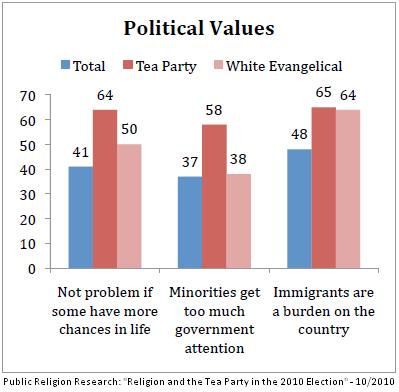
Here’s another cut, showing the Tea Party’s greater comfort with inequality of opportunity and stronger belief that the government devotes too many resources to minorities:
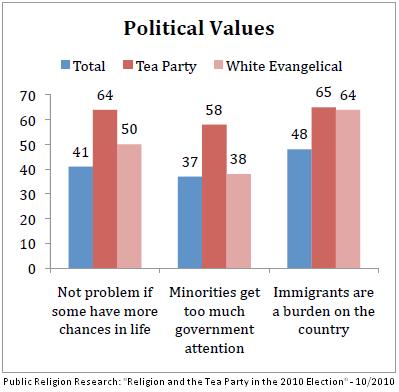
It’s a revolt against the composition of government much more than the level.
Now, it’s true that Republicans aren’t exactly translating this blueprint into action, but they’re not exactly flouting it, either. There is always a generalized antipathy toward spending amongst Republican and swing voters, but it disappears when the subject turns to actual government programs. Usually Republicans decide to just cut taxes for the rich instead. Here’s is the one part of the article proposing a defined policy change:
Even Ralph Reed, the Republican operative most tapped in to evangelicals, reflected the new GOP mindset when he gave this surprising wish list for the next presidential race: “In a perfect world, I’d like to hear the Republican nominee run on a platform that takes the capital gains tax to zero over five years.” Reed, who summoned several of the presidential candidates to Iowa for his Faith & Freedom Coalition this week, made it clear that Christian conservatives will still need to be catered to, but added that his side will understand the nominee’s need to focus on swing voters.
So an article putatively about the GOP redefining itself as an anti-spending party has one actual programmatic detail, and it’s: a zeroing out of the capital gains tax. In the name of appealing to swing voters — who, in fact, oppose tax cuts for the rich. Meet the new boss…
By: Jonathan Chait, The New Republic, March 14, 2011
Share This Blog


 Unknown Feed
- An error has occurred; the feed is probably down. Try again later.
 mykeystrokes.com

You must be logged in to post a comment.