Lawmakers in New Hampshire and Missouri are advancing so-called right-to-work bills that would allow private-sector workers to opt out of joining unions, the latest such efforts to curb labor unions in the legislative season that in many states is now entering the home stretch.
The measures, if successful, would mark the first expansion in a decade of right-to-work laws, which are on the books in 22 states.
Lawmakers in New Hampshire, where Republicans took control of both chambers last fall, passed a right-to-work measure last week. Its success will hinge on whether the state House of Representatives has enough votes to override a promised veto by Democratic Gov. John Lynch. If the bill passes, New Hampshire would become the first right-to-work state in the Northeast, historically a union stronghold.
In Missouri, the sponsor of a state Senate right-to-work bill is trying to shape a compromise in the final days of the legislative session.
Right-to-work measures were proposed in 18 states this year, an unusually high number that labor experts attribute to state budget and economic woes, GOP gains in November and influence by tea-party groups that oppose unions’ political clout. Ohio and Wisconsin didn’t pass specific right-to-work legislation but did adopt laws allowing public-sector employees to opt out of paying dues. The laws generally are backed by business groups and Republicans, opposed by Democrats and denounced by labor.
Most of the bills proposed this year likely are not far enough along to pass before legislative sessions end. Others died during negotiations. In Indiana, for instance, where Democrats fled the state in part to protest such a measure, House Republicans abandoned the idea to get them back to the table.
Still, the large number of proposals demonstrate the growing momentum of the idea. Legislators in many states say they will take up similar measures next year.
Right-to-work legislation is typically among the most contentious. A key contributor to the states’ red ink, advocates say, is public-employee benefits and pensions set by generous union contracts. Additionally, advocates say, the slow economy and a desire to create jobs has revived the issue.
“The political equation has changed in a lot of states,” said Michael Eastman, executive director of labor policy for the U.S. Chamber of Commerce. “Measures that may not have been possible two and four and six years ago now may be.”
But unions view such measures as a political attack, aimed at curbing their influence. The laws threaten unions because they permit workers to opt out of joining or paying dues in unionized workplaces. Dues are a key source of funds for political efforts, and higher numbers of workers give unions more clout during contract talks. Without right-to-work laws, workers covered by union contracts can be required to pay union dues.
The goal of right-to-work measures is to “weaken the labor movement in key states around the country,” said Mark MacKenzie, president of the AFL-CIO’s state federation in New Hampshire. “If you look at the map, it has nothing to do with protecting workers rights but taking over key areas of the country” for the 2012 presidential election.
Right-to-work laws were set by the Taft-Hartley Act of 1947. They have largely been enacted by states on the Great Plains and in the South. Those states, including Texas and North Carolina, tend to have the lowest unionization rates.
In March, right-to-work states had both the nation’s lowest U.S. unemployment rate, at 3.6% in North Dakota, and the highest, at 13.2% in Nevada, which still has a relatively large percentage of union members.
In Missouri, 9.9% of all workers belong to a union, and in New Hampshire 10.2% of workers do, according to the U.S. Labor Department. Missouri Sen. Luann Ridgeway, who sponsored that state’s right-to-work measure, said schemes to attract jobs with tax breaks haven’t worked. The bill has stalled in the Senate, but Ms. Ridgeway, a Republican, said she and her colleagues were weighing compromises, such as a voter referendum.
In New Hampshire, unions are lobbying the House, where Republicans have a 294-102 majority. The Senate passed the bill with a two-thirds majority needed to override the veto, but the House vote fell short of that mark.
Unions say they are uncertain about their chances. “I would say that we don’t have the votes right now,” said Dennis Caza, political coordinator for International Brotherhood of Teamsters Local 633, in Manchester, N.H., which represents workers at United Parcel Service Inc. and Anheuser-Busch Cos., among other companies.
By: Kris Majer and Amy Merrick, The Wall Street Journal, May 9, 2011
May 9, 2011
Posted by raemd95 |
Businesses, Collective Bargaining, Democracy, Economy, Elections, GOP, Government, Governors, Jobs, Labor, Lawmakers, Politics, Public Employees, Republicans, State Legislatures, States, Tea Party, Union Busting, Unions | AFL-CIO, Gov John Lynch, Indiana, Missouri, New Hampshire, Ohio, Right To Work Laws, Taft-Hartley Act, Wisconsin, Workers |
Leave a comment
Wisconsin Republican Gov. Scott Walker and GOP leaders have launched a push to ram several years’ worth of conservative agenda items through the Legislature this spring before recall elections threaten to end the party’s control of state government.
Republicans, in a rapid sequence of votes over the next eight weeks, plan to legalize concealed weapons, deregulate the telephone industry, require voters to show photo identification at the polls, expand school vouchers and undo an early release for prisoners.
Lawmakers may also act again on Walker’s controversial plan stripping public employee unions of their collective bargaining rights. An earlier version, which led to massive protest demonstrations at the Capitol, has been left in limbo by legal challenges.
“Everything’s been accelerated,” said Republican Rep. Gary Tauchen, who is working on the photo ID bill. “We’ve got a lot of big bills we’re trying to get done.”
The speed-up is the latest move in a tumultuous legislative session that followed last fall’s midterm elections in which Republicans won the governorship and control of both houses of the Legislature. In other states where conservatives won major victories, such as Ohio, Florida and Michigan, the GOP has moved more deliberatively.
Walker got off to a fast start in January, passing a slew of measures before he unveiled a two-year budget designed to plug a $3.6 billion shortfall. That legislation, involving deep cuts to a wide range of programs, was expected to consume months. Other measures were on tap for next year. But a three-week boycott by Democrats in the winter and recall efforts targeting nine legislators have changed the strategy.
“They know there’s a very strong possibility their days of controlling every level of government are numbered,” Democratic Assembly Leader Peter Barca said. “You’re moving forward huge pieces of legislation that dramatically change the direction and traditions and values of this state. Generally, doing that takes much longer.”
Recall campaigns likely will force six Republican senators to defend their seats this summer. Three Democrats may also be on recall ballots. A net victory of three seats would give the Democrats control of the Senate, which the GOP now controls 19-14. The first elections are scheduled for July 12.
At least publicly, Wisconsin Republicans deny they’re rushing legislation for fear of losing their majority.
“Right now, I don’t foresee (losing the majority),” Assembly Speaker Jeff Fitzgerald said. “Obviously, I’m sure it will be in the back of your mind, but you’ll have to see how that plays out later this summer.”
But Rep. Robin Vos, co-chairman of the Legislature’s budget-writing committee, which will attempt to handle two months of budget legislation in half the usual time, acknowledged, “It’s a factor. For the budget, yeah, I want to get it done by June 30.”
Four of the 12 Republicans on the committee are targets of the recall.
The blitz has created an almost frantic atmosphere in the Capitol.
Major bills, like the one to legalize concealed weapons, were introduced just days before public hearings. A major revision to the photo ID proposal was released late on a Friday afternoon, just four days before a committee passed it, prompting complaints from the nonpartisan board that oversees elections.
“There has been no time for the careful evaluation and vetting needed to ensure the best options for voters and election officials is enacted,” wrote Kevin Kennedy, head of the nonpartisan Government Accountability Board.
Republican leaders scheduled a full Assembly vote on a bill deregulating the telecommunications industry only a week after a hearing, leaving little opportunity for public comment.
Walker said his plan to move his agenda is unchanged. “From our standpoint, it’s really been about being aggressive from the beginning,” he said in an interview.
At the same time lawmakers are pushing through conservative policies, they will be wrestling with Walker’s budget proposal. Walker wants to cut roughly $1 billion from schools and local governments, split the Madison campus from the University of Wisconsin System and slow the growth of Medicaid by $500 million.
The Legislature also may try to quickly pass a redistricting plan, a politically charged process that would reshape congressional and legislative districts with new 2010 census data.
If the Legislature votes again on Walker’s plan stripping public workers of their union negotiating rights, it can sidestep the legal challenges to the first vote, which came after 14 Senate Democrats fled to Illinois to deprive the Senate of a quorum. Unions and Democrats claim the original vote violated the open meetings law and the state constitution’s quorum requirement. The case is pending before the state Supreme Court.
Senate Majority Leader Scott Fitzgerald said he and other leaders are just trying to make up the time lost during the earlier turmoil. “There is an expectation that some of these bills would be completed early on,” he said.
By: Scott Bauer, Huffington Post, May 7, 2011
May 8, 2011
Posted by raemd95 |
Class Warfare, Collective Bargaining, Conservatives, Democracy, Economy, Education, Elections, Gov Scott Walker, Government, Ideologues, Lawmakers, Medicaid, Middle Class, Politics, Public Employees, State Legislatures, States, Wisconsin, Wisconsin Republicans | Concealed Weapons, Deregulation, Government Accountability Board, Open Meetings, Recalls, Rep Gary Tauchen, School Vouchers, Telecommunications, Unions, Voter ID, Wisconsin Legislature |
Leave a comment
In 2008, Milwaukee, Wisconsin became the third city in America to guarantee workers paid sick leave, joining Washington D.C. and San Fransisco. These cities are stepping up to fill a void left by the federal government, which is content to leave America as one of the only countriesin the developed world that does not guarantee workers paid time off if they are sick.
The sick leave law was approved by referendum — with nearly 70 percent of voters in favor — and was upheld a few weeks ago by the state’s court of appeals. However, Republicans in the Wisconsin state legislature passed a bill preempting the city’s law and ensuring that no jurisdiction within the state of Wisconsin is allowed to decide it wants to mandate paid sick days. Gov. Scott Walker (R-WI) — who gained notoriety for proposing a law stripping public sector workers of their collective bargaining rights and sparking mass protests — signed the anti-sick leave bill into law today:
Gov. Scott Walker has signed a bill that prohibits local governments from passing ordinances guaranteeing workers’ paid sick and family leave…Walker, a Republican, says in a statement the bill removes another barrier to creating jobs.
But Walker’s concern about job-loss is overblown. The Drum Major Institute conducted a study examining San Francisco’s paid sick leave law and found “no evidence that businesses in San Francisco have been negatively impacted by the enactment of paid sick leave.” In fact, the U.S. economy as a whole loses $180 billion in productivity annually due to sick employees attending work and infecting other workers.
Despite Walker’s misguided action, as the National Association of Working Women noted, plenty of other cities are forging ahead with paid sick leave legislation:
In Philadelphia, a paid sick days bill was passed out of a City Council committee a few weeks ago, and in Connecticut, the state legislature is moving forward on a bill with bipartisan support. Paid sick days legislation in New York City has 35 City Council sponsors, legislation is about to be introduced in Seattle, and more than a dozen states have coalitions advocating actively for paid sick days and paid family leave policies. San Francisco and Washington, DC have already implemented paid sick days laws.
In the end, repealing Milwaukee’s paid sick leave law is simply one more way in which Walker is undertaking his assault on Wisconsin’s workers.
By: Pat Garofalo, The Wonk Room, Think Progress, May 5, 2011
May 6, 2011
Posted by raemd95 |
Collective Bargaining, Conservatives, Democracy, Economy, GOP, Gov Scott Walker, Governors, Ideology, Jobs, Lawmakers, Middle Class, Politics, Republicans, Right Wing, State Legislatures, States, Unions, Wisconsin, Wisconsin Republicans, Women, Womens Rights | Connecticut Legislature, D. C., Local Governments, National Association of Working Women, NWC City Council, Philadelphia, San Francisco, Sick Leave, Washington, Wisconsin Court of Appeals, Wisconsin Legislature, Workers, Workers Rights |
Leave a comment

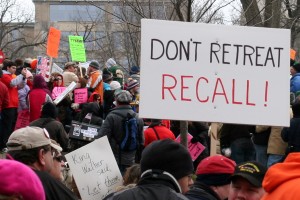
Recent protests at WI capitol
Recall elections loom on the horizon as petitions against nine Wisconsin state senators were recently submitted to the Government Accountability Board (GAB). Each successful petition must include 25 percent of the total number of votes cast in that senate district in the last election.
The recall efforts of Republican senators who supported Gov. Scott Walker’s Budget Repair Bill, and the Democratic senators who left the state to delay voting on the bill, are a result of the political firestorm that quickly flared up over the bill that sought to eliminate almost all collective bargaining rights for public workers.
Currently, the Republican senators who are facing a recall election are Alberta Darling, Robert Cowles, Sheila Harsdorf, Luther Olsen, Randy Hopper and Dan Kapanke. Democrats are facing recall efforts are — Dave Hansen, Jim Holperin and Robert Wirch.
The Milwaukee Journal Sentinel reported that there have also been petitions that didn’t have enough signatures on them to spark a recall. Democratic senators Lena Taylor and Spencer Coggs (both from Milwaukee), Senate Minority Mark Miller (Monona) and Fred Risser (Madison) all have all survived the recall attempts against them. Recall efforts against Republicans Glenn Grothman (West Bend) and Mary Lazich (New Berlin) also failed to garner sufficient support.
Circulators hired by the state Republican Party have submitted “hundreds if not thousands of invalid signatures” in recall drives targeting three Democratic state senators. Volunteers have been working overtime to enter each name into a data base and cross-check it with the phone book and other record. One man who signed a recall petition was Bill Pocan, the deceased father of State Representative Marc Pocan. The Wisconsin Democratic Party (DPW) is formally challenging all three of the recall petitions filed against Democrat senators.
Republicans have filed challenges against “all petitions targeting GOP senators. In addition to their individual signature challenges, they claim the GAB should throw out the petitions because the recall organizers did not properly register with the state.” The elections for recalled legislators with completed petitions will likely be held July 12, 2011.
By: Jennifer Page, Center for Media and Democracy, May 6, 2011
May 6, 2011
Posted by raemd95 |
Collective Bargaining, Democracy, Elections, Gov Scott Walker, Politics, Public Employees, State Legislatures, Union Busting, Unions, Wisconsin | Activism, Government Accountability Board, Milwaukee Journal Sentinel, Recalls, Wisconsin Democratic Party, Wisconsin Legislature, Wisconsin Republicans, Wisconsin Senate |
Leave a comment
The stripping of all power of the local government in Benton Harbor, MI has brought the national spotlight to the tiny town on the shores of Lake Michigan. The first city to be declared in a “financial emergency” by Michigan Governor Rick Snyder, CMDreported that Emergency Financial Manager (EFM) Joseph Harris was assigned to the city back in 2010 by then-Governor Jennifer Granholm. But it wasn’t until March of this year that Harris essentially disbanded the local government and boards.
The Rev. Jesse Jackson, Sr. responded to this takeover while on a tour of the state, calling for a rainbow coalition to organize against the EFM bill and others that Snyder and the Republican-led Senate has passed. At a protest in Benton Harbor, Jackson said that he, along with Michigan Congressman John Conyers, Lansing Mayor Virg Bernero and Benton Harbor Mayor Wilce Cook will file a lawsuit to challenge the law’s constitutionality.
Governor “Decimates Democracy”
WNDU in South Bend reported on Jackson’s speech to members of Benton Harbor: “It simply decimates democracy and gives dictatory powers in someone who does not live here but has the power to sit down officials and cancel contracts, but have power over assets selling off the properties of the city and its assets, that’s un-American” says Jackson.
Jackson also wrote an op-ed piece for the Chicago Sun-Times calling for an “uprising” in Benton Harbor and around Michigan. The town’s poor, mostly African-American population has been highlighted by Jackson and Rachel Maddow of MSNBC.
“Benton Harbor, Mich., is a town of nearly 11,000 people, about 90 percent of whom are African American. It is a catalogue of the misery of the industrial Midwest,” said Jackson in the Chicago Sun-Times. “It was the headquarters and manufacturing center of Whirlpool, but the last Whirlpool plant closed years ago. Now Benton Harbor has a per capita income of about $10,000 a year. And it is plagued by the ills that accompany poverty in today’s America: high unemployment, broke government, failing schools, crime, drugs and despair.”
Community activist Rev. Edward Pinkney in his blog, Blanco, notes: “there is nothing to stop the state from abolishing democratic governance in any of Michigan’s cities, if an emergency can be declared or created. On April 15, the mostly black city of Benton Harbor, the poorest jurisdiction in the state, was placed under total financial martial law, its citizens suddenly made more powerless than blacks in Selma, Alabama, prior to the civil rights movement.”
A Developer’s Dream – A Corporate Coup?
The take over of Benton Harbor has been linked to a commercial development plan, backed by Whirlpool and the very legislator who introduced the EFM bill, Rep. Al Pscholka. Pscholka is a former aide to the grandson of Whirlpool’s founder, Rep. Fred Upton, and former vice president of one of the companies involved with the Harbor Shores development and also on the Board of Directors of a non-profit involved with the development. The plan is to build a high-end lakeshore housing development and golf course, taking over the city’s sprawling public park and beach, Jean Klock Park, gifted to the city in 1917.
The latest protest on April 27th saw hundreds of people march through the streets of Benton Harbor with signs and chants decrying the takeover.
Business Insider, however, wrote that “Benton Harbor’s finances are indeed a mess – the result of mismanagement, poor accounting and too much spending.”
But Rev. Jackson doesn’t see it that way. He holds fast to the belief that the problems in Benton Harbor, as in other previously-industrialized cities in the Rust Belt, are a symptom of the resulting poverty that followed the end to factory jobs in these areas. The solution, he says, is to invest in the very people that have all but been forgotten by the Governor Snyder’s office.
“They’ve shut down the jobs, and taken over the schools. Now they want to shut down the democracy and turn the public parks into a rich man’s playground,” said Jackson. “But in Benton Harbor, as in Selma and Montgomery, they forget even the poorest people have a sense of dignity…. In Benton Harbor, it is time for the good people to make themselves heard.”
By: Jennifer Page, Center for Media and Democracy, May 3, 2011
May 4, 2011
Posted by raemd95 |
Corporations, Democracy, Government, Governors, Politics, Public Employees, Republicans, State Legislatures, States, Voters | Benton Harbor, Emergency Financial Managers, Gov Rick Snyder, Jean Klock Park, Jobs, Local Governments, Low Income, Martial Law, Michigan, Rep John Conyers, Rev Jessie Jackson, St. Rep Al Pscholka, Whirlpool |
Leave a comment


 Unknown Feed
 mykeystrokes.com
You must be logged in to post a comment.