Two weeks ago, Newt Gingrich said this is what he would do about Libya, if he were president: “Exercise a no-fly zone this evening”.
Yesterday, here’s what Newt said about Libya, where the United States is exercising a no-fly zone: “I would not have intervened”.
After a full day of people making fun of him, the former House speaker — who masquerades as an intellectual policy wonk but who is actually just a master self-promoter — explained himself in a lengthy Facebook post, Sarah Palin-style, that generally made no sense, Sarah Palin-style.
His position seems to be that he would not have intervened, but once the president said, “Gadhafi must go,” the United States had to intervene, to save face, and that’s when Newt would’ve exercised the no-fly zone, if he were president and had made that statement, which he wouldn’t have done.
Also, Gingrich says, now that we’ve done this we should also do it in the Sudan, Syria, Zimbabwe, Yemen and elsewhere, except we shouldn’t do it at all, anywhere.
We here at the War Room have just received, from the future, the next two weeks of Newt Gingrich’s public statements on Libya, and other assorted matters of national import.
“Meet the Press,” March 27
“What the president needs to do is have Congress vote on the use of ground troops in Libya, immediately.”
Neil Cavuto, March 29
“If I were president I’d unilaterally strike Iran right now instead of wasting our time and resources in Libya.”
Facebook, March 29
“My position on Libya has not changed: What the United States should’ve done is invade with a ground force, after receiving congressional authorization, but only if he hadn’t sought United Nations approval, which would’ve changed everything. Under the current circumstances, with the president already having totally blown it, our best option is a surprise airstrike on Iran.”
Human Events.com, March 31
“This is the single biggest foreign policy disaster I’ve seen since, literally, the Battle of Blandensburg, which I am writing a book about. We should pull out now and refocus on jobs, here at home.”
“Good Morning America,” April 1
“Look, if I was the commander in chief, I wouldn’t rest until we had Gadhafi’s head on a pike outside one of his gaudy palaces.”
Facebook, April 2
“Again, I’m distraught to see America so poorly led during this time of great international turmoil. My position is clear: The United States has a jobs crisis exacerbated by the failed policies of our current president, but after we committed ourselves to removing Gadhafi, we forced ourselves to take literally any action at our disposal to make that a reality, as long as we did it right, because if we aren’t doing it right, which we aren’t, but which I would, we should not do it.
“I also apologize to the hardworking staff at ‘Good Morning America’ for the incident with the chair, but I am growing tired of constantly answering such transparently biased questions about my very simple position on the conflict in Libya.”
“Face the Nation,” April 3
“I support gay marriage.”
“Fox and Friends,” April 6
“Gay people should be thrown in jail, forever, if they try to marry each other.”
Twitter, April 6
“deep respect 4 homosexual americans-vow to serve ALL americans if prez-inmate marriage will strengthen national respect 4 traditional family.”
By: Alex Pareene, Salon War Room, March 24, 2011
March 24, 2011
Posted by raemd95 |
Foreign Policy, Jobs, Libya, Middle East, Neo-Cons, Newt Gingrich, No Fly Zones, Politics, President Obama, Qaddafi | Facebook, Fox and Friends, Gay Marriage, Good Morning America, Homosexuals, Inmates, Meet The Press, National Policy, Neil Cavuto, Republicans, Traditional Family |
1 Comment
Now that a Wisconsin judge has temporarily blocked a state law that would strip public employee unions of most collective bargaining rights, it’s worth stepping back to place these events in larger historical context.
Republicans in Wisconsin are seeking to reverse civic traditions that for more than a century have been among the most celebrated achievements not just of their state, but of their own party as well.
Wisconsin was at the forefront of the progressive reform movement in the early 20th century, when the policies of Gov. Robert M. La Follette prompted a fellow Republican, Theodore Roosevelt, to call the state a “laboratory of democracy.” The state pioneered many social reforms: It was the first to introduce workers’ compensation, in 1911; unemployment insurance, in 1932; and public employee bargaining, in 1959.
University of Wisconsin professors helped design Social Security and were responsible for founding the union that eventually became the American Federation of State, County and Municipal Employees. Wisconsin reformers were equally active in promoting workplace safety, and often led the nation in natural resource conservation and environmental protection.
But while Americans are aware of this progressive tradition, they probably don’t know that many of the innovations on behalf of working people were at least as much the work of Republicans as of Democrats.
Although Wisconsin has a Democratic reputation these days — it backed the party’s presidential candidates in 2000, 2004 and 2008 — the state was dominated by Republicans for a full century after the Civil War. The Democratic Party was so ineffective that Wisconsin politics were largely conducted as debates between the progressive and conservative wings of the Republican Party.
When the Wisconsin Democratic Party finally revived itself in the 1950s, it did so in a context where members of both parties were unusually open to bipartisan policy approaches. Many of the new Democrats had in fact been progressive Republicans just a few years earlier, having left the party in revulsion against the reactionary politics of their own senator, Joseph R. McCarthy, and in sympathy with postwar liberalizing forces like the growing civil rights movement.
The demonizing of government at all levels that has become such a reflexive impulse for conservatives in the early 21st century would have mystified most elected officials in Wisconsin just a few decades ago.
When Gov. Gaylord A. Nelson, a Democrat, sought to extend collective bargaining rights to municipal workers in 1959, he did so in partnership with a Legislature in which one house was controlled by the Republicans. Both sides believed the normalization of labor-management relations would increase efficiency and avoid crippling strikes like those of the Milwaukee garbage collectors during the 1950s. Later, in 1967, when collective bargaining was extended to state workers for the same reasons, the reform was promoted by a Republican governor, Warren P. Knowles, with a Republican Legislature.
The policies that the current governor, Scott Walker, has sought to overturn, in other words, are legacies of his own party.
But Mr. Walker’s assault on collective bargaining rights breaks with Wisconsin history in two much deeper ways as well. Among the state’s proudest traditions is a passion for transparent government that often strikes outsiders as extreme. Its open meetings law, open records law and public comment procedures are among the strongest in the nation. Indeed, the basis for the restraining order blocking the collective bargaining law is that Republicans may have violated open meetings rules in passing it. The legislation they have enacted turns out to be radical not just in its content, but in its blunt ends-justify-the-means disregard for openness and transparency.
This in turn points to what is perhaps Mr. Walker’s greatest break from the political traditions of his state. Wisconsinites have long believed that common problems deserve common solutions, and that when something needs fixing, we should roll up our sleeves and work together — no matter what our politics — to achieve the common good.
Mr. Walker’s conduct has provoked a level of divisiveness and bitter partisan hostility the likes of which have not been seen in this state since at least the Vietnam War. Many citizens are furious at their governor and his party, not only because of profound policy differences, but because these particular Republicans have exercised power in abusively nontransparent ways that represent such a radical break from the state’s tradition of open government.
Perhaps that is why — as a centrist and a lifelong independent — I have found myself returning over the past few weeks to the question posed by the lawyer Joseph N. Welch during the hearings that finally helped bring down another Wisconsin Republican, Joe McCarthy, in 1954: “Have you no sense of decency, sir, at long last? Have you left no sense of decency?”
Scott Walker is not Joe McCarthy. Their political convictions and the two moments in history are quite different. But there is something about the style of the two men — their aggressiveness, their self-certainty, their seeming indifference to contrary views — that may help explain the extreme partisan reactions they triggered. McCarthy helped create the modern Democratic Party in Wisconsin by infuriating progressive Republicans, imagining that he could build a national platform by cultivating an image as a sternly uncompromising leader willing to attack anyone who stood in his way. Mr. Walker appears to be provoking some of the same ire from adversaries and from advocates of good government by acting with a similar contempt for those who disagree with him.
The turmoil in Wisconsin is not only about bargaining rights or the pension payments of public employees. It is about transparency and openness. It is about neighborliness, decency and mutual respect. Joe McCarthy forgot these lessons of good government, and so, I fear, has Mr. Walker. Wisconsin’s citizens have not.
By: William Cronon, Op-Ed Contributor, The New York Times, March 21, 2011
March 22, 2011
Posted by raemd95 |
Class Warfare, Collective Bargaining, Gov Scott Walker, Governors, Jobs, Politics, State Legislatures, States, Unions, Wisconsin, Wisconsin Republicans | Joe McCarthy, Labor, Open Meetings Law, Progressive Reform, Transparency, University Of Wisconsin, Wisconsin Democrats, Wisconsin Legislature, Wisconsin Reformers |
Leave a comment
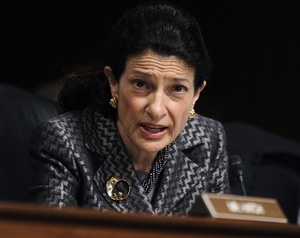
Sen. Olympia Snowe, R-Maine, acted in the best interests of her party's far right, not her constituents, when she voted last week in favor of the federal budget bill. (2009 AP file)
Sen. Olympia Snowe has apparently decided that it is better to bow to political pressure from the tea party movement than to stand up for the interests of Maine.
How else to explain her vote last week for a federal spending measure that would harm Maine’s economy while punishing thousands of Mainers, including seniors, veterans, preschool children, college students and families struggling to keep their oil furnace running?
It turns out that the tea party does not have to defeat U.S. senators to claim their seat. It just has to threaten them. If what Snowe voted for last week becomes law, 700,000 jobs are likely to be lost in Maine and across the country.
This is not according to a Democratic think-tank, but an economic adviser to the presidential campaign of Sen. John McCain, Mark Zandi.
NO TO HEAT ASSISTANCE
Snowe voted to throw tens of thousands of Maine families off of a lifeline that enables them to get through a Maine winter. She voted to cut the emergency energy assistance program — LIHEAP — by 66 percent, literally tossing Maine families out of the program and into the cold.
She voted to undermine services to Maine seniors who benefit from the Medicare program. Payments benefitting seniors who participate in the Medicare Advantage program, for instance, would be suspended, according to Secretary of Health and Human Services Kathleen Sebelius. And Snowe’s vote would create “significant disruption” to providers, suppliers and seniors who use Medicare.
Snowe voted to cut 3,500 positions from the Social Security administration, guaranteeing extended delays in the distribution of basic retirement claims and disability payments. She voted to eliminate 10,000 supportive housing vouchers for homeless veterans.
Sen. Snowe voted to knock 218,000 kids out of the Head Start program and force 16,000 classrooms to close while cutting 1.7 million college students from the Pell Grant program — their lifeline to a college education.
From the seat once held by the environmental champion Sen. Edmund Muskie, Snowe voted to cut land and water conservation, energy efficiency and renewable energy projects, and one-third of the entire Environmental Protection Agency’s budget.
Make no mistake — this was not a vote about doing the difficult but right thing to confront the federal budget deficit.
A sober debate about reining in long-term federal deficits begins by recognizing that the first step to fiscal health is an economy that produces decent-paying jobs.
Jobs fill pockets with money to spend on goods and services that in turn create more jobs. These jobs produce revenue that reduces the federal deficit. You are not serious about fueling a fragile economic recovery when you slash hundreds of thousands of jobs with one vote.
You are not serious about balancing the federal deficit when you support maintaining the Bush tax cuts for the wealthiest of Americans at a price of $2.5 trillion over 10 years — exactly the amount that congressional Republicans want to slash and burn from the federal budget over this same time period.
You are not serious about addressing the federal budget deficit when you repeatedly vote to borrow hundreds of billions of dollars for the war in Afghanistan.
The wars in Iraq and Afghanistan alone account for 23 percent of the federal budget deficit since 2003.
STATE CUTS HURT TOO
The Portland Press Herald’s Bill Nemitz quoted a Portland middle school librarian who drove to the State House in Augusta last week to testify against similar tea party-driven cuts to Maine’s state budget.
Kelley McDaniel described the cuts this way: “It’s not economically sound. It’s not morally sound. And I think you know that. I would be embarrassed to support something so ludicrous — taking from the poor to give to the rich. Maybe you are testing us, checking to see if we, your constituents, are really paying attention, really listening. I hope that’s what’s going on, because the alternative involves me losing faith in representative government, in democracy, and in you, the elected officials.”
Our fragile economic recovery, our kids, college students, seniors, veterans, environment and our health all took a hit on the floor of the U.S. Senate from a senator who was once described as independent.
Sen. Snowe might think that she made a prudent political calculation by bowing to the radical right of her party and placing her political interests ahead of the interests of her constituents. But she needs to know that Mainers are paying attention. And that the seat she is holding is Maine’s U.S. Senate seat. Not the tea party’s.
By: Tom Andrews, Former Maine U.S. Congressman, The Portland Press Herald, March 15, 2011
March 17, 2011
Posted by raemd95 |
Deficits, Economy, Education, Federal Budget, Jobs, Medicare, Politics, Sen Olympia Snowe, Teaparty | College Education, College Students, Head Start, Heating Assistance, LIHEAP, Maine, Pell Grants, Republicans |
Leave a comment
The movement has been set back for now, but the standoff in Madison captured labor’s political imagination. Although the Republicans have cynically used the “nuclear option” to ram through the anti-union bill, the battleground will now just shift to other states.
Ohio lawmakers are mulling a bill similar to Wisconsin’s, which would restrain the collective bargaining rights of some 360,000 state and local employees.
Ohio does not need as many votes for a quorum. This means Democrats cannot hold up the voting process by going AWOL, as they did in Wisconsin and are still doing in Indiana (where unions are fighting proposals to further erode union rights and public education). But in Ohio’s case, Madison-style people power could be deployed in a more concrete way, according to some lawmakers. House minority leader Armond Budish told Bloomberg News that even if the bill initially passes, he and other Democrats will mobilize citizens to thwart the legislation through other channels, through public pressure and perhaps ultimately, the ballot box:
Too few to block Republicans from having a quorum, Ohio Democrats are asking for more public involvement and hearings on the bill in an effort to sway opinion and will seek a ballot issue to repeal it if necessary, Budish said.
“If I have to take the lead on a statewide referendum, we will fight until we win,” Budish, the House minority leader, said in a telephone interview from Columbus….
With Republicans holding a 59-to-40 seat advantage in the House, Democrats should focus on a repeal referendum, said Representative Robert Hagan, a Democrat from Youngstown.
“What we’re doing now is performing a charade,” Hagan said in an interview. “They should get it over with, and we should put this on the ballot as soon as possible.”
With passage in the House all but certain, Ohio could now overtake Wisconsin as a bellwether for the struggle. After the fireworks in Madison, labor activists recognize that the partisan gridlock over collective bargaining rights is merely a proxy battle for a new kind of class antagonism that has emerged from the Great Recession.
Ohio’s referendum process offers a form of direct democracy that Wisconsin Republicans stridently denied to protesters by ignoring, vilifying and shutting out demonstrators at the capitol.
Bloomberg reports that voters can launch a ballot initiative..
if petition forms with more than 231,000 voters’ signatures are filed within 90 days of the law’s approval, according to the secretary of state’s office. The number of signatures is 6 percent of the total vote cast for governor last year.
Gathering that many petitions in three months is no small feat, though the required number of signatures equals just under two-thirds of the number of workers potentially impacted by the bill. More importantly, the spirit of protest across the Midwest has truly gone viral, inspiring parallel demonstrations in Indiana, Ohio and other states, and cheers across the Twitterverse, pizza from Haiti, and picketing from Cairo. And on top of potential court challenges, there are rising calls for a general strike to paralyze Gov. Walker’s administration. In the wake of that outpouring of solidarity, a conventional referendum seems almost too easy.
In many ways, it is. Which is why the temporary defeat in Wisconsin should have a more enduring influence on the campaign to protect union rights than any other tactic. The battle for labor’s integrity won’t be won or lost on the political chessboard of a state legislature.
As activists regroup and take stock of what they’ve gained these past few weeks, they can still claim one victory: they never gave an inch. And by standing their ground, they gave workers across the country the momentum to push ahead to November and beyond.
By: Michelle Chen, In These Times, March 11, 2011
March 13, 2011
Posted by raemd95 |
Class Warfare, Collective Bargaining, Democracy, Economy, Governors, Ideologues, Jobs, Middle Class, State Legislatures, States, Unions | Anti-Union, Ballot Box, Democrats, GOP, Gov John Kasich, Gov Scott Walker, Indiana, Jobs, Ohio, Recalls, Republicans, Wisconsin, Workers Rights |
Leave a comment
Congratulations to whoever had “less than two months” in the “conservative overreach” betting pool. There was never a question about whether the Republican Party, awarded huge political gains last year by voters, would let ideology outstrip political reality. The issue was when. And the new faces of conservative overreach have been preening recently.
Here is Wisconsin Gov. Scott Walker, who sparked an old-fashioned national labor controversy by trying to break his state’s public unions. His assertion that he’s merely trying to achieve fiscal responsibility is belied by the fact that while rolling back government workers’ collective bargaining rights itself saves no money, the tax cut he pushed through upon taking office costs an amount strikingly similar to this year’s budget gap; and the fact that when the unions offered to accede to his budget demands in exchange for keeping their bargaining rights, the governor wouldn’t accept that “yes” for an answer.
Indeed, while he has tried to imbue his power grab with the voters’ imprimatur by claiming that union-busting was part of his campaign agenda (it was not), Walker, speaking with a liberal blogger pretending to be billionaire supporter David Koch, described the actual unveiling of the policy as akin to dropping a “bomb.” In that same call, he added a phrase to the lexicon of overreach. “This is our moment,” he told faux-Koch, “this is our time to change the course of history.”
Away from Wisconsin, members of the Tea Party Patriots, meeting in Phoenix recently, gave that sentiment more guttural voice. When Texas GOP Rep. Joe Barton tried to brag that the $61 billion in spending cuts the House recently passed were the “largest . . . in the history of America,” they booed him, shouting “More, more!” One Tea Partyer told the Associated Press that she and her fellow activists were displeased with the House GOP for failing to follow through on their campaign pledge to slice $100 billion from government outlays this year: “Have we seen that? No. But we’ve heard excuses.” Another warned, “If they don’t [live up to their promises], we’re going to pull up another candidate to run against them.” Why shouldn’t they? This is their moment.
That even the conservative House Republicans are unable to conjure more than $61 billion shows both the hollowness of their $100 billion campaign pledge and the governing corner into which they have painted themselves. And, the Tea Party activists will no doubt be pained to learn, negotiations with the White House and Senate Democrats won’t get them any closer.
Not for lack of trying, to be sure. Congressional Republicans have demonstrated an unstinting commitment to an economic philosophy that can best be described as cutting for cutting’s sake. It’s certainly not for the sake of fiscal responsibility. The same party that brought you the Reagan budget deficits and Bush budget deficits certainly speaks the language of fiscal responsibility. But Republicans concern themselves only with the spending side of the ledger, perhaps forgetting that deficits come not from spending in isolation but when spending and revenue are out of balance.
So they piously speak of dealing with the deficit with their $61 billion in proposed cuts (or even the $100 billion Tea Party standard) while trying to repeal President Obama’s healthcare reform law, a move that would add more than $200 billion to the deficit over 10 years, according to the Congressional Budget Office. And all of those numbers are dwarfed by the $4 trillion hole they would blow over 10 years if they successfully managed to make the Bush tax cuts permanent.
And they’re not focused, campaign rhetoric aside, on jobs. A recent Goldman Sachs report estimated that the $61 billion in spending cuts that the House GOP passed would reduce economic growth by 1.5 to 2 percentage points. This would not help spur job growth. Moody’s analyst Mark Zandi (who has advised both parties) weighed in last week with an estimate that the Republican spending cuts “would mean some 400,000 fewer jobs created by the end of 2011 and 700,000 fewer jobs by the end of 2012.” And last Wednesday, Federal Reserve Chairman Ben Bernanke put that number at “a couple of hundred thousand jobs,” adding, “It’s not trivial.”
In other words, the Republicans’ spending cuts legislation is the very definition of, to borrow their phrase, a job-killing bill. And the Tea Party gang doesn’t think it goes far enough. Is the GOP really willing to sacrifice economic growth at the altar of their cutting obsession? Indiana Gov. Mitch Daniels, the George W. Bush budget director-turned-spending hawk, was asked on NPR whether budget cuts are worth it if they cost a lot of jobs. “The answer is yes,” he said.
This view bespeaks the kind of market fundamentalism the Tea Party GOP has embraced. It involves a blind faith in the free market: cut taxes, gut regulations, cut spending, gut labor unions. The market is always right. And if that means the loss of a few hundred thousand jobs, then, in the instantly immortal words of House Speaker John Boehner, “So be it.”
But the GOP has gotten so lost in its own philosophy that they have made the mistake of believing their own rhetoric about the United States being ideologically conservative. It is surely true that the electorate prefers a government that is in some senses limited; but so too do they want the free market limited, its rough edges softened.
It may be, in Governor Walker’s words, their moment. But overreaching conservatives will learn that the more tightly they embrace it, the more quickly it will pass. In self-consciously trying to change history, they will become it.
By: Robert Schlesinger, U.S. News and World Report, March 11, 2011
March 13, 2011
Posted by raemd95 |
Class Warfare, Collective Bargaining, Deficits, Economy, Ideologues, Income Gap, Jobs, Middle Class, Politics, Teaparty, Unions | Budget Cuts, Bush Tax Cuts, Congress, Conservatives, Gov Scott Walker, Koch Brothers, Republicans, Wisconsin |
Leave a comment


 Unknown Feed

You must be logged in to post a comment.