We Deceive, You Believe: A New Reality Show For Sarah Palin And Fox
I have a great idea for a new show on Fox. It would be a reality comedy show with Sarah Palin as the host. It’s what Hollywood calls “high concept.” The idea would be that all the Republican presidential candidates would travel across America in Sarah’s RV. Hilarity follows.
Late night comic Jimmy Fallon put it best: “Obama was in Ireland. He thought about buying a four-leaf clover for good luck, and then he looked at the field of Republican candidates and decided it wasn’t necessary.”
Dramatis personae include:
Gary Johnson—Ex-governor of New Mexico who favors the legalization of pot. He didn’t get an invite to the next GOP debate, but his hopes are high and he has grassroots support.
Herman Cain—Multi-millionaire and former CEO of Godfather’s Pizza. He’s rolling in dough.
Newt Gingrich—Former speaker of the House. If he really is a fiscal conservative, he would use his $500,000 revolving charge account at Tiffany’s to make a payment on the federal debt. He is clearly the jewel in the GOP crown. The former speaker is currently on a cruise with his wife in the Mediterranean. He will return to the campaign trail after he decides whether he supports or opposes the Ryan plan to gut Medicare. It might be a long trip.
Palin—Can the former half-term and half-baked governor of Alaska see Russia from her magic bus? This trip is her magical mystery tour because we have no idea where it will lead. She rained on Mitt Romney’s parade by showing up in New Hampshire on the day of Romney’s formal announcement and popping him for his support of a state run healthcare program in Massachusetts with a personal mandate. National surveys indicate that twice as many voters dislike her as like her. So, I don’t think she will get a mandate from Americans.
Michele Bachmann—Tea Party favorite and conservative congresswoman from Minnesota. When baseball players have a short stay in the majors, it’s a cup of coffee. She will have a cup of tea in the presidential race. Last week, Representative Bachmann said she and former half-governor Palin were friends. That didn’t last long. This week, Bachmann’s campaign manager said Palin wasn’t a “serious” candidate. At least the Minnesotan and I agree on something.
Chris Christie—Governor of New Jersey. Teddy Roosevelt described the presidency as a bully pulpit. Christie is just a bully. Don’t be surprised if he helicopters into the race.
Rudy Giuliani—The former mayor of New York City. Why not? He did so well last time. If he runs, he should borrow Donald Trump’s toupee and MapQuest Iowa so he can find it this time.
Jon Huntsman—Ex-governor of Utah who served two years as President Barack Obama’s ambassador to China. He will charge Obama with incompetence. Just look at the clown the president made ambassador to China.
Bobby Jindal—The governor of Louisiana who is not ready for prime time TV. But that hardly disqualifies him in this field.
Mitt Romney—Former governor of Massachusetts and the father of Obamacare. This would be the grudge match of all time. Healthcare reform 1.0 vs. 2.0. A Romney position is like the New England weather. Don’t like it, just wait, because it changes every 15 minutes.
Ron Paul—Paul is the anti-Romney because the Texas congressman sticks to his positions for more than 15 minutes. Actually, he still holds Herbert Hoover’s positions. But will socially conservative voters buy his opposition to drug laws and will the neocons accept his opposition to the wars in Afghanistan and Iraq? I don’t think so.
Tim Pawlenty—The former two-term governor of Minnesota is as bland as his fellow charismatically challenged Minnesotan, Walter Mondale. Jay Leno described T-Paw to a t when he joked, “You know, I don’t want to say Tim Pawlenty is boring, but his Secret Service codename is Al Gore.” Bland is good, though, because the other GOP candidates have enough baggage to fill a Boeing 727 headed for LAX.
Rick Perry—In 2009, the governor of Texas threatened to secede from the union. The question is whether he wants to lead or to secede. Too bad Jeff Davis isn’t still around to be his running mate.
Rick Santorum—Why does he torture himself with the hope he could win? Is the GOP this desperate for a candidate? He lost his Senate seat in a presidential battleground state, Pennsylvania, by 16 percent.
This may be why four out of 10 Republicans in a new Pew Research Center poll say they are not impressed with the GOP presidential candidates. But I think the reality TV show would get good ratings hammocked between Family Guy and The Simpsons on Sunday nights.
By: Brad Bannon, U. S. News and World Report, June 9, 2011
One Person, One Vote? Not Exactly
Two economists, Brian Knight and Nathan Schiff, set out a few years ago to determine how much Iowa, New Hampshire and other early-voting states affected presidential nominations.
Mr. Knight and Mr. Schiff analyzed daily polls in other states before and after an early state had held a contest. The polls tended to change immediately after the contest, and the changes tended to last, which suggested that the early states were even more important than many people realized. The economists estimated that an Iowa or New Hampshire voter had the same impact as five Super Tuesday voters put together.
This system, the two men drily noted in a Journal of Political Economy paper, “represents a deviation from the democratic ideal of ‘one person, one vote.’ ”
A presidential campaign is once again upon us, and Iowa and New Hampshire are again at the center of it all. On Thursday, Mitt Romney will announce his candidacy in Stratham, N.H. Last week, Tim Pawlenty opened his campaign in Des Moines. The two states have dominated the nominating process for so long that it’s easy to think of their role as natural.
But it is not natural. It’s undemocratic, in fact. It is unfair to voters in the other 48 states. And it distorts economic policy in several damaging ways.
Most obviously, the federal government has lavished subsidies on ethanol, even though those subsidies drive up food prices and do little to solve the climate problem, partly because candidates pander to the Iowa corn industry. (Mr. Pawlenty, who now says the subsidies must end, is an admirable exception.) Beyond ethanol, a recent peer-reviewed study found that early-voting states received more federal dollars after a competitive election — so long as they supported the winning candidate.
Pork is hardly the only problem with the voting calendar. In the long run-up to the first votes, Iowa and New Hampshire also distort the national conversation because they are so unrepresentative. They are not better or worse than other states, to be clear. But they are different.
Their populations are growing more slowly than the rest of the country’s. Residents of Iowa and New Hampshire are more likely to have health insurance. They are older than average. They are more likely to work in manufacturing.
Above all, Iowa and New Hampshire lack a single big city, at a time when large metropolitan areas are crucial to lifting economic growth. Big metro areas are where big ideas most often take shape and great new companies are most often born. The country’s 25 largest areas are responsible for 52 percent of the country’s economic output, according to the Brookings Institution, and are home to 42 percent of the population.
Yet metro areas are also struggling with major problems. The quality of schools is spotty. Commutes last longer than ever. Roads, bridges, tunnels and transit systems are aging.
You don’t hear much about these issues in the first year of a presidential campaign, though. No wonder. Iowa, New Hampshire and the next two states to vote, Nevada and South Carolina, do not have a single city among the country’s 25 largest. Las Vegas, the 30th-largest metro area, and the Boston suburbs that stretch into New Hampshire are the closest these states come.
So the presidential calendar becomes another cause of what Edward Glaeser, a conservative-leaning Harvard economist, calls our “anti-urban policy bias.” Suburbs and rural areas receive vastly more per-person federal largess than cities. One big reason, of course, is the structure of the Senate: the 12 million residents of Iowa, New Hampshire, Nevada and South Carolina have eight United States senators among them, while the 81 million residents of California, New York and Texas have only six.
Bruce Katz, a Brookings vice president and veteran of Democratic administrations, points out that the world’s other economic powers take their cities more seriously. China, in particular, has made urban planning a central part of its economic strategy.
“The United States stands apart as an anti-urban nation in an urbanizing world,” Mr. Katz told me. “Our political tilt toward small states and small towns, in presidential campaigns and the governing that follows, is not only a quaint relic of an earlier era but a dangerous distraction at a time when national prosperity depends on urban prosperity.”
The typical defense from Iowa and New Hampshire is that they care more about politics than the rest of us and therefore do a better job vetting candidates. But the intense 2008 race between Barack Obama and Hillary Clinton showed that if Iowa and New Hampshire care more, it’s only because of their privileged status. In 2008, turnout soared in states that finally had a primary that mattered, be it Indiana or Texas, North Carolina or Rhode Island.
A more democratic system would allow more voters to see the candidates up close for months at a time. The early states could rotate each year, so that all kinds — big states and small, younger and older, rural and urban — had a turn. In 2016, the first wave could include states that have voted near the end recently, like Indiana, North Carolina, Oregon and South Dakota.
A rotation along these lines would enliven the political debate. Investments in science and education, which are the lifeblood of future economic growth, might play a bigger role in the campaign. You could even imagine — optimistically, I know — that the deficit might prove easier to address if Medicare and Social Security recipients did not make up such a disproportionate share of early voters.
The issues particular to small-town America would still receive extra attention because so many of the 50 states are rural and sparsely populated. It’s just that Iowa and New Hampshire would no longer receive the extreme special treatment they now do.
And that special treatment is a nice thing, indeed. It focuses the entire country, and its next leader, on the concerns of only 1 percent of the population, as if democracy were supposed to work that way.
At a recent candidates’ forum in Des Moines, The Wall Street Journal reported, the moderator did something that seemed perfectly normal: She chided Mr. Romney for not having spent enough time in Iowa lately. “Where have you been?” she asked.
How do you think the rest of us feel?
By: David Leonhardt, Economic Scene, The New York Times, May 31, 2011
How The Right Brought The Trump Birther Madness On Itself
GOP primary voters should reward substance, rather than pols who masterfully exploit hot button issues. So why are so many Republicans embracing Donald Trump? They’ve been trained to elevate politicians based on the “tough” rhetoric they use rather than the record they’ve amassed. And to rally around anyone seen as being disrespected by the dread mainstream media.
The talk radio right bears much of the blame for these pathologies. Caught up in the Tea Party excitement, guys like Mark Levin used their platforms to act as apologists for Republicans like Sarah Palin and Christine O’Donnell. Didn’t they fire up the base? Weren’t they unafraid to zing President Obama? As Donald Trump rises in the polls, however, Levin is having second thoughts. The right is suddenly foolish to embrace demagogues with thin resumes and incoherent political philosophies. For all their differences, folks like Ross Douthat, David Frum, Reihan Salam, David Brooks, Daniel Larison, and many others have long been urging the GOP to pick its champions based on substance. You’ll never hear any of them urge that Donald Trump be taken seriously.
Meanwhile, Sarah Palin is defending Trump. Will Levin call out the woman whose political judgment he has frequently touted? Rush Limbaugh is inviting Trump on his show for softball interviews, and telling callers to his program that the celebrity billionaire ought to be taken “half-seriously.” Having announced that taking Trump at all seriously is idiocy of the highest order, will Levin openly criticize his fellow talk radio host? Or does this bully lack the courage to go after anyone with a bigger audience than his? Remember that the next time he tries to tell you that the reformers embody what’s wrong with the right. Like all bullies, his targets aren’t chosen based on desert.
In failing to call out the people most responsible for the right’s pathologies, Mark Levin is not alone. As Adam Serwer notes:
Trump’s candidacy is largely a problem of the GOP’s own making. It’s a symptom of circumstances Republicans have spent the last two years tacitly cultivating as an asset. Republican leaders have at best refused to tamp down the most outlandish right-wing conspiracy-mongering about the president and at worst have actively enabled it. The result: A substantial portion of their base believes a complete myth about the president’s birth certificate, and Republicans are stuck with a candidate shameless enough to exploit the issue without resorting to the usual euphemisms more respectable Republicans tend to employ when hinting at the president’s supposed cultural otherness. I don’t know how you solve a problem like Donald Trump, but I know it’s a problem the Republican Party brought on itself.
Indeed, half of the Iowa GOP are birthers. It’s so much of a problem that Ann Coulter and Karl Rove are out there assuring everyone that President Obama was in fact born in the United States. In doing so, they frame Birtherism as a trap liberals are setting. They’re implicitly criticizing all the mainstream voices on the right who’ve flirted with Birtherism, but are uninclined to name names, or to come right out and state that what those conservatives did has come back to bite the right.
Some of us have long insisted that the conservative movement was going to pay for its embrace of demagoguery, anti-intellectualism, bombast in place of substance, and shameless pandering. For our trouble, we’ve been dismissed by talk radio hosts and conservative bloggers, who took an ends-justify-the-means approach to the 2010 primaries and opposition to President Obama generally. Lo and behold, the conservative movement is now paying a price, exactly as predicted. The GOP has a weak field for 2012, and although Donald Trump isn’t going to win the nomination, his early status as a front-runner is an unwelcome distraction and may end up pulling other candidates toward the sort of absurd populism that will hurt them in a general election.
Even Mark Levin, Ann Coulter and Karl Rove now see these pathologies on the right, and the dangers they pose. So are they going to criticize the most prominent conservatives who brought these conditions about? Nope. There is never direct intra-movement criticism of Rush Limbaugh or Roger Ailes. There is never any appreciation of the pathologies encouraged by everyone who supported Sarah Palin. Instead we get self-righteous criticism that is too little, too late, and a cowardly refusal to confront the culpable parties in a way that would prevent this sort of thing from happening again.
By: Conor Friedersdorf, The Atlantic, April 21, 2011
GOP Presidential Contenders Compete To Win Over “The Political Army Of The Lord”
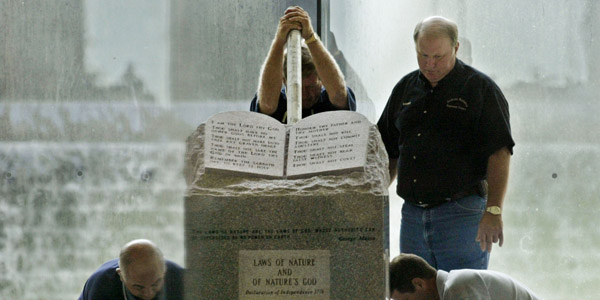
Workers remove a monument of the Ten Commandments from the rotunda of the Alabama Judicial Building after Superior Court Justice Roy Moore refused to take it down in 2003
So you can add another car to the crazy train that is the 2012 Republican presidential nominating contest. No, I’m not talking about last week’s sensation, Donald Trump. He’s a pretty conventional figure compared to the latest would-be president, former Alabama Supreme Court Chief Justice Roy Moore, who is currently barnstorming through Iowa after announcing an exploratory committee.
You may remember Judge Moore as the man who was forced from his judicial post after refusing to remove a gigantic monument to the Ten Commandments from his courthouse. He was also known for abrasive comments from the bench about homosexuality as contrary to God’s will, which in Moore’s opinion was dispositive. A martyr for theocrats everywhere, Moore spent some time hauling his monument around Alabama before launching two notably unsuccessful gubernatorial races — coming in a bad second in 2006’s Republican primary and a bad fourth in 2010 — and becoming a minor fixture at tea party events.
Moore was undoubtedly drawn to Iowa by that state’s furor over same-sex marriage, decreed legal by a 2009 state Supreme Court ruling. Iowa’s powerful Christian Right movement has made overturning that decision Job One, beginning with a successful effort in 2010 to remove three of the seven jurists responsible for it. It’s one of the few places left where Republicans don’t try to ignore the whole issue of gay rights as a divisive loser of an issue (which is why presidential wannabees like Tim Pawlenty have anachronistically come out against the repeal of “don’t ask, don’t tell). For Moore, it must have felt more like “home” than home.
Before writing off Moore as a kook trying to horn in on the spotlight of a presidential race, consider the company he’s keeping on his tour of the first-in-the-nation-caucuses state: former state legislator Danny Carroll. Carroll was co-chairman (with three-time gubernatorial candidate Bob Vander Plaats) of Mike Huckabee’s successful 2008 Caucus campaign, and more recently, signed on as a lobbyist for Vander Plaats’ new Christian Right umbrella group, The Family Leader. He’s a reasonably big deal in Iowa GOP circles, and by no means someone who howls at the moon.
For all I know, Carroll sees something in the crusty Alabama judge that others haven’t seen. Or maybe Judge Moore is a convenient stalking horse for Huckabee, designed to keep The Faithful loose and out of anyone else’s camp, in case Huck ultimately decides to run.
Regardless of Carroll’s (or Moore’s) personal motives, it’s likely the national Republican chattering class will dismiss the Judge’s campaign as a joke even worse than Trump’s. Or, it may be said, there is now such a crowd on the far right that opportunities are opening up for more moderate possibilities like Romney, T-Paw or an establishment-backed candidate-yet-to-be-named.
But I’d like to suggest another theory: the Christian/tea party right in Iowa is big enough, powerful enough, and politically sophisticated enough to hold its own caucus-within-a-caucus (well, caucuses, to be technical about it), an intramural contest to determine which candidate will actually represent the cause when Iowa Republicans make their final commitments before Caucus Night. Proven zealots like Michele Bachmann, Herman Cain, and now Moore, will joust with more suspect supplicants like T-Paw, Newt Gingrich — and maybe even Donald Trump! — over the next few months, with someone emerging as the designated favorite of the political army of the Lord. That is arguably what happened in Iowa in 2008, when Huckabee and Sen. Sam Brownback fought to become the Christian Right alternative to Mitt Romney, with Huckabee becoming The Man only after he out-organized Brownback at the State Party Straw Poll in Ames during the summer.
Moore’s candidacy may not ultimately have any direct influence on what happens next winter in Iowa, when conservative evangelicals and conservative Catholics get together to shape the 2012 Republican nominating process.
But he could indeed intensify the competition for Christian Right voters. And just as importantly, he could definitely serve as a symbol of the ideological and psychological gap between rigorous conservative activists and the mainstream political commentariat. Most of the latter think Moore is a crazy person. But most of the Iowa audiences before which Moore speaks will consider him an authentic if polarizing voice expressing the Word of God. That’s a pretty big gulf in perception, but also a pretty good reflection of the real differences Americans experience in how they view their leaders.
By: Ed Kilgore, Managing Editor of The Democratic Strategist and Senior Editor, Progressive Policy Institute. Article published in The Atlantic, April 20, 2011: Photo by Tami Chappell (Reuters)
Flirting With The Fringe: Stop Pretending Michele Bachmann Can Win The Iowa Caucuses
Ever since Michele Bachmann announced her intention to form a presidential exploratory committee, pundits, including Ed Kilgore at TNR, have been making the case that she has a good chance at winning Iowa—or if not winning, then doing well enough to hurt one or more of the stronger candidates. Republican caucus-goers in the state, they argue, are at least half-nuts, and therefore may well support Bachmann or some other candidate who doesn’t pass conventional standards of seriousness.
Certainly, Iowa Republicans are very socially conservative, more so than in some other states. But a closer look at Iowa caucus history shows that their history of supporting fringe candidates is not quite what it’s made out to be.
The case that “wacky Iowans will do anything” essentially comes down to interpreting a handful of episodes from recent decades. The first occurred in 1988 when Pat Robertson stunned everyone by finishing second with 25 percent of the vote, besting George H.W. Bush and Jack Kemp. But Pat Robertson was a social conservative—and no ordinary one at that—in a year in which the frontrunner (George H.W. Bush) was not. Moreover, that example is now over two decades old, and since then Iowa Republicans have had no trouble voting for mainstream candidates with conventional credentials, as long as those candidates—Lamar Alexander, George W. Bush—had solid records on social conservative issues.
That leaves us with three other supposed episodes of Iowan craziness: Pat Buchanan’s second place finish in 1996; the surprising showings of fringe candidates Alan Keyes and Gary Bauer in 2000; and Huckabee’s victory in 2008. Closer inspection of each of these episodes, however, reveals that none were quite as crazy as they appear.
Take Pat Buchannan in 1996. As odd as it might seem now, he was almost a serious candidate at the time: He had already run for president in 1992, and while he was never quite a plausible nominee, he did have some serious claim as a repeat candidate that Bachmann doesn’t have now. Nor was Buchannan’s success in Iowa especially unique. In fact, he proceeded to win the primary in New Hampshire, and wound up beating his Iowa percentage in sixteen states (several of those, to be sure, were after other candidates had dropped out, so the higher percentage was less impressive).
As for Alan Keyes and Gary Bauer in 2000, they certainly were fringe candidates—even more so than Bachmann—and their combined 25 percent was both impressive and anomalous; they combined for only 7 percent in New Hampshire, although Keyes did have some stronger showings in late states after the nomination was decided. However, it’s also the case that they didn’t have a whole lot of competition. John McCain campaigned in Iowa in 2000, but he did not fully commit to the state, and the only other candidate they beat was Orrin Hatch, who hardly ran any campaign at all. And even with their totals combined, Keyes and Bauer finished well back of Steve Forbes for second, and even further behind winner George W. Bush.
Finally, there’s Huckabee’s surprise victory in 2008; but the extent to which his candidacy was in any way similar to Bachmann’s has been vastly overstated. Yes, he won with the support of social issues voters. But Huckabee wasn’t some backbench member of the House; he was a recent former governor, and, in that sense, just as legitimate a candidate as Jimmy Carter or Bill Clinton.
Compared to Huckabee, Michele Bachmann is an altogether different sort of candidate. Since 1972, no candidate in any way similar has run a competitive campaign. The only three members of the House who had plausible shots at winning—Mo Udall in 1976, Jack Kemp in 1988, and Dick Gephardt in 1988 and 2004—were all senior members with leadership positions, legislative accomplishments, or both. No, Bachmann belongs in a different category, with other sideshow acts who may attract attention but have no real chance to win the nomination. And even in allegedly crazy Iowa, those candidates rarely impress on caucus day.
By: Jonathan Bernstein, The New Republic, April 16, 2011
Share This Blog


 Unknown Feed
- An error has occurred; the feed is probably down. Try again later.
 mykeystrokes.com

You must be logged in to post a comment.