How Conservative Attacks on Health Care Reform Will Affect You
Attempts to Repeal Affordable Care Act Have Serious Consequences
The Affordable Care Act provides Americans economic and health security with protections against exorbitant premium hikes, better health benefits, and slower growth in health care costs. Conservatives in the Congress are intent on taking these benefits away.
Conservatives are starting to implement their onslaught to repeal the Affordable Care Act this week as Republicans take control of the House of Representatives. They have scheduled a vote on January 12. If conservatives have their way and repeal the Affordable Care Act, we will go back to a health care system that failed millions of Americans: one with skyrocketing costs bankrupting families and our budget, fewer people with access to quality care, and more people at the mercy of the health insurance industry.
Increasing premiums for millions of Americans. Prior to passage of the Affordable Care Act, individuals and families were faced with skyrocketing premiums. Premiums for individuals increased 120 percent and family premiums increased 130 percent from 1999 to 2009. The Affordable Care Act controls these costs. In fact, the nonpartisan Congressional Budget Office or CBO looked at the law’s effect on premiums in 2016 and estimated that the health reform law would cut premiums for millions of Americans. These premiums cuts would be more substantial for those in the individual market, most of whom will receive subsidies to help cover the cost. According to the CBO, those receiving help in the individual market would see their premiums reduced by 56 percent to 59 percent less than they would pay without the law, while also enjoy better coverage than what they currently receive. Repealing the law means going back to a status quo of skyrocketing premiums that made health insurance out of reach and unaffordable for American families.
Costing 400,000 jobs annually. The Affordable Care Act helps create as many as 400,000 jobs annually over the next decade by lowering costs and helping promote a healthier workforce. It includes cost-containment measures to slow the rate of growth of health care spending. Small businesses in particular are helped through exchanges that allow them to pool resources to lower costs as well as tax credits to make it more affordable to offer their employees health coverage. These cost-reduction provisions free up money that otherwise would be spent on health care and allow companies to spend it hiring more workers. In addition, a healthier workforce is a more productive workforce. Those benefits disappear, as well as the jobs created along with it, if the law is repealed.
Increasing costs for seniors by as much as $1,500 in 2011. The Affordable Care Act eliminates the “donut hole” in the Medicare prescription drug program by 2020. Seniors with high prescription drug expenses before health reform had to pay full price for their prescription drugs—without any help from their drug plan—once their prescription drug spending reached a pre-defined limit. People who hit this limit in 2011 will get a 50 percent discount on their name-brand prescription drugs, saving some Medicare enrollees as much as $1,500 in out-of-pocket drug costs. Those savings will not be realized if the Affordable Care Act is repealed.
Hurting communities of color. Communities of color are more likely to be uninsured, and they suffer from higher rates of chronic illness than the rest of the population. The Affordable Care Act addresses these inequities by expanding health insurance coverage and improving access to primary care, including preventive services. These provisions will be eliminated if conservatives have their way and repeal the health reform law.
Increasing costs and deficits. The Affordable Care Act creates tools to control the growth in health costs while improving quality of care. Effective implementation can reduce administrative costs for small businesses and individuals, promote greater use of preventive care, and prevent unnecessary hospitalizations, saving as much as $2 trillion in total health spending over the next decade. In addition, the CBO estimated the law will reduce the federal budget deficit by $143 billion over the first 10 years and more than $1.2 trillion over the next two decades. Repealing the new law stymies these much-needed efforts and reverts to the unsustainable status quo of skyrocketing costs that were bankrupting our country. Make no mistake: The Affordable Care Act provides Americans economic and health security with protections against exorbitant premium hikes, better health benefits, and slower growth in health care costs. Conservatives in Congress are intent on taking these benefits away and going back to a health system that was failing America. And, to top it off, they’d keep their benefits, while taking away ours.
Americans deserve better. We need the Affordable Care Act.
By: Tony Carrk, Center For American Progress. Note: Originally Published January 5, 2011 prior to US House Vote on Repeal.
Judge Vinson’s Tea Party Manifesto

Mark Hall, Fred and Elizabeth Turnage Professor of Law, Wake Forest University School of Law
On first read, the most striking aspect of Judge Vinson’s ruling today is not its remedy — striking the Affordable Care Act in its entirety — but the impression one gets that the opinion was written in part as a Tea Party Manifesto. At least half of the relevant part of the opinion is devoted to discussing what Hamilton, Madison, Jefferson and other Founding Fathers would have thought about the individual mandate, including the following remarkably telling passage (p. 42):
It is difficult to imagine that a nation which began, at least in part, as the result of opposition to a British mandate giving the East India Company a monopoly and imposing a nominal tax on all tea sold in America would have set out to create a government with the power to force people to buy tea in the first place.
As I’ve written elsewhere, the same Founders wrote a Constitution that allowed the federal government to take property from unwilling sellers and passive owners, when needed to construct highways, bridges and canals. But Judge Vinson dismissed those and other examples with the briefest of parenthetical asides: “(all of [these] are obviously distinguishable)” (p. 39). Instead, he twice cites and quotes the lower court opinion in Schechter Poultry (pp. 53, 55), which struck down the National Industrial Recovery Act, at the height of the Great Depression and the pinnacle of Lochner jurisprudence.
Still, it’s fair enough to conclude, absent controlling precedent, that being uninsured might not constitute interstate commerce. What’s harder to swallow is the judge’s rejection of the Necessary and Proper Clause. In refusing to sever the individual mandate, he not only concedes the mandate “is indisputably necessary to the Act’s insurance market reforms, which are, in turn, indisputably necessary to . . . what Congress was ultimately seeking to accomplish,” he astonishingly devotes about ten pages (63-74) to hammering home the mandate’s necessity, explaining, for instance, that:
this Act has been analogized to a finely crafted watch . . . . It has approximately 450 separate pieces, but one essential piece (the individual mandate) is defective and must be removed. It cannot function as originally designed. There are simply too many moving parts in the Act and too many provisions dependent (directly and indirectly) on the individual mandate and other health insurance provisions — which, as noted, were the chief engines that drove the entire legislative effort — for me to try and dissect out the proper from the improper
So if the mandate is so clearly necessary, why is it not “proper.” The answer, as in Virginia’s Judge Hudson’s opinion, is a virtual tautology: because the Commerce Clause does not permit it. Here are critical excerpts:
the Clause is not an independent source of federal power (p. 58) . . . Ultimately, the Necessary and Proper Clause vests Congress with the power and authority to exercise means which may not in and of themselves fall within an enumerated power, to accomplish ends that must be within an enumerated power. (p. 60)
In light of [United States v. South-Eastern Underwriters], the “end” of regulating the health care insurance industry (including preventing insurers from excluding or charging higher rates to people with pre-existing conditions) is clearly “legitimate” and “within the scope of the constitution.” But, the means used to serve that end must be “appropriate,” “plainly adapted,” and not “prohibited” or inconsistent “with the letter and spirit of the constitution.” . . . The Necessary and Proper Clause cannot be utilized to “pass laws for the accomplishment of objects” that are not within Congress’ enumerated powers. (p. 62)
The defendants have asserted again and again that the individual mandate is absolutely “necessary” and “essential” for the Act to operate as it was intended by Congress. I accept that it is. Nevertheless, the individual mandate falls outside the boundary of Congress’ Commerce Clause authority and cannot be reconciled with a limited government of enumerated powers. By definition, it cannot be “proper.” (p. 63)
My full rebuttal is here, but in brief: none of this is consistent with Comstock, which allows the federal government to commit mentally ill former prisoners to civil treatment, despite the clear absence of any general federal civil commitment power. And this is inconsistent with Lopez and with Justice Scalia’s concurrence in Raich, which note that regulation, otherwise forbidden, of local noneconomic activities, can be justified when this is “an essential part of a larger regulation of economic activity, in which the regulatory scheme could be undercut unless the intrastate activity were regulated.” Thus, we still await a convincing explanation of why rejecting the “necessary and proper” defense is consistent with recent Supreme Court opinions, authored or joined by most of the conservative justices.
By: Professor Mark Hall, Health Reform Watch, January 31, 2011
Judge Rules Against Reform, Ignores Facts
Federal Judge Roger Vinson has ruled against the Affordable Care Act, striking down not just the individual mandate but the rest of the law, as well. Vinson had made his skepticism of the law very clear during oral argument, so the ruling isn’t surprising, although his decision to invalidate the entire statute goes farther than the decision by Judge Henry Hudson, the federal judge who invalidated the law last last year.
Vinson did not halt implementation of the law. (That would have been surprising.) And, to be clear, two other federal judges have ruled the law is constitutional while about a dozen more have dismissed lawsuits without even hearing. The final word, almost certainly, will come from the Supreme Court. And it could be two years before a case reaches that far.
I’ve only skimmed the decision very quickly. Once I’ve read it more carefully, I’ll (hopefully) have more intelligent things to say. But, at first glance, two things leap out at me.
Defenders of the Affordable Care Act (myself among them) argue that the power to impose the mandate lies in two parts of the Constitution: the power to levy taxes and the power to regulate interstate commerce. Vinson rejects the tax argument and, in explaining his rationale, suggests that even the two judges who upheld the mandate agreed with him on this. But this is incorrect. Judge George Steeh, the federal judge from Michigan, declared that the tax argument was “without merit.”
The other striking thing about Vinson’s ruling is his reasoning on interstate commerce–and its apparent ignorance of policy reality. Vinson says the mandate is unconstitutional because, in effect, the link between insurance status and interstate commerce is too weak:
…the mere status of being without health insurance, in and of itself, has absolutely no impact whatsoever on interstate commerce (not “slight,” “trivial,” or “indirect,” but no impact whatsoever) — at least not any more so than the status of being without any particular good or service. [Emphasis in original]
Again, this is just wrong, as anybody who understands the health care market will tell you. From my January article on the case:
When doctors and hospitals give uncompensated care to people without insurance, these providers of care pass along higher prices to everybody else who pays, and those higher prices show up as either larger taxes, larger insurance premiums, or larger out-of-pocket expenses. In addition, if people know they can get insurance even if they have pre-existing conditions, some will wait until getting sick before buying insurance. That upsets the delicate actuarial balance of insurance plans, which depend on premiums from healthy people to offset the costs of the sick. Premiums end up rising even more.
Researchers at the nonpartisan Urban Institute, which has developed its own mathematical model of the health care market, have run simulations on how the Affordable Care Act would play out without the individual mandate. They found that an additional 18 million people would end up without insurance. Jonathan Gruber, an MIT economist and respected authority in his own right, determined that without a mandate, premiums for people buying coverage on their own would be 27 percent higher. Gruber has advised health care reformers, including the architects of the Affordable Care Act. But the nonpartisan Congressional Budget Office got similar results from its calculations. And while economic models can certainly be wrong, these results are consistent with real-world experience: In those states where laws already require insurers to sell to anybody but insurance enrollment is not compulsory, premiums have gone way up.
Again, I’ll have more to say soon. In the meantime, keep in mind that the plaintiffs got the results they wanted in part because they got the judge they wanted. Bill McCollum, Florida’s attorney general, and his allies didn’t file the case before the federal court in Tallahassee. They filed the case in nearby Pensacola. I assume (although I can’t be sure) that’s because it increased their chances of getting a conservative judge, like Vinson.
In any event, it’s just one decision among several. And it ultimately matters only insofar as the Supreme Court decides to embrace it.
By: Jonathan Cohn-The New Republic, January 31, 2011
Mr. Speaker: What Comes After No?
The Republicans have vowed to “repeal and replace” President Obama’s historic health care reform law. Now that House Republicans have muscled through a symbolic repeal bill, they will have to deliver their own alternative plan. Don’t expect much.
By: New York Times- Editorial, The Opinion Pages, January 24, 2011
There are many more slogans than details. But it is already clear that their approach would do almost nothing to control skyrocketing health care costs and would provide little help to the 50 million uninsured Americans.
When Republican leaders talk of reducing medical costs they really mean reducing insurance premiums for some people, primarily by letting the young and healthy buy insurance in states that allow the sale of skimpy policies. That won’t help older and less healthy people and would probably drive up their premiums as they flock to states whose regulations guarantee them coverage.
The Republicans have offered no coherent plan for slowing the rapid rise in medical costs that is driving up insurance premiums, Medicare and Medicaid costs, and the federal deficit. The reform law, by contrast, has multiple provisions for changing the delivery of health care in ways that should reduce costs.
As for the Republicans’ calls to reduce waste and fraud in Medicare, reform the medical malpractice system, and expand high-risk pools to cover people with pre-existing conditions, most of these ideas are already in the reform law. They could surely be strengthened if both parties worked together.
Even as it denounces reform at every turn, the Republican leadership has figured out that many Americans want the many consumer protections that come with the new law. So, once reform is repealed, the leaders are vowing to reinstate such provisions as letting young people stay on their parents’ plans until age 26, preventing insurers from canceling policies after people become sick, and barring insurers from placing caps on what they will pay.
The problem is that such requirements will drive up the cost of insurance unless they are paired with a mandate (or comparable prod) requiring that everyone buy insurance so that healthy people offset the costs of less healthy beneficiaries. Yes, that’s the same mandate the Republicans have vowed to overturn.
Many Republicans have also vowed to restore more than $130 billion worth of unjustified subsidies to private Medicare Advantage plans that is needed to help pay for the expansion of coverage under health care reform.
In coming weeks, expect to see a lot more posturing on issues that might energize the party’s conservative base or poll well with people made skittish by months of Republican exaggerations about the new reform law. They have already introduced bills making it even harder for insurance policies in new insurance exchanges to cover abortions, never mind that the law already has incredibly strict provisions.
The Party of No will also try to use its new control of the House to block implementation of reform by withholding money needed to hire people to write necessary regulations. The House Republican Study Committee has proposed legislation that would prohibit using money in the annual budget to carry out any provision of the law or to defend it in court.
The Republicans need to explain how they plan to address the problems of covering the uninsured, wrestling down medical costs and controlling the deficit. Just saying no isn’t enough.
Size Matters: The GOP & Health Care
During the health care debate in 2009 and 2010, a serious issue emerged — the number of pages in congressional bills. I’m not kidding. The Republicans wanted short bills, and the health care reform bill was way, way too long (proving that it did too much and would end civilization as we know it). There was outrage across the country. Angry opponents of reform went to congressional town hall meetings brandishing huge stacks of paper. Then Minority Leader Boehner, foreshadowing his leadership priorities today, used a nationally televised address to condemn the length of the health care bill three times in as many minutes.
The extremists went wild. Rumors swept across the land. Some Tea Party types claimed the bill was 10,000 pages. Slate called the explosive stack-of-paper obsession “peculiar.” Ultimately, the New York Times set the record straight: “In the original version,” the Times said, “H.R. 3590 as passed by the Senate on Dec. 24, 2009, ran to some 2,400 pages, although with a very large font, triple spacing and huge left and right margins.” The newspaper went on to explain that, “With normal margins the document probably would shrink to about 500 pages or so.” Which meant the bill was not really that long when compared to other major bills, such as the financial reform law and past budget deals.
In the November mid-term elections, the Republicans ran on a platform of change, and change is what we got. Not only will the House Republicans vote to repeal the new health care law this week, they’re going to do so with a bill that’s only two pages long.
This is a triumph of conciseness, a 247-word beacon of brevity. The low word-count works especially well for the GOP, given the party’s unfinished “repeal and replace” campaign pledge. The Republicans addressed repeal, but they haven’t quite gotten to the “replace” part. That, we’re told, is a work in progress, and the question is being referred to various House committees to kick around for months.
In Sunday’s Washington Post, reporter Amy Goldstein noted that the Republican repeal vote is “the prelude to a two-pronged strategy that is likely to last throughout the year, or longer.” Great. Just what we need — another interminable debate on health care when the Republicans ought to be focusing on bipartisan solutions to create jobs. Rep. Fred Upton (R-Mich.), the new House Energy and Commerce Committee chairman, said it “may take time” for the GOP to develop a health care plan. Upton, who has been in Congress since 1987, has had only 24 years to come up with some health care ideas of his own. Instead, he hired Julie Goon, the former top lobbyist for the health insurance industry’s biggest trade group, as his special adviser.
I’m not sure what the Republican “replace” plan is (or how many pages it will be), but I know their two-page repeal bill is a bad deal for America’s families, seniors and small businesses.
The Republican repeal bill will take away dozens of benefits and important consumer protections that are making a real difference in peoples’ lives right now. When the Republicans vote for repeal, they’ll be taking away people’s newly won freedom from fear of insurers denying their care, dropping them when their sick and imposing double-digit premium hikes with impunity. They’ll be booting young adults off their parents’ health plans. They’ll be telling seniors they have to pay back the $250 donut hole checks they received to help buy prescription medications and give up their new 50% discount on brand-name drugs. The Republican repeal plan will force nearly 900,000 American families a year into bankruptcy because of huge medical bills. And it will take job-creating tax credits away from small businesses.
Speaker John Boehner and the Republicans don’t want the public to know the truth about the Affordable Care Act and what their repeal plan will take away from America’s consumers. And you can bet the debate about repeal will be filled with misleading information from Boehner and the new Republican majority. To help folks see beyond the rhetoric, Health Care for America Now made a chart that tells the truth. You can read and download a printable, high-resolution version with citations here and below.
The Republican Repeal Bill puts insurance companies back in charge of your health care.
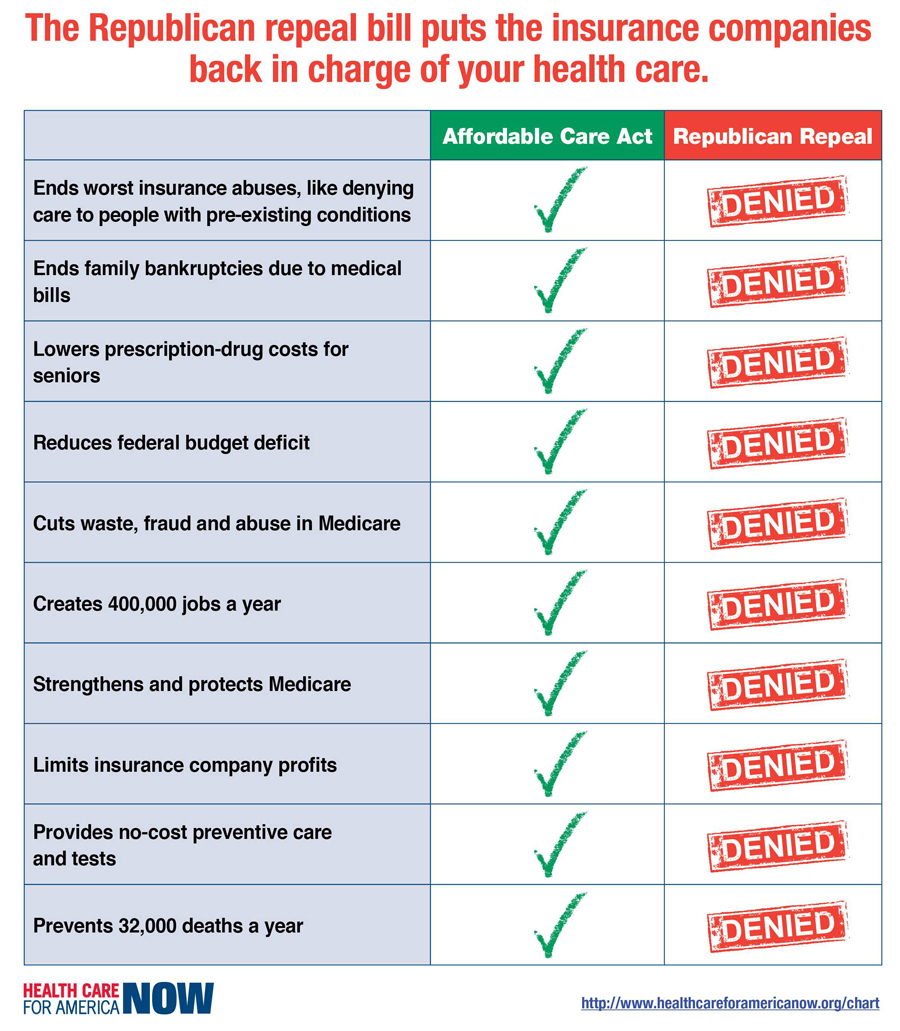
The Republican Repeal Bill
Share This Blog


 Unknown Feed
- An error has occurred; the feed is probably down. Try again later.
 mykeystrokes.com
You must be logged in to post a comment.