Pandering To The Extremists: Mitt Romney In A Time Warp
There was something almost quaint about Mitt Romney’s speech on health careThursday, as if we were watching early sound footage of Theodore Roosevelt.
Republicans no longer talk about the virtues of government social programs, especially if they intend to run for president in a party that now considers Medicare the first cousin of socialism. Yet there was Mr. Romney defending a mandate to buy health insurance as passionately as in any similar speech by President Obama.
When he was governor of Massachusetts, of course, Mr. Romney created a health care system very similar to the one championed by the president. He could have walked away from it, as he did in the 2008 presidential race, or fecklessly repudiated it, as Tim Pawlenty, the former governor of Minnesota, did in the Republican debate last week regarding his earlier support for a cap-and-trade system to reduce greenhouse gases.
This time, to his credit, Mr. Romney is standing by his record, perhaps hoping there might still be a few primary voters who appreciate candor — assuming he doesn’t pivot again in the heat of the right-dominated primaries.
Tearing it down might help him politically, he said, but “it wouldn’t be honest.” He said he did what he “thought would be right for the people of my state.” A mandate to buy insurance, he said, makes sense to prevent people from becoming free riders, getting emergency care at enormous cost to everyone else.
Where he went off the rails, however, was in not acknowledging that that same logic applies to the nation. Mr. Romney tried desperately to pivot from praising his handiwork in Massachusetts to trashing the very same idea as adapted by Mr. Obama. His was an efficient and effective state policy; Mr. Obama’s was “a power grab by the federal government.”
He tried to justify this with a history lesson on federalism and state experimentation, but, in fact, said nothing about what makes Massachusetts different from its neighbors or any other state. And why would he immediately repeal the Obama mandate if elected president? Because Mr. Obama wants a “government takeover of health care,” while all he wanted was to insure the uninsured.
That distinction makes no sense, and the disconnect undermines the foundation of Mr. Romney’s candidacy. At heart, he is still the kind of old-fashioned northeastern Republican who believes in government’s role while trying to conceal it under a thin, inauthentic coating of conservative outrage. But in its blind abhorrence of President Obama, the party has also left behind former centrists like Mr. Romney, and it is unlikely that any amount of frantic pandering about the free market will change that. He is trapped not only between the poles of his party but between eras, a candidate caught in an electoral time warp.
By: The New York Times, Editorial, May 12, 2011
Paul Ryan’s Moral Barbarism
Karl Rove’s column the other day joined the many conservatives expressing their hurt and anger that President Obama would depict Paul Ryan’s budget as harming sick and vulnerable citizens:
Mr. Obama likes campaigning more than governing. And for this president, campaigning means knocking down straw men and delivering a steady stream of misleading attacks. It means depicting opponents as indecent, heartless people who take special delight in targeting seniors and autistic children.
In fact, Obama has never accused Ryan, or anybody, of having a “special delight” in targetting seniors and autistic children. But he has accused them of pursuing policies that would harm, among others, seniors and autistic children. That’s because it’s incontrovertably true. The Center on Budget and Policy Priorities delves into the details of Ryan’s plan to slash Medicaid by more than a third over the next decade, and in half over the next two decades:
- Seniors: An overwhelming majority of Medicare beneficiaries who live in nursing homes rely on Medicaid for their nursing home coverage. Because the Ryan plan would require such deep cuts in federal Medicaid funding, it would inevitably result in less coverage for nursing home residents and shift more of the cost of nursing home care to elderly beneficiaries and their families. A sharp reduction in the quality of nursing home care would be virtually inevitable, due to the large reduction that would occur in the resources made available to pay for such care.
- People with disabilities: These individuals constitute 15 percent of Medicaid beneficiaries but account for 42 percent of all Medicaid expenditures, mostly because of their extensive health and long-term care needs. Capping federal Medicaid funding would place significant financial pressure on states to scale back eligibility and coverage for this high-cost population, many of whom would be unable to obtain coverage elsewhere because of their medical conditions.
- Children: Currently, state Medicaid programs must provide children with health care services and treatments they need for their healthy development through the Early Periodic Screening, Diagnostic and Treatment (EPSDT) aspect of Medicaid, which provides regular preventive care for children and all follow-up diagnostic and treatment services that children are found to need. A block grant would likely permit states to drop EPSDT coverage, meaning that children, particularly those with special health care needs, would not be able to access some care that medical professionals find they need (because Medicaid would no longer cover certain health services and treatments for children, and their parents wouldn’t be able to afford to pay for that care on their own).
- Working parents and pregnant women: Many state Medicaid programs already have extremely restrictive eligibility criteria for parents. In the typical state, working parents are ineligible for Medicaid if their income exceeds 64 percent of the poverty line (or $14,304 a year for a family of four), and unemployed parents are ineligible if their income exceeds 37 percent of the poverty line ($8,270 a year for a family of four). Under a block grant, states could cut these already low eligibility levels even further, cap enrollment, and/or require low-income parents to pay more for health services. States could do the same for low-income pregnant women who rely on Medicaid for their prenatal care, resulting in them forgoing services that are critical to ensuring a healthy pregnancy.
Now, Rove appears to be a pathological liar, or at least so deeply enmeshed in partisan spin it’s not clear that a distinction exists in his mind between objective truth and claims that are useful to his side. But many other conservatives have likewise expressed what has the ring of genuine outrage that Obama would accuse Ryan of snatching medical care away from people in nursing homes, very poor families, special needs children, and so on. I think it reflects, in part, an inability or lack of desire to think with any specificty about the concrete ramifications of imposing extremely deep cuts to Medicaid. Who do they think is on Medicaid? Prosperous, healthy people?
No, Medicaid is a bare-bones program throwing a lifeline to people who are in bad shape. Cutting Medicaid may be the politically easiest way for Ryan to clear budget room to preserve Bush-era revenue levels, as Medicaid patients have little political clout. But it is, well, deeply immoral. I’m actually surprised that conservatives not only can’t seem to imagine (or care about) the consequences of such policies, but they can’t even imagine that people like Obama would actually feel moral outrage at their plan. They can’t imagine a liberal objection as representing anything other than an attempt to score political points. It’s bizarre. I mean, of course Obama finds it morally objectionable to take away medical care to people in nursing homes and children with special needs. That’s why he’s a Democrat.
By: Jonathan Chait, The New Republic, May 3, 2011
Health Care Hypocrisy: How Paul Ryan And House Republicans Are Contradicting Themselves Over Medicare
In the debate over the House Republicans’ budget plan championed by Representative Paul Ryan, it’s been remarkable to watch the contortions and contradictions in the GOP on the issue of health care. The cornerstone of the Republican critique of the Affordable Care Act over the past year or so has been that it would lead to rationing. While Republicans initially manufactured lies about this issue—anyone remember death panels?—they eventually focused on one provision in the bill that was focused on cutting costs: the Independent Payment Advisory Board (IPAB). As specified in the legislation, the IPAB is a 15-member board of medical experts who are appointed by the president, confirmed by the Senate, and tasked with cutting costs in the Medicare system, unless Congress acts to alter the proposal or discontinue automatic implementation. The legislation also specifies that a goal of such cost-cutting should be to actually improve access for beneficiaries. At a time when rising health care costs are a concern for families’ pocketbooks and the federal budget, the IPAB was a means to maintain public oversight of Medicare but insulate it from the normal politics of congressional decision-making, thus helping ensure that best medicine was the driver of cost reductions.
Republicans, however, viciously attacked the IPAB as being a bunch of unelected bureaucrats making decisions to cut costs at the expense of the quality of care seniors would receive. The rhetoric became quite heated: Congressman Phil Roe went so far as to call the IPAB the “real death panel.” Other Republicans, like Representative John Fleming, likened the IPAB to communism, saying, “It will take you back to the old Soviet Union, that’s the way they did things—with a central planning committee that set prices, targeted costs.”
Now, more than a year after health care reform passed, Paul Ryan, facing stiff opposition to his plan to end Medicare as we know it, has taken to attacking the IPAB as a way to rebut his critics. He’s arguing that, while his plan would keep Medicare the same for current beneficiaries, the IPAB “puts a board in charge of cutting costs in Medicare” that will “automatically put price controls in Medicare” and “diminish the quality of care seniors receive.” It’s this sort of dishonest vitriol that has led to 73 House Republicans, as well as some Democrats, to cosponsor legislation to eliminate the IPAB.
What’s fascinating about the posture of these cosponsors is that it runs into direct conflict to the vote the House took mere days ago on the overall Ryan budget, which passed thanks to broad Republican support. Indeed, the budget, which the co-sponsors voted for, changes Medicare into a voucher program in which seniors can only choose from among private insurance options, eliminating the public insurance that is currently at the heart of Medicare. In other words, rather than public officials, elected or unelected, making decisions as to what is covered in Medicare, the Republicans just voted to more or less privatize the program. So, , after all of their complaining about how the IPAB moved too far away from public accountability, they’ve just proposed eliminating all such accountability, insisting instead that private insurance companies know best.
Would Americans really feel better with insurance companies deciding whether they or their parents get the care they need? Probably not. The truth is that Republicans are not actually worried about accountability or giving Americans more health care options. They are not even worried about cutting costs: Medicare has a much lower cost per beneficiary than private health care now, so it makes no sense to privatize it in order to lower costs. What they are worried about is public health care; they can’t stand it—and are even willing to contradict themselves and hand people’s health over to unelected, private insurers to defeat it.
By: Neera Tanden, Chief Operating Officer, Center for American Progress, April 30, 2011
The Ryan Plan For Medicaid: Not Good For Low-Income Americans Or State Budgets
With Washington looking for ways to rein in costly entitlement programs and state governments struggling to balance budgets, conservatives have revived an old nostrum: turning Medicaid into a block grant program.
The desire for fiscal relief is understandable. Medicaid insures low-income people and in these tough economic times, enrollment and costs — for the federal government and state governments — have swelled.
Representative Paul Ryan, and the House Republicans, are now proposing to ease Washington’s strain by capping federal contributions. Like his proposal for Medicare, that would only shift the burden — this time onto both state governments and beneficiaries.
Still, some governors may be tempted. His plan promises them greater flexibility to manage their programs — and achieve greater efficiency and save money. That may sound good, but the truth is, no foreseeable efficiencies will compensate for the big loss of federal contribution.
Mr. Ryan also wants to repeal the health care reform law and its requirement that states expand their Medicaid rolls starting in 2014. Once again Washington would pay the vast bulk of the added cost, so states would be turning down a very good deal to save a lesser amount of money.
Here’s how Medicaid currently works: Washington sets minimum requirements for who can enroll and what services must be covered, and pays half of the bill in the richest states and three-quarters of the bill in the poorest state. If people are poor enough to qualify and a medical service recommended by their doctors is covered, the state and federal governments will pick up the tab, with minimal co-payments by the beneficiaries. That is a big plus for enrollees’ health, and a healthy population is good for everyone. But the costs are undeniably high.
Enter the House Republicans’ budget proposal. Instead of a commitment to insure as many people as meet the criteria, it would substitute a set amount per state. Starting in 2013, the grant would probably equal what the state would have received anyway through federal matching funds, although that is not spelled out. After that, the block grant would rise each year only at the national rate of inflation, with adjustments for population growth.
There are several problems with that, starting with that inflation-pegged rate of growth, which could not possibly keep pace with the rising cost of medical care. The Congressional Budget Office estimates that federal payments would be 35 percent lower in 2022 than currently projected and 49 percent lower in 2030.
To make up the difference, states would probably have to cut payments to doctors, hospitals or nursing homes; curtail eligibility; reduce benefits; or increase their own payments for Medicaid. The problems do not end there. If a bad economy led to a sharp jump in unemployment, a state’s grant would remain the same. Nor would the block grant grow fast enough to accommodate expensive advances in medicine, rising demand for long-term care, or unexpected health care needs in the wake of epidemics or natural disasters. This would put an ever-tightening squeeze on states, forcing them to drop enrollees, cut services or pump up their own contributions.
This is not the way to go. The real problem is not Medicaid. Contrary to most perceptions, it is a relatively efficient program — with low administrative costs, a high reliance on managed care and much lower payments to providers than other public and private insurance.
The real problem is soaring medical costs. The Ryan plan does little to address that. The health care law, which Republicans have vowed to repeal, seeks to reform the entire system to deliver quality care at lower cost.
To encourage that process, President Obama recently proposed a simplified matching rate for Medicaid, which would reward states for efficiencies and automatically increase federal payments if a recession drives up enrollments and state costs. The president’s approach is better for low-income Americans and for state budgets as well.
By: The New York Times, Editorial, April 30, 2011
GOP Medicare Proposal Doesn’t Work Like Members of Congress’ Health Care As Republicans Claim
The Center for American Progress has previously pointed out that the House Republican budget for fiscal year 2012 forces future beneficiaries out of Medicare into more expensive private plans. One of the ways Republicans are trying to sell their Medicare proposal is by claiming that beneficiaries would “be enrolled in the same kind of health-care program that members of Congress enjoy.” That claim is false. In fact, if the rate of growth under this Medicare proposal were applied to federal employees’ most popular health option, the Blue Cross Blue Shield Standard Option, federal workers, including members of Congress, with family coverage would have to pay another $3,330 for the care they enjoy today. Those with individual coverage would have to pay another $1,555.
Most federal workers receive their health coverage through the Federal Employees Health Benefits Plan, or FEHBP. The government contributes a portion of their health premium. That portion is set by law and applied to the weighted average of actual premiums charged in any given year. Beneficiaries make up the rest of the cost.
The Republican budget replaces the traditional fee-for-service Medicare for future beneficiaries with a voucher to private insurance companies that is established on very different terms. Unlike FEHBP, which has a consistent government contribution based on actual premiums charged in any given year, the amount of the voucher is determined independent of actual premiums. Its growth is instead tied to the rate of the consumer price index for all urban consumers, or CPI-U. Because health costs have typically increased faster than inflation, the level of government support from the voucher would become a lower share of actual premium costs over time. In other words, Medicare beneficiaries would be left holding the bag.
What would happen if FEHBP operated like the GOP Medicare proposal?
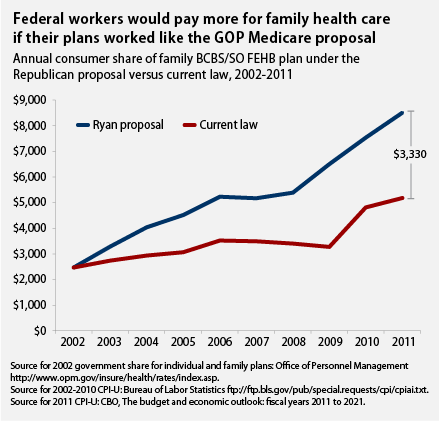
We examined what would happen if FEHBP had operated like the Republican Medicare proposal over the last decade. We used data from the Office of Personnel and Management to look at the annual premiums for federal workers enrolled in the Blue Cross Blue Shield Service Benefit Plan (Standard Family and Standard Individual). We chose this plan because nearly 60 percent of those enrolled in FEHBP have Blue Cross Blue Shield, and the Standard Option is the most popular FEHBP plan. We increased government support for the individual and family plans by the rate of growth in the CPI-U index from 2002 to 2011. We then compared the difference between the government’s share and the actual total premium in each year—which is the amount the beneficiary would pay—under the Republican proposal and the real FEHBP.

The result: A typical federal worker, or member of Congress, enrolled in family coverage in the Blue Cross Blue Shield Standard Option, would have had to pay an additional $3,330.36 for the same level of coverage they have today. Those with individual coverage would have had to pay $1,555 more.
By: Nicole Cafarella, Payment Reform Manager and Policy Analyst and Tony Clark, Policy Analyst, Center for American Progress, April 27, 2011
Share This Blog


 Unknown Feed
- An error has occurred; the feed is probably down. Try again later.
 mykeystrokes.com
You must be logged in to post a comment.