“Keeping Desperation As High As Possible”: Why The Greedy Upper Class Loves The GOP
Last week, Reihan Salam took a whack at America’s upper class in Slate. His charge? That the upper class uses its considerable political clout to protect itself from competition and keep its own incomes high, thus making life harder on everyone else further down the economic ladder. And he’s not wrong!
But Salam is also a conservative, with a conservative’s standard desire for low taxes, few regulations, and a skimpy social safety net. And what he conveniently leaves out of his screed is the fact that these preferences are themselves the ultimate expression of upper-class greed and self-dealing.
Let’s start with what Salam gets right. He points out that licensing and accreditation laws protect professions like dentists, lawyers, electricians, hairstylists, and the like from competition, which raises the costs of services they provide and prevents other workers from breaking into the market. The local land-use restrictions and zoning regulations that many in the upper class favor drive up housing prices, which makes it harder for the lower class to live in good neighborhoods with good schools, or to benefit from the economic development that comes with gentrification. The upper class seems implicitly content with an immigration status quo that maximizes competition in working-class jobs while minimizing it among high-skill professions. And of course there was the recent collapse of President Obama’s proposal to raise new tax revenue from 529 college savings accounts, a self-interested revolt of the upper class if ever there was one.
However, if you read between the lines, Salam isn’t really talking about the upper class writ large here. He’s talking about the liberal upper class. The issues he cites are mainly a big deal in cities, where liberals cluster. And conservative commentary in general these days has a tendency to talk about the American upper class as if it’s populated entirely by liberal yuppies who love yoga, organic food, Neil deGrasse Tyson, and abortions, and who think that guns are barbaric and that religion is backwards.
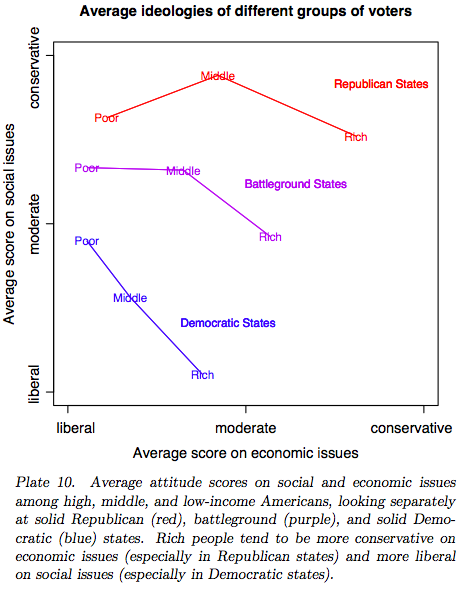
As it happens, however, the GOP relies on the upper class even more than Democrats. Median household income in the United States is $52,250, and if you look at the 2012 election, voters below that mark broke hard for Obama, with those above going for Mitt Romney by lesser margins. This trend of the Democrats getting way more votes below the median income level has roughly held for decades. These days, strong support for Republicans really doesn’t kick in until you get close to $75,000, or roughly the top third of the income ladder.
The difference between the parties is not that one relies on the wealthy and one doesn’t. Both parties lean heavily on those voters and divvy them up in various ways. (Mainly through cultural and social issues.) But the Democrats’ coalition also includes a fair portion that’s lower and working class, that’s still fighting for attention in the party, and that occasionally gets it. Conversely, lower- and working-class voters are mostly just absent from the GOP.
This matters because the upper class also has a pretty distinctive set of economic policy preferences. According to a recent study by Pew, the most financially secure Americans — roughly a fourth to a third of the population, by Pew’s definition — disproportionately say that government can’t afford to do more to help the needy, and that poor people “have it easy” thanks to government benefits. The less financially secure think the opposite. Large majorities of those making below $75,000 say the thing that bothers them the most about taxes is that the wealthy don’t pay their fair share. Large majorities of Americans oppose cuts to everything from Social Security and Medicare to aid for the poor. They support making union organizing easier and more federal spending on education.
Hell, 57 percent of the Republican or Republican-leaning voters who do make less than $30,000 think government doesn’t do enough to support poor people.
The reason the GOP can get away with being on the opposite side on all these matters is the fact that the voting population skews upper class: Even Democrats in the top third of the income distribution are noticeably more economically right-wing than poorer Democrats or Republicans, and Republicans in the top third are really economically right-wing.
There’s a pretty straightforward argument for why the upper class tilts in this direction. As Salam notes, the policy preferences of the upper class that really stick in his craw boil down to protecting their incomes and thus making the goods and services they provide more expensive for everyone else. But the flip side of that is making sure the goods and services everyone else provides — and thus their incomes — come cheap. That’s where the GOP comes in.
The essence of worker bargaining power is the ability to tell an employer “no.” That forces business owners to offer a better deal, driving up wages and benefits. A broad and generous welfare state gives workers leverage in that regard. It also helps boost aggregate demand, getting us closer to the full employment that really gives workers an edge. In short, the income of the working class is inversely proportional to its level of economic desperation. The effect of conservatives’ preferred economic policies — from slashing spending to imposing work requirements for aid — is to keep that desperation as high as possible. And of course, the upper class certainly doesn’t want to shoulder the taxes necessary to make such a system work.
The thing to remember is that, when it comes to what to do with the working class, the interests of the upper class and the super-rich cohere. Whether you’re a corporate CEO, a small-business owner, or just a well-heeled professional who consumes a lot of high-end goods and services, it benefits you to keep the labor of everyday Americans as cheap, compliant, and disposable as possible. It’s true, as Salam notes, that the truly rich aren’t quite as desperate to defend their interests as the upper class is; if you’ve got Mitt Romney’s dough, you can put up with more taxes, regulations, and workers demanding dignified pay and good benefits.
But that just bolsters the point that the fervent bastion of the economic right is the upper class. They’ve got the most to gain by slashing taxes, cutting regulations, scrapping government aid programs, and busting unions.
As Salam acknowledges, he doesn’t want high taxes on the wealthy, or for America to go down the road of the big European welfare states. His fellow reform conservatives and the Republican Party agree with him in this regard. Salam then says of the upper class: “I sensed that their gut political instincts were all about protecting what they had and scratching out the eyeballs of anyone who dared to suggest taking it away from them.”
But aren’t conservative economic policies the perfect expression of that exact impulse?
By: Jeff Spross, The Week, February 3, 2015
“Mollifying The Extremists”: GOP Back To ‘Impeachment,’ ‘Jail Time’ For Obama
As the 2014 cycle progressed, the number of congressional Republicans talking about impeaching President Obama faded, and there’s no real mystery as to what happened. GOP leaders, fearing a public backlash, told Republican incumbents and candidates to dial it down a notch. Why rile up Democrats, who too often stay home in midterm cycles, when they’re tuning out?
And as a consequence, for months, the “i” word more or less faded. That is, until very recently.
Last week, Rep. Brian Babin (R-Texas), less than a month into his first term in Congress, announced his belief that President Obama, without a doubt, “deserves impeachment.” He’s not the only one talking like this.
Republican Rep. Tom Marino of Pennsylvania says President Obama is “getting close” to impeachment. “People say, ‘should the president be impeached?’ I say, we’re getting close to that,” Marino said in a video posted on YouTube Wednesday by the local newspaper, the Wellsboro Gazette.
Marino said he was talking about impeachment because “it comes up consistently at town hall meetings.”
Well, that’s a good reason. Marino was a little fuzzy on what, exactly, would be the grounds for presidential impeachment, but for many GOP lawmakers, that’s a minor and inconvenient detail that shouldn’t interfere with reckless rhetoric.
Rep. Mo Brooks (R-Ala.), meanwhile, has no use for subtlety and is already talking publicly about “jail time” for the president:
In an appearance on “The Steve Malzberg Show” [Tuesday], Rep. Mo Brooks, R-Ala., continued his crusade against President Obama’s executive actions on immigration reform, calling on the federal courts to find that the president’s actions violated the law.
If Obama defies such a ruling, Brooks said, then Congress should pass a contempt citation against the president for his “reckless conduct” and demand that he comply with the court’s decision.
He said that Obama would then drop his executive actions since he, like Richard Nixon, doesn’t want to “incur the wrath that comes with a contempt citation with potential fines and jail time.”
At this point, I still consider it unlikely that GOP leaders will go along with the far-right’s impeachment crusade, but conservative media appears to be on board, and the number of congressional Republican talking up the idea since the elections keeps growing.
Even if party leaders balk, this only means they’ll have to think of something else to mollify the extremists in their midst, and pointless anti-Obama lawsuits probably won’t cut it.
By: Steve Benen, The Maddow Blog, February 4, 2015
“Highly Situational Principles”: How The Vaccine Controversy Shows The Limits Of GOP Libertarianism
As a demonstration that anything can become political and you never know what issue is going to take over a campaign, every potential presidential candidate is now thinking very carefully about what they should say on the topic of childhood immunizations. Chris Christie kicked things off when he answered a question about a spreading measles outbreak with some comments about parental choice that he sort-of walked back, but the real news came when Rand Paul — a graduate of Duke University medical school, which I’m fairly certain is a real thing — gave an interview to CNBC in which he said, “I’ve heard of many tragic cases of walking, talking, normal children who wound up with profound mental disorders after vaccines.”
Needless to say, this is utterly bogus. What Paul should have noted was that this question has been studied exhaustively, and there is no evidence whatsoever that vaccines cause autism or any other “mental disorder.”
But if you thought that every GOP candidate would be rushing to pander to people’s fears about big government forcing them to stick needles in their kids, you’d be wrong. In fact, the ones we’ve heard from so far have been clearly pro-vaccine. And this shows just where the limits of libertarianism within the Republican Party are.
As the New York Times noted this morning, Mike Huckabee has in the past advocated that vaccines be widely used, and specifically dismissed the debunked connection to autism, while Rick Perry has also touted his administration’s efforts to increase vaccination. You’ll recall that Perry was criticized by his Republican opponents in 2012 for mandating that girls in Texas public schools receive the HPV vaccine (though he eventually reversed himself when he was convinced by other Texas conservatives that giving a 10-year-old girl a shot to prevent her from getting cervical cancer after she becomes an adult would obviously turn her into a sex maniac). Ben Carson also made clear that mandatory vaccination is critical to preventing disease, no matter what religious or philosophical objections people might have. John Boehner too said that every child should be vaccinated.
While there are a few candidates we haven’t yet heard from, it may be surprising that Paul isn’t getting more company; indeed, he’s probably surprised, given how much Republicans have talked about individual liberty in the last few years. Paul doesn’t deny that there are risks to not vaccinating children, but he says that it’s a matter of personal freedom: parents, not the government, should make the choice. However, it turns out that other Republicans don’t agree. In this case they believe that the welfare of the community trumps the individual’s right to decide.
What that tells us is that the broader Republican commitment to libertarian principles is highly situational. Libertarians laud themselves for their philosophical consistency (though Rand Paul is a quasi-libertarian at most), but ordinary conservatives are picking and choosing based on who’s getting what and who’s paying what. In the case of something like guns, where there’s an analogous situation (individuals want to make a choice that potentially endangers others), conservatives see the gun owner getting a benefit, and one many of them enjoy. When they say that companies should be released from environmental regulations, they’re thinking about people and organizations they admire getting the benefit of unconstrained market freedom, and the cost (environmental degradation) is something they’re only marginally concerned about.
But in the case of vaccines, the beneficiaries are a bunch of wackos and conspiracy theorists who are gaining nothing more than the ability to endanger their own children, at the cost of endangering everybody else’s children. And I’m guessing it also matters that a lot of the vaccine truthers who get attention are liberals, the Marin County types who think that because they feed their children organic food that the kids will have super-charged immune systems and therefore can’t become sick. (It should be noted that vaccine trutherism is a non-partisan affliction: liberals are no more likely than conservatives to think vaccines cause autism.)
What’s more, while it’s also true that advocating for vaccines requires conservatives to agree with Science, this issue isn’t like climate change, where many on the right think the entire scientific community is engaged in a vast conspiracy of deception. On climate, people fear that they’ll lose something (like their SUVs) and have to change their lifestyle in order to address the problem; the issue also threatens their traditional allies in the energy industry. There are few such considerations in the vaccine issue.
So the vaccine issue demonstrates that while nearly every Republican agrees with libertarian ideas on some issues, this doesn’t necessarily reflect just an inviolable philosophical commitment to individual liberty. When being a libertarian means getting something they want without having to give up anything they like, they’re happy to wave the anti-government flag. But if it means their kids might get sick because some people are dumb enough to take their medical advice from Jenny McCarthy, the needs of the many begin to look much more pressing than the delusions of the few.
By: Paul Waldman, Senior Writer, The American Prospect; Contributor, The Plum Line, The Washington Post, February 3, 2015
“Why Obama’s Budget Matters”: Differences Within The GOP That Could Be Finessed In The Past Will Have To Be Dealt With Openly
When President Obama releases his budget on Monday, the words “dead on arrival” will be widely incanted because they are part of a quasi-religious Beltway ritual.
This year, those words will be misleading.
No one expects Obama’s budget to be enacted as he proposes it. Republicans responded even to early outlines of his plan with a wall of opposition. But this time around is different because, paradoxically perhaps, the fact that Republicans control both the House and Senate makes Obama’s role more rather than less important.
For the last four years, the budget game was three-cornered. The president played alongside an often radically conservative Republican House and a Democratic Senate with views of its own. Now, Obama’s plan will be the main public alternative to whatever the Republicans decide to do.
Moreover, the Republicans are responsible for passing a budget through two houses, so differences within the GOP that could be finessed in the past will have to be dealt with openly.
The most obvious will be on whether to continue cuts in the defense budget prescribed under the so-called sequester enacted in 2011. GOP defense advocates want to raise Pentagon spending substantially, libertarians want to keep both domestic and military spending low, and many mainstream conservatives will try to cut domestic spending even more to accommodate defense increases. The third option will almost certainly be a non-starter, not only with the president — he has a veto and will insist that any cuts be balanced between the two sides of the ledger — but also with many in the GOP rank-and-file.
Obama has declined to offer premature concessions to the Republicans in his own proposal, which further clarifies the stakes. At the same time, he has made things trickier still for his opponents by putting many of his ideas in a form that Republicans have supported in the past. That’s true even of some of his tax proposals.
The president is aware that the most damaging alliance in Washington has been the one between establishment deficit hawks, who continue to think that long-term deficits are the premier economic issue before the country, and Republican conservatives, who have used the legitimate concerns of the deficit hawks to justify deep cuts in government programs without any offsetting increases in revenues.
The president will call this bluff by putting $1.8 trillion in long-term deficit reduction on the table. But most of it will come on the revenue side. His argument here is straightforward: The bulk of the deficit reduction in the deals reached since 2011 has come from cuts in discretionary spending — that is, almost everything except the big retirement programs — which is now at its lowest level as a share of GDP in decades.
The deficit hawks who aren’t part of the ideological assault on the public sector know that the basic functions of government have already been cut too much and that some new domestic spending, particularly for infrastructure, is essential. Obama calls the question: If additional revenues are unacceptable, how is deficit reduction supposed to be achieved? There can’t be any “grand bargains” until conservatives acknowledge upfront that tax increases of some kind need to be part of any long-term solution.
But the biggest challenge to Republicans may be whether they are willing to go along with Obama on ideas that are plainly in their wheelhouse. One small but significant hope: Rep. Paul Ryan (R-WI) and Sen. Patty Murray (D-WA) have been pushing the idea that we need more evidence-based policymaking, and Obama is joining their campaign. This sounds like a no-brainer, but much needs to be done to integrate concerns about what works and what doesn’t into our governing routines.
Republicans have been trying hard to tout their concern about income stagnation and an increasingly frozen class structure. Obama will be pushing for a new initiative, “The Upward Mobility Project,” to provide more flexibility to local officials in a set of government programs if they can show how their efforts will help people climb occupational and income ladders. Projects of this sort are exactly what we should be thinking about.
When budget fights become melodramas over whether the government will shut down or default, we lose track of what the exercise is supposed to be about. Obama’s opening bid ought to be the start of a back-to-basics debate — an argument that will extend into the 2016 campaign — over what we actually want government to do, and how we propose to pay for it.
By: E. J. Dionne, Jr., Opinion Writer, The Washington Post; The National Memo, February 2, 2015
“Heading Towards A GOP Train Wreck”: You’re Going To See The Republican Party With All Their Clothes Off
Does anyone else see a train wreck coming for this Republican Congress?
House Ways and Means Chair Paul Ryan (R-WI) will lead along with two other top committee chairs a Republican task force to come up with a plan in case the Supreme Court strikes a blow to Obamacare later this year…
They will be tasked with working up an alternative plan if the Supreme Court invalidates tax credits in the 30-plus states that use HealthCare.gov, as well as a more general Obamacare alternative if the law were to be repealed…
Coming in the opposite direction is this train:
There is internal dissent on whether Republicans ought to come up with an alternative. One congressional GOP health aide, who was granted anonymity to speak candidly, said his party is as determined as ever to fight Obamacare, and will remain so as long as it exhibits failure. He said devising an alternative is fraught with the difficulty of crafting a new benefits structure that doesn’t look like the Affordable Care Act.
“If you want to say the further and further this gets down the road, the harder and harder it gets to repeal, that’s absolutely true,” the aide said. “As far as repeal and replace goes, the problem with replace is that if you really want people to have these new benefits, it looks a hell of a lot like the Affordable Care Act. … To make something like that work, you have to move in the direction of the ACA. You have to have a participating mechanism, you have to have a mechanism to fund it, you have to have a mechanism to fix parts of the market.”
Pushing on the accelerator of both trains is this:
Leaders in the GOP-controlled House and Senate see the court challenge as their best hope for tearing apart a law they have long opposed. If the court strikes down the subsidies, Democrats are expected to clamor for lawmakers to pass a measure correcting the language in the law to revive them. Congressional Republicans say there is no possibility they would allow that.
“No, no, no, no;” said Sen. Dan Coats (R., Indiana).
Rep. McDermott came up with a different analogy.
GOP congressional leaders haven’t coalesced around a specific replacement for the law should the court strike down the subsidies. Democrats say that makes them vulnerable, and plan to paint the GOP as responsible for taking away benefits that millions already receive.
“What you’re going to see is the Republican party with all their clothes off,” said Rep. Jim McDermott (D., Wash.) “They are standing out there naked as a jaybird and they are going to have to stand up and explain, ’Well, now we got rid of it – now what do we do?’”
It would all be humorous if it weren’t so terribly tragic.
By: Nancy LeTourneau, Political Animal Blog, The Washington Monthly, January 31, 2015
Share This Blog


 Unknown Feed
- An error has occurred; the feed is probably down. Try again later.
 mykeystrokes.com