Mr. Gingrich’s Intolerant History: A Presidential Bid Built On Divisiveness And Name-Calling
Newt Gingrich, the former House speaker and latest entrant in the Republican presidential field, has money, experience and name recognition. His introductory videois all serenity and hope, a deceptively calm way for many voters to meet a splenetic politician with a long history of slashing divisiveness and intolerance.
He refers to himself as a historian, but apparently his personal study of history has primarily taught him about the effectiveness of demagogy. Donald Trump, fiddling with birth certificates, is an amateur compared with Mr. Gingrich at sliming the Obama administration — as well as Democrats, Muslims, blacks and gay men and lesbians.
The Democrats who won in 2008, including President Obama, are “left-wing radicals” who lead a “secular socialist machine,” he wrote in his 2010 book, “To Save America.” He accused them of producing “the greatest political corruption ever seen in modern America.” And then the inevitable historical coup de grâce: “The secular-socialist machine represents as great a threat to America as Nazi Germany or the Soviet Union once did.”
The slurs don’t stop there. He compared the Muslims who wanted to open an Islamic center in Lower Manhattan to the German Reich, saying it “would be like putting a Nazi sign next to the Holocaust Museum.” He is promoting the fringe idea that “jihadis” are intent on imposing Islamic law on every American village and farm.
Last year, he called for a federal law to stop the (nonexistent) onslaught of Sharia on American jurisprudence and accused the left of refusing to acknowledge its “mortal threat to the survival of freedom in the United States and in the world as we know it.” This nuanced grasp of world affairs was reinforced when he said that Mr. Obama displayed “Kenyan, anti-colonial behavior.”
In his world, advocates for gay rights are imposing a “gay and secular fascism” using violence and harassment, blacks have little entrepreneurial tradition, and Justice Sonia Sotomayor of the Supreme Court is a “Latina woman racist.” (He kind of took back that last slur.)
Despite all this, not to mention the ethics violation when he was speaker, Mr. Gingrich’s real liability among the conservative and fundamentalist groups that dominate the Republican primaries is his personal history of infidelity that led to two sordid divorces. (Much of which took place while he was denouncing President Bill Clinton for moral transgressions.) That may explain his endless calls to restore Judeo-Christian values.
It is sometimes difficult to know what some Republican candidates stand for, as they pander to the far right without alienating the center. It is not difficult to know what Newt Gingrich stands for, and to find it repellent.
By: The New York Times, Editorial, May 12, 2011
A Catastrophe For America: Liberals Should’t Even Consider Gloating About Donald Trump
Now that Donald Trump appears on the verge of launching a presidential campaign, it is worth reflecting on the meaning of this low moment in American political history. Trump is a clown and a buffoon, and the odds of him winning even one Republican caucus or primary appear slim. But there is no denying that Trump has managed to tap into something genuinely worrisome in American politics. Democrats may be tempted to take pleasure in the fact that Trump will likely push the GOP presidential field to the right, and thereby help Obama in 2012. But this would be sheer myopia, and any delight over Trump’s arrival on the political scene is entirely misplaced. The Trump ascendancy calls not for glee, but for serious concern about the state of our country.
It’s true that the media erred in awarding Trump such a large spotlight—did all the cable news networks really have to cover his press conference on Wednesday?—but, at this point, the Trump phenomenon does not seem to be a mere media creation. His popularity (he currently leads in several polls) can no longer be denied. So what is Trump’s appeal? Why do his message and vulgar personality resonate with such a significant percentage of Americans? Trump’s embrace of birtherism has been the most widely discussed aspect of his rise. But this only scratches the surface of the Trump phenomenon.
What Trump actually stands for is an exaggerated sense of victimhood. This is the theme that unites his personal style with the political views he has thus far expressed. Are you tired of being pushed around? Are you tired of our country being pushed around? Trump’s political acuity lies in his ability to take these grievances and turn them into politics. His foreign policy views in essence consist of a pledge to bully other nations.Chinais “decimating our country.” OPEC is imperiling the economy. And ungrateful Libyans and Iraqis are trying to build a society from oil that is rightfully ours. (“We won the war. We take over the oil fields. We use the oil.”) When Bill O’Reilly, in an interview with Trump, seemed taken aback by the idea that we could simply force OPEC orChinato do our bidding, Trump appeared surprised that anyone could view international relations as anything more than a contest of machismo. “The messenger is the key,” Trump told O’Reilly. “If you have the right messenger and they know how to deliver the message … you’re going to scare them, absolutely.”
Trump’s thinly veiled accusation that President Obama benefited from affirmative action when he applied to college derives from the same theme. This time the victims aren’t Americans as a whole, they are white Americans; but the message—of anger, resentment, and victimhood—is identical.
Americais currently engaged in three wars. The country faces major economic challenges. Global warming is continuing apace. There is no chance any of these issues can be solved by yelling at foreign countries, or stirring up anger at Iraqis or Libyans or minority applicants to elite colleges. Donald Trump has appointed himself spokesman for some of the nastiest impulses in American politics, and he seems to have a following. The sooner the Republican mainstream rejects him, the better. And we liberals should be cheering them along as they do.
By: The Editors, The New Republic, April 29, 2011
GOP Presidential Contenders Compete To Win Over “The Political Army Of The Lord”
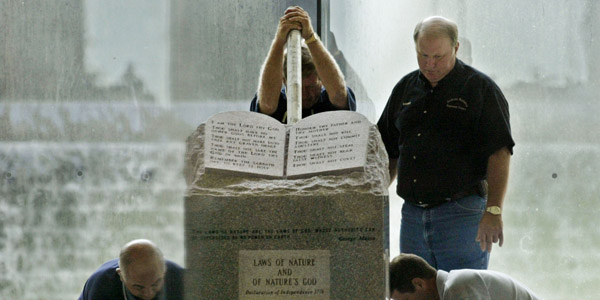
Workers remove a monument of the Ten Commandments from the rotunda of the Alabama Judicial Building after Superior Court Justice Roy Moore refused to take it down in 2003
So you can add another car to the crazy train that is the 2012 Republican presidential nominating contest. No, I’m not talking about last week’s sensation, Donald Trump. He’s a pretty conventional figure compared to the latest would-be president, former Alabama Supreme Court Chief Justice Roy Moore, who is currently barnstorming through Iowa after announcing an exploratory committee.
You may remember Judge Moore as the man who was forced from his judicial post after refusing to remove a gigantic monument to the Ten Commandments from his courthouse. He was also known for abrasive comments from the bench about homosexuality as contrary to God’s will, which in Moore’s opinion was dispositive. A martyr for theocrats everywhere, Moore spent some time hauling his monument around Alabama before launching two notably unsuccessful gubernatorial races — coming in a bad second in 2006’s Republican primary and a bad fourth in 2010 — and becoming a minor fixture at tea party events.
Moore was undoubtedly drawn to Iowa by that state’s furor over same-sex marriage, decreed legal by a 2009 state Supreme Court ruling. Iowa’s powerful Christian Right movement has made overturning that decision Job One, beginning with a successful effort in 2010 to remove three of the seven jurists responsible for it. It’s one of the few places left where Republicans don’t try to ignore the whole issue of gay rights as a divisive loser of an issue (which is why presidential wannabees like Tim Pawlenty have anachronistically come out against the repeal of “don’t ask, don’t tell). For Moore, it must have felt more like “home” than home.
Before writing off Moore as a kook trying to horn in on the spotlight of a presidential race, consider the company he’s keeping on his tour of the first-in-the-nation-caucuses state: former state legislator Danny Carroll. Carroll was co-chairman (with three-time gubernatorial candidate Bob Vander Plaats) of Mike Huckabee’s successful 2008 Caucus campaign, and more recently, signed on as a lobbyist for Vander Plaats’ new Christian Right umbrella group, The Family Leader. He’s a reasonably big deal in Iowa GOP circles, and by no means someone who howls at the moon.
For all I know, Carroll sees something in the crusty Alabama judge that others haven’t seen. Or maybe Judge Moore is a convenient stalking horse for Huckabee, designed to keep The Faithful loose and out of anyone else’s camp, in case Huck ultimately decides to run.
Regardless of Carroll’s (or Moore’s) personal motives, it’s likely the national Republican chattering class will dismiss the Judge’s campaign as a joke even worse than Trump’s. Or, it may be said, there is now such a crowd on the far right that opportunities are opening up for more moderate possibilities like Romney, T-Paw or an establishment-backed candidate-yet-to-be-named.
But I’d like to suggest another theory: the Christian/tea party right in Iowa is big enough, powerful enough, and politically sophisticated enough to hold its own caucus-within-a-caucus (well, caucuses, to be technical about it), an intramural contest to determine which candidate will actually represent the cause when Iowa Republicans make their final commitments before Caucus Night. Proven zealots like Michele Bachmann, Herman Cain, and now Moore, will joust with more suspect supplicants like T-Paw, Newt Gingrich — and maybe even Donald Trump! — over the next few months, with someone emerging as the designated favorite of the political army of the Lord. That is arguably what happened in Iowa in 2008, when Huckabee and Sen. Sam Brownback fought to become the Christian Right alternative to Mitt Romney, with Huckabee becoming The Man only after he out-organized Brownback at the State Party Straw Poll in Ames during the summer.
Moore’s candidacy may not ultimately have any direct influence on what happens next winter in Iowa, when conservative evangelicals and conservative Catholics get together to shape the 2012 Republican nominating process.
But he could indeed intensify the competition for Christian Right voters. And just as importantly, he could definitely serve as a symbol of the ideological and psychological gap between rigorous conservative activists and the mainstream political commentariat. Most of the latter think Moore is a crazy person. But most of the Iowa audiences before which Moore speaks will consider him an authentic if polarizing voice expressing the Word of God. That’s a pretty big gulf in perception, but also a pretty good reflection of the real differences Americans experience in how they view their leaders.
By: Ed Kilgore, Managing Editor of The Democratic Strategist and Senior Editor, Progressive Policy Institute. Article published in The Atlantic, April 20, 2011: Photo by Tami Chappell (Reuters)
Sarah Palin: You Becha, “I Am AFP”…”All For Profit”
Former half-term Gov. Sarah Palin (R) — remember her? — headlined a conservative rally in Madison yesterday, apparently hoping to generate support for Wisconsin Gov. Scott Walker’s (R) far-right agenda. More interesting than the message, though, was the turnout.
Attendees heard fairly predictable rhetoric. Palin, for example, insisted that Walker’s anti-union agenda is “not trying to hurt union members.” The Fox News personality also excoriated congressional Republicans for not being even more intransigent. The whole thing was organized by the Koch brother’s right-wing Americans for Prosperity, and Palin spoke behind a podium with a sign that read, “I am AFP.”
But who exactly heard all of this?
Away from the stage, the passionate arguments went right on, each side claiming the upper hand, the larger crowd, the right side of history. The police estimated a crowd — at its highest point — of about 6,500 people, though it was uncertain how many of those were Tea Party supporters and how many were there to protest. Either way, the figure was far smaller than the tens of thousands of demonstrators that had been reported around the Capitol on several days in recent months.
At the height of progressive protests in February and March, tens of thousands braved the elements to condemn the Walker agenda — and wouldn’t leave. Yesterday, Palin led a parade of odd right-wing figures, at an event paid for by powerful billionaires, and about 6,500 people showed up.
And of those 6,500, most of those in attendance were there to oppose Palin and her far-right allies, not support them.
It’s a reminder about the changing tide. When Tea Partiers organize a rally and bring one of their highest-profile stars to headline, but are nevertheless outnumbered at their own event, which suffered from poor attendance anyway, it’s not a good sign.
By: Steve Benen, Washington Monthly, Political Animal, April 16, 2011
Flirting With The Fringe: Stop Pretending Michele Bachmann Can Win The Iowa Caucuses
Ever since Michele Bachmann announced her intention to form a presidential exploratory committee, pundits, including Ed Kilgore at TNR, have been making the case that she has a good chance at winning Iowa—or if not winning, then doing well enough to hurt one or more of the stronger candidates. Republican caucus-goers in the state, they argue, are at least half-nuts, and therefore may well support Bachmann or some other candidate who doesn’t pass conventional standards of seriousness.
Certainly, Iowa Republicans are very socially conservative, more so than in some other states. But a closer look at Iowa caucus history shows that their history of supporting fringe candidates is not quite what it’s made out to be.
The case that “wacky Iowans will do anything” essentially comes down to interpreting a handful of episodes from recent decades. The first occurred in 1988 when Pat Robertson stunned everyone by finishing second with 25 percent of the vote, besting George H.W. Bush and Jack Kemp. But Pat Robertson was a social conservative—and no ordinary one at that—in a year in which the frontrunner (George H.W. Bush) was not. Moreover, that example is now over two decades old, and since then Iowa Republicans have had no trouble voting for mainstream candidates with conventional credentials, as long as those candidates—Lamar Alexander, George W. Bush—had solid records on social conservative issues.
That leaves us with three other supposed episodes of Iowan craziness: Pat Buchanan’s second place finish in 1996; the surprising showings of fringe candidates Alan Keyes and Gary Bauer in 2000; and Huckabee’s victory in 2008. Closer inspection of each of these episodes, however, reveals that none were quite as crazy as they appear.
Take Pat Buchannan in 1996. As odd as it might seem now, he was almost a serious candidate at the time: He had already run for president in 1992, and while he was never quite a plausible nominee, he did have some serious claim as a repeat candidate that Bachmann doesn’t have now. Nor was Buchannan’s success in Iowa especially unique. In fact, he proceeded to win the primary in New Hampshire, and wound up beating his Iowa percentage in sixteen states (several of those, to be sure, were after other candidates had dropped out, so the higher percentage was less impressive).
As for Alan Keyes and Gary Bauer in 2000, they certainly were fringe candidates—even more so than Bachmann—and their combined 25 percent was both impressive and anomalous; they combined for only 7 percent in New Hampshire, although Keyes did have some stronger showings in late states after the nomination was decided. However, it’s also the case that they didn’t have a whole lot of competition. John McCain campaigned in Iowa in 2000, but he did not fully commit to the state, and the only other candidate they beat was Orrin Hatch, who hardly ran any campaign at all. And even with their totals combined, Keyes and Bauer finished well back of Steve Forbes for second, and even further behind winner George W. Bush.
Finally, there’s Huckabee’s surprise victory in 2008; but the extent to which his candidacy was in any way similar to Bachmann’s has been vastly overstated. Yes, he won with the support of social issues voters. But Huckabee wasn’t some backbench member of the House; he was a recent former governor, and, in that sense, just as legitimate a candidate as Jimmy Carter or Bill Clinton.
Compared to Huckabee, Michele Bachmann is an altogether different sort of candidate. Since 1972, no candidate in any way similar has run a competitive campaign. The only three members of the House who had plausible shots at winning—Mo Udall in 1976, Jack Kemp in 1988, and Dick Gephardt in 1988 and 2004—were all senior members with leadership positions, legislative accomplishments, or both. No, Bachmann belongs in a different category, with other sideshow acts who may attract attention but have no real chance to win the nomination. And even in allegedly crazy Iowa, those candidates rarely impress on caucus day.
By: Jonathan Bernstein, The New Republic, April 16, 2011
Share This Blog


 Unknown Feed
- An error has occurred; the feed is probably down. Try again later.
 mykeystrokes.com
You must be logged in to post a comment.