Wisconsin Recalls Are Heating Up
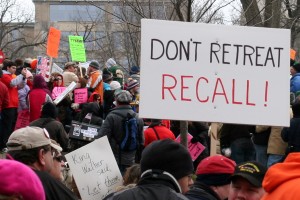
Recent protests at WI capitol
Recall elections loom on the horizon as petitions against nine Wisconsin state senators were recently submitted to the Government Accountability Board (GAB). Each successful petition must include 25 percent of the total number of votes cast in that senate district in the last election.
The recall efforts of Republican senators who supported Gov. Scott Walker’s Budget Repair Bill, and the Democratic senators who left the state to delay voting on the bill, are a result of the political firestorm that quickly flared up over the bill that sought to eliminate almost all collective bargaining rights for public workers.
Currently, the Republican senators who are facing a recall election are Alberta Darling, Robert Cowles, Sheila Harsdorf, Luther Olsen, Randy Hopper and Dan Kapanke. Democrats are facing recall efforts are — Dave Hansen, Jim Holperin and Robert Wirch.
The Milwaukee Journal Sentinel reported that there have also been petitions that didn’t have enough signatures on them to spark a recall. Democratic senators Lena Taylor and Spencer Coggs (both from Milwaukee), Senate Minority Mark Miller (Monona) and Fred Risser (Madison) all have all survived the recall attempts against them. Recall efforts against Republicans Glenn Grothman (West Bend) and Mary Lazich (New Berlin) also failed to garner sufficient support.
Circulators hired by the state Republican Party have submitted “hundreds if not thousands of invalid signatures” in recall drives targeting three Democratic state senators. Volunteers have been working overtime to enter each name into a data base and cross-check it with the phone book and other record. One man who signed a recall petition was Bill Pocan, the deceased father of State Representative Marc Pocan. The Wisconsin Democratic Party (DPW) is formally challenging all three of the recall petitions filed against Democrat senators.
Republicans have filed challenges against “all petitions targeting GOP senators. In addition to their individual signature challenges, they claim the GAB should throw out the petitions because the recall organizers did not properly register with the state.” The elections for recalled legislators with completed petitions will likely be held July 12, 2011.
By: Jennifer Page, Center for Media and Democracy, May 6, 2011
A Catastrophe For America: Liberals Should’t Even Consider Gloating About Donald Trump
Now that Donald Trump appears on the verge of launching a presidential campaign, it is worth reflecting on the meaning of this low moment in American political history. Trump is a clown and a buffoon, and the odds of him winning even one Republican caucus or primary appear slim. But there is no denying that Trump has managed to tap into something genuinely worrisome in American politics. Democrats may be tempted to take pleasure in the fact that Trump will likely push the GOP presidential field to the right, and thereby help Obama in 2012. But this would be sheer myopia, and any delight over Trump’s arrival on the political scene is entirely misplaced. The Trump ascendancy calls not for glee, but for serious concern about the state of our country.
It’s true that the media erred in awarding Trump such a large spotlight—did all the cable news networks really have to cover his press conference on Wednesday?—but, at this point, the Trump phenomenon does not seem to be a mere media creation. His popularity (he currently leads in several polls) can no longer be denied. So what is Trump’s appeal? Why do his message and vulgar personality resonate with such a significant percentage of Americans? Trump’s embrace of birtherism has been the most widely discussed aspect of his rise. But this only scratches the surface of the Trump phenomenon.
What Trump actually stands for is an exaggerated sense of victimhood. This is the theme that unites his personal style with the political views he has thus far expressed. Are you tired of being pushed around? Are you tired of our country being pushed around? Trump’s political acuity lies in his ability to take these grievances and turn them into politics. His foreign policy views in essence consist of a pledge to bully other nations.Chinais “decimating our country.” OPEC is imperiling the economy. And ungrateful Libyans and Iraqis are trying to build a society from oil that is rightfully ours. (“We won the war. We take over the oil fields. We use the oil.”) When Bill O’Reilly, in an interview with Trump, seemed taken aback by the idea that we could simply force OPEC orChinato do our bidding, Trump appeared surprised that anyone could view international relations as anything more than a contest of machismo. “The messenger is the key,” Trump told O’Reilly. “If you have the right messenger and they know how to deliver the message … you’re going to scare them, absolutely.”
Trump’s thinly veiled accusation that President Obama benefited from affirmative action when he applied to college derives from the same theme. This time the victims aren’t Americans as a whole, they are white Americans; but the message—of anger, resentment, and victimhood—is identical.
Americais currently engaged in three wars. The country faces major economic challenges. Global warming is continuing apace. There is no chance any of these issues can be solved by yelling at foreign countries, or stirring up anger at Iraqis or Libyans or minority applicants to elite colleges. Donald Trump has appointed himself spokesman for some of the nastiest impulses in American politics, and he seems to have a following. The sooner the Republican mainstream rejects him, the better. And we liberals should be cheering them along as they do.
By: The Editors, The New Republic, April 29, 2011
The Republican Threat To Voting
Less than a year before the 2012 presidential voting begins, Republican legislatures and governors across the country are rewriting voting laws to make it much harder for the young, the poor and African-Americans — groups that typically vote Democratic — to cast a ballot.
Spreading fear of a nonexistent flood of voter fraud, they are demanding that citizens be required to show a government-issued identification before they are allowed to vote. Republicans have been pushing these changes for years, but now more than two-thirds of the states have adopted or are considering such laws. The Advancement Project, an advocacy group of civil rights lawyers, correctly describes the push as “the largest legislative effort to scale back voting rights in a century.”
Anyone who has stood on the long lines at a motor vehicle office knows that it isn’t easy to get such documents. For working people, it could mean giving up a day’s wages.
A survey by the Brennan Center for Justice at New York University School of Law found that 11 percent of citizens, 21 million people, do not have a current photo ID. That fraction increases to 15 percent of low-income voting-age citizens, 18 percent of young eligible voters and 25 percent of black eligible voters. Those demographic groups tend to vote Democratic, and Republicans are imposing requirements that they know many will be unable to meet.
Kansas’ new law was drafted by its secretary of state, Kris Kobach, who also wrote Arizona’s anti-immigrant law. Voters will be required to show a photo ID at the polls. Before they can register, Kansans will have to produce a proof of citizenship, such as a birth certificate.
Tough luck if you don’t happen to have one in your pocket when you’re at the county fair and you pass the voter registration booth. Or when the League of Women Voters brings its High School Registration Project to your school cafeteria. Or when you show up at your dorm at the University of Kansas without your birth certificate. Sorry, you won’t be voting in Lawrence, and probably not at all.
That’s fine with Gov. Sam Brownback, who said he signed the bill because it’s necessary to “ensure the sanctity of the vote.” Actually, Kansas has had only one prosecution for voter fraud in the last six years. But because of that vast threat to Kansas democracy, an estimated 620,000 Kansas residents who lack a government ID now stand to lose their right to vote.
Eight states already had photo ID laws. Now more than 30 other states are joining the bandwagon of disenfranchisement, as Republicans outdo each other to propose bills with new voting barriers. The Wisconsin bill refuses to recognize college photo ID cards, even if they are issued by a state university, thus cutting off many students at the University of Wisconsin and other campuses. The Texas bill, so vital that Gov. Rick Perry declared it emergency legislation, would also reject student IDs, but would allow anyone with a handgun license to vote.
A Florida bill would curtail early voting periods, which have proved popular and brought in new voters, and would limit address changes at the polls. “I’m going to call this bill for what it is, good-old-fashioned voter suppression,” Ben Wilcox of the League of Women Voters told The Florida Times-Union.
Many of these bills were inspired by the American Legislative Exchange Council, a business-backed conservative group, which has circulated voter ID proposals in scores of state legislatures. The Supreme Court, unfortunately, has already upheld Indiana’s voter ID requirement, in a 2008 decision that helped unleash the stampede of new bills. Most of the bills have yet to pass, and many may not meet the various balancing tests required by the Supreme Court. There is still time for voters who care about democracy in their states to speak out against lawmakers who do not.
By: The New York Times, Editorial, April 26, 2011
Share This Blog


 Unknown Feed
- An error has occurred; the feed is probably down. Try again later.
 mykeystrokes.com
You must be logged in to post a comment.