Is Donald Trump A Demagogue?: He Might Aspire To Be One—But He Doesn’t Have The Chops
Unless you live under a rock, you know Donald Trump is thinking about running for president. His sensational public endeavors—pushing the White House to release President Obama’s long-form birth certificate and, most recently, questioning the authenticity of the president’s academic record—have met with astonishment, outrage, and dismay. A recent Bloomberg BusinessWeek cover featured a photo of Trump in mid-rant with the one-word headline, “Seriously?” Journalists, commentators, and even Jerry Seinfeld (who recently canceled an appearance at a Trump fundraiser) have taken to calling Trump a demagogue.
In recent decades, this powerful term, traditionally a scalpel for taking apart dangerous leaders, has become blunt and ineffectual through overuse. I’ve been thinking and writing about demagogues for a decade. I’ve been watching with a mix of bemusement and concern as Trump strains to elevate himself into an actual political figure, rather than the ego tornado he’s been for decades. But one of the lessons of history is that, while it’s easy to underestimate demagogues, it’s also easy to overestimate them. For the time being, I’ve concluded that Trump is not a demagogue. He lacks both the common connection and the lawlessness of classic demagogues, whether Venezuela’s Hugo Chavez today or, in the past, figures ranging from Benito Mussolini to George Wallace to Joseph McCarthy. Instead, call him a quasi-demagogue: a political figure with the desire, but not the chops, to manipulate the masses.
Demagogues are part of the natural life cycle of democracy. So much so that the Founding Fathers designed our various checks and balances and circuit-breakers in part from their mortal terror that a predatory mass leader—a demagogue—would convert popular adulation into American tyranny. James Madison, for instance, explained that “provisions against the measures of an interested majority,”such as an independent judiciary, were required to control “the followers of different Demagogues.” This doesn’t mean, however, that demagogues haven’t popped up throughout the country’s history.
During my years studying and watching demagogues, the one lesson that has stuck with me is this: Many politicians could become demagogues if they wanted to. They could choose the gross emotional appeal, the naked ambition, and the cunning blend of vulgarity and artistry that is the true demagogue’s métier. They don’t because most of them are governed by an ethic of shame. Where others blush and quail, the demagogue happily blusters ahead—crossing boundaries, coloring outside lines, toppling walls.
Demagogues often look most ridiculous to the people they’re most uninterested in impressing. When the colorful, autocratic Louisiana Governor Huey Long was sworn into the U.S. Senate in 1931, it was precisely his clownishness that gave him such political amplitude. He prompted a firestorm of controversy when he met a German naval commander paying an official call in a pair of green silk pajamas and a bathrobe. One scholar writes, “[T]he lesson he learned from the incident was less the importance of diplomatic niceties than the value of buffoonery in winning national publicity.” With these techniques, Long soon attracted more attention from the press than his 99 Senatorial colleagues combined. He would have challenged FDR for president in 1936, had he not been assassinated by the son of a political opponent in 1935.
You might think that Trump’s own clownishness puts him in the class of a Huey Long. But let’s take a closer look. As I argued in my book Demagogue: The Fight to Save Democracy from Its Worst Enemies, a true demagogue meets four tests. First, he presents himself as a man of the people, rather than the elites. Second, he strikes a very strong, even overpowering emotional connection with the people. Third, he uses this connection for his own political benefit. Fourth, he threatens or breaks established rules of governance. This fourth test is the most important, distinguishing a demagogue like Huey Long (who routinely used the National Guard to intimidate or brutalize political opponents, for instance) from populists like William Jennings Bryan (who, as rambunctious as he may have been, tended to play by the rules).
For Trump, let’s take the four tests in turn. With his Theater of the Absurd hairdo and his massively knotted silk ties, his Manhattan address and his glitzy brand, Trump is hardly a man of the people. True, he’s employing incautious bluster as a proxy for common appeal. “Authenticity” has become the coin of today’s reality-television realm, and there is a mass appeal to his straight-talkin’ persona—this is why his recent use of the “f bomb” plays to his curious political strengths, even while appalling elites. But for Trump to swap his fancy persona for that of a commoner would require him to blow up the brand he’s spent decades building, a task for which he is probably not constitutionally capable.
Second, Trump does not have the broad emotional appeal to the masses that marks the classic demagogue. Over the last decades, Trump has enjoyed billions of dollars of both paid and earned media exposure. He couldn’t be better-known by the American people. Yet he is consistently polling under 20 percent right now among Republicans and right-leaning independents (a recent CNN poll has him at only 14 percent), giving him a base of well under one in ten among the general voting population. The emotional surge for Trump among the very hard-core Tea Party right should certainly be noted. But it’s more likely this brushfire halts at a particular firebreak: the general American public’s hostility and suspicion to the Tea Partiers.
On the third test, it’s very unclear whether Trump is interested in actual political power, or just in increasing his personal brand and wealth. Even now, we can’t tell whether he will run—and keep running, after the glitz of the initial launch wears off—for president. Even if he gets into the race, will he slog through the hard work of an 18-month campaign, including getting on the ballot in all 50 states, participating in debates, developing policy positions? And, if he drops out, will he really have an interest in putting his shoulder to a real political end? Time will tell, but the initial signs are that this is mostly about Trumpery rather than government.
The most important test is the fourth—that demagogues, unlike populists, bend or break the rules. Trump clearly has no inhibition about lying for political benefit. But real demagogues go much further. Look at Joseph McCarthy, who used his selected issue of anti-communism to demolish people’s personal and professional lives. It’s hard to imagine that Trump really wants to encourage threatening behavior. But, if he ever started to ask his followers to test boundaries of lawfulness, to “challenge authority,” our hackles should quickly rise.
None of this means Trump isn’t worth taking seriously. To the contrary: Where Trump is succeeding in his demagogic appeals, he’s also illuminating shadowy corners of the American public. And we have to take a hard look at how this is happening. Demagogues, like nightshade, have always flourished in dark places of extreme economic or social distress. The 1920s were the last great era of American demagoguery, when Huey Long and the Detroit “radio priest” Father Coughlin rallied millions of terrified Americans against elites. It’s been no surprise that the 2010s, a time of similar distress, have fostered divisive figures from Sarah Palin to Glenn Beck to Trump.
The lesson here is that today’s restless, upset public needs reassurance—and vigorous economic policy that addresses their concerns. But we also need the media to exercise some discretion. In today’s fragmented, 24-7 echo chamber, where 500,000 nightly viewers qualify you as a pundit and one persistent blogger can take over a news cycle, the media has more responsibility for steering the ship of state toward calmer waters. Trump—as quasi-demagogue—is a creation largely of the media. The real conspiracy isn’t Trump’s mania du jour; it’s hundreds of news editors, assignment editors, reporters, and bloggers whom he’s playing like fiddles.
More broadly, though, history shows that the only real antidote to demagogues is an alert, vigilant civic culture. The ancient Athenians, exhausted by a series of vicious demagogues, passed a law exiling anyone who “proposed a measure contrary to democratic principles.” We probably don’t need to go so far, though some watching Trump today doubtless wouldn’t mind moving him to Canada. America, after all, is the land of the civic mores the visiting Frenchman Alexis de Tocqueville chronicled and admired. And we almost always eventually turn on demagogues. The stars of Father Coughlin, Joseph McCarthy, George Wallace, and David Duke all rose for a time, but, when they fell, they crashed hard.
We can never be complacent about our constitutionalism, and the Trump phenomenon bears careful watching, lest the little fires he’s clearly capable of starting spread into a larger conflagration. But, in general, Americans have shown they’ve got what it takes to nip even quasi-demagogues in the bud. Take note of Palin and Beck’s recent fates: Under heavy fire from the public for their own excesses (a persecution complex in Palin’s case, and anti-Semitic conspiracy theories in Beck’s), they both are retreating to the sidelines.
We’re early in Trump’s political career, so I offer these judgments cautiously, but my suspicion is that Trump, too, will burn out, like a hot fuse on a cold rocket. This may already have started. When President Obama took the stage last week in his stunner of a press conference to take on Trump’s birther attacks, he declared, “We’re not going to be able to solve our problems if we get distracted by sideshows and carnival barkers.” A hilarious tweet I received shortly after said that carnival barkers were protesting that the comparison with Trump was giving them a bad name. And, of course, the president easily made Trump look both inane and irrelevant when the coverage of Osama bin Laden’s death interrupted “The Celebrity Apprentice.”
There’s also a final thing Trump himself should remember, before he goes farther down what is likely a dead-end road to demagoguery: History remembers Joseph Welch’s famous question to McCarthy—“Have you no sense of decency, sir? At long last, have you left no sense of decency?”—as well as it remembers McCarthy himself. Trump has shown he doesn’t take criticism well, sending an angry retort to Vanity Fair and appearing openly thin-skinned after jokes were made at his expense at the White House Correspondents Dinner. He will likely realize soon, if he hasn’t already, that his brand, not to mention his ego, will not sustain the sort of historical thrashing that will inevitably follow any furthering of his demagogic aspirations. Indeed, in the end, The Donald’s self-love might just be his own best friend.
By: Michael Signer, The New Republic, May 7, 2011
Wisconsin Recalls Are Heating Up
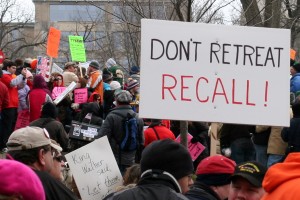
Recent protests at WI capitol
Recall elections loom on the horizon as petitions against nine Wisconsin state senators were recently submitted to the Government Accountability Board (GAB). Each successful petition must include 25 percent of the total number of votes cast in that senate district in the last election.
The recall efforts of Republican senators who supported Gov. Scott Walker’s Budget Repair Bill, and the Democratic senators who left the state to delay voting on the bill, are a result of the political firestorm that quickly flared up over the bill that sought to eliminate almost all collective bargaining rights for public workers.
Currently, the Republican senators who are facing a recall election are Alberta Darling, Robert Cowles, Sheila Harsdorf, Luther Olsen, Randy Hopper and Dan Kapanke. Democrats are facing recall efforts are — Dave Hansen, Jim Holperin and Robert Wirch.
The Milwaukee Journal Sentinel reported that there have also been petitions that didn’t have enough signatures on them to spark a recall. Democratic senators Lena Taylor and Spencer Coggs (both from Milwaukee), Senate Minority Mark Miller (Monona) and Fred Risser (Madison) all have all survived the recall attempts against them. Recall efforts against Republicans Glenn Grothman (West Bend) and Mary Lazich (New Berlin) also failed to garner sufficient support.
Circulators hired by the state Republican Party have submitted “hundreds if not thousands of invalid signatures” in recall drives targeting three Democratic state senators. Volunteers have been working overtime to enter each name into a data base and cross-check it with the phone book and other record. One man who signed a recall petition was Bill Pocan, the deceased father of State Representative Marc Pocan. The Wisconsin Democratic Party (DPW) is formally challenging all three of the recall petitions filed against Democrat senators.
Republicans have filed challenges against “all petitions targeting GOP senators. In addition to their individual signature challenges, they claim the GAB should throw out the petitions because the recall organizers did not properly register with the state.” The elections for recalled legislators with completed petitions will likely be held July 12, 2011.
By: Jennifer Page, Center for Media and Democracy, May 6, 2011
The Tortured Logic Of Enhanced Interrogation
Did torture work? This is the question everyone is asking after Osama bin Laden’s death and the revelation that his fate was sealed by the identification of a courier whose nom de guerre emerged from the interrogation of top al Qaeda operatives who were known to have been subjected to waterboarding and similar techniques. “Did brutal interrogations produce the intelligence that led to the killing of Osama bin Laden?” a May 3 New York Timesstory asked.
This is hardly the first time we’ve had this debate. In 2006, my team of interrogators in Iraq located local al Qaeda leader Abu Musab al-Zarqawi by identifying and following one of his spiritual advisors, Abu Abd al-Rahman. Eric Maddox, a U.S. Army interrogator, found Saddam Husseinby similar means, identifying his former bodyguards. It’s these little pieces of information that form the mosaic that gradually leads to a breakthrough. But how best to get those little pieces?
Current and former U.S. officials and their supporters have been quick to argue that “enhanced interrogation techniques” and waterboarding led to the identification of the courier’s alias, which started U.S. intelligence down the road to bin Laden. The day after the al Qaeda leader’s death was announced, U.S. Rep. Peter King (R-N.Y.), the House Homeland Security Committee chair, told Fox News’s Bill O’Reilly that “For those who say that waterboarding doesn’t work, who say it should be stopped and never used again, we got vital information [from waterboarding] that directly led us to bin Laden.” John Yoo, the former U.S. Justice Department official who drafted the George W. Bush administration’s legal rationales for officially sanctioned torture, repeated the claim and praised“Bush’s interrogation and warrantless surveillance programs that produced this week’s actionable intelligence.” The torture bandwagon has started to kick into high gear. But let’s not get ahead of ourselves.
In fact, the information about the existence of a courier working for bin Laden was provided by several detainees, not just waterboarded al Qaeda operatives Kalid Sheikh Mohammed and Abu Faraj al-Libi — we had one detainee in Iraq who provided information about a courier in 2006. The key pieces of information, however, were the courier’s real name and location. His family name was first uncovered by CIA assets in Pakistan through other sources. The NSA subsequently figured out his full real name and location from an intercepted phone call. Waterboarding had nothing to do with it.
Moreover, common sense dictates that all high-ranking leaders have couriers — and their nicknames do little to lead us to them. This is because many members of al Qaeda change names or take on a nom de guerre after joining for both operational security and cultural reasons. The names are often historically relevant figures in the history of Islam, like the Prophet Mohamed’s first follower, Abu Bakr. Think of it as the equivalent of a boxer taking on a nickname like “The Bruiser.”
Understanding these cultural nuances is just one critical skill interrogators must have to be effective. The other is an understanding of the social science behind interrogations, which tells us that torture has an extremely negative effect on memory. An interrogator needs timely and accurate intelligence information, not just made-up babble.
What torture has proven is exactly what experienced interrogators have said all along: First, when tortured, detainees will give only the minimum amount of information necessary to stop the pain. No interrogator should ever be hoping to extract the least amount of information. Second, under coercion, detainees give misleading information that wastes time and resources — a false nickname, for example. Finally, it’s impossible to know what information the detainee would have disclosed under non-coercive interrogations.
But to understand the question “Does torture work?” one must also define “work.” If we include all the long-term negative consequences of torture, that answer becomes very clear. Those consequences include the fact that torture handed al Qaeda its No. 1 recruiting tool, a fact confirmed by the U.S. Department of Defense’s interrogators in Iraq who questioned foreign fighters about why they had come there to fight. (I have first-hand knowledge of this information because I oversaw many of these interrogations and was briefed on the aggregate results.) In addition, future detainees will be unwilling to cooperate from the onset of an interrogation because they view all Americans as torturers. I heard this repeatedly in Iraq, where some detainees accused us of being the same as the guards at Abu Ghraib.
The more you think about, the less sense torture makes. U.S. allies will become unwilling to conduct joint operations if they are concerned about how detainees will be treated in U.S. custody (an argument made by the 9/11 Commission, among others). And future enemies will use our actions as justification to torture American captives. Torture also lowers our ethical standards to those of our enemies, an ugly shift that spreads like a virus throughout the Armed Services; witness the abuses of Abu Ghraib or the recent murders of civilians in Afghanistan.
Most importantly, we should be talking about the morality of torture, not its efficacy. When the U.S. infantry becomes bogged down in a tough battle, they don’t turn to chemical weapons even though they are extremely effective. The reason they don’t is because such weapons are illegal and immoral.
During the Revolutionary War, one top general made the point that torture was inconsistent with the fundamental beliefs of our founding fathers. “Should any American soldier be so base and infamous as to insure any [prisoner] … I do most earnestly enjoin you to bring him to such severe and exemplary punishment as the enormity of the crime may require,” he wrote to his troops in the Northern Expeditionary Force in the first year of the war. The general in question was George Washington. There’s a reason we pledge to believe in “liberty and justice for all” and not “liberty and security for all”: It’s because we place our values and principles higher than we place our security. When we cease to do so, we forfeit our right to be called Americans.
We cannot become our enemy in trying to defeat him. American interrogators safely guided us through World War II without the use of torture, fighting an enemy and interrogating prisoners every bit as brutal and dedicated as the members of al Qaeda. Our interrogators continue to prove time and time again that they are smart enough to outwit al Qaeda’s best and brightest. No one should ever doubt that we have the mental and ethical fortitude to win this war — and to do it without lowering ourselves to the level of our foes.
By: Matthew Alexander, Foreign Policy, May 4, 2011
Share This Blog


 Unknown Feed
- An error has occurred; the feed is probably down. Try again later.
 mykeystrokes.com
You must be logged in to post a comment.