Big Government Bailout Worked
Don’t expect to see a lot of newspapers and Web sites with this headline: “Big Government Bailout Worked.” But it would be entirely accurate.
The actual headlines make the point. “Demand for fuel-efficient cars helps GM to $3.2 billion profit,”declared The Post. “GM Reports Earnings Tripled in First Quarter, as Revenue Jumped 15%,” reported the New York Times.
Far too little attention has been paid to the success of the government’s rescue of the Detroit-based auto companies, and almost no attention has been paid to how completely and utterly wrong bailout opponents were when they insisted it was doomed to failure.
“Having the federal government involved in every aspect of the private sector is very dangerous,” Rep. Dan Burton (R-Ind.) told Fox News in December 2008. “In the long term it could cause us to become a quasi-socialist country.” I don’t see any evidence that we have become a “quasi-socialist country,” just big profits.
Rep. Lamar Smith (R-Tex.) called the bailout “the leading edge of the Obama administration’s war on capitalism,” while other members of Congress derided the president’s auto industry task force. “Of course we know that nobody on the task force has any experience in the auto business, and we heard at the hearing many of them don’t even own cars,” declared Rep. Louie Gohmert (R-Tex.) after a hearing on the bailout in May 2009. “And they’re dictating the auto industry for our future? What’s wrong with this picture?”
What’s wrong, sorry to say, is that you won’t see a news conference where the bailout’s foes candidly acknowledge how mistaken they were.
The lack of accountability is stunning but not surprising. It reflects a deep bias in the way our political debate is carried out. The unexamined assumption of so much political reporting is that attacks on government’s capacity to do anything right make intuitive sense because “everybody knows” that government is basically inefficient and incompetent, especially when compared with the private sector.
Government failure gets a lot of coverage. That’s useful because government should be held accountable for its mistakes. What’s not okay is that we hear very little when government acts competently and even creatively. For if mistakes teach lessons, successes teach lessons, too.
In the case of the car industry, allowing the market to operate without any intervention by government would have wiped out a large part of the business that is based in Midwestern states. This irreversible decision would have damaged the economy, many communities and tens of thousands of families.
And contrary to critics’ predictions, government officials were quite capable of working with the market to restructure the industry. Government didn’t overturn capitalism. It tempered the market at a moment when its “natural” forces were pushing toward catastrophe. Government had the resources to buy the industry time.
What’s heartening is that average voters understand that broad assaults on government provide better guidance for the production of sound bites than for the creation of sensible public policy. That’s why House Republicans are backpedaling like crazy on their plans to privatize Medicare — even as they pretend not to.
Conservatives really believed that voters mistrusted government so much that they’d welcome a chance to scrap Big Government Medicare and have the opportunity to purchase policies in the wondrous health insurance marketplace. Don’t people assume that anything is better than government?
But there were deep potholes on the road to a market utopia. Put aside that the Republican budget wouldn’t provide enough money in the long term for the elderly to afford decent private coverage. The truth is that most consumers don’t have great confidence in the private insurance companies, with which they have rather a lot of experience.
When it comes to guaranteeing their access to health care in old age, most citizens trust government more than they trust the marketplace. This doesn’t mean they think Medicare is without flaws. What they do know is that Medicare does not cut people off in mid-illness and that its coverage is affordable because government subsidizes it.
It’s axiomatic that government isn’t perfect and that we’re better off having a large private sector. It ought to be axiomatic that the private market isn’t perfect, either, and that we need government to step in when the market fails. The success of the auto bailout and the failure of the Republicans’ anti-Medicare campaign both teach the same lesson: The era of anti-government extremism is ending.
By: E. J. Dionne, Opinion Writer, The Washington Post, May 8, 2011
Mothers We Could Save: Family Planning Is Just As Essential For Humans As For Horses
Here’s a Mother’s Day thought: There’s a way to save many of the world’s 350,000 women who die in childbirth each year. But it’s very controversial, for it’s called family planning.
Republicans in Congress have gone on the warpath this budget season against family planning programs at home and abroad. To illustrate the stakes, let me share a Mother’s Day story about a pregnant 30-year-old Somali woman named Hinda Hassan.
Ms. Hassan lived in a village near this remote town of Baligubadle in Somaliland (a self-ruling enclave carved from Somalia). She never used family planning, for none is available within several days’ walk. When her eighth child was still an infant, she became pregnant again.
“I was happy when she became pregnant,” said her husband, Muhammad Isse, who tends a herd of 13 camels with his family. “I was very happy, because I had faith in God.”
When Ms. Hassan went into labor, she was looked after by two traditional birth attendants, both of them unschooled, untrained and unequipped. “We try to wash our hands with soap and water,” one of them, Amina Ahmed, told me. “But sometimes we don’t have soap. And if there is no water, we rub our hands in the sand to clean them.”
Ms. Hassan’s labor did not go well. After 11 hours, her husband paid a man with a pickup truck $50 to drive her three hours to the clinic here in Baligubadle. The clinic couldn’t help Ms. Hassan and sent her on another two-and-a-half-hour bone-rattling drive in the back of the pickup to the Somaliland capital of Hargeisa. Shortly after Ms. Hassan arrived at the Edna Adan Maternity Hospital (mentioned in my last column), she died.
Her death was infuriatingly unnecessary — and I felt doubly saddened when I met some of her eight orphans.
There are any number of ways that Ms. Hassan’s life could have been saved. She had an off-the-charts hemoglobin level of just 4, reflecting a stunning level of anemia. A trained midwife could have given her a deworming pill and iron supplements early in the pregnancy, addressing that anemia and strengthening her. Later, Ms. Hassan developed a complication called eclampsia that would have been detected if she had had pre-natal care.
Yet maybe the simplest way to save her life would have been contraception. If Somali women had half as many pregnancies (they now average six births), there would be only half as many maternal deaths. But modern contraception doesn’t exist in this part of Somaliland.
“The only method of family planning we have is breast-feeding,” said Nimo Abdi, the midwife at the clinic here, noting that breast-feeding reduces the likelihood of a new pregnancy. Ms. Abdi thinks that some local people would accept modern contraceptives if they were available.
“If I had injectables and condoms, people would accept them,” she said. “They would want them.”
I wonder if that isn’t a bit optimistic; in a place like this, family planning requires much more than just handing out contraceptives. Ms. Hassan’s husband told me that he had never heard of contraception, and he sounded wary of the idea.
Many people in poor countries want large families, partly to ensure that some will survive despite high death rates. Or a woman may distrust contraceptives or fear her husband’s reaction if she is caught using them.
By United Nations estimates, 215 million women worldwide have an “unmet need” for family planning, meaning they don’t want to become pregnant but are not using effective contraception. The Guttmacher Institute, a widely respected research organization, estimates that if all the unmet need for contraception were met, the result would be 94,000 fewer women dying of pregnancy complications each year, and almost 25 million fewer abortions each year.
Greater access to birth control would also help check the world population, which the United Nations warned a few days ago is rising more quickly than expected. The U.N. now projects the total population in 2100 will be 10.1 billion.
Yet this year, Republicans in Congress have been trying to slash investments in family planning. A budget compromise last month cut international family planning spending by 5 percent, but some Republicans are expected to seek much bigger cuts in future years.
If they succeed, the consequences will be felt in places like this remote Somali town. Women won’t get access to contraceptives, and the parade of unwanted pregnancies, abortions, fistulas, and mothers dying in childbirth will continue.
Ah, but there was one Republican-sponsored initiative for family planning in Congress this year. It provided contraception without conditions — for wild horses in the American West. It passed on a voice vote.
Maybe on Mother’s Day, we could acknowledge that family planning is just as essential for humans as for horses.
By: Nicholas D. Kristof, Op-Ed Columnist, The New York Times, May 7, 2011
Are There Any Pro-Choice Republicans Left In The House?
Yes, America, there are pro-choice Republicans. But after this week, there’s some question about whether are any left in the U.S. Congress.
H.R. 3, the “No Taxpayer Funding For Abortion Act” that passed the House May 4 is not likely to become the law of the land. But the fact that it passed the House with unanimous Republican support means the pro-life members of the party, which includes all the House leadership, can tout their attachment to social issues, even after the supposedly fiscal-first tea party movement helped take over the GOP last year.
For pro-choice Republicans, the vote means embarrassing questions. Basically every pro-choice group says H.R. 3 is an anti-abortion bill that goes far beyond the government’s current prohibitions on abortion funding and actually raises taxes on women who want to seek abortion coverage in their private insurance plans.
That’s a double-whammy for pro-choice Republicans. One, raising taxes under any circumstances is a no-no for anyone in the modern GOP. And, two, the bill has been cast as the biggest assault on abortion rights in years.
Voting against such a measure, then, would seem like a no-brainer. Except it wasn’t. None of the about a dozen House GOP members of the Republican Majority For Choice PAC considered as allies, voted against H.R. 3. In fact, all of them voted yes.
“We opposed the bill, we considered it an anti-choice, big government intrusion and politically we think it’s a bad move for the Republicans to keep focusing on this,” K.R. Ferguson, executive director of the PAC told TPM.
Still, she says that she’s not prepared to say the members who voted for it have given up their pro-choice credentials. She pointed to the refusal of some Republicans to sign on to the House plan to defund Planned Parenthood as the kind of thing that will keep the PAC’s endorsement coming.
“I would not say we would stop supporting any of the members who took this vote,” Ferguson said. She said that though it’s hard to rectify being pro-choice and voting for H.R. 3, support from her PAC isn’t “an all or nothing” prospect.
There are still Republicans who run as pro-choice members, despite the fact that the party in the House is about as far from supporting a woman’s right to choose as it could possibly be these days.
Rep. Robert Dold (R-IL) touted his endorsement from Ferguson’s PAC back in 2010. Ferguson said he might get it again, despite his vote for H.R. 3. Dold’s office didn’t respond to a request for comment.
Though repeatedly expressing her extreme disappointment with the vote, Ferguson suggested Dold and his fellow pro-choice Republicans really had no choice.
“The extreme who was pushing this bill did a masterful job of spinning it as a no taxpayer fundings for abortion [measure] and putting these members in an almost impossible position,” she said. “We don’t like it, we will continue to call on our members to try to educate them” on the truth of the bill.
Illinois Republican Rep. Judy Biggert, a past co-chair of the House pro-choice caucus, says that her vote for H.R. 3 was completely consistent with her pro-choice views.
“Rep. Biggert is pro-choice. She supports a women’s right to chose, but she does not support public funding for abortion,” spokesperson Zachary Cikanek told TPM. “Abortion is a private decision, and it should be paid for with private dollars – without government involvement. That’s why she voted for H.R. 3.”
Cikanek noted that Biggert “has stated publically that she thinks Congress should be keeping its attention focused on spending and jobs, and not spending its time locked in debate on divisive social issues.”
Not all pro-choice advocates are willing to accept that kind of answer. NARAL President Nancy Keenan told TPM that a pro-choice vote for H.R. 3 is a political oxymoron. Though her group is non-partisan, NARAL hasn’t endorsed any Republicans serving in the current House, despite the fact that members like Biggert claim to be supporters of the cause.
“No member of congress can vote for this egregious bill and be considered pro-choice,” Keenan said. “Bottom line.”
By: Evan McMorris-Santoro, Talking Points Memo, May 7, 2011
Killing Of Osama bin Laden: Both Well Executed And Lawful
Some are questioning the legality of the raid in Pakistan that resulted in the death of Osama bin Laden. Was it lawful for a team of Navy SEALs to launch a mission in Abbottabad without permission from Pakistani leaders? Did they comply with international strictures when they killed the al-Qaeda leader rather than capturing him and bringing him before a court of law?
In a word: yes.
The analysis must begin with the events of Sept. 11, 2001, when about 3,000 innocents were murdered by Osama bin Laden and his forces. There was no guesswork involved in pinpointing the culprits: He took credit for the bloodshed and reiterated his call for attacks against the United States and its allies. In passing the Authorization for the Use of Military Force (AUMF) just one week later, Congress explicitly empowered the president to take all appropriate and necessary action against al-Qaeda, the Taliban and all those who helped or harbored them. It was, in short, a declaration of war, and Osama bin Laden was rightly targeted for his central role in the atrocities.
Absent a surrender, there is no question that U.S. forces would have been entitled to shoot him on sight had they encountered him on an Afghan battlefield. But that is not where the terrorist leader spent his time. After lengthy and intricate intelligence-gathering, the Obama administration tracked him to a heavily secured mansion in a city outside Islamabad populated by military officers and the country’s elite military academy. With suspicions high that Osama bin Laden enjoyed some semblance of official protection, the Obama administration rightly decided to proceed without notifying Pakistan.
International law recognizes a country’s inherent right to act in self-defense, and it makes no distinction between vindicating these rights through a drone strike or through a boots-on-the-ground operation. Administration officials have described the raid as a “kill or capture” mission and asserted that the SEALs would have taken Osama bin Laden alive had he surrendered and presented no threat to U.S. personnel or the others in the compound that night. This, according to official accounts, did not happen.
Much has been made of the disclosure that Osama bin Laden was unarmed, but this, too, is irrelevant in determining whether the operation was lawful. The SEALs entered the compound on a war footing, in the middle of the night, prepared to encounter hostile fire in what they believed to be the enemy leader’s hideout. They reported that they became embroiled in a firefight once inside; they had no way of knowing whether Osama bin Laden himself was armed. Even if he had signaled surrender, there is no reason to believe that danger had evaporated. As Sen. Lindsey O. Graham (R-S.C.) said during a congressional hearing on Wednesday: “From a Navy SEAL perspective, you had to believe that this guy was a walking IED,” prepared to blow up himself and those around him or possibly to detonate an explosive that would have engulfed the entire house.
It is easy in the light of day to second-guess decisions made in the heat of war. It is particularly easy for those who refuse to acknowledge that war in the first place. Based on information released by the administration, the covert military operation that brought down the most wanted terrorist in the world appears to have been gutsy and well executed. It was also lawful.
By: Editorial Board Opinion, The Washington Post, May 4, 2011
GOP Medicare Proposal Doesn’t Work Like Members of Congress’ Health Care As Republicans Claim
The Center for American Progress has previously pointed out that the House Republican budget for fiscal year 2012 forces future beneficiaries out of Medicare into more expensive private plans. One of the ways Republicans are trying to sell their Medicare proposal is by claiming that beneficiaries would “be enrolled in the same kind of health-care program that members of Congress enjoy.” That claim is false. In fact, if the rate of growth under this Medicare proposal were applied to federal employees’ most popular health option, the Blue Cross Blue Shield Standard Option, federal workers, including members of Congress, with family coverage would have to pay another $3,330 for the care they enjoy today. Those with individual coverage would have to pay another $1,555.
Most federal workers receive their health coverage through the Federal Employees Health Benefits Plan, or FEHBP. The government contributes a portion of their health premium. That portion is set by law and applied to the weighted average of actual premiums charged in any given year. Beneficiaries make up the rest of the cost.
The Republican budget replaces the traditional fee-for-service Medicare for future beneficiaries with a voucher to private insurance companies that is established on very different terms. Unlike FEHBP, which has a consistent government contribution based on actual premiums charged in any given year, the amount of the voucher is determined independent of actual premiums. Its growth is instead tied to the rate of the consumer price index for all urban consumers, or CPI-U. Because health costs have typically increased faster than inflation, the level of government support from the voucher would become a lower share of actual premium costs over time. In other words, Medicare beneficiaries would be left holding the bag.
What would happen if FEHBP operated like the GOP Medicare proposal?
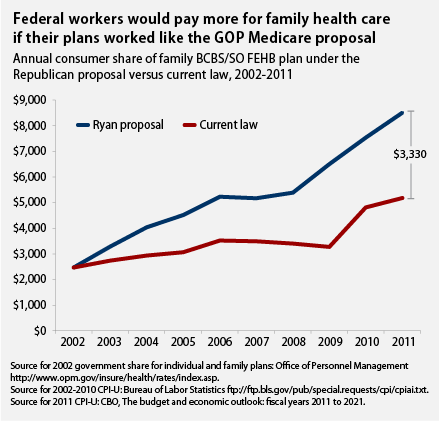
We examined what would happen if FEHBP had operated like the Republican Medicare proposal over the last decade. We used data from the Office of Personnel and Management to look at the annual premiums for federal workers enrolled in the Blue Cross Blue Shield Service Benefit Plan (Standard Family and Standard Individual). We chose this plan because nearly 60 percent of those enrolled in FEHBP have Blue Cross Blue Shield, and the Standard Option is the most popular FEHBP plan. We increased government support for the individual and family plans by the rate of growth in the CPI-U index from 2002 to 2011. We then compared the difference between the government’s share and the actual total premium in each year—which is the amount the beneficiary would pay—under the Republican proposal and the real FEHBP.

The result: A typical federal worker, or member of Congress, enrolled in family coverage in the Blue Cross Blue Shield Standard Option, would have had to pay an additional $3,330.36 for the same level of coverage they have today. Those with individual coverage would have had to pay $1,555 more.
By: Nicole Cafarella, Payment Reform Manager and Policy Analyst and Tony Clark, Policy Analyst, Center for American Progress, April 27, 2011
Share This Blog


 Unknown Feed
- An error has occurred; the feed is probably down. Try again later.
 mykeystrokes.com
You must be logged in to post a comment.