While the president canceled his campaign schedule and flew northward to join the relief effort, Romney struggled for relevance. Presumably with the best intentions, he tried to transform an Ohio rally into a charitable gathering, where his campaign would collect canned food and bottled water for hurricane victims. But then his campaign workers were caught purchasing cases of food and water at a local Walmart, evidently planning to stage fake giving if necessary.
As he played his role in this flummery, Romney repeatedly refused to answer questions from reporters about his vow to dismantle FEMA as a cost-cutting measure. It would be “immoral” to spend money on federal disaster relief, as he told a debate audience in 2011, when the government is running a substantial deficit. And it is true that the budget and tax policies promoted by Romney and his running mate, Paul Ryan, would require such significant cuts in domestic spending as to decimate disaster relief.
Disbanding FEMA and discarding its skilled personnel apparently would be fine with Romney, who said “absolutely” when asked by CNN’s John King whether he would consign disaster relief to the states rather than the federal government. For that matter he would go still further, said the former Massachusetts governor; best of all would be to let the private sector assume FEMA’s responsibilities.
Nobody asked Romney how a privatized FEMA would function, but it is interesting to imagine the private-equity version of disaster management—and how that entity might squeeze profit from tragedy. Under present circumstances, the Romney campaign denies any plan to abolish FEMA, but who really knows?
In this awful moment Christie, Cuomo, Bloomberg — and every other official watching them — must have realized that should cataclysm strike their city or state, they have a reliable partner in President Obama. The Romney Republicans inspire no such confidence.
By: Joe Conason, The National Memo, November 21, 2012
November 2, 2012
Posted by raemd95 |
Election 2012 | Chris Christie, FEMA, Hurricane Sandy, Mario Cuomo, Michael Bloomberg, Mitt Romney, Paul Ryan, Politics, Republicans |
1 Comment
Although some may find it crass to speculate on the political impact of The Storm, I’m going to go ahead and do it, for two reasons. First, I’ve earned the right, and second, because complaints that things are “politicized” are almost always misconceived. Politics is important. It concerns choices that affect all our lives. And campaigns ought to be connected to the actual business of governing, so when an event occurs that implicates our government, it should be talked about. Problems sometimes arise not from the fact that something is politicized, but the way it’s politicized. For instance, when in the 2002 election, Republicans charged that Democrats were on the side of al Qaeda because those Democrats favored a different bill establishing the Department of Homeland Security than the bill Republicans favored, it was despicable not because September 11 had been “politicized,” but because of the manner in which it was politicized.
Anyhow, back to the storm. This morning, an editor at the Prospect suggested to me that if Romney loses, Republicans will say bitterly for some time to come that had it not been for the storm, his momentum would have carried him to victory. I don’t doubt they will say that (although I think that will be what the sober Republicans will say; the others will find voting conspiracies to convince them that he didn’t legitimately win). But the question is, even if they were right, what’s wrong with that?
You can look at this just as a campaign issue—perhaps the fact that Romney is losing a couple of days in which the campaign, and his persuasive arguments, would have been on the front pages instead of storm cleanup, and that might make some tiny difference in the outcome of the race. But there’s a substantive issue here too. Natural disasters offer a visible opportunity for a president to either succeed or fail, and it’s appropriate to judge Barack Obama on how this one is handled. That’s true on the level of his performance at the moment, and when it comes to the personnel and systems he put in place in preparation for this kind of event.
One also can’t help thinking back to what happened seven years ago when Hurricane Katrina hit New Orleans, and there’s nothing wrong with that either. When George W. Bush took office, he gave the FEMA directorship to his campaign manager, Joe Allbaugh, who hadn’t had that kind of experience before. Allbaugh was succeeded by “Heckuva Job” Michael Brown, who came from the nationally vital position of judging commissioner of the International Arabian Horse Association. Point is, I doubt President Bush much cared who was in charge of FEMA, and when Americans needed it, it wasn’t up to the job. When Barack Obama took office, he appointed Craig Fugate, whose last job was running Florida’s emergency management agency. Obama obviously didn’t want to repeat Bush’s mistake, and by all accounts FEMA is working far better than it did during the Bush years.
Republicans may be frustrated by the fact that just before the election, we get an event that reminds people that there are some things we need government for. And it’s more bad luck for them that this particular event will also remind people of what happened seven years ago when they were in charge. But there’s nothing unfair about it. If Mitt Romney has a case to make as to why his small-government philosophy would produce better disaster response than what we’re seeing now, let him go ahead and make it.
By: Paul Waldman, Contributing Editor, The American Prospect, November 11, 2012
November 2, 2012
Posted by raemd95 |
Election 2012 | Barack Obama, Craig Fugate, FEMA, George W. Bush, Hurricane Katrina, Michael Brown, Mitt Romney, Politics, Republicans |
Leave a comment
As you’ve probably seen, New Jersey Gov. Chris Christie — a prominent Republican and Romney endorser — has recently repeatedly praised President Barack Obama for his and the federal government’s response to Hurricane Sandy. Christie has likely done this because … he is grateful and the federal government has been helpful, but the political press needs stuff to write about, so people have written about it as a political act.
Most conservatives are just sort of ignoring this development, as liberals gleefully publicize pictures of the men joining together to inspect the damage along the Jersey Shore and compliment each other for the cameras. But some are weighing in. Here are the conservative explanations for Chris Christie’s recent effusive praise of Barack Obama: The Daily Caller’s Matt Lewis says the force of Christie’s praise is suspect: “The issue here is about the degree to which he is going out of his way to help Obama politically — and the context of the timing.” He thinks this indicates a personal schism between Christie and Romney.
But my favorite explanation comes from genius political analyst Joel Pollack at Big Government, one of the increasingly easily ignorable stable of dumb blogs and lie-generation machines founded by the late Andrew Breitbart.
Here is Pollack’s theory: Christie is praising Obama because Mitt Romney is so far ahead that it doesn’t matter.
But the truth about Christie’s outreach to Obama is blindingly obvious: Mitt Romney is now running away with this election, freeing Christie to praise the president without fear that doing so will tip the scales.
Oh. I see! But … aren’t all the national polls essentially tied? Yes, but you forgot about skewing.
Romney’s lead in the national polls may appear small, but it is likely much more significant, since the electorate that shows up on Tuesday will include proportionally fewer Democrats than most polls have assumed thus far.
Oh. I see! (There aren’t any links to anything in that paragraph btw.)
Democrats and journalists have clung desperately to one illusion after another–first, that Obama was winning in Ohio, until that was no longer true; next, that Obama had an edge in early voting, until that was wrong; and finally, that Obama had a stronger ground game, until that began to fall apart.
Now that Obama is on defense in blue states such as Pennsylvania, Minnesota, Oregon and Michigan, a Romney victory is within reach.
Haha sure. OK. The evidence that Obama is losing Ohio is one Rasmussen poll — the only poll showing Romney leading in Ohio, by the way — and the “ground game” link is just a Robert Stacy McCain blog post about how he met an excited Romney canvasser and went to an Americans for Prosperity event.
Also Obama’s visit to New Jersey “merely highlights the fact that he abdicated that leadership on 9/11.”
In conclusion, Chris Christie was really nice to Barack Obama because all conservatives secretly know that when you unskew the polls Mitt Romney is winning in all swing states, the end.
By: Alex Pareene, Salon, October 31, 2012
November 2, 2012
Posted by raemd95 |
Election 2012 | Chris Christie, Conservatives, Early Voting, Hurricane Sandy, Mitt Romney, New Jersey, Ohio, Politics, Swing States |
Leave a comment
Greetings from the battleground state of Ohio, which Democrats and Republicans alike insist will determine the presidential race.
No use resenting us if you don’t live here. For a few more days, we’ll be the center of the universe. After Election Day, you can go back to wondering how a state with so many dairy farms and coal miners can be in the same time zone as Manhattan.
President Barack Obama continues to hold the lead in polls in Ohio. Beltway pundits love to rattle off the reasons, but this Buckeye who lives here has narrowed it down to one: the auto rescue.
So, let me tell you about my car.
Last summer, I traded in my Pontiac Vibe for a Chevy Cruze. It’s bright red. I call it my red-hot mama car, just to embarrass the kids.
I bought the Cruze primarily because of my roots. I was born in Ohio and raised here by blue-collar parents who believed in God, hard work and organized labor. In the early 1970s, dozens of my relatives, including my utility worker father, worked in union jobs at power plants, steel mills and auto factories. I grew up believing that Ohioans knew how to make things — big things — that were shipped all around the world.
How my parents would have loved the story of the Chevy Cruze. It’s a tale of many cities, many of them in my home state, full of the people I come from.
Bear with me, please, as I rattle off Ohio workers’ contributions to the Cruze, which is now one of the best-selling cars in America:
The engine is made in Defiance.
The seat frames: Lorain.
The brackets: Waverly.
The fasteners: Brunswick.
The plastics: Tallmadge.
The seats: Warren.
The transmission: Toledo.
The sound system: Springboro.
The steel: Middletown and Cleveland.
The wing nuts: Tiffin.
The weld nuts: Hudson.
The weld studs: Medina.
The insulators: Norwalk.
The wheel bearings: Sandusky.
That is a partial list of Cruze parts made in Ohio.
The Cruze is assembled by about 4,500 union workers in Lordstown, Ohio, which is producing cars around the clock.
But wait… there’s more.
Even if you don’t live here, you probably have heard about another made-in-Ohio car: Chrysler’s Jeep Wrangler, which is assembled by union workers in Toledo.
I’ll spare you that list of Ohio suppliers. Lots of cities — and lots of workers, too.
Mitt Romney, who opposed the auto rescue, recently claimed during a campaign stop in Defiance, Ohio, that Chrysler is planning to move its Jeep production to China.
For a few hours, I was willing to write off this absurd claim as just another Romney gaffe. He says a lot of ridiculous things. Some of them are even unscripted.
Then Romney doubled down on his lie with TV and radio ads here in Ohio. In them, he claims that President Obama “sold Chrysler to Italians who are going to build Jeeps in China.” A little word-tweaking, but the clear intention is to scare Ohio workers into believing they are about to lose their jobs.
For this whopper, Romney has earned nonpartisan PolitiFact’s worst rating, “Pants on Fire.” As PolitiFact also reminded readers, about 1 in 8 jobs in this state are auto-related. That’s more than 800,000 jobs, which means at least a half-million families who have better lives because of the auto industry. These workers have relatives — friends and neighbors, too. Most of them care about the survival of the auto industry, too, because they care about the people who work in it.
This is very bad news for Romney — just as it was bad news for Ohio Republicans when going after the collective bargaining rights of state workers backfired on them last year.
In the wake of Romney’s ad, Chrysler CEO Sergio Marchionne felt the need to send a letter to his employees: “Jeep assembly lines will remain in operation in the United States and will constitute the backbone of the brand,” he said. “It is inaccurate to suggest anything different.”
Nevertheless, as I write this, Romney’s ad continues to run in Ohio.
And I’m days away from renaming my made-in-Ohio Chevy Cruze the red-hot victory car for Barack Obama.
By: Connie Schultz, The National Memo, October 31, 2012
November 1, 2012
Posted by raemd95 |
Election 2012 | China, Chrysler, Collective Bargaining, Jeep, Mitt Romney, Ohio, Politics, Sergio Marchionne, Union Workers |
Leave a comment
I decided to support Barack Obama pretty early in the Democratic primary, around spring of 2007. But unlike so many of his supporters, I never experienced a kind of emotional response to his candidacy. I never felt his election would change everything about American politics or government, that it would lead us out of the darkness. Nothing Obama did or said ever made me well up with tears.
Possibly for that same reason, I have never felt even a bit of the crushing sense of disappointment that at various times has enveloped so many Obama voters. I supported Obama because I judged him to have a keen analytical mind, grasping both the possibilities and the limits of activist government, and possessed of excellent communicative talents. I thought he would nudge government policy in an incrementally better direction. I consider his presidency an overwhelming success.
I can understand why somebody who never shared Obama’s goals would vote against his reelection. If you think the tax code already punishes the rich too heavily, that it’s not government’s role to subsidize health insurance for those who can’t obtain it, that the military shouldn’t have to let gays serve openly, and so on, then Obama’s presidency has been a disaster, but you probably didn’t vote for him last time. For anybody who voted for Obama in 2008 and had even the vaguest sense of his platform, the notion that he has fallen short of some plausible performance threshold seems to me unfathomable.
Obama’s résumé of accomplishments is broad and deep, running the gamut from economic to social to foreign policy. The general thrust of his reforms, especially in economic policy, has been a combination of politically radical and ideologically moderate. The combination has confused liberals into thinking of Obamaism as a series of sad half-measures, and conservatives to deem it socialism, but the truth is neither. Obama’s agenda has generally hewed to the consensus of mainstream economists and policy experts. What makes the agenda radical is that, historically, vast realms of policy had been shaped by special interests for their own benefit. Plans to rationalize those things, to write laws that make sense, molder on think-tank shelves for years, even generations. They are often boring. But then Obama, in a frenetic burst of activity, made many of them happen all at once.
Bipartisan panels of economists had long urged Medicare to reform its payment methods to curb perverse incentives by hospitals and doctors to run up costs as high as possible; Obama overcame fierce resistance in Congress in order to craft, as part of Obamacare, a revolution in paying for quality rather than quantity. He eliminated billions of dollars in useless subsidies to banks funneling (at no risk) government loans to college students. By dangling federal public-education grants, Obama unleashed a wave of public-school reform, over the objections of the most recalcitrant elements of the teachers union movement. And he forced Wall Street to accept financial regulations that, while weaker than ideal, were far tougher than anybody considered possible to get through Congress.
It is noteworthy that four of the best decisions that Obama made during his presidency ran against the advice of much of his own administration. Numerous Democrats in Congress and the White House urged him to throw in the towel on health-care reform, but he was one of very few voices in his administration determined to see it through. Many of his own advisers, both economists steeped in free-market models and advisers anxious about a bailout-weary public, argued against his decision to extend credit to, and restructure, the auto industry. On Libya, Obama’s staff presented him with options either to posture ineffectually or do nothing; he alone forced them to draw up an option that would prevent a massacre. And Obama overruled some cautious advisers and decided to kill Osama bin Laden.
The latter three decisions are all highly popular now, but all of them carried the risk of inflicting a mortal political wound, like Bill Clinton’s health-care failure and Jimmy Carter’s attempted raid into Iran. (George W. Bush, presented with a similar option, did not strike bin Laden.) In making these calls, Obama displayed judgment and nerve.
A year ago, I wrote about the pervasive disillusionment felt by Obama’s supporters. It is a sentiment that has shadowed every Democratic president since Franklin Roosevelt, and even Roosevelt provoked long bouts of agony and disillusionment among his supporters. All were seen by many Democrats at the time as failures, weaklings, or unprincipled deal-makers. It’s true that all of them, including Obama, have made terrible errors. What this tells us, though, is that we need some realistic baseline against which to measure them.
Obama can boast a record of accomplishment that bests any president since Roosevelt, and has fewer demerits on his record than any of them, including Roosevelt. The only president that comes close in gross positive accomplishment is Lyndon Johnson, whose successes were overwhelmed by his failures to such a degree that he abandoned his reelection campaign. The immediacy of the political moment can — and usually does — blind us. (In the aftermath of September 11, 2001, the wide and even bipartisan sentiment prevailed that George W. Bush was exactly the right sort of person we would want to have as president at that moment.)
The sense among Obama’s wavering supporters that he has failed rests upon a two-part indictment. The first and most potent is that he has presided over a weak economy. This line of attack on Obama became inevitable starting on approximately September 14, 2008, when the U.S. financial system imploded. The economists Carmen Reinhart and Kenneth Rogoff have established that financial crises wreak vastly deeper harm than regular recessions. Financial crises freak out consumers, and they freak out political elites in a way that creates a panicked stampede toward exactly the wrong sorts of policies (like reducing short-term deficits) that in turn makes the crisis even worse.
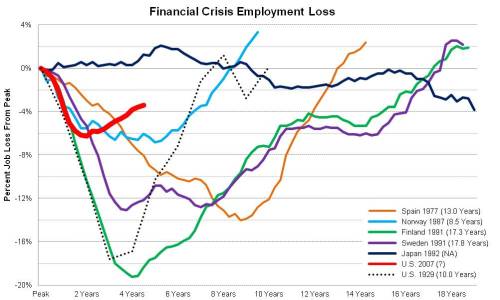
This panic has impeded Obama’s recovery measures. But the fact remains that, by the standards of a financial crisis, the United States suffered through a relatively shallow trough and has enjoyed a fairly rapid recovery. (Here is a chart laying out the comparison between the United States and other comparably afflicted economies.) Obama managed to stabilize the financial system and, through the stimulus, avert a total collapse in consumer demand.
But while America has suffered less since 2008 than other victims of a financial crisis, it has suffered. Obama’s notable success in containing the damage has not redounded to his benefit for another, even more historically durable reason: Voters tend to blame or credit incumbent politicians for the state of their lives utterly regardless of responsibility. This is not even limited to things like the economy, where politicians can affect the outcome. Voters reward or punish incumbents based on the weather or the success of local sports teams. Mitt Romney’s campaign theme attempting to assign all blame to Obama for the state of the economy is a clever manipulation of this long-standing form of irrationality. In 2004, Romney dismissed any attempt to blame George W. Bush for the decline of jobs under his watch as “poppycock.” In his most condescending tone, Romney explained that of course outside forces were to blame — those outside forces being the vastly milder 2001 recession — and that attempting to hold Bush responsible for the economic record of his term was sheer stupidity. Now Romney has made that very theme the central basis of his presidential campaign.
The second indictment of Obama is that he failed to redeem the broader vision of trans-partisan governance he campaigned on. The reason this happened is that the Republicans’ leadership in Congress grasped early on that its path to returning to power required Obama to fail, and that they could help bring this about by denying his initiatives any support. In a meeting before Obama’s inauguration reported by Time’s Michael Grunwald, the House Republican leadership instructed their members on exactly this strategy. GOP Senate Minority Leader Mitch McConnell has followed the same strategy. GOP House members and senators have admitted, some of them publicly, that their leadership prevailed upon them not to negotiate with Obama.
Partisan strife between Congress and the president has gone on for decades. In the past, members of Congress often opposed the president’s agenda, but they also believed that the voters would punish them if they failed to show accomplishments, and so they carefully balanced their substantive opposition with a sense of political self-preservation. What makes the Republican opposition different is that it rests upon a novel, and probably true, insight. Most Americans pay little attention to the details of policy. They rely upon a broad heuristic — if something has touched off an ugly and protracted battle, it is probably bad, but if both sides agree on it, it is probably good. Even many Sunday political talk-show chatterers and other blowhards use the same basic thought process. And so, as McConnell actually said out loud, “if the proponents of the bill were able to say it was bipartisan, it tended to convey to the public that this is O.K., they must have figured it out.” McConnell, in keeping with his Bond-villain habit of boasting openly about his nefarious intentions, actually announced in a prepared speech that his top political priority was to make Obama a one-term president.
The Republican strategy is perfectly clear and not even very well hidden. Yet many of us don’t accept it as a reality because it does not feel true. We instinctively hold the president, not Congress, responsible, another finding political scientists have measured. The hunger to attribute all outcomes to the president is so deep that the political elite take it on faith. Bob Woodward, who is justly famed as a reporter but whose opinions are interesting only as a barometer of Washington establishmentarianism, blamed Obama because Republicans turned down an extraordinarily favorable budget deal. “Presidents work their will — or should work their will,” Woodward declared, “on the important matters of national business.”
How can a president “work his will” in such a way as to force autonomous members of the opposite party controlling a co-equal branch of government to sacrifice their own calculated self-interest? It is a form of magical thinking, but a pervasive one. Which is exactly why the Republican strategy — making Obama’s promise to transcend partisanship fail by withholding cooperation — has worked.
Whether this strategy succeeds in its ultimate goal — returning the GOP to power in 2013 — depends on the election. In an unusual way, the success of Obama’s first term hangs in large part on his reelection bid, as a President Romney would probably kill his grandest achievement of providing health insurance to those Americans too sick or poor to acquire it in the marketplace. So any evaluation of Obama’s term before the election must be provisional.
What can be said without equivocation is that Obama has proven himself morally, intellectually, temperamentally, and strategically. In my lifetime, or my parents’, he is easily the best president. On his own terms, and not merely as a contrast to an unacceptable alternative, he overwhelmingly deserves reelection.
By: Jonathan Chait, Daily Intel, October 31, 2012
November 1, 2012
Posted by raemd95 |
Election 2012 | Barack Obama, Congress, Economic Policy, Foreign Policy, Health Reform, Mitch McConnell, Politics, Republicans, Wall Street |
5 Comments


 Unknown Feed