“Batten Down The Hatches!”: A Perilous Week Ahead For Our Republican Friends
There’s really only one way to say it: the week of September 21, 2015 could be unpleasant for a Republican Party struggling to find its way in the runup to a big, high-stakes election.
Its presidential field remains nearly as large and definitely as unwieldy as ever. Initial polling after last week’s second CNN debate shows that the long-awaited, fervently prayed-for decline in support for Donald Trump isn’t happening just yet. The main result of the debate was instead to consolidate the powerful position of three dubiously qualified “outsiders,” Trump, Ben Carson, and the star of the moment, Carly Fiorina. All three of them continue to say and do things that aren’t particularly troubling to the angry Republican “base” but are very problematic in a general election.
Over the weekend Trump batted away criticism over his silence in the face of a supporter who loudly insisted in the candidate’s presence that the president is a Muslim born outside the United States (an assertion an alarming percentage of Republicans believe against all evidence). Trump says it’s not his job to defend the hated Obama. Carson is in the spotlight for insisting against the rather explicit language of the U.S. Constitution that there should in fact be a “religious test” for the presidency, barring Muslims. Meanwhile, Fiorina is being besieged by the facts she ignored in her debate presentation–especially with respect to the Planned Parenthood videos she discussed to the delight of Christian Right voters–and by the long-overdue MSM scrutiny of her arguably catastrophic record as CEO of HP, her primary credential for high office (see Jeffrey Sonnenberg’s refutation of her debate remarks about him and her HP tenure).
But even as the three zero-experience front-runners lose friends and alienate people, it’s not like the rest of the field is moving on up. One early favorite, Scott Walker, is by all accounts in desperate condition, and having decided to drop everything else to go try to shore up his horrendous standing in Iowa, made a poor impression on his first post-CNN-debate public appearance there.
Off the campaign trail, congressional Republicans are snarled in separate yet equally dangerous internal disputes over the extent to which they will court a government shutdown to express unhappiness with the Iran Nuclear Deal–which they strangely consider a big political winner for themselves–and to cut off federal funding for Planned Parenthood. Budget wizard Stan Collender has now raised his estimate of the odds of a government shutdown to 75%. It’s a particularly bad sign that Republicans are already resorting to the tired and notably ineffective tactic of arguing that it’s Obama who would be shutting down the government by rejecting GOP demands.
If that’s not enough for you, keep in mind the Pope is coming to town this week, and whatever comfort conservatives take from his inevitable condemnation of legalized abortion, he is certain to bring a message on climate change and corporate greed that will make conservative Catholics go a little crazy.
And stimulating craziness will definitely be like bringing coals to Newcastle for the GOP right now. Batten down the hatches!
By: Ed Kilgore, Contributing Writer, Political Animal Blog, The Washington Monthly, September 21, 2015
“Caring About The Political Fortunes Of The Causes”: If Bernie Sanders Wins, Centrist Liberals Are Morally Obligated To Support Him
In modern electoral politics, moderate and centrist Democrats are well-known for browbeating leftists with the lesser-evil argument. Democrats might not be particularly concerned about, say, child poverty, but they’re still better than Republicans on just about any issue you care to name. Obama might drone strike American citizens, but at least he doesn’t start full-blown wars of aggression that kill hundreds of thousands of people.
And that’s true, so far as it goes. However, there is a small but distinct possibility that moderates might find themselves on the receiving end of such an argument in the next election, if a leftist like Bernie Sanders wins the presidential nomination. As Matt Bruenig points out, they don’t seem to like this possibility. But they better be prepared for it.
For an example of a Democratic partisan, here’s Mark Kleiman explaining why he doesn’t agree with “emo-progs” (i.e., left-wing critics of Obama), in a post from a couple years ago entitled “Confessions of an Obamabot”:
What the emo-progs refuse to remember — now, and in the run-up to the 2010 election — that I never for a moment forget is that, whatever the failings of Barack Obama the human being, “Barack Obama” the political persona is the leader of the Democratic Party (and thus, effectively, of the entire progressive coalition) in a battle with a well-organized, well-funded, and utterly dedicated plutocrat-theocrat-racist-misogynist-obscurantist-ecocidal Red Team, whose lunatic extremism is now actually a threat to republican governance. If I’m reluctant to help Rand Paul and Glenn Greenwald add NSA! to Benghazi! and IRS! and Solyndra! and all the other b.s. pseudo-scandals designed to make Obama into Richard Nixon, it’s not because I’m in love with “The One:” it’s because, for good or ill, the political fortunes of the cause I care about are now tied to Obama’s political fortunes. [Washington Monthly]
Interpreted narrowly, this is a reasonable point. It is very often taken too far, of course — as with the people who blame the 97,000 Nader voters in Florida in 2000 for Gore’s loss of that state, instead of the 2.9 million who affirmatively voted for Bush. I would further add that Democrats should not always be supported without question. Centrist hack Democrats like Andrew Cuomo do not care about left-wing priorities like affordable housing and quality public transit — indeed he has actively worked against both. In Cuomo’s case, it is worth risking a potential loss in order to change the political incentives in New York at the state level.
Still, in America, tactical voting must always be a consideration. And for voters in swing states, that consideration is powerful indeed. Republicans really could do spectacular damage — just look at the smoking wreckage the last GOP president left.
The question is whether moderates are willing to swallow such an argument if Sanders manages to clinch the Democratic nomination. It’s still an extreme long shot, but it’s not completely out of the question.
After all, something similar happened in the U.K. just last week, with the election of Jeremy Corbyn as leader of the Labour Party. The reaction was not encouraging. Moderate liberals, like New Labourite Tony Blair, who all but begged his nation on hands and knees not to vote Corbyn (and probably added 10 points to Corbyn’s victory margin in the process), are furious. Some Labour MPs have reportedly even approached the Liberal Democratic Party about defecting.
Of course, that’s in the U.K., a genuinely multi-party democracy. There is less of an obligation to support Labour when the Greens or Scottish National Party could end up being part of a liberal coalition. In the U.S., there are only two real national parties, thus greatly strengthening any lesser-evil argument.
So unless moderate liberals’ arguments were 100 percent hypocrisy, should Sanders lock down the nomination, they will be obliged to support him. If they really care about the political fortunes of the causes they care about — ObamaCare, climate change, women’s rights, a higher minimum wage, keeping 27-year-old Heritage interns off the Supreme Court, etc. — they best start saying “actually, democratic socialism is good” in front of a mirror. They may need the practice.
By: Ryan Cooper, The Week, September 20, 2015
“A Kind Of White-Identity Interest”: The Republican Candidates Chose Nativism Over Christian Rhetoric
Where did God come up in Wednesday night’s GOP debate? In two key places: the discussion of religious liberty (vis-a-vis Kentucky county clerk Kim Davis, who recently made headlines by refusing to issue marriage licenses to gay couples) and a brief consideration of Planned Parenthood, which came under fire earlier this summer thanks to a series of videotapes that purported to show Planned Parenthood officials selling fetal tissue for profit.
What was interesting about the candidates’ treatment of these issues and the others that followed was how limited their discussion of Christianity really was, especially compared to their focus on the transcendent values of America itself, more nativist than Christianist. While Christian reasoning likely underpinned much of the reasoning aired on stage—for instance, the unanimous anti-abortion sentiment and distress over religious liberty when it comes to contraception and gay marriage—direct appeals to Jesus and the Bible were rare and muted. In his statements on Planned Parenthood, Jeb Bush said he believed “life is a gift from God”; the remainder of the candidates explored their plans to defund the organization based not on clearly articulated religious objections to its practices, but rather on its impact on, as Carly Florina put it, “the character of the nation.”
Appeals to the strength and identity of the United States rather than specific religious interests also issued from other candidates. When asked about his position on a flat tax based on Biblical tithing procedures, Carson replied: “It’s all about America.” The Biblical reason he had formerly proposed for flat taxation disappeared.
Mike Huckabee, who flew to Kentucky in the wake of Kim Davis’ jailing to offer her support, made relatively little of his excursion. In fact, during his arguments for strengthened religious liberty protections, Huckabee cited the accommodations made for Muslim prisoners as evidence that Christian workers like Davis deserved the same treatment. When prompted to describe his litmus test for a Supreme Court judge, Huckabee said he would demand an appointee recognize fetal life as human, but then listed a series of amendments he would also require an appointee to value, among them the second and tenth. For a candidate who built his entire career on the Evangelical ascendancy of the 1980s, he said remarkably little about, say, the country’s failure to please God.
Former New York Gov. George Pataki stood out in his argument that Kim Davis and other individuals who refuse to carry out their work on religious grounds should be fired, based on a respect for the rule of law. Pataki, who is a Roman Catholic, received applause from the audience when he said he would have fired Davis for her refusal.
The most rousing rhetoric of the night centered around the character of the United States and the preservation thereof: as in, for example, Pataki’s suggestion that allowing Davis and workers like her to refuse to perform their jobs on religious grounds would be tantamount to an Iranian-style theocracy. Given the debate’s setting, there were numerous invocations of former President Ronald Reagan, who seemed to stand in for an age of American greatness which Donald Trump, among others, seem eager to recover. But the description of the nation as specifically Christian as opposed to just great was notably muted.
Even John Kasich, who, in the run-up to the GOP debates was vocally invested in his Christian faith, seemed to pipe down on the Christian rhetoric. “Jewish and Christian principles force us to live a life bigger than us,” he noted at one point, when explaining a position on foreign military policy.
The majority of the debates were spent discussing immigration, the Iran nuclear deal, and economic policy with regard to flat versus progressive taxation schemes. But the Christian issues of yesteryear—the scourge of pornography, the presence of creationism in schools, the nature of the country as a specifically Christian nation—were ignored. Of the original issues that stirred evangelicals during Reagan’s reign, only abortion remained as a prominent issue, and it has mostly zeroed down to a debate about how to deal with Planned Parenthood in light of a specific scandal. In the place of those specifically Christian concerns is the nativist nationalism Trump introduced into the race early on, which his fellow candidates must now echo to compete with him for the support of their base. Nativism is almost never friendly to Christianity as anything more than a kind of white-identity interest, and even then, the international nature of the religion and its roots in the Middle East tend to put the most ardent white nationalists off. While no GOP candidates currently exhibit that level of nativist sentiment, there certainly appears to be a choice of focuses: either hardcore nativism, or Christianity itself. In this debate at least, it’s clear which decision the candidates made.
By: Elizabeth Bruenig, The New Republic, September 17, 2015
“Organization Has Just One Member”: ‘Veterans For A Strong America’ Draws Scrutiny
Republican presidential hopeful Donald Trump hasn’t offered much in the way of policy speeches since launching his campaign, so it was of great interest this week when Team Trump announced plans for a major foreign-policy speech, delivered from a decommissioned battleship. If you’ve watched the show this week, however, you know the speech didn’t quite live up to its billing.
Right off the bat, Trump’s speech on matters of national security had very little to do with national security. There weren’t even any references to ISIS. Military Times published a report noting that the remarks “featured few new ideas for military policy or Veterans Affairs reform but plenty of promises to crack down on illegal immigration and ‘make our country great again.’”
The GOP frontrunner did, however, vow to “come out with some plans in a very short time,” which struck an odd note given that this was supposed to be a speech about Trump’s plans.
And while all of this matters – presidential candidates with vague platforms who promise to deliver a major address on foreign policy should keep that promise – it’s not the most interesting part of the story.
As it turns out, the event aboard the USS Iowa was less of a campaign speech and more of a fundraiser for a group called “Veterans for a Strong America” – an organization that Trump claims represents “hundreds of thousands of veterans.”
As best as we can tell, Veterans for a Strong America does not, however, have a sizable membership base. In fact, as Rachel noted on the show on Wednesday, the group does not appear to have any members at all.
What’s more, the organization staff itself appears to consist of just one individual: Joel Arends of Sioux Falls, South Dakota.
And Joel Arends of Sioux Falls, South Dakota, has quite a political background.
In the 2014 election cycle, he worked with a Republican U.S. Senate candidate who was recently convicted on election-related crimes – which the candidate blames on advice she received from Joel Arends.
Arends’ group has also been under investigation by two Arizona agencies for alleged election irregularities. Arends is also facing allegations in Texas of being involved in a super PAC scam.
And just in case that weren’t quite enough, the Associated Press published this report Wednesday:
The Internal Revenue Service revoked the nonprofit status of the veterans benefit organization that hosted and sold tickets to a foreign policy speech by Republican presidential candidate Donald Trump aboard a retired U.S. battleship, The Associated Press has learned. The group’s endorsement of Trump at the event also could raise legal problems under campaign finance laws.
So, taken together, this story raises some questions that deserve answers. A political operative facing some legal scrutiny appears to be the sole official at a group, Veterans for a Strong America, which, according to the IRS, has lost its nonprofit status for failing to file tax returns. And yet, the frontrunner for the Republican nomination headlined a fundraiser for the group this week – the organization sold tickets to Trump’s event for up to $1,000 a piece – and repeated a claim about the group’s dubious membership. How did this happen, exactly?
As Rachel concluded, it now seems as if the Trump campaign “is either in on some kind of scheme with this group that is not a non-profit, or Donald Trump and his campaign got duped and taken for a ride by a guy who, you could suss out pretty easily, with literally one page of Googling and 30 spare seconds. In either instance, that is the kind of base-level failure in a presidential campaign that doesn’t bode well for the long-term viability of that candidate – just in terms of the basic functions of what it takes to run.”
By: Steve Benen, The Maddow Blog, September 18, 2015
“Making Congress Do Its Job, Anyway”: It’s Time For Congress To Start Living In The Real World, Either Do Your Job Or Don’t Get Paid
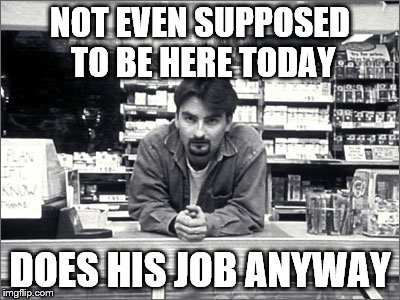
In the wake of county clerk Kim Davis’ refusal to give out marriage licenses to same sex couples a series of internet memes circulated with individuals in jobs that required them to do things they preferred not to do, but did their job anyway. It’s a funny concept, but one that doesn’t apply to Republicans in Congress who repeatedly threaten to shut down the government, failing to do their jobs in order to throw a temper tantrum over the conservative outrage du jour.
It has almost no chance of passing (see, Republicans in Congress) but a bill has been introduced to incentivize Congressmembers to actually govern responsibly:
Rep. Rick Nolan (D-Minn.) introduced a bill Friday that would prevent members of Congress from getting paid in the event of a government shutdown.
“It’s time to put an end to government by crisis management,” Nolan said in a statement. “And it’s time for Congress to start living in the real world — where you either do your job — or you don’t get paid. If hundreds of thousands of other federal employees are to go without their salaries — twisting slowly in the wind in a government shutdown — then the Congress should not be paid either.”
Under Nolan’s bill, members of Congress would go unpaid for the duration of the shutdown. He introduced similar legislation during the 16-day government shutdown in 2013 that left 800,000 federal workers furloughed without pay. While his bill never got off the ground, Nolan donated the money he was paid over the shutdown to charities in his district.
If Republicans want to run government like a business, this would be a good way to start. If you don’t do the work you’re supposed to do you don’t get paid. But the GOP only pays lip service to wanting the government to run efficiently.
At some point in the future when Democrats finally retake Congress, this should be one of the first bills they pass. The era of government by crisis hostage taking needs to end.
By: David Atkins, Political Animal Blog, The Washington Monthly, September 20, 2015
Share This Blog


 Unknown Feed
- An error has occurred; the feed is probably down. Try again later.
 mykeystrokes.com