“This Is Not A Game”: The Difference A “Different Decider” Makes
We may be headed for disaster in Iran, but at least this time we may be able to have a sane debate about it.
As the bleating of the Republican war caucus gets louder and louder, it’s beginning to sound a lot like 2002, when the Bush administration was treating us to daily news about the terrifying threat posed by Saddam Hussein’s vast arsenal of weapons of mass destruction, ready to incinerate us all in weeks if we didn’t launch a war. Some of the same people who made the case then are making the case now that we need to start bombing Iran. As you’re watching them, it’s hard not to shake your head and say, “Are these people insane? Do they actually believe that it’s a good idea for America to start another war in the Middle East? My god, are we getting on this train to disaster again?!?”
But before we all get too frustrated, it’s important to remember one thing: now matter how loud people like Liz Cheney may shout (and somebody please remind me why anyone should give a crap what she thinks), no matter how much infantile chest-beating we get from the Republican candidates (sample Mitt Romney quote: “I will station multiple aircraft carriers and warships at Iran’s door”), this will be a very different debate from the one we had back then. The reason is simple: We’ve got a different Decider.
It was extremely satisfying to see President Obama, at his press conference yesterday, treat the grunts of those lusting for war with Iran with something approaching the contempt they deserve:
Now, what’s said on the campaign trail — those folks don’t have a lot of responsibilities. They’re not Commander-in-Chief. And when I see the casualness with which some of these folks talk about war, I’m reminded of the costs involved in war. I’m reminded that the decision that I have to make in terms of sending our young men and women into battle, and the impacts that has on their lives, the impact it has on our national security, the impact it has on our economy.
This is not a game. There’s nothing casual about it. And when I see some of these folks who have a lot of bluster and a lot of big talk, but when you actually ask them specifically what they would do, it turns out they repeat the things that we’ve been doing over the last three years, it indicates to me that that’s more about politics than actually trying to solve a difficult problem.
Now, the one thing that we have not done is we haven’t launched a war. If some of these folks think that it’s time to launch a war, they should say so. And they should explain to the American people exactly why they would do that and what the consequences would be. Everything else is just talk.
There are lots of reasons to be worried about this problem, from the horrifying possibility that a President Romney would feel obliged to follow up on the absurd things he’s saying now, to the unpredictability of Israeli actions, to the potentially awful consequences of an Israeli strike that occurs with or without Washington’s approval. But whatever else happens, in this country we aren’t going to see those calling for sanity get marginalized the way they were in 2002 and 2003. In any debate, particularly one on foreign policy or matters of war, the media will define the debate by where the president and the administration stand. He’s the one with the biggest megaphone. Ten years ago, that megaphone was booming, “They’re going to kill us! Be afraid! Warwarwar!” and that became the axis around which the debate turned, enabling the people who turned out to be right to be dismissed as loons whose ideas didn’t need to be part of serious discussions about Iraq. Today that megaphone is saying—and appropriately so—”Just calm the f–k down.”
For now, anyway.
By: Paul Waldman, Contributing Editor, The American Prospect, March 7, 2012
Remembering Dr. King
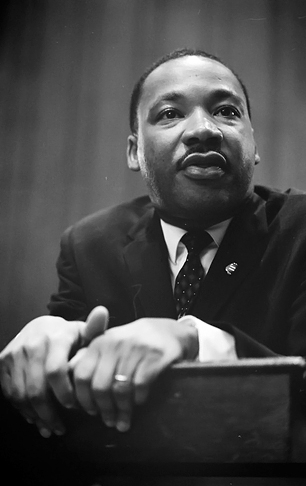
Dr. Martin Luther King, Jr (BuyenLarge/Getty Images)
I was surprised by his assassination. I didn’t see the Poor People’s Campaign as the threat to Washington and the Establishment that I now see it was. We feared for Dr. King’s life more in the early Sixties, through 1963, than we did by 1968. Up through 1965, there was a civil-rights-related death every couple of months, though most of them didn’t make headlines. By the end of ’65, there was a lull in the killings, and I thought perhaps we were finally beyond all that.
In his last year, we worried about Dr. King’s health. He was working eighteen to twenty hours a day. He would stay up all night reading, talking, clowning – whatever he felt like doing – and then wake up at five-thirty raring to go. His wife used to say that he had a war on sleep.
We would tell him that it looked like he was going to be around for a long time, and he couldn’t possibly keep this pace up, because he was close to forty. But if you said anything, he’d brush you off. I could never argue with him anyway. He was a preacher. And whenever we argued, he’d get to preaching. You never won an argument because he would take off on flights of oratory, and you’d forget your point trying to listen to him.
The year he died was the year he felt he had to establish the agenda for America’s future. For fifteen years he’d been struggling with the issues of racism, poverty and war. He refused to be just a civil rights leader. He was a sensitive lover of people who saw his primary responsibility in the black community. By 1968, though, it was clear to him that the black community could not concern itself with civil rights issues alone. The country was spending billions of dollars in Vietnam, and he saw racism and war becoming ever more tied up into one big problem for this country.
It was a time of increasing desperation for him. The SCLC had a fraction of the budget it should have had, about $700,000, and a small staff of fifty people, trying to take on the problems of the urban North, as well as the South, which still had large pockets of resistance. Not only weren’t we getting any aid from the federal government, but we had legions of FBI agents tracking us down, harassing us, trying to disrupt the work we were doing – work which I thought was the only thing that was giving America a fighting chance to survive.
The dangerous times when we were together were always the times he was most humorous. For years we couldn’t go anywhere without FBI men following us around. Dr. King was philosophical about it and very friendly toward them. Every now and then, we would leave a meeting through another entrance – not to escape the car that trailed us, but to sneak up on them. Dr. King would say hello, introduce us and (we always gave them the benefit of the doubt) thank them for the “protection” they were giving us.
I think he would have been quite content to be pastor of the Riverside Church, maybe teach at a university or a seminary. He wanted to teach the philosophy of religion, which was the subject of his Ph.D. He turned down a chance for the presidency of the NAACP when he first came to Montgomery in 1954, because he wasn’t sure he wanted to become that involved in the growing civil rights movement.
But when the bus boycott came in ’55, he was pressed into action. He had to respond. He was just twenty-six, and he never had the time to be the fun-loving man that he really was. He made the cover of Time magazine only a couple of years after he finished his degree, and then he was a celebrity.
From that time on he felt the burden of the country, his people and the world on his shoulders. He accepted it, but he always said he would have liked to do something else. He felt responsible for America’s future and its survival because he said that nobody understands nonviolence except black Americans, and if America was going to learn to live with the rest of the world, we’d have to help her find a nonmilitary course. In his Nobel Peace Prize speech, in fact, Dr. King said that the choice was nonviolence or nonexistence. I think back sometimes to what this country would have been like without Dr. King. The South was an armed camp in the Forties and Fifties. The GI bill and better job opportunities had created the beginnings of a black middle class, and they were not going to tolerate oppression any further. The white forces of reaction were trying to resist the advance of this new black middle class.
Every black family in the South had a gun. My father was probably the least violent man I know, and yet there were at least four guns in our household. Had there been no Martin Luther King Jr., the southern part of the United States would have looked like Northern Ireland or Lebanon.
And yet Martin saw that blacks and whites did not hate each other. They were being forced down through history on a collision course. Martin Luther King straightened out that course. He made it possible for blacks and whites to move in a parallel course of development and work together by using the tactic and methodology of nonviolence. He did not blame the white man for the problems that blacks were having. He saw blacks and whites caught up in a situation that they didn’t create, that they inherited. He saw nonviolence as a means for bringing people to realize that they could work their way together out of the situation.
Dr. King never understood why J. Edgar Hoover couldn’t comprehend what he was doing. If you read Hoover’s FBI reports on the March on Washington speech, you realize that he never saw Dr. King’s vision of a New America. He saw a powerful, radical political voice trying to destroy the nation.
I didn’t know then, but I now think that there lies the indirect responsibility for his assassination. I don’t know if it can ever be pinned down, but there are so many client groups that did dirty jobs around and for official people. I think now that Dr. King’s assassination was directly related to the fear that officialdom had of his bringing large numbers of poor people to the nation’s capital, setting up tents, demanding some response from them.
By: Andrew Young, Rolling Stone, January 13, 2012. (This story is from the December 1, 1977 issue of Rolling Stone). Writing in 1977, the famed civil rights activist Andrew Young reflects on the life and legacy of Martin Luther King.
The Neocons Are Trying To Talk Us Into War — Again!
“They have learned nothing and forgotten nothing,” Voltaire said of the members of the Hapsburg dynasty of his day. The same might be said of the American hawks who are calling for U.S. military intervention in Libya’s civil war.
Sens. John McCain and Joe Lieberman, along with others, have raised the possibility of establishing “no-fly zones” in Libya, along the lines of those in Iraq between the end of the Gulf War in 1991 and the beginning of the Iraq War in 2003, in order to prevent Libyan dictator Moammar Gadhafi from using his air force to bomb the rebels seeking to overthrow his regime. Another suggestion is to help Libyan rebels establish secure enclaves, from which they can capture the rest of the country from forces loyal to Gadhafi.
The implication is that the enforcement of “no-fly zones,” by the U.S. alone or with NATO allies, would be a moderate, reasonable measure short of war, like a trade embargo. In reality, declaring and enforcing a no-fly zone in Libya would be a radical act of war. It would require the U.S. not only to shoot down Libyan military aircraft but also to bomb Libya in order to destroy anti-aircraft defenses. Under any legal theory, bombing a foreign government’s territory and blasting its air force out of the sky is war.
Could America’s war in Libya remain limited? The hawks glibly promise that the U.S. could limit its participation in the Libyan civil war to airstrikes, leaving the fighting to Libyan rebels.
These assurances by the hawks are ominously familiar. Remember the phrase “lift-and-strike”? During the wars of the Yugoslav succession in the 1990s, Washington’s armchair generals claimed that Serbia could easily be defeated if the U.S. lifted the arms embargo on Serbia’s enemies and engaged in a few antiseptic airstrikes. Instead, the ultimate result was a full-scale war by NATO. Serbia capitulated only when it was faced with the possibility of a ground invasion by NATO troops.
Undeterred by the failure of lift-and-strike in the Balkans, neoconservatives proposed the same discredited strategy as a way to remove Saddam Hussein from power in Iraq. Paul Wolfowitz and others proposed the creation of enclaves in Iraq, from which anti-Saddam forces under the protection of U.S. airpower could topple the tyrant. Critics who knew something about the military dismissed this as the “Bay of Goats” strategy, comparing it to the Kennedy administration’s failed “Bay of Pigs” operation that was intended to overthrow Fidel Castro without direct U.S. military involvement by landing American-armed Cuban exiles in Cuba. In Iraq, as in the Balkans, the ultimate result was an all-out U.S. invasion followed by an occupation.
In Afghanistan, Afghan rebels played a key role in deposing the Taliban regime. But contrary to the promises of the Bush administration that the Afghan War would be short and decisive, the objective was redefined from removing the Taliban to “nation-building” and the conflict was then thoroughly Americanized. The result is today’s seemingly endless, expensive Afghan quagmire.
The lesson of these three wars is that the rhetoric of lift-and-strike is a gateway drug that leads to all-out American military invasion and occupation. Once the U.S. has committed itself to using limited military force to depose a foreign regime, the pressure to “stay the course” becomes irresistible. If lift-and-strike were to fail in Libya, the same neocon hawks who promised that it would succeed would not apologize for their mistake. Instead, they would up the ante. They would call for escalating American involvement further, because America’s prestige would now be on the line. They would denounce any alternative as a cowardly policy of “cut and run.” And as soon as any American soldiers died in Libya, the hawks would claim that we would be betraying their memory, unless we conquered Libya and occupied it for years or decades until it became a functioning, pro-American democracy.
Those who are promoting an American war against Gadhafi must answer the question: “You and whose army?” The term “jingoism” comes from a Victorian British music-hall ditty: “We don’t want to fight but by Jingo if we do,/ We’ve got the ships, we’ve got the men, we’ve got the money too.” Unfortunately for 21st-century America’s jingoes, we haven’t got the ships, the men or the money. The continuing wars in Iraq and Afghanistan have stretched U.S. military manpower to the limits. The U.S. has paid for these wars by borrowing rather than taxation. The long-term costs of these conflicts, including medical care for maimed American soldiers, will run into the trillions, according to the economists Joseph Stiglitz and Linda Bilmes.
If a lift-and-strike policy failed, and the result was a full-scale American war in Libya, how would Sen. McCain propose to pay for it? Republicans since Reagan have preferred to use deficit spending rather than taxes to pay for wars and military buildups. No doubt the Republican hawks would support paying for a Libyan war, like the Iraq and Afghan wars, by adding hundreds of billions or trillions to the deficit, even as they claim that non-military programs are bankrupting the country.
Napoleon and Hitler were brought down when they foolishly fought wars on two fronts. In hindsight they look like strategic geniuses compared to the American hawks who, not content that the U.S. is fighting two simultaneous wars in the Muslim world, are recklessly proposing a third.
Fortunately, the American people in 2008 chose not to entrust Sen. McCain with the office of commander in chief. While his domestic policy has been too timid and incremental, in his foreign policy Barack Obama has proven to be the cautious realist that America needed after the trigger-happy George W. Bush. His prudence is shared by his conservative secretary of defense, Robert Gates, who recently told an audience of West Point cadets:
“In my opinion, any future defense secretary who advises the president to again send a big American land army into Asia or into the Middle East or Africa should ‘have his head examined,’ as General MacArthur so delicately put it.”
Gates is right. Those who propose U.S. military intervention in Libya, even as the U.S. remains bogged down in Iraq and Afghanistan, should get their heads examined.
By: Michael Lind, Salon, March 8, 2011
Share This Blog


 Unknown Feed
- An error has occurred; the feed is probably down. Try again later.
 mykeystrokes.com
You must be logged in to post a comment.