“Leading From Behind, And Proud Of It”: America May Just Need To Get Over Its Own Sense Of Paternalism
Egypt and the UAE went forward with air strikes against Islamists in Libya without informing the United States. They did this presumably because they are concerned with the growing influence of Islamist extremists in their region of the world. No doubt their concerns don’t exist in a vacuum; the whole world is watching as Islamists garner more control in Iraq and Syria. Apparently America is supposed to be upset about the move because we should have been informed. The thought is that we’ve provided some of the weaponry, so we should have a say. There’s also the uncomfortable truth that America may just need to get over its own sense of paternalism if we really want to stay out of conflict.
Poll after poll shows an American populace that does not favor intervention overseas. It’s become quite clear since the downturn of the economy that we have enough to work on here at home without getting into multibillion-dollar conflicts. So we don’t want to intervene, but we don’t want to be left out either. The favorite saying of what I would call war hawks is that this is what happens when America “leads from behind.”
Well, here’s my question: Why do we have to lead at all?
I would argue that at this point and time we are in no position to lead anyone. We have record -low unemployment, the middle class that once defined the American dream is dissipating, and we have social issues bubbling under the surface that we should probably start to address. We have serious infrastructure needs that need to be met, and plenty of ingrown homeland-security challenges I’m positive our military could focus on (not to mention millions of families who would be grateful not to send off their loved ones into dubious wars).
I understand that America has serious political interests in the Middle East beyond oil. I understand that leaving the area completely is a pipe dream, largely because leaving Israel to its own devices at this point would be like leaving a kid in the desert to fend for herself. That said, isn’t that kind of what Americans did when we declared independence? Or when we fought our incredibly deadly civil war? What if the superpower of the time got involved in our own now-infamous civil conflict? What if we were not allowed to fight it out but were forced to form ourselves under the influence of a foreign culture that no one understood?
That is what we have been doing in the Middle East, and it is time to stop. It is time to let regional powers figure out their own regional conflicts, and it is time for America to begin addressing our own. We have thousands of people trying to get into our country because the situation below our border is so dire, partially for reasons that are well within our control (e.g., the drug war). Maybe we don’t see that problem as just as much of a threat as those in the Middle East, but we should. As we have seen with the latest incident at the Texas border, we can only ignore our neighbors for so long as we toil along overseas.
The interests are strong, and the history is thick, but I, for one, am happy that Egypt and the UAE made a unilateral decision without us. I am happy that Egypt orchestrated the Israeli/Palestinian ceasefire. I am glad that we are starting to “lead from behind” in the rest of the world, because maybe that means we can lead our own country.
By: Courtney McKinney, The Huffington Post Blog, August 28, 2014
“Bizarre Looking-Glass Ideology”: Deficit Scolds Are The Most Crazed Ideologues In America
A new Congressional Budget Office report shows that the projected increase in the national debt has slowed dramatically. Good news for deficit scolds, right? Not for Ron Fournier, who still thinks the nation is on its last legs:
Only in Washington, the place where you land when you fall through the looking glass, could this be hailed as good news… Our deficit levels (annual totals of red ink) are stalled at breathtakingly high levels — and are projected to soar again in a few years… Scary news, right? Not according to many media outlets and a cynical leadership class in Washington. Some news organizations focused on the sugar-high of good news — the (temporary) dip in deficits.
Think of a reporter covering a shooting. The police tell him the victim is dying of blood loss. Is the headline “Shooting Victim Expected to Die” or “Blood Flow Slows for Shooting Victim”? [National Journal]
Fournier’s economic analysis, if it may be so dignified with the phrase, is comprehensively wretched. As I’ve argued, the real problem with the deficit is that it’s coming down way too fast. Premature austerity has crippled the economic recovery and kept millions out of work. The biggest economic problem facing the nation is unemployment, which outweighs the stupid deficit by Graham’s Number levels of importance.
But the main problem is that his scold case is weak even on its own terms. Fournier understands neither what is driving the increase in the national debt nor why that might be a problem — all of which betrays a bizarre ideology that holds that pain must be inflicted before any gains can be made.
The huge increase in the annual deficit in 2008-09 was driven by two things: first, the economic collapse, which caused revenues to fall and spending to increase as people drew on safety net programs like unemployment insurance. Second, the Recovery Act, aka the stimulus, which provided a one-time surge of spending to restore aggregate demand and get people back to work. Though the stimulus was not nearly large enough to fill the hole in demand, this is what macroeconomic policy is supposed to do in a recession (a fact that Republicans were happy to accept when they were in power).
The long-term debt and deficit projections, on the other hand, are entirely about health-care spending. As Peter Fisher once said, the government is basically an insurance company with an army, and for many years the price of health care increased much faster than the rate of economic growth. This made government spending on health care (mostly Medicare and Medicaid) consume an ever-greater portion of the federal budget. Past CBO projections just assumed this trend would continue, which accounts for past reports predicting that the national debt would eventually eat the whole budget.
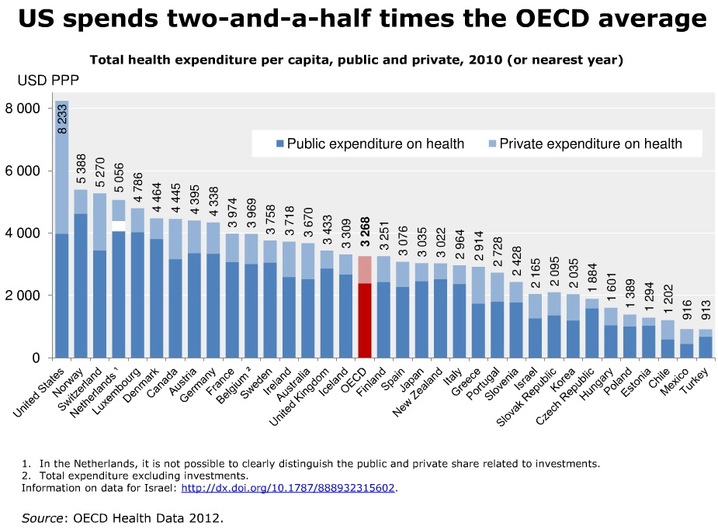
What this means is that Fournier’s preferred solution for dealing with this trend — higher taxes, fewer entitlements — is completely pointless. We have to fix the problem of rising prices, otherwise eventually a single tablet of aspirin will consume the entire federal budget. And the price problem is driven by awful policy design, not excessive generosity. America manages the rare trick of having very patchy and stingy social insurance that is simultaneously incredibly expensive. We spend more government money per person than Canada does — and the Canadians have universal single-payer coverage.
Fewer entitlements or higher taxes will get you a few years of breathing room before price increases eat up all the savings — and the whole point of Fournier’s column is that a couple decades of breathing room is still grounds for hair-on-fire panic.
Luckily, since the passage of ObamaCare, price increases have indeed slowed dramatically. That, plus a new projection that interest rates will stay low for a long time, accounts for the new CBO analysis showing slower debt growth. Just why this is happening is a matter of some dispute; I suspect it is partly the result of several programs in ObamaCare designed to bring prices down, and partly that health-care prices are already so high they’re running into resource constraints.
I think the fact that Fournier is patently uninterested in any of these things, and favors a policy that would accomplish nothing whatsoever on the deficit by his own standards, reveals that the pro-austerity school of punditry isn’t about the deficit at all. Instead, he says that his entitlement-cutting agenda is “going to happen sooner or later, painfully or more painfully.” As with David Gregory, the pain is the operative concept. The centrist definition of responsible politics holds that the American people must suffer a little more to keep the nation healthy. It’s only the “hateful partisans” who are keeping the wise, reasonable moderates from making those tough bipartisan compromises to slash social insurance and inflict pain.
But make no mistake: This has nothing to do with economics, and everything to do with the bizarre looking-glass ideology of “serious people” in Washington, D.C.
By: Ryan Cooper, The Week, July 24, 2014
“Such Short Memories”: The Worst President Since World War II? Uh, Guess Again
When George W. Bush was inaugurated president of the United States on January 20, 2001, the unemployment rate stood at 2.4 percent. By the time Dubya completed his second term in office on January 19, 2009, the unemployment rate at risen to 7 percent. When Dubya took office in 2001, he was left with a budget surplus of $127.3 billion. When he completed his second term, he left a budget deficit of $1.4 trillion. The US national debt was $5.7 trillion on January 19, 2001. After eight years of Dubya, the debt was $10.6 trillion.
The US was at peace on January 20, 2001. After eight years of Dubya, the US was involved in two overseas wars in Afghanistan and Iraq that had cost US taxpayers nearly $1 trillion. The bigger of the two — Iraq — was launched based on mistaken, manipulated, or concocted information (or some combination of the three), and had resulted in the deaths of approximately 4,200 US military personnel and somewhere between 100,000 to 500,000 Iraqi civilians.
America’s image abroad took a serious plunge under Dubya, primarily because of Iraq. International surveys of tens of thousands of people taken by the Pew Research Center’s Pew Global Attitudes Project during those years consistently found extremely low opinions of Dubya and the US due to the war in Iraq, particularly among Muslims. The revelations of atrocities committed by US soldiers at Abu Ghraib prison and abuses by contracted security firms like Blackwater certainly didn’t help. Oh, and the little matter of holding prisoners at Guantanamo and… more torture.
Both wars were carried out in retaliation for the terrorist attacks of September 11, 2001. The attacks, which took place during Dubya’s first year, resulted in the deaths of nearly 3,000 people and at least $10 billion in material damage.
A muscular foreign policy? Well, yeah… if you consider taking on third-rate powers like Iraq and Afghanistan “muscular.” Dubya couldn’t do much against Russia when it invaded Georgia in 2008, nor against Iran’s nuclear program. Also impotent to prevent the military rise of China. Some things just can’t be helped — not even if you’re a superpower.
The stock market? When Dubya took office in 2001, the Dow Jones stood at $10,587.59, the S&P 500 at $1,342.54, the NASDAQ at $2,770.38. Eight years later, the Dow was at $7,949.09, the S&P at $805.22, and the NASDAQ at $1,440.86. Those represented drops of 25 percent, 40 percent, and 48 percent, respectively.
The Great Recession in the US, which occurred during Dubya’s seventh and eighth years (2007-2008) in office, triggered a worldwide financial crisis — the worst since the Great Depression of the 1930s, and resulted in the collapse of numerous large financial firms in the US and around the world. It threatened the very viability of the international financial system.
During Dubya’s seventh and eighth years, Americans lost a total of $16.4 trillion in household wealth. In 2008 alone — Dubya’s last year — more than 1 million Americans lost their homes, and the foreclosure process had begun on another 2 million Americans.
Health care costs? Under the Dubya years, health insurance premiums doubled. According to the Kaiser Family Foundation, the average cost of employer-sponsored premiums for a family of four was $6,000 per year in January 2001. Eight years later, the average cost had risen to $12,680. It’s no wonder that the number of Americans with healthcare insurance dropped by 7.9 million under Dubya. Some 13.7 percent of Americans were uninsured in January 2001. Eight years later, the figure had risen to 15.4 percent.
Oh, Americans have such short memories — made only worse by how pathetically poor many choose to be informed. This is perhaps best reflected in the immensely entertaining poll recently taken by Quinnipiac University on June 24-30. The poll surveyed 1,446 people and asked them to rate US presidents since World War II. The result? Barack Obama was found to be the worst president since WWII. Right.
It brings to mind a gag quote I found online a couple of years ago. It was accompanied by a photo of Dubya. Went like this: “I screwed you all. But thanks for blaming it on the black guy.”
Bill Clinton perhaps put it best when he described the Republican Party’s position toward Obama: “We left him a total mess. He hasn’t cleaned it up fast enough, so fire him and put us back in.”
By: Marco Caceres, The Huffington Post Blog, July 8, 2014
“The Three Biggest Right-Wing Lies About Poverty”: So Why Do So Many Right-Wing Republicans Tell These Lies?
Rather than confront poverty by extending jobless benefits to the long-term unemployed, endorsing a higher minimum wage, or supporting jobs programs, conservative Republicans are taking a different tack.
They’re peddling three big lies about poverty. To wit:
Lie #1: Economic growth reduces poverty.
“The best anti-poverty program,” wrote Paul Ryan, the House Budget Committee chairman, in the Wall Street Journal, “is economic growth.”
Wrong. Since the late 1970s, the economy has grown 147 percent per capita but almost nothing has trickled down. The typical American worker is earning just about what he or she earned three decades ago, adjusted for inflation.
Meanwhile, the share of Americans in poverty remains around 15 percent. That’s even higher than it was in the early 1970s.
How can the economy have grown so much while most people’s wages go nowhere and the poor remain poor? Because almost all the gains have gone to the top.
Research by Immanuel Saez and Thomas Piketty shows that forty years ago the richest 1 percent of Americans got 9 percent of total income. Today they get over 20 percent.
It’s true that redistributing income to the needy is politically easier in a growing economy than in a stagnant one. One reason so many in today’s middle class are reluctant to pay taxes to help the poor is their own incomes are dropping.
But the lesson we should have learned from the past three decades is economic growth by itself doesn’t reduce poverty.
Lie #2: Jobs reduce poverty.
Senator Marco Rubio said poverty is best addressed not by raising the minimum wage or giving the poor more assistance but with “reforms that encourage and reward work.”
This has been the standard Republican line ever since Ronald Reagan declared that the best social program is a job. A number of Democrats have adopted it as well. But it’s wrong.
Surely it’s better to be poor and working than to be poor and unemployed. Evidence suggests jobs are crucial not only to economic well-being but also to self-esteem. Long-term unemployment can even shorten life expectancy.
But simply having a job is no bulwark against poverty. In fact, across America the ranks of the working poor have been growing. Around one-fourth of all American workers are now in jobs paying below what a full-time, full-year worker needs in order to live above the federally defined poverty line for a family of four.
Why are more people working but still poor? First of all, more jobs pay lousy wages.
While low-paying industries such as retail and fast food accounted for 22 percent of the jobs lost in the Great Recession, they’ve generated 44 percent of the jobs added since then, according to a recent report from the National Employment Law Project.
Second, the real value of the minimum wage continues to drop. This has affected female workers more than men because more women are at the minimum wage.
Third, government assistance now typically requires recipients to be working. This hasn’t meant fewer poor people. It’s just meant more poor people have jobs.
Bill Clinton’s welfare reform of 1996 pushed the poor into jobs, but they’ve been mostly low-wage jobs without ladders into the middle class. The Earned Income Tax Credit, a wage subsidy, has been expanded, but you have to be working in order to qualify.
Work requirements haven’t reduced the number or percent of Americans in poverty. They’ve merely increased the number of working poor — a term that should be an oxymoron.
Lie #3: Ambition cures poverty.
Most Republicans, unlike Democrats and independents, believe people are poor mainly because of a lack of effort, according to a Pew Research Center/USA Today survey. It’s a standard riff of the right: If the poor were more ambitious they wouldn’t be poor.
Obviously, personal responsibility is important. But there’s no evidence that people who are poor are less ambitious than anyone else. In fact, many work long hours at backbreaking jobs.
What they really lack is opportunity. It begins with lousy schools.
America is one of only three advanced countries that spends less on the education of poorer children than richer ones, according to a study by the Organization for Economic Cooperation and Development.
Among the 34 O.E.C.D. nations, only in the United States, Israel and Turkey do schools serving poor neighborhoods have fewer teachers and crowd students into larger classrooms than do schools serving more privileged students. In most countries, it’s just the reverse: Poor neighborhoods get more teachers per student.
And unlike most OECD countries, America doesn’t put better teachers in poorly performing schools,
So why do so many right-wing Republicans tell these three lies? Because they make it almost impossible to focus on what the poor really need – good-paying jobs, adequate safety nets, and excellent schools.
These things cost money. Lies are cheaper.
By: Robert Reich, The Robert Reich Blog, June 13, 2 014
“Time For Some Happy Talk From Democrats”: Ban The Word “But” Until After The Election
Democrats, if you want to win in the fall, take some advice from Pharrell Williams: “Clap along if you feel like happiness is the truth.”
The Mountie-hat-wearing pop singer’s infectious “Happy” should be the Democratic Party’s theme song for the midterm election. Despite Republican claims to the contrary, things are definitely looking up. Democrats ought to be clicking their heels and spreading the good news.
Friday’s announcement that unemployment fell to 6.3 percent was huge. The fact that the economy added 288,000 jobs in April — despite continued bad weather early in the month in parts of the country — suggests that the recovery has greater momentum than pessimists had feared. Economists were expecting decent numbers. These are great.
The stock market, meanwhile, is flirting with an all-time high. The Dow has risen about 10 percent over the past year; the S&P 500, more than 16 percent; the Nasdaq, about 22 percent . During President Obama’s term in office, the Dow has more than doubled. If he were a socialist, as his harshest critics claim, he’d be a truly lousy one.
The numbers prove that Obama is, in fact, a skillful capitalist who guided the economy out of its worst slump since the Great Depression. He accomplished this feat despite being saddled with a Republican opposition in Congress that reflexively opposes his every initiative — even those based on policies the GOP supported in the past.
Speaking of which, the Affordable Care Act — which is based, you’ll recall, on a framework developed in Republican think tanks — is clearly a success and may soon be seen as a triumph. More than 8 million people have signed up for insurance through the federal and state exchanges; Obama’s benchmark had been 7 million. Enough of these enrollees are young and healthy to ensure the program’s continued viability.
The disasters predicted by the Republican Party have not come true. Critics have stopped talking about a hypothetical “death spiral” in which the health insurance reforms collapse of their own weight, since it is now clear that nothing of the sort will happen. Early indications are that any increase in premiums for next year will be modest. Republicans will keep attacking Obamacare because it fires up the base, but the program is here to stay.
Democrats now have a positive story they can tell in their campaign ads and speeches: “We promised you that these were the right policies to get the economy on track and reform health care. We said it would take time to see results and asked for patience. You gave us your trust, and now we’re seeing the benefits. This is just the beginning. Give us a mandate to keep moving forward on an agenda that is working.”
This is what Democrats are saying, more or less. But would it hurt to show a little enthusiasm?
Obama can be excused for his brief and relatively low-key reaction to the jobs numbers Friday. He spoke in the White House Rose Garden alongside German Chancellor Angela Merkel, with whom he had just met, and the situation in Ukraine was clearly weighing on both leaders’ minds.
“The grit and determination of the American people are moving us forward,” Obama said, “but we have to keep a relentless focus on job creation and creating more opportunities for working families.”
I propose that Democrats ban the word “but” until after the election.
Republicans are giving “but” a workout. Unemployment may be down to 6.3 percent, they say, but too many people are leaving the workforce. The jobs numbers for April may look good, but we don’t know if this rate of growth can be sustained. Enrollment numbers for the Affordable Care Act may be impressive, but have all those people actually paid their premiums?
These are not honest caveats. Republican claims about enrollees not paying their insurance premiums, for example, are based on a survey taken before many of those premiums were even due. The GOP wants to foster the notion that nothing is going well with Democrats in charge of the White House and the Senate — and that it’s time for a change.
When Democrats sound like the old “Saturday Night Live” character Debbie Downer — emphasizing what’s still ailing about the economy, promising to “fix what’s broken” in Obamacare — they reinforce the Republicans’ message rather than refute it.
Listen up, Democrats. You fixed the economy. You expanded access to health care. Oh, and you ended two wars.
Show a little happiness. It’s contagious.
By: Eugene Robinson, Opinion Writer, The Washington Post, May 5, 2014
Share This Blog


 Unknown Feed
- An error has occurred; the feed is probably down. Try again later.
 mykeystrokes.com