John McCain & Lindsey Graham: The Mean Girls of the U.S. Senate
I have a theory about human social evolution: life doesn’t progress much after high school. This week, I can thank John McCain and Lindsey Graham for providing empirical data that supports this hypothesis.
Here’s how government should work: lawmakers ponder the great issues of the day in serious manner and then decide, according to their own beliefs and values, which policies are best for their constituents and the public. But in the past few days, we’ve seen government-by-hissy-fit, with Sens. McCain and Graham, the Batman and Robin of cranky self-proclaimed GOP mavericks, placing personal petulance ahead of the common good.
As the Senate on Saturday was in the process of repealing the “Don’t ask, don’t tell” policy that bans out-in-the-open gays and lesbians from serving in the military, McCain practically threw a tantrum on the Senate floor, decrying “this bizarro world” and denouncing senators in favor of repeal for “acting in direct repudiation of the message of the American people.” (Never mind that most polls show majority support for repealing DADT.) Looking as if steam would shoot out of his ears at any moment, McCain went on to exclaim that ending DADT would endanger “the survival of our young men and women in the military.”
Them are fighting words. But what made McCain’s over-the-top performance so bizarro itself was that only four years ago he had said that he would back repeal if military leaders endorsed it — and now the secretary of defense and the chairman of the joint chiefs of the military were supporting the change. Not only had McCain flip-flopped, he had become an angry crusader, seemingly full of rage at a policy initiative he once quasi-endorsed. How to explain this? It seemed more personal than policy — as in he really doesn’t fancy seeing a victory for President Obama, the fellow who prevented McCain from becoming BMOC.
Graham’s behavior was more outlandish. On Sunday, the South Carolina Republican said that he wouldn’t vote for the START treaty that will reduce U.S. and Russian nuclear arms because “this lame duck [congressional session] has been poisoned.” And what poisoned it? In part, Graham said, it was the passage of the “Don’t ask, don’t tell” repeal. Here was a U.S. senator saying he wouldn’t take up the critical issue of nuclear nonproliferation because he was peeved by the repeal of DADT, which sailed through on a 65-to-31 vote. Governing via tantrum?
It gets worse. The day before the Senate overturned DADT, Graham was complaining that the workload in the Senate was too much for him and he was too close to physical collapse to handle a vote on START:
It’s been a week from hell. It’s been a week where you are dealing with a lot of big issues from taxes to funding the government to special interest politics. And I’ve had some to think about START but not a lot and it’s really wearing on the body.
Poor Graham. Many Americans work more than one job just to feed their family and to keep from being tossed out of their home. Yet he was bellyaching about some end-of-the-year heavy-lifting that was occurring because the Senate, partly due to GOP obstructionism, had not finished its important business. By the way, the START treaty was signed by the United States and Russia in April; that had allowed Graham and other senators plenty of time to think about it. (Previous START pacts were ratified by the Senate after much less time for Senate consideration.) Graham was whining. Two words: man up.
And it gets worse. On Monday, the Huffington Post reported that early last week, McCain and Graham had tried to cut a deal with the White House: they offered to deliver enough GOP votes to ratify the START treaty, if Obama and the Democrats would sideline any vote on DADT. The White House said no, thanks. But this was a cynical maneuver on the senators’ part: if you don’t give us what we want (no DADT repeal), we won’t give you something you want (START ratification). Forget about the merits of the treaty. McCain and Graham, who fashion themselves serious students of national security, were engaged in playground politics concerning a nuclear arms treaty. They were willing to vote for it — only if the White House would appease them. The substance didn’t matter.
When McCain and Graham didn’t get their way, Graham groused he was too overwhelmed to deal with the treaty, and McCain tried to kill the agreement by offering an amendment that would force the United States and Russia to renegotiate the pact. The Senate rejected his amendment on Saturday. Which probably irritated the hell out of him. On Monday, Brent Scowcroft, who was national security adviser for President George H.W. Bush and who supports START ratification, accused McCain of assailing the treaty because of his anger over the repeal of DADT: “To play politics with what is in the fundamental national interest is pretty scary stuff.” I look forward to McCain yelling at Scowcroft to get off his lawn.
But McCain and Graham have not merely been grumpy old men. They have been behaving like mean girls — hatching plots, acting spoiled, wallowing in self-absorption and melodrama, and having cows when they don’t win. It’s a sorry spectacle, especially because both men in the past have tried to be reasonable adults within the Senate. Now they’re embarrassing themselves, as they flail about in a puddle of pique. The best news for them is that within days, school will be out.
By: David Corn, Washington Bureau Chief , Mother Jones Magazine; Politics Daily, December 21, 2010
We Gather to Mourn the Loss of John McCain’s Integrity

Maverick or Total Fraud?
We are gathered here today to pay our final respects to John McCain’s integrity.
It died recently — turned a triple somersault, stiffened like an exclamation point, fell to the floor with its tongue hanging out — when the senator told Newsweek, “I never considered myself a maverick.” This, after the hard-fought presidential campaign of 2008 in which McCain, his advertising team, his surrogates and his running mate all but tattooed the “M” word on their foreheads.
Indeed, not only did they call McCain a maverick, but so did the subtitle of his 2003 memoir. Heck, his campaign plane when he ran for president back in 1999 was dubbed Maverick One. Yet there he is in the April 12, 2010, edition of Newsweek, page 29, top of the center column: “I never considered myself a maverick.”
And his integrity kicked twice and was still.
The death was not unexpected. McCain’s integrity had been in ill health for a long time. Once, it had been his most attractive political trait, drawing smitten prose from political reporters and intrigued attention from voters sick of the same old, same old from politicians who would bend like Gumby for the electorate’s approval.
McCain’s integrity wouldn’t allow him to be that guy. He was this hard-bitten former Navy flier and heroic POW, impatient with the belittling demands of politics as usual, a fellow who would speak an impolitic truth or cross the aisle to work with the opposition because he had this quaint idea that the needs of the country superseded the needs of his party. Then came the GOP presidential primary of 2000 in which McCain was bested by one George Walker Bush and a load of dirty tricks. McCain took note. And his integrity took sick.
The illness began in that selfsame campaign.
By his own admission, McCain lied to voters about his opinion of the Confederate battle flag, fearing that calling it what it is — a flag of treason, racism and slavery — would cost him votes in flag-worshipping South Carolina.
In later years, he embraced right-wing religious extremists he had once condemned. And reneged on a promise that he’d be open to repealing “Don’t Ask, Don’t Tell” if military leaders advised it. And went from opposition of offshore oil drilling to “Drill, baby, drill!” And et cetera.
Two things here: One, all the nattering about flip-flops aside, there is nothing wrong with changing one’s opinion. It indicates a thinking mind.
Two, McCain is hardly unique. Indeed, they have a name for people who change their opinions in order to win votes: politicians.
But these are not just changes of opinion we’re talking about. Rather, they are betrayals of core principle. And while that might be politics as usual, there is a higher standard for the politician who has positioned himself as a man of uncommon integrity, a purveyor of straight talk in a nation hungry for same. When that man panders, the disappointment is keen.
So it stings to see McCain knuckle under to the ideological rigidity that makes it heresy to cross the aisle, question the orthodoxy or have an independent thought. There’s a sense of loss for those who ask of leaders, leadership. It reinforces the cynical notion that there is no one out there who is authentic.
One is reminded of that poignant scene in “The Truman Show” where Jim Carrey as Truman Burbank has just discovered his entire life was a made-for-TV fiction. “Was nothing real?” he asks. A voter who believed in John McCain, who regarded his iconoclastic singularity as a stirring example, might be forgiven for asking the very same thing.
“I never considered myself a maverick”?! Wow.
With those words, McCain completes his transmutation into an avatar of all that is wrong in American politics.
May his integrity rest in peace.
Miami Herald columnist Leonard Pitts Jr.’s column appears regularly on editorial pages of The Times. His e-mail address is: lpitts@miamiherald.com: AP photo by Michael Conroy
Procedurally Correct: The House Can Decide How to Enact Health Reform

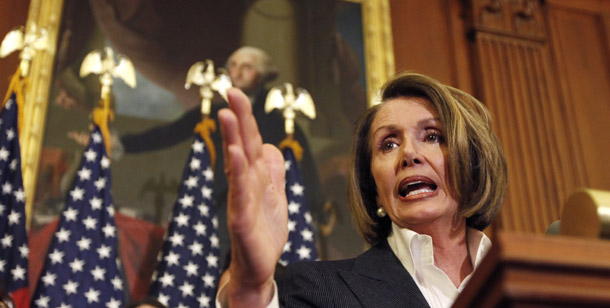
House Speaker Nancy Pelosi (D-CA) is considering asking the full House to vote on a package of amendments to the Senate-passed health care bill that would also contain language adopting the Senate bill
People who are opposed to health care reform are raising a real ruckus over a possible parliamentary maneuver being considered by Speaker of the House Nancy Pelosi (D-CA). She is thinking of asking the full House to vote on a package of amendments to the Senate-passed health care bill that would also contain language adopting the Senate bill. That may sound like a fairly exotic method of enacting important legislation, but is it inappropriate? My answer is no.
What this so-called “deeming” provision does is essentially join the two pieces of legislation into one. If the Senate had a different rule on debate this would happen in a conference committee. The House conferees would insist on amendments very similar to those now in the package that Pelosi is bringing to the floor, but the amendments and underlying legislation would all be wrapped together as a single conference report and voted up or down by both the House and Senate.
Because the 59 senators who support health care cannot shut off debate on such a conference report that option is not open, so the House has created this procedure as a substitute.
But, as some might ask, isn’t the 60-vote majority required to end a Senate filibuster part of the legislative process? Is it fair for the House to attempt to circumvent that process by joining two pieces of legislation—one that has already passed the Senate and the other that is being sent to the Senate for consideration?
The answer is yes. Although the filibuster is part of current Senate rules it has not always been. Further, while some continue to think that the 60-vote supermajority required to terminate debate in the Senate has constitutional origins, the Constitution in fact implies that such matters should be resolved by a simple majority—leaving the House free to take whatever view it chooses on the question of the 60-vote supermajority required by current Senate rules.
The possibly apocryphal story of George Washington and Thomas Jefferson arguing over the role of the Senate is often cited by defenders of the filibuster. Washington supposedly asked Jefferson, “Why did you pour that coffee into your saucer?” Jefferson responded, “To cool it.” Then Washington is said to have replied, “Even so, we pour legislation into the senatorial saucer to cool it.”
But the Senate rules did not permit a filibuster at the time this conversation allegedly took place. Filibusters were not allowed under Senate rules until 1806 and they were not practiced until the 1840s—when they were used largely against legislation to limit the practice of slavery.
The Constitution did structure the Senate in a way that it would counterbalance the possibility for erratic tendencies in the House, which elects all of its members every two years. Senators are elected for six-year terms so that only a third of the body is subjected to the scrutiny of the electorate in any one election.
The Constitution does specify that supermajorities are necessary for certain actions by the Senate. For instance, the Constitution requires that two-thirds of the Senate must vote to approve the overturn of a presidential veto or to ratify a treaty. In five other instances the Constitution requires the Senate to act by a supermajority, but for matters such as the passage of ordinary legislation like the health care bill the Constitution provides it to be determined by majority vote.
The House can’t completely circumvent the current Senate rules, but it can respond to the Senate passage of legislation that is unpopular with House members by packaging it as though it were a conference agreement and sending it forward saying that the body agrees to this legislation only if it is amended as specified by the amendments contained in the rest of the package. That is not simply permissible but it provides the House with the only means of voting on the issue that reflects the true sentiment of the body.
Further, it should be noted that use of self-executing or deeming resolutions is in fact not all that exotic and that the record of those feigning great dismay over its use have repeatedly used exactly the same procedure themselves—often with far less justification than can be provided in the current instance. House Minority Leader John Boehner (R-OH) calls the proposed procedure “the twisted scheme by which Democratic leaders plan to bend the rules.” Yet during the 109th Congress alone (a portion of which Rep. Boehner served as his party’s floor leader when his party was in the majority) deeming resolutions were used 36 times and Boehner supported all of them.
What the speaker is now considering as a means of resolving the long-protracted debate on health care is putting the two pieces of legislation that deal with health care together so the House can vote on them up or down as one package. That is the way our new policy on health care should be considered and it is highly regrettable that the archaic and undemocratic rules of the Senate don’t allow that as the order of business in both houses of Congress.
By:Scott Lilly-Senior Fellow at the Center for American Progress-March 17, 2010
Share This Blog


 Unknown Feed
- An error has occurred; the feed is probably down. Try again later.
 mykeystrokes.com

You must be logged in to post a comment.