The Ohio Tea Party’s Big “Obamacare” Fail
Ohio tea partiers will finally get their big moment at the ballot box on November 8. That’s when Ohioans vote on Issue 3, a referendum spearheaded by tea party groups that would amend the state constitution to ban any law or rule requiring that citizens buy health insurance. The intent is obvious: to rebuke President Obama by blocking the individual mandate—the part of the Affordable Care Act (ACA) that requires Americans to buy health insurance or pay a fine. Issue 3 was also seen as a way to fire up conservative voters in an off-year election when the fate of Gov. John Kasich’s anti-union SB 5 bill is on the line.
But the measure backfired. Not only won’t it block the ACA’s individual mandate, but it’s so vague, legal experts say, that it could have the damaging, unintended effect of undermining key public services and regulations in Ohio, including blocking the state’s ability to collect crucial data on infectious diseases. If passed, it could also spark a wave of costly lawsuits, with taxpayers likely footing the bill. “It’s extremely sloppy and extremely overbroad,” says Jessie Hill, a professor at Case Western Reserve University School of Law. “I hesitate to say whether these potentially extremely troubling consequences were intended or whether the amendment was just misguided.” And if you trust the polls, Issue 3 isn’t even energizing Ohio conservatives.
Issue 3 is the brainchild of the Ohio Liberty Council, a coalition of tea party chapters, 912 groups, and other liberty-loving activists. The Council tried to put Issue 3—which it calls the “Healthcare Freedom Amendment”—on the ballot in November 2010, but fell short in the signature-gathering process. This year, the group redoubled its efforts and managed to gather nearly 427,000 signatures, enough to put the issue before voters. (The Liberty Council did not respond to multiple requests for comment.)
The amendment, endorsed by Ohio Right to Life and Republican state Sen. Bob Peterson, was pitched as a direct response to Obama’s Affordable Care Act. An early pamphlet (PDF) created by the Ohio Project, the grassroots group created to promote the amendment, focuses entirely on defusing “the new federal health care measure passed by Congress.”
But if Issue 3 passes, it won’t affect the Affordable Care Act. Richard Saphire, a professor at the University of Dayton Law School, says passage of Issue 3 might deliver a symbolic rejection of the individual mandate, but legally it would have zero effect, because Article VI of the US Constitution says that federal law trumps state law. “It’s very defective,” he says. “Folks that come out and vote for it, probably most of them are going to think they’re going to accomplish something that they’re not going to accomplish, which is prevent federal law from going into effect.”
Issue 3 supporters now concede this. But they insist the measure will still prevent a Massachusetts-style, state-based individual mandate from becoming law in Ohio and will set the stage for individual Ohioans to challenge the Affordable Care Act in court. Ohioans could say “you are fundamentally restricting our liberty and property here, and there was no due process,” Chris Littleton, a cofounder of the Ohio Liberty Council, said at an Issue 3 debate in late October.
While Issue 3 won’t derail “Obamacare,” it would have potentially “massive and disastrous impacts” on health care delivery and public health regulation in Ohio, says Case Western’s Hill.
A report (PDF) cowritten by Hill and released by Innovation Ohio, a liberal public policy group that opposes Issue 3, found that the amendment’s overbroad language could undermine a slew of programs that include some form of mandate. The amendment reads, in part:
No federal, state, or local law or rule shall compel, directly or indirectly, any person, employer, or health care provider to participate in a health care system.
Although the amendment would exempt laws in place before 2010, any new reforms to, say, workers’ compensation, which requires employers to buy insurance in case of workplace injuries, would violate the measure. State law also requires that public schools pay to immunize students whose families can’t afford it; reforms of that program would be blocked under Issue 3 because the immunization requirement is a type of mandate, according to the Innovation Ohio report. The amendment, the report noted, would likely render unconstitutional a key reporting element in a state law to regulate so-called pill mills, because it compels “participation” in a “health care system.” And Issue 3 would handcuff the state’s ability to gather data on infectious diseases including HIV and influenza for the same reason.
Hill and Saphire both say Issue 3’s passage would likely set off a wave of litigation aimed at discovering the true meaning and reach of the amendment. And it would be Ohioans, Hill says, footing the bill for those lawsuits.
Issue 3 isn’t getting much love from Ohio opinion makers, liberal or conservative. Despite its opposition to the “deeply flawed” Affordable Care Act, the conservative editorial board of the Columbus Dispatch, the state’s largest newspaper, urged a “no” vote on the measure. Arguing that state constitutions should not be subject to “short-term political gamesmanship,” the Dispatch wrote that “trying to counter the federal law with an ineffective amendment to the Ohio Constitution is a bad idea. This is not where that battle should be fought.” Every major newspaper editorial board in Ohio that’s taken a position on Issue 3 has opposed it.
If recent polls are any judge, Issue 3 hasn’t done much to mobilize conservative voters, either. An October 28 survey by the University of Akron Bliss Institute of Applied Politics found that 34 percent of respondents favor Issue 3 and 18 percent oppose it. The remaining 48 percent remained undecided less than two weeks before the vote. More importantly, the Akron survey found much more enthusiasm around Issue 2—which polls suggest will be defeated, repealing Kasich’s SB 5 bill—than around Issue 3, which polls suggest will pass.
If Issue 3 becomes law, it wouldn’t be the first time voters approved an amendment to a state constitution that didn’t serve its intended purpose, Saphire says. After the US Supreme Court’s 1954 Brown v. Board of Education ruling declared racial segregation in public schools unconstitutional, a handful of states passed symbolic amendments expressing opposition to the Brown decision. The Supreme Court is expected to decide the fate of the ACA’s individual mandate in its upcoming term. If the high court decides to uphold the law, Ohio tea partiers—Issue 3 or no—will have to buy health insurance or pay a fine.
By: Andy Kroll, Mother Jones, November 3, 2011
Health Care Lawsuits: Separating Law From Spin

"Now if we can just fool the Courts"
If a public figure walks on water at noon, by 3 p.m. a dozen talking heads will be explaining that he can’t swim. That’s politics. But we can hope that federal judges won’t think in sound bites.
The current lawsuits challenging the Affordable Care Act raise this question insistently. I return to this lawsuit in yet another column because I believe this case will dominate both constitutional law and political discourse over at least the next 12 months–and because I believe its stakes far transcend its immediate consequences, important though they will be. I think that if our federal courts are willing to sign on to the challengers’ jejune theory of this case, not only we but our children will spend years dealing the malign consequences of the mistake. Nothing less than the ability of the United States to function as a modern nation may be at stake.
So far, in two of the pending lawsuits, opponents of the law have succeeded in spinning the judges, framing the lawsuits as posing the question whether (as Virginia argued) the federal government can “impose a penalty for what amounts to passive inactivity.”
We know the talk-radio answer to this question: Tyranny! Death panels! Black helicopters! Praise the Lord and pass the ammunition!
But the judicial answer, it seems to me, should be two-fold.
The first, and most important, answer a judge should give is, “I dunno. Find a case where the government does that and get back to me.” Because that description of the Affordable Care Act is simply inaccurate.
The second answer, which a judge shouldn’t give but a Con Law jock like me can, is, “Why ever not?”
I will get to that one later; but first, let’s deal with the canard that the Act somehow “penalizes inactivity.”
Here’s how Judge Henry Hudson put it in his decision in Cuccinelli v. Sebelius: The Act “requires that every United States citizen, other than those falling within specified exceptions, maintain a minimum level of health insurance.”
This snappy apothegm is the logical equivalent of saying that the Defense Appropriations Act “requires that every United States citizen, other than those who leave the country, engage in accepting a minimum level of protection by the United States military.” The provisions of the Health Care Act provide a benefit. The majority of Americans, who already have health coverage (and seem, by and large, to regard this coverage as worth bargaining for) will simply see improvements in their existing health care benefits, such as an end to lifetime benefit limits and the right to include older adult children on their policies. A significant number of others who are currently uninsured will become eligible for government-funded health insurance.
There will remain a small but significant number of Americans who can afford health care insurance but choose not to buy it. But contrary to the sound bite above, even they are not required to “maintain a minimum level of health insurance.” If they wish to keep their uninsured status, they may do so by paying an addition to their income tax bills–ranging from as little as $695 for an individual taxpayer to $2085 for a family of six or more. The claim that the government is “forcing individuals to buy a commercial product” is worse than spin; it is simply false.
In fact, even the choice of procuring insurance or paying a tax is put not to “every United States citizen,” or even “every United States citizen not already covered by insurance,” but only to those who earn enough income to qualify as taxpayers. “A small fraction of fewer than half of United States citizens,” though accurate, is much less thrilling to say, even for a judge, than “every citizen.”
This brings us to the contention that the act somehow regulates “inactivity.” Let’s you and I test this proposition: why don’t you just remain totally inactive in 2014, when the Act first takes effect.
Quit your job and get rid of your investments. The government will not regulate you. (True, it may offer you government-financed health care; but again, that is a benefit, not a regulation or punishment.)
But if you decide actually to work (I recommend that, by the way), you are not being “inactive.” You are taking part in commerce. The Constitution gives Congress plenary authority “to regulate commerce with foreign nations, and among the several States, and with the Indian Tribes.”
A system of regulation might easily include requiring you to pay taxes if you choose to burden commerce; willful refusal to maintain adequate health coverage for yourself and your family is such a burden. To claim otherwise doesn’t pass the straight-face test.
Conservatives like to prate about “individual responsibility” when it is a question of forcing the poor to work; asking the solvent to pay for themselves seems quite in line with these conservative values.
And as to the idea that Congress can only regulate “activity,” here again, verbal formulae are obscuring the practical truth. The Constitution does not say anything about “activity”; that’s a gloss that the Rehnquist Court put on it. Nor does it refer to “interstate commerce,” which to some (apparently including Justice Thomas) means men in knee breeches handing trinkets across state lines. The Constitution says that Congress may “regulate commerce . . . among the several states.”
Chief Justice Marshall (who was a ratifier, though not a Framer, of the Constitution) wrote in 1824 that “among” means “intermingled with,” not “between.” Marshall wrote that Congress’s commerce power reaches everything except that small set of matters “which are completely within a particular state, which do not affect other states, and with which it is not necessary to interfere, for the purpose of executing some of the general powers of the government.” Health care, and the citizen’s economic relationship with it, most assuredly affect all the states, and individual decisions about insurance are an important part of that effect–just as a farmer’s decision to raise private wheat are a part of agriculture’s effect on commerce.
I am somewhat mystified why the state plaintiffs even have standing to appear. In order for them to be injured, the Act would have to infringe some power that is reserved by the Constitution to the states. Judge Hudson placed great emphasis on an obscure 1922 precedent called Bailey v. Drexel Furniture, in which a laissez-faire majority of the Supreme Court invalidated a federal tax on products produced by child labor. The tax, the Court reasoned, was an attempt to prevent exploitation of children in factories and mills; such labor regulations were “a purely state activity.”
The Court has long since given up the idea that “labor laws” are solely state matters. But assume that in the formal sense Drexel is good law. So what? The tax, or penalty, in the Affordable Health Care Act doesn’t regulate any “purely state activity.” If it pretended to regulate commerce but was actually aimed at preventing divorce, or imposing a national zoning code, or requiring homeowners to maintain tasteful wallpaper, there might–might–be a Tenth Amendment issue. But not here: In the guise of regulating commerce, the Act regulates . . . commerce.
Here’s the nub of the objectors’ argument–it is not that this isn’t a regulation of commerce, but that the Commerce Power isn’t strong enough to regulate an entire national market. That kind of limitation on the Commerce Power finds no support in, well, the Constitution.
The doctrine under which the Act is being assailed quite simply constitutes a threat to most of the significant advances in federal law of the past 100 years: federal pension programs, national wildernesses and parks, consumer protection, environmental regulation, and most particularly statutory guarantees of civil rights.
It’s not coincidental that right now Ron Paul laments the Civil Rights Act and that Haley Barbour speaks fondly the segregated South, that anti-immigrant extremists target birthright citizenship, or that right-wingers seek to wreck the Constitution with an old-South style amendment letting states repeal federal laws. A decision to void the Act would furnish a powerful precedent for those who would “restore” a libertarian dreamland that never existed, and that for most of us would quickly become a nightmare.
The great achievement of the Framers–the one they clearly thought most important–was the creation of a national Congress with plenary powers in the spheres assigned to it. Trying to wreck Congress is warring on the Constitution.
That’s not to say that Congress can regulate commerce by unconstitutional means. But the prohibitions on means are in the Constitution, not in the fevered brain of Cuccinelli & McCollum. If a new health care act were to restrict free speech, or impose ex post facto laws, or authorize bills of attainder, or deny due process, the courts should certainly step in.
But that’s not what is at issue here.
Stripped of spin, the state plaintiffs are arguing that Congress can’t use its commerce power to actually regulate commerce. If the courts buy this nonsense, they may fatally damage the power of Congress to manage a modern commercial economy. Repairing that mistake would involve far greater sacrifices than having to pay a tax.
By: Garrett Epps- former reporter for The Washington Post-Original article-The Atlantic, December 30, 2010
Procedurally Correct: The House Can Decide How to Enact Health Reform

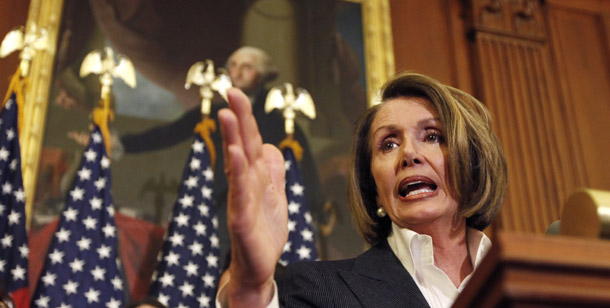
House Speaker Nancy Pelosi (D-CA) is considering asking the full House to vote on a package of amendments to the Senate-passed health care bill that would also contain language adopting the Senate bill
People who are opposed to health care reform are raising a real ruckus over a possible parliamentary maneuver being considered by Speaker of the House Nancy Pelosi (D-CA). She is thinking of asking the full House to vote on a package of amendments to the Senate-passed health care bill that would also contain language adopting the Senate bill. That may sound like a fairly exotic method of enacting important legislation, but is it inappropriate? My answer is no.
What this so-called “deeming” provision does is essentially join the two pieces of legislation into one. If the Senate had a different rule on debate this would happen in a conference committee. The House conferees would insist on amendments very similar to those now in the package that Pelosi is bringing to the floor, but the amendments and underlying legislation would all be wrapped together as a single conference report and voted up or down by both the House and Senate.
Because the 59 senators who support health care cannot shut off debate on such a conference report that option is not open, so the House has created this procedure as a substitute.
But, as some might ask, isn’t the 60-vote majority required to end a Senate filibuster part of the legislative process? Is it fair for the House to attempt to circumvent that process by joining two pieces of legislation—one that has already passed the Senate and the other that is being sent to the Senate for consideration?
The answer is yes. Although the filibuster is part of current Senate rules it has not always been. Further, while some continue to think that the 60-vote supermajority required to terminate debate in the Senate has constitutional origins, the Constitution in fact implies that such matters should be resolved by a simple majority—leaving the House free to take whatever view it chooses on the question of the 60-vote supermajority required by current Senate rules.
The possibly apocryphal story of George Washington and Thomas Jefferson arguing over the role of the Senate is often cited by defenders of the filibuster. Washington supposedly asked Jefferson, “Why did you pour that coffee into your saucer?” Jefferson responded, “To cool it.” Then Washington is said to have replied, “Even so, we pour legislation into the senatorial saucer to cool it.”
But the Senate rules did not permit a filibuster at the time this conversation allegedly took place. Filibusters were not allowed under Senate rules until 1806 and they were not practiced until the 1840s—when they were used largely against legislation to limit the practice of slavery.
The Constitution did structure the Senate in a way that it would counterbalance the possibility for erratic tendencies in the House, which elects all of its members every two years. Senators are elected for six-year terms so that only a third of the body is subjected to the scrutiny of the electorate in any one election.
The Constitution does specify that supermajorities are necessary for certain actions by the Senate. For instance, the Constitution requires that two-thirds of the Senate must vote to approve the overturn of a presidential veto or to ratify a treaty. In five other instances the Constitution requires the Senate to act by a supermajority, but for matters such as the passage of ordinary legislation like the health care bill the Constitution provides it to be determined by majority vote.
The House can’t completely circumvent the current Senate rules, but it can respond to the Senate passage of legislation that is unpopular with House members by packaging it as though it were a conference agreement and sending it forward saying that the body agrees to this legislation only if it is amended as specified by the amendments contained in the rest of the package. That is not simply permissible but it provides the House with the only means of voting on the issue that reflects the true sentiment of the body.
Further, it should be noted that use of self-executing or deeming resolutions is in fact not all that exotic and that the record of those feigning great dismay over its use have repeatedly used exactly the same procedure themselves—often with far less justification than can be provided in the current instance. House Minority Leader John Boehner (R-OH) calls the proposed procedure “the twisted scheme by which Democratic leaders plan to bend the rules.” Yet during the 109th Congress alone (a portion of which Rep. Boehner served as his party’s floor leader when his party was in the majority) deeming resolutions were used 36 times and Boehner supported all of them.
What the speaker is now considering as a means of resolving the long-protracted debate on health care is putting the two pieces of legislation that deal with health care together so the House can vote on them up or down as one package. That is the way our new policy on health care should be considered and it is highly regrettable that the archaic and undemocratic rules of the Senate don’t allow that as the order of business in both houses of Congress.
By:Scott Lilly-Senior Fellow at the Center for American Progress-March 17, 2010
Share This Blog


 Unknown Feed
- An error has occurred; the feed is probably down. Try again later.
 mykeystrokes.com

You must be logged in to post a comment.