Republicans Say Everything the Dems Pass Is Unconstitutional — Even Policies They’ve Championed for Decades
That Republicans are relentlessly attacking the constitutionality of what had long been one of their signature ideas for reforming the health-care system — the individual mandate requiring people to buy insurance or pay a penalty – is a testament to just how far down the rabbit-hole our discourse has gone.
Late last year, when a federal judge ruled against the mandate (two other courts disagreed, and the Supreme Court will end up deciding the question), Senator Orrin Hatch, R-Utah, rejoiced. “Today is a great day for liberty,” he said. “Congress must obey the Constitution rather than make it up as we go along.” It was an odd testament to freedom, given that Hatch himself co-sponsored a health-care reform bill built around an individual mandate in the late 1990s.
Journalist Steve Benen noted that while “the record here may be inconvenient for the right … it’s also unambiguous: the mandate Republicans currently hate was their idea.”
It was championed by the Heritage Foundation… Nixon embraced it in the 1970s, and George H.W. Bush kept it going in the 1980s. For years, it was touted by the likes of John McCain, Mitt Romney, Scott Brown, Chuck Grassley, Bob Bennett, Tommy Thompson, Lamar Alexander, Lindsey Graham, John Thune, Judd Gregg, and many other … notable GOP officials.
According to NPR, the mandate was the Right’s response to progressive proposals to establish a single-payer system. Mark Pauly, the conservative economist widely credited with the idea, explained that “a group of economists and health policy people, market-oriented, sat down and said, ‘Let’s see if we can come up with a health reform proposal that would preserve a role for markets but would also achieve universal coverage.'”
That was then, this is now. Since it was a Democratic Congress that enacted the mandate, this conservative idea for creating a business-friendly model of universal health care has become something profoundly un-American, according to many of those very same Republicans who championed it. (Asked about the GOP’s retreat from the individual mandate it had long promoted, Pauly said, “That’s not something that makes me particularly happy.”)
And as is generally the case in these heady days of Tea Party conservatism, it’s not just that the individual mandate is bad – it’s also “un-Constitutional” (just like child labor laws, federal disaster assistance, food safety standards, etc.). As Gary Epps, a legal scholar at the University of Baltimore, put it, “Conservative lawmakers increasingly claim that the ‘original intent’ of the Constitution’s framers and the views of the right wing of the Republican Party are one and the same.”
A brief filed in support of Virginia’s challenge to the Affordable Care Act by the Landmark Legal Foundation – headed by noted wing-nut radio host Mark Levin, who believes that the Tea Partiers have been “tormented and abused far more than the colonists were by the King of England” – laid out the argument, calling the erstwhile Republican approach to universal health care “evidence of congressional power run amok.”
Congress can tax interstate commerce, it can regulate interstate commerce, it can even prohibit certain types of interstate commerce, but it cannot compel an individual to enter into a legally binding private contract against the individual’s will and interests. There is nothing in the history of this nation, let alone the history of the Constitution … that endorses such a radical departure from precedent, law, and logic.
Like most of the Right’s views of the Constitution – and the Founders’ intent – this is entirely wrong; it’s historical revisionism driven by ideology.
In 1792, none other than George Washington signed the Uniform Militia Act, a law requiring every white male citizen to purchase a whole basket of items – “a good musket or firelock, a sufficient bayonet and belt, two spare flints, and a knapsack, a pouch, with a box therein” – from private companies. Bradley Latino at Seton Hall law school’s Health Reform Watch added that “this was no small thing.”
Although anywhere from 40 to 79% of American households owned a firearm of some kind, the Militia Act specifically required a military-grade musket. That particular kind of gun was useful for traditional, line-up-and-shoot 18th-century warfare, but clumsy and inaccurate compared to the single-barrel shotguns and rifles Americans were using to hunt game. A new musket, alone, could cost anywhere from $250 to $500 in today’s money. Some congressmen estimated it would cost £20 to completely outfit a man for militia service — about $2,000 today.
Some on the Right have argued that this history is irrelevant as the law was passed under the auspices of the Constitution’s militia clauses, not the Commerce Clause. That’s true, but doesn’t change the fact that it disproves the claim that Congress has never compelled citizens to purchase goods or services from private firms – that’s patently false, regardless of how the measures differed in their details.
And despite the fact that there were a number of legislators serving in that Congress who had signed the Constitution five years earlier, “not one of militia reform’s many opponents thought to argue the mandate was a government taking of property for public use. Nor did anyone argue it to be contrary to States’ rights under the Tenth Amendment.” Those who opposed the bill simply argued that it would put too great a burden on the poor.
Of course, mandating that citizens buy a gun is different than requiring them to purchase health insurance. But as Rick Ungar, an attorney and writer, pointed out, Congress did in fact pass a mandate requiring health insurance…back in 1798.
The Act for Sick and Disabled Seamen created a government-operated hospital system – socialized medicine! – and mandated that all privately employed sailors purchase health insurance in order to sail.
It’s not an exact parallel. Nobody was forced to become a merchant seaman. But as Ungar noted, “this is no different than what we are looking at today. Each of us has the option to turn down employment that would require us to purchase private health insurance under the health care reform law.”
The Act also required sea captains to withhold 1 percent of sailors’ earnings to finance the program rather then mandate that they purchase a policy themselves – it was the first payroll tax. But as Ezra Klein noted in the Washington Post, “if conservatives really do prefer a system of payroll taxes that purchase you public insurance to the private system envisioned in the Affordable Care Act, I’m sure there are a lot of liberals who would vote for a bill that repealed the Affordable Care Act and replaced it with Medicare-for-all.”
It’s an important point – the liberal approach to universal health care is not only simpler and far more cost-effective, but unlike the Right’s individual mandate, it also falls unambiguously within the federal government’s enumerated powers.
Health care is also, in the words of the Congressional Research Service, “a unique market” in that one cannot opt out of it even if one wishes to do so. That’s because, by law, we don’t allow people to simply die in the streets, untreated. The uninsured without the means to pay nonetheless get (very costly) care in emergency rooms, and the rest of us pick up the tab.
And here, again, it’s worth noting that “the 5th Congress did not really need to struggle over the intentions of the drafters of the Constitutions in creating this Act as many of its members were the drafters of the Constitution.” The bill was signed into law by none other than John Adams, considered to be among the most influential of the “Founding Fathers.” Thomas Jefferson was the president of the Senate at the time, and Jonathan Dayton, the youngest man to sign the Constitution, served as Speaker of the House.
As the current legislation stands, even the American Enterprise Institute concedes that “the majority of constitutional experts are betting that the courts will uphold the mandate” – although they’re not happy about it. And that’s because the other Constitutional arguments against the reforms are just as dubious. Conservatives have come to use the Constitution as a crutch, avoiding debates on the merits of various proposals by asserting, with a broad wave of the hand, that whatever the policy in question may be, it’s all illegitimate.
The constitutionality of the health-care mandate will ultimately be decided by an activist majority on the Supreme Court. Nobody can predict how it will rule, but the Constitution gives the Congress power to “to lay and collect Taxes, Duties, Imposts and Excises … and provide for the common Defense and general Welfare of the United States,” a power the Congressional Research Service characterizes as ”one of the broadest powers in the Constitution,” and one that forms “the basis of government health programs in the Social Security Act, including Medicare, Medicaid, and the State Children’s Health Insurance Program.”
The Supreme Court has interpreted the Commerce Clause as giving the government the authority to regulate not only interstate commercial transactions in a limited sense, but also “those activities having a substantial relation to interstate commerce.” (Our health-care system is the costliest in the world, and eats up about 18 percent of our economic output, so it’s hard to see how one can argue that it doesn’t have a “substantial relation” to our national economy.)
Then there’s the common conservative argument that the Commerce Clause only covers economic activity, but not inactivity – a claim that is also factually incorrect, but was nonetheless accepted by Henry Hudson, the federal judge who ruled against the government in the Virginia suit. But even if it were true, it’s hard to see the relevance of the argument given the Constitution’s Necessary and Proper clause, which authorizes the government to “make all Laws which shall be necessary and proper for carrying into Execution the foregoing Powers.”
So, to recap: Congress is expressly authorized to raise taxes and spend public funds to further the “general welfare” of the nation; it can regulate any area that has a “substantial relation” to interstate commerce, and it can pass any law that is “necessary and proper” to further those enumerated powers.
On its face, there’s nothing in the Constitution constraining the government from enacting its health-care scheme. But the heart of conservative rhetoric these days is that any legislation passed by Democrats is illegitimate and defies the will of the Founders, as channeled by the mystics who lead the Tea Party movement.
That’s apparently the case even when those policies are among those they’ve championed for years based on their own ideological preferences.
By: Joshua Holland, Editor and Senior Writer, AlterNet-January 28, 2011
What The Teaparty Wants From The Constitution
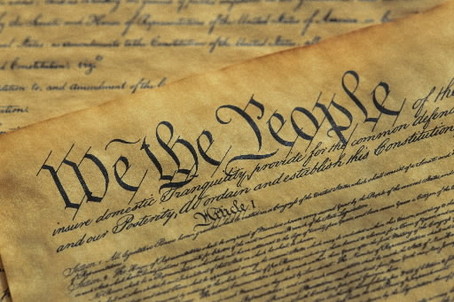
U.S. Constitution: Relevant only when it meets the needs of us "Real Americans"
I’m very curious to know what the GOP — or the tea partyers they’re presumably pandering to — think will happen when every piece of legislation requires “a statement from its sponsor outlining where in the Constitution Congress is empowered to enact such legislation.” What’s the evidence that this will make legislation more, rather than less, constitutional, for whatever your definition of the Constitution is?
Let’s take an example: Most legislation doesn’t currently include a statement of constitutional authority. But there’s one recent measure that did: Section 1501 of the Patient Protection and Affordable Care Act. That is to say, the individual mandate.
“The individual responsibility requirement provided for in this section (in this subsection referred to as the requirement) is commercial and economic in nature, and substantially affects interstate commerce,” reads the opening paragraph. Shortly thereafter, the legislation makes itself more explicit: “In United States v. South-Eastern Underwriters Association (322 U.S. 533 (1944)), the Supreme Court of the United States ruled that insurance is interstate commerce subject to Federal regulation.”
Has that statement convinced the GOP that the individual mandate is constitutional? Of course not. Currently, two judges have ruled in favor of the provision and one judge has ruled against. The split has been clean across partisan lines. The political verdicts have been little different: Sen. Chuck Grassley went from co-sponsoring an individual mandate in June of 2009 when it was still an idea connected to Republicans to condemning it as unconstitutional a few months later when it was clear that President Obama owned it and no Republicans would be joining his health-care bill.
My friends on the right don’t like to hear this, but the Constitution is not a clear document. Written more than 200 years ago, when America had 13 states and very different problems, it rarely speaks directly to the questions we ask it. The Second Amendment, for instance, says nothing about keeping a gun in the home if you’ve not signed up with a “well-regulated militia,” but interpreting the Second Amendment broadly has been important to those who want to bear arms. And so they’ve done it.
That’s their right, of course. Liberals pick and choose their moments of textual fidelity as well. But as the seemingly endless series of 5-4 splits on the Supreme Court shows, even the country’s most experienced and decorated constitutional authorities routinely disagree, and sharply, over what the text means when applied to today’s problems. To presume that people writing what they think the Constitution means — or, in some cases, want to think it means — at the bottom of every bill will change how they legislate doesn’t demonstrate a reverence for the document. It demonstrates a disengagement with it as anything more than a symbol of what you and your ideological allies believe.
In reality, the tea party — like most everyone else — is less interested in living by the Constitution than in deciding what it means to live by the Constitution. When the constitutional disclaimers at the bottom of bills suit them, they’ll respect them. When they don’t — as we’ve seen in the case of the individual mandate — they won’t.
By: Ezra Klein-Washington Post, 12/30/10: Photo credit: Todd Gipstein/National Geographic/Getty Images
Fear and Favor-A note to Tea Party activists: This is not the movie you think it is.
A note to Tea Party activists: This is not the movie you think it is. You probably imagine that you’re starring in “The Birth of a Nation,” but you’re actually just extras in a remake of “Citizen Kane.”True, there have been some changes in the plot. In the original, Kane tried to buy high political office for himself. In the new version, he just puts politicians on his payroll.
I mean that literally. As Politico recently pointed out, every major contender for the 2012 Republican presidential nomination who isn’t currently holding office and isn’t named Mitt Romney is now a paid contributor to Fox News. Now, media moguls have often promoted the careers and campaigns of politicians they believe will serve their interests. But directly cutting checks to political favorites takes it to a whole new level of blatancy.
Arguably, this shouldn’t be surprising. Modern American conservatism is, in large part, a movement shaped by billionaires and their bank accounts, and assured paychecks for the ideologically loyal are an important part of the system. Scientists willing to deny the existence of man-made climate change, economists willing to declare that tax cuts for the rich are essential to growth, strategic thinkers willing to provide rationales for wars of choice, lawyers willing to provide defenses of torture, all can count on support from a network of organizations that may seem independent on the surface but are largely financed by a handful of ultrawealthy families.
And these organizations have long provided havens for conservative political figures not currently in office. Thus when Senator Rick Santorum was defeated in 2006, he got a new job as head of the America’s Enemies program at the Ethics and Public Policy Center, a think tank that has received funding from the usual sources: the Koch brothers, the Coors family, and so on.
Now Mr. Santorum is one of those paid Fox contributors contemplating a presidential run. What’s the difference?
Well, for one thing, Fox News seems to have decided that it no longer needs to maintain even the pretense of being nonpartisan.
Nobody who was paying attention has ever doubted that Fox is, in reality, a part of the Republican political machine; but the network — with its Orwellian slogan, “fair and balanced” — has always denied the obvious. Officially, it still does. But by hiring those G.O.P. candidates, while at the same time making million-dollar contributions to the Republican Governors Association and the rabidly anti-Obama United States Chamber of Commerce, Rupert Murdoch’s News Corporation, which owns Fox, is signaling that it no longer feels the need to make any effort to keep up appearances.
Something else has changed, too: increasingly, Fox News has gone from merely supporting Republican candidates to anointing them. Christine O’Donnell, the upset winner of the G.O.P. Senate primary in Delaware, is often described as the Tea Party candidate, but given the publicity the network gave her, she could equally well be described as the Fox News candidate. Anyway, there’s not much difference: the Tea Party movement owes much of its rise to enthusiastic Fox coverage.
As the Republican political analyst David Frum put it, “Republicans originally thought that Fox worked for us, and now we are discovering we work for Fox” — literally, in the case of all those non-Mitt-Romney presidential hopefuls. It was days later, by the way, that Mr. Frum was fired by the American Enterprise Institute. Conservatives criticize Fox at their peril.
So the Ministry of Propaganda has, in effect, seized control of the Politburo. What are the implications?
Perhaps the most important thing to realize is that when billionaires put their might behind “grass roots” right-wing action, it’s not just about ideology: it’s also about business. What the Koch brothers have bought with their huge political outlays is, above all, freedom to pollute. What Mr. Murdoch is acquiring with his expanded political role is the kind of influence that lets his media empire make its own rules.
Thus in Britain, a reporter at one of Mr. Murdoch’s papers, News of the World, was caught hacking into the voice mail of prominent citizens, including members of the royal family. But Scotland Yard showed little interest in getting to the bottom of the story. Now the editor who ran the paper when the hacking was taking place is chief of communications for the Conservative government — and that government is talking about slashing the budget of the BBC, which competes with the News Corporation.
So think of those paychecks to Sarah Palin and others as smart investments. After all, if you’re a media mogul, it’s always good to have friends in high places. And the most reliable friends are the ones who know they owe it all to you.
By PAUL KRUGMAN: New York Times Op-Ed Columnist, Oct. 3, 2010
Is The Tea Party Just a Big Scam?

E. J. Dionne
Is the tea party one of the most successful scams in American political history?
Before you dismiss the question, note that word “successful.” Judge the tea party purely on the grounds of effectiveness and you have to admire how a very small group has shaken American political life and seized the microphone offered by the media, including the so-called liberal media.
But it’s equally important to recognize that the tea party constitutes a sliver of opinion on the extreme end of politics receiving attention out of all proportion with its numbers.
Yes, there is a lot of discontent in America. But that discontent is better represented by the moderate voters who expressed quiet disillusionment to President Obama at the CNBC town hall meeting on Monday than by tea party ideologues who proclaim the unconstitutionality of the New Deal and everything since.
The tea party drowns out such voices because it has money—some of it from un-populist corporate sources, as Jane Mayer documented last month in The New Yorker—and has used modest numbers strategically in small states to magnify its impact.
Just recently, tea party victories in Alaska and Delaware Senate primaries shook the nation. In Delaware, Christine O’Donnell received 30,563 votes in the Republican primary, 3,542 votes more than moderate Rep. Mike Castle. In Alaska, Joe Miller won 55,878 votes for a margin of 2,006 over incumbent Sen. Lisa Murkowski, who is now running as a write-in candidate.
Do the math. For weeks now, our national political conversation has been driven by 86,441 voters and a margin of 5,548 votes. A bit of perspective: When John McCain lost in 2008, he received 59.9 million votes.
Earlier this year, much was made of the defeat of Sen. Bob Bennett, a Utah conservative insufficiently conservative for the tea party. Bennett lost not in a primary but at a Republican convention attended by all of 3,500 delegates.
Even in larger states, the tea party’s triumphs were built on small shares of the electorate. Rand Paul received 206,986 votes in Kentucky where there are more than 1 million registered Republicans and nearly 2.9 million registered voters. Sharron Angle won with 70,452 votes in Nevada, a state with more than 1 million registered voters.
The media have given substantial coverage to tea party rallies and even small demonstrations. But how many people are actually involved in this movement?
Last April, a New York Times/CBS News poll found that 18 percent of Americans identified themselves as supporters of the tea party movement, but slightly less than a fifth of these sympathizers said they had actually attended a tea party rally or meeting. That means just over 3 percent of Americans can be characterized as tea party activists. A more recent poll by Democracy Corps, just before Labor Day, found that 6 percent of voters said they had attended a tea party rally or meeting.
The tea party is not the only small group in history to wield more power than you’d expect from its numbers. In 2008, Barack Obama did very well in party caucuses, which draw many fewer voters than primaries. And it was Lenin who offered the classic definition of a vanguard party as involving “people who make revolutionary activity their profession” in organizations that “must perforce not be very extensive.”
But something is haywire in our media and our politics. Jill Lepore, a Harvard historian whose new book is “The Whites of Their Eyes: The Tea Party’s Revolution and the Battle Over American History,” observed in an interview that there is a “hall of mirrors” effect created by the rise of “niche” opinion media. They magnify small movements into powerhouses while old-fashioned journalism, which is supposed to put such movements in perspective, reacts to the same niche incentives.
There is also the decline of alternative forces in politics. The Republican establishment, such as it is, has long depended far more on big money than on troops in the field. In search of new battalions, GOP leaders stoked the tea party, stood largely mute in the face of its more outrageous untruths about Obama—and now has to defend candidates like O’Donnell and Angle.
And where are the progressives? Sulking is not an alternative to organizing, and weary resignation is the first step toward capitulation. The tea party may be pulling a fast one on the country and the media. But if it has more audacity than everyone else, it will, I am sorry to say, deserve to get away with it.
E.J. Dionne, Jr. is is a Washington Post columnist, a senior fellow at the Brookings Institution, and a professor at Georgetown University. He is the author of, most recently, Souled Out: Reclaiming Faith and Politics After the Religious Right. Original Post: The New Republic, September 23, 2010.
The Tea Party’s Big Money
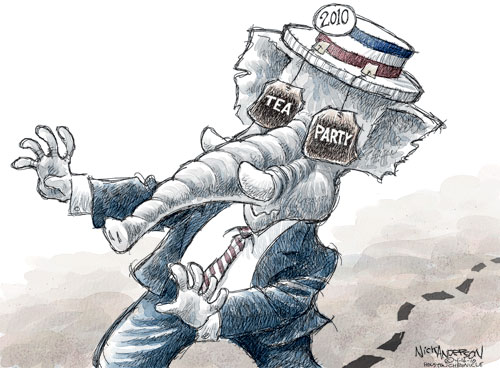
"Establishment Republicans"
Tea Party supporters and their candidates like to imagine themselves as insurgents, crashing the barricades of Washington to establish a new order of clean and frugal government. In earthbound reality, many of the people pulling the Tea Party’s strings are establishment Republican operatives and lobbyists. Some have made money off the party for years.
One example is Sal Russo, a gun-for-hire who has worked for former President Ronald Reagan, former Gov. George Deukmejian of California, former Gov. Christine Todd Whitman of New Jersey, former Gov. George Pataki of New York, and many other Republicans. As The Times reported on Sunday, Mr. Russo saw a sure thing last year, establishing a group called the Tea Party Express to support candidates in the midterm elections and raise cash at the same time.
The group has spent nearly $1 million in an effort to replace Harry Reid of Nevada, the Democratic Senate leader. It spent nearly $350,000 to elect Senator Scott Brown of Massachusetts. It is pouring money into Alaska to support Joe Miller’s Senate bid. And it has spent $250,000 in Delaware on behalf of Christine O’Donnell, now the Republican nominee for the United States Senate. Mr. Russo held a fund-raiser for Ms. O’Donnell and organized a rally.
In all, Mr. Russo and his group have raised $5.2 million and are the biggest independent supporters of Tea Party candidates. Of that, $3 million to buy advertising went to his political consulting firm or one controlled by his wife. Of course, he takes a substantial cut of each buy.
Dick Armey, the former House Republican leader, considers himself a godfather of the Tea Party and is co-author of the book, “Give Us Liberty: a Tea Party Manifesto.” Writing in The Wall Street Journal, he called for a “hostile takeover” of the Republican Party, which sounds so very revolutionary until one remembers that he helped lead that party for many years, guiding its policies and raising its money. When he left office in 2003, he cashed in on his connections to become a very high-paid lobbyist at DLA Piper, one of Washington’s biggest law firms, which has clients that include health-care companies, energy producers and foreign governments.
Then there is Carl Paladino, the Tea Party-backed Republican nominee for governor of New York. His bloodcurdling denunciations of Albany never seem to mention that he is one of the biggest landlords of state agencies, owning properties with $85 million in taxpayer leases in Buffalo alone that provide him with income of more than $5 million a year. He is the biggest property owner in Buffalo, and much of his empire has been constructed with state development incentives and tax breaks. An adviser is Roger Stone, an operator for Republicans since Richard Nixon’s re-election campaign.
There are undoubtedly thousands of Tea Partiers who would love to purge Washington of well-connected lobbyists, high-priced political consultants and others who take millions of taxpayer dollars while condemning the lawmakers who spend it. They should take a long look at the leaders and candidates who are driving their movement and decide whether purging begins at home.
New York Times-Editorial: Published Sept. 23, 2010
Share This Blog


 Unknown Feed
- An error has occurred; the feed is probably down. Try again later.
 mykeystrokes.com
You must be logged in to post a comment.