A GOP Reality-Show Race, Thanks To The Tea Party
The contest for the 2012 Republican presidential nomination has been described as a reality show and a circus. But what’s happening inside the GOP is quite rational and easily explained.
The obvious Republican nominee was Texas Gov. Rick Perry — obvious because his government-bashing, ideology-mongering, secessionist-flirting persona was a perfect fit for a Republican primary electorate that has shifted far to the right of Ronald Reagan.
The yearning for someone like Perry was inevitable. He combined the right views — actually, very right views — with experience as a chief executive that made him seem like somebody who was ready to be president.
Consider that even before he had gotten into the race, mere word that he might run sent Republican voters scrambling his way. He already had 18 percent to Romney’s 23 percent in a late July Gallup poll. Michele Bachmann was next at 13 percent. At that point, Newt Gingrich was at 6 percent and Herman Cain was at 4 percent.
After Perry announced his candidacy, he soared. The
Aug. 17-21 Gallup survey had him at 29 percent, Romney at 17 percent, Bachmann down to 10 percent and Gingrich and Cain both at 4 percent. (Ron Paul, holding aloft the libertarian banner, holds his core voters no matter what’s happening around him. Paul was at 10 percent in July, 13 percent in August.) Another survey at the time by Public Policy Polling put Perry at 33 percent to 20 percent for Romney.
This nomination was Perry’s to lose, and lose it he appears to have done. This opened the way for the relatively short-lived, if entertaining, Herman Cain show, which finally closed on Saturday.
Yet Romney still can’t take off, and a lot of ink and online pixels have been spent trying to explain why. I see four factors holding Romney back. That he is a flip-flopper is no longer a charge by his opponents; it is taken as a given. His refusal to repudiate his Massachusetts health-care plan goes down badly with conservatives. His public personality is, well, stiff and patrician enough that the Internet is now full of videos of Romney’s awkwardness. And he is a Mormon, a problem for some conservative evangelicals.
It’s outrageous that Romney’s religion is an issue, and anyone analyzing its impact has a moral obligation to say so. Alas, that does not mean it has no effect. And Romney ought to be proud of his health initiative — although it’s disingenuous of him to deny the strong links between what he did and what President Obama fought to get enacted.
But what’s going on is not just a Romney problem. The Republican Party’s core electorate has changed radically since 2008 — and even then John McCain won the nomination against the wishes of many on the Republican right because the opposition to him was splintered.
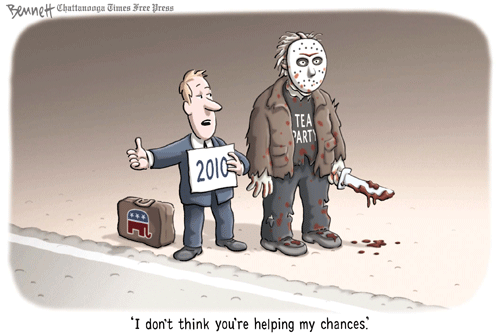
A party that lived by the tea crowd in 2010 is being severely hobbled by it now. The Republican right wants the kind of purity that led it to take candidates such as Cain and Bachmann with great seriousness for a while. The same folks took Sharron Angle, Christine O’Donnell and Joe Miller seriously in the 2010 Senate primaries, too. None of them got elected.
Perry once seemed the answer to this problem. Now that he, Cain and Bachmann have faltered, lonely conservative hearts have turned to Gingrich. This is odd, since Gingrich can give Romney an excellent run in any flip-flopping contest.
But Gingrich has always kept at least one foot in the camp of movement conservatism, and he talks like a movement guy. This could be enough. The question is whether he has the discipline not to say something really foolish between now and Jan. 3, the date of the Iowa caucuses. (Free advice to Newt: Stop talking about yourself in the third person as a world historical figure.)
There is talk of the “Republican establishment” swooping in to save matters, and things certainly seem ripe for a draft write-in campaign for some new candidate. But the Republican establishment, such as it is, is essentially powerless. It sold its soul to the Tea Party, sat by silently as extremist rhetoric engulfed the GOP and figured that swing voters would eventually overlook all this to cast votes against a bad economy.
That’s still Romney’s bet; yet his failure to break through suggests the right wing will not be trifled with. Republican leaders unleashed forces that may eat their party alive. And the only Republican really enjoying what’s happening is Newt Gingrich.
By: E. J. Dionne, Jr, Opinion Writer, The Washington Post, December 4, 2011
“Eat The Future”: The GOP And Federal Spending
On Friday, House Republicans unveiled their proposal for immediate cuts in federal spending. Uncharacteristically, they failed to accompany the release with a catchy slogan. So I’d like to propose one: Eat the Future.
I’ll explain in a minute. First, let’s talk about the dilemma the G.O.P. faces.
Republican leaders like to claim that the midterms gave them a mandate for sharp cuts in government spending. Some of us believe that the elections were less about spending than they were about persistent high unemployment, but whatever. The key point to understand is that while many voters say that they want lower spending, press the issue a bit further and it turns out that they only want to cut spending on other people.
That’s the lesson from a new survey by the Pew Research Center, in which Americans were asked whether they favored higher or lower spending in a variety of areas. It turns out that they want more, not less, spending on most things, including education and Medicare. They’re evenly divided about spending on aid to the unemployed and — surprise — defense.
The only thing they clearly want to cut is foreign aid, which most Americans believe, wrongly, accounts for a large share of the federal budget.
Pew also asked people how they would like to see states close their budget deficits. Do they favor cuts in either education or health care, the main expenses states face? No. Do they favor tax increases? No. The only deficit-reduction measure with significant support was cuts in public-employee pensions — and even there the public was evenly divided.
The moral is clear. Republicans don’t have a mandate to cut spending; they have a mandate to repeal the laws of arithmetic.
How can voters be so ill informed? In their defense, bear in mind that they have jobs, children to raise, parents to take care of. They don’t have the time or the incentive to study the federal budget, let alone state budgets (which are by and large incomprehensible). So they rely on what they hear from seemingly authoritative figures.
And what they’ve been hearing ever since Ronald Reagan is that their hard-earned dollars are going to waste, paying for vast armies of useless bureaucrats (payroll is only 5 percent of federal spending) and welfare queens driving Cadillacs. How can we expect voters to appreciate fiscal reality when politicians consistently misrepresent that reality?
Which brings me back to the Republican dilemma. The new House majority promised to deliver $100 billion in spending cuts — and its members face the prospect of Tea Party primary challenges if they fail to deliver big cuts. Yet the public opposes cuts in programs it likes — and it likes almost everything. What’s a politician to do?
The answer, once you think about it, is obvious: sacrifice the future. Focus the cuts on programs whose benefits aren’t immediate; basically, eat America’s seed corn. There will be a huge price to pay, eventually — but for now, you can keep the base happy.
If you didn’t understand that logic, you might be puzzled by many items in the House G.O.P. proposal. Why cut a billion dollars from a highly successful program that provides supplemental nutrition to pregnant mothers, infants, and young children? Why cut $648 million from nuclear nonproliferation activities? (One terrorist nuke, assembled from stray ex-Soviet fissile material, can ruin your whole day.) Why cut $578 million from the I.R.S. enforcement budget? (Letting tax cheats run wild doesn’t exactly serve the cause of deficit reduction.)
Once you understand the imperatives Republicans face, however, it all makes sense. By slashing future-oriented programs, they can deliver the instant spending cuts Tea Partiers demand, without imposing too much immediate pain on voters. And as for the future costs — a population damaged by childhood malnutrition, an increased chance of terrorist attacks, a revenue system undermined by widespread tax evasion — well, tomorrow is another day.
In a better world, politicians would talk to voters as if they were adults. They would explain that discretionary spending has little to do with the long-run imbalance between spending and revenues. They would then explain that solving that long-run problem requires two main things: reining in health-care costs and, realistically, increasing taxes to pay for the programs that Americans really want.
But Republican leaders can’t do that, of course: they refuse to admit that taxes ever need to rise, and they spent much of the last two years screaming “death panels!” in response to even the most modest, sensible efforts to ensure that Medicare dollars are well spent.
And so they had to produce something like Friday’s proposal, a plan that would save remarkably little money but would do a remarkably large amount of harm.
By: Paul Krugman, Op-Ed Columnist, The New York Times-February 13, 2011
Beyond Reason on the Budget: House Republicans Have Finally Revealed There Real Vision
After two years of raging at President Obama’s spending plans, House Republican leaders have finally revealed their real vision of small government: tens of billions in ideologically driven cuts to job training, environmental protection, disease control, crime protection and dozens of other critical functions that only the government can perform.
In all, they want more than $32 billion in cuts below current spending packed into the next seven months. They would be terribly damaging to a frail recovery and, while spending reductions must be part of long-term deficit control, these are the wrong cuts, to the wrong programs, at the wrong time.
But they are not deep enough for many Tea Party members, freshmen and other extremists in the House Republican caucus. In a closed-door meeting on Wednesday, they forced the leadership to abandon its cuts and prepare to double them. The new list is expected on Friday and promises to be one of the most irresponsible budget documents ever issued by a House majority.
The Senate should make it clear that it is not worthy of consideration, and President Obama should back them up with a veto threat.
If House Republicans don’t come to their senses, they could shut down the government on March 4 when the stopgap measure that is now financing it runs out. If that does take place, it will at least be clear to voters that their essential government services were turned off in the service of two single-minded and destructive goals: giving the appearance of cutting a deficit that was deliberately inflated by years of tax cuts for the rich, and going after programs that the Republicans never liked in good times or bad.
Many of the Republican freshmen want to stick to the “Pledge to America” that they would cut $100 billion from the president’s 2011 budget, a nice round number apparently plucked from thin air. More experienced Republican leaders knew it would be impossible to cut that much in the remaining few months of the fiscal year and said they would trim the equivalent percentage. Harold Rogers, the Republican chairman of the House Appropriations Committee, warned that the full cut would require laying off F.B.I. agents and air traffic controllers.
If he was trying to make his $32 billion in cutbacks seem modest by comparison, he failed. The list would cut $2 billion from job training programs — precisely what is needed to help employ workers mismatched with the job market. It would cut $1.6 billion from the Environmental Protection Agency, which is struggling to keep up with the growth of greenhouse gases. There would be significant cuts to legal assistance for the poor and renewable energy programs and an end to all spending for AmeriCorps, public broadcasting and high-speed rail.
The battle over the rest of the 2011 budget is only a prelude, of course, to the bigger fight about to begin over the 2012 budget. President Obama is scheduled to unveil his budget on Monday, and already he seems willing to feed the bottomless Republican hunger for cuts rather than fight them. An ominous early sign is his proposal to cut the low-income heating assistance program nearly in half to $2.57 billion. Administration officials say that energy prices have fallen, but, as Democratic lawmakers from the frostbitten Northeast have pointed out to him, there are many more unemployed people now.
Some cuts will have to be made, but strategically it seems to make little sense to start giving away important ones before reaching the negotiating table. Republican lawmakers in the House have already made it clear that they are indifferent to the suffering and increased joblessness their cuts will cause. As the extreme reductions are heaped up in the next few days, Democrats in Congress and in the White House need to make a clear case to the public that quality of the nation’s civic life is at stake.
By: Editorial-Opinion Pages, The New York Times, February 10, 2011
Voters Are About to be Disillusioned With the GOP

The Puppet Master and his Minions
But going forward, now that they control the House and aspire to gain control of the Senate and the executive branch in the next election, Republicans will be forced to work for an actual agenda. And as Paul Waldman nicely explains in The American Prospect, this can produce a great pivot in the political climate of the country, very fast:
As a long history of public-opinion research has made clear — and as events continue to remind us — Americans are “symbolic conservatives” but “operational liberals.” In other words, they like the idea of limited government, but they also like just about everything government does. Good things happen to the party that can successfully pander to both impulses, which is why we saw so many ads from Republicans…condemning Democrats for passing a big-government health-care plan because it would … curtail the growth of Medicare.Perhaps they’re just being cautious as they get used to their new majority, but in the last week, Republicans have steadfastly refused to say what their professed desire to limit government would actually entail. Press them hard on what they want to cut, and they’ll answer “earmarks,” which would be fine were it not for the fact that a) earmarks do not appropriate new money; they merely direct money that has already been appropriated, and b) the value of all earmarks amounts to less than 1 percent of the federal budget….
If there’s one thing Republicans have been clear about, it’s their desire to repeal the Affordable Care Act. Even here, though, they don’t want to get too specific. As you’ve no doubt heard many times, a bare majority of the public opposes “health-care reform” (or “Obamacare”), while substantial majorities favor almost all the major provisions of the law. Once again, Republicans can win the vague, general argument but not the specific one. Faced with the impossibility of repealing the entire act (which Obama would veto), Republicans have said they’ll try to dismantle it piece by piece. Try that, however, and they’re suddenly attacking not “health-care reform” but those particular things people like.
That isn’t to say Republicans will inevitably be punished for attempting to repeal the ACA. Pushing repeal will only be dangerous for them if Democrats make it so. Republicans will suffer if they’re attacked aggressively for wanting to reopen the Medicare prescription-drug “doughnut hole,” for wanting to kick young people off their parents’ insurance, or for wanting to give the insurance companies the ability to deny coverage to children with pre-existing conditions. Those are all provisions of the ACA that have already gone into effect. The Democrats are hardly guaranteed to win the battle of ACA, but they have a shot if they make the right arguments.
Waldman goes on to note that House Republicans will have to write a budget resolution, and moreover, are virtually promising a budget showdown with the president, probably forcing a shutdown of the federal government. There’s no particular reason to assume that tactic will fare any better than it did when Newt Gingrich tried it back in the ’90s. But that scenario, too, will force Republicans–and attentive voters generally–to make some sheep-and-goat distinctions between government programs and services that are essential and those that are not. It’s when those two judgments begin to diverge, as they undoubtedly will, that the GOP will begin to pay a high price for consciously promising an austerity budget that somehow won’t upset their own voters. Campaigning on a Big Lie–Big Government is a terrible threat to your liberties and your pocketbook, but Big Government doesn’t involve anything that you care about, dear voter–can cause a real boomerang when the lies have to be turned into an agenda.
BY: Ed Kilgore, The New Republic, November 11, 2010
The Cleansing of the GOP

"Ditto" or the Highway: Republican Democracy
The purification process — hard-core and uncompromising partisans driving heretics from their ranks — has been going on for a long time. Saturday’s Republican convention in Utah, the one in which conservative Senator Robert Bennett was defeated for being not conservative enough (despite an 84 percent approval rating from the American Conservative Union), is just one more step in a decades-long effort to drive independent thought from the political decisionmaking process.
This year, of course, attention has been focused primarily on Marco Rubio’s success in driving Florida Governor Charlie Crist out of the Republican Party (he’s now running for the Senate as an Independent) and former Congressman Pat Toomey’s success in converting Republican Senator Arlen Specter into a Democrat. But in both of those cases one can argue that the targeted incumbent was simply too far out of step with his own party. The same ACU ratings index on which Bennett scored an 84 gave Specter a 40. The ratings only measure members of Congress but Crist had more than once angered party members with his support of initiatives that were fiercely opposed by most Republicans. But given Bennett’s long embrace of conservative positions, with relatively few departures from the party-line script over a period of nearly two decades, what happened in Utah was something of a very different and disturbing nature. It was checklist politics, a demand for suspension of judgment and lockstep adherence to an ideological instruction manual that would brook no deviation.
That is important in assessing what is happening in the political wars. When Jeff Bell, a member of the American Conservative Union’s board of directors, took on and defeated incumbent Republican Senator Clifford Case in a party primary in 1978, it was because Bell’s views were, in Republican terms, more mainstream than those of the liberal Case. It was not a matter of the extremes knocking off the middle but of a traditional conservative ousting a Republican who was, for all practical purposes, not a Republican at all. Similarly, two years later, Alfonse D’Amato knocked off incumbent Republican Senator Jacob Javits, another liberal, in a New York primary.
When Ned Lamont defeated incumbent Senator Joseph Lieberman in Connecticut’s Democratic Senate primary — after Lieberman had been his party’s vice presidential nominee — it was because one overriding issue — war — was of sufficient weight to overshadow the rest of Lieberman’s record and his Democratic credentials. War is a trump card; absent Lieberman’s support for the invasion of Iraq, it is unlikely that he would have been challenged by a fellow Democrat, much less be defeated, even though he had long been known for speaking his own mind (as witnessed by his forceful condemnation of Bill Clinton in the wake of the Lewinsky affair).
To be clear, Bennett’s defeat in Utah was not an unprecedented challenge of an incumbent who was just not as conservative as his opponent. Ronald Reagan almost defeated the generally conservative Gerald Ford in 1976 when Ford was seeking the Republican nomination to succeed himself in the White House. But for the most part, parties have been willing to allow some departure from the party line if a legislator’s overall record has been sufficiently on key.
Signs that this is changing were seen recently within the governing ranks of the GOP, with local party leaders attempting to force National Chairman Michael Steele to adopt a “purity” test to determine which Republican candidates would receive the party’s financial support. Steele refused to go along but it is the same sentiment that has now ended Robert Bennett’s Senate career.
When the voters send a man or woman to write the laws, in Washington or a state capitol, that legislator is obligated to weigh seriously the views of his or her constituents, to examine thoroughly the important issues of the day and the proposals to deal with them, and to consult the relevant constitution (federal or state) and then act accordingly. Increasingly, the last two items on that list — intelligent assessment and constitutional constraint — are being driven from the process. One is expected to listen — and to obey — the preferences, indeed the demands, not of “constituents” but of that small band of constituents who dominate party primaries and party conventions.
Ironically, those who demand such mindless conformity cry out a demand for adherence to the Constitution, even as they undermine the most important principles of rational constitutional self-government.
Original post by Mickey Edwards-The Cleansing: The Atlantic-May 10, 2010
Share This Blog


 Unknown Feed
- An error has occurred; the feed is probably down. Try again later.


You must be logged in to post a comment.