Rep. Paul Ryan-The Flimflam Man
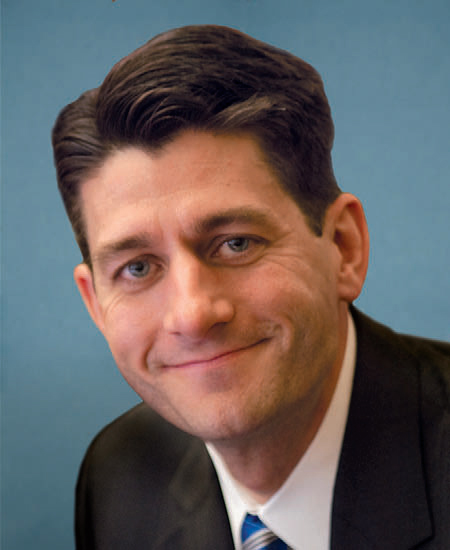
Rep. Paul Ryan
One depressing aspect of American politics is the susceptibility of the political and media establishment to charlatans. You might have thought, given past experience, that D.C. insiders would be on their guard against conservatives with grandiose plans. But no: as long as someone on the right claims to have bold new proposals, he’s hailed as an innovative thinker. And nobody checks his arithmetic.
Which brings me to the innovative thinker du jour: Representative Paul Ryan of Wisconsin.
Mr. Ryan has become the Republican Party’s poster child for new ideas thanks to his “Roadmap for America’s Future,” a plan for a major overhaul of federal spending and taxes. News media coverage has been overwhelmingly favorable; on Monday, The Washington Post put a glowing profile of Mr. Ryan on its front page, portraying him as the G.O.P.’s fiscal conscience. He’s often described with phrases like “intellectually audacious.”
But it’s the audacity of dopes. Mr. Ryan isn’t offering fresh food for thought; he’s serving up leftovers from the 1990s, drenched in flimflam sauce.
Mr. Ryan’s plan calls for steep cuts in both spending and taxes. He’d have you believe that the combined effect would be much lower budget deficits, and, according to that Washington Post report, he speaks about deficits “in apocalyptic terms.” And The Post also tells us that his plan would, indeed, sharply reduce the flow of red ink: “The Congressional Budget Office has estimated that Rep. Paul Ryan’s plan would cut the budget deficit in half by 2020.”
But the budget office has done no such thing. At Mr. Ryan’s request, it produced an estimate of the budget effects of his proposed spending cuts — period. It didn’t address the revenue losses from his tax cuts.
The nonpartisan Tax Policy Center has, however, stepped into the breach. Its numbers indicate that the Ryan plan would reduce revenue by almost $4 trillion over the next decade. If you add these revenue losses to the numbers The Post cites, you get a much larger deficit in 2020, roughly $1.3 trillion.
And that’s about the same as the budget office’s estimate of the 2020 deficit under the Obama administration’s plans. That is, Mr. Ryan may speak about the deficit in apocalyptic terms, but even if you believe that his proposed spending cuts are feasible — which you shouldn’t — the Roadmap wouldn’t reduce the deficit. All it would do is cut benefits for the middle class while slashing taxes on the rich.
And I do mean slash. The Tax Policy Center finds that the Ryan plan would cut taxes on the richest 1 percent of the population in half, giving them 117 percent of the plan’s total tax cuts. That’s not a misprint. Even as it slashed taxes at the top, the plan would raise taxes for 95 percent of the population.
Finally, let’s talk about those spending cuts. In its first decade, most of the alleged savings in the Ryan plan come from assuming zero dollar growth in domestic discretionary spending, which includes everything from energy policy to education to the court system. This would amount to a 25 percent cut once you adjust for inflation and population growth. How would such a severe cut be achieved? What specific programs would be slashed? Mr. Ryan doesn’t say.
After 2020, the main alleged saving would come from sharp cuts in Medicare, achieved by dismantling Medicare as we know it, and instead giving seniors vouchers and telling them to buy their own insurance. Does this sound familiar? It should. It’s the same plan Newt Gingrich tried to sell in 1995.
And we already know, from experience with the Medicare Advantage program, that a voucher system would have higher, not lower, costs than our current system. The only way the Ryan plan could save money would be by making those vouchers too small to pay for adequate coverage. Wealthy older Americans would be able to supplement their vouchers, and get the care they need; everyone else would be out in the cold.
In practice, that probably wouldn’t happen: older Americans would be outraged — and they vote. But this means that the supposed budget savings from the Ryan plan are a sham.
So why have so many in Washington, especially in the news media, been taken in by this flimflam? It’s not just inability to do the math, although that’s part of it. There’s also the unwillingness of self-styled centrists to face up to the realities of the modern Republican Party; they want to pretend, in the teeth of overwhelming evidence, that there are still people in the G.O.P. making sense. And last but not least, there’s deference to power — the G.O.P. is a resurgent political force, so one mustn’t point out that its intellectual heroes have no clothes.
But they don’t. The Ryan plan is a fraud that makes no useful contribution to the debate over America’s fiscal future.
By PAUL KRUGMAN-Op-Ed Columist and Nobel Prize Winner-Economics, The New York Times-Aug 5, 2010; Photo- Wikipedia
“Hypocrisy,” Say Morons

Elephants and facts just don't seem to go together
Republicans plan to hammer the debt and deficit hypocrisy theme in the days and weeks ahead. White House economic adviser Larry Summers has lectured Congressional Democrats that now is a good time for the federal government to borrow to “stimulate demand” because interest rates are low. Yet the President keeps insisting that fiscal responsibility is an important priority of the White House. Republicans are having a field day. A recent email blast reminded supporters of a statement made by President Obama on November 18th: “It is important though to recognize if we keep on adding to the debt, even in the midst of this recession, that at some point, people could lose confidence in the U.S. economy in a way that could actually cause a double dip recession.”
Fiscal schizophrenia reigns in the White House.
Okay, let’s go back and read what Obama said last November 18th:
There may be some tax provisions that can encourage businesses to hire sooner rather than sitting on the sidelines; so, we’re taking a look at those. I think it is important though to recognize that if we keep on adding to the debt, even in the midst of this recovery, that at some point, people could lose confidence in the US economy in a way that could actually lead to a double-dip recession.
And so one of the trickiest things we’re doing right now, is to on the one hand make sure the recovery is supported and not withdraw a lot of money either with tax increases or big spending cuts – and states, for example, need a lot of support to keep hiring teachers and so forth – at the same time, making sure that we’re setting up a pathway longterm for deficit reduction.
Got that? Obama was saying the same thing he’s saying now. In the short run, we have an economic crisis that requires deficits. In the long-run, we’ll need to reduce the deficit. (And the long-term costs of temporary stimulus are pretty low.) Indeed, taking steps that increase long-term deficits could actually hurt in the short run. These are not contradictory ideas. Indeed, in his November interview, Obama endorsed the very notion (helping states mitigate budget cuts for teachers and other things) that he’s pushing for right now.
Moore and the Republicans think it’s “hypocrisy” to be for high deficits during a liquidity crisis but against them during a recovery. Really. The whole Republican message is based on not understanding this distinction.
By: Jonathan Chait-The New Republic-June 18, 2010
Share This Blog


 Unknown Feed
- An error has occurred; the feed is probably down. Try again later.
 mykeystrokes.com
You must be logged in to post a comment.