The Conservative Constitution of the United States

TeaParty Sacred Text?
Article I
Congress shall have only the powers literally, specifically and expressly granted herein, and no others. That means definitely, without question, absolutely, no regulation of the Health Insurance or Financial Services industries. The Senate of the United States shall be composed of two Senators from each State, elected not directly by the People, but by other people whom the People have elected to better represent the People.
Any law enacted by Congress and signed by the President may be overturned by the vote of three or more States if they find it burdensome, offensive, annoying or in any way touching on Health Insurance, Property Rights or Guns.
Congress shall have no power to raise Taxes except on February 29, and then only if all the People of the United States approve such a measure unanimously, in writing and in English.
Congress shall balance the Federal Budget, preferably by eliminating the Departments of Labor, Energy, Education and State.
The preceding provision shall not apply to spending for the Department of Defense, appropriations for which shall increase three times as quickly as the growth in gross domestic product and upon the approval of House leadership in conference with Boeing, Halliburton, the Ashcroft Group and Kissinger Associates.
Arizona shall have the power to regulate Immigration.
Article II
No person except a natural-born Citizen who can produce video, photographic or eyewitness evidence of birth in a non-island American State shall be eligible to the Office of President.
The President shall faithfully execute the laws, except when, as Commander in Chief, he decides he’d really rather not.
The President shall not negotiate any Treaty without first receiving a signed and notarized note granting him permission, personally executed by every member of the Senate and the House, all 50 Governors and the editorial board of the Weekly Standard. Suspected Terrorists shall be taken to Guantanamo and drawn and quartered in a public ceremony. Trials are optional, but if they occur, must be conducted in a Military Tribunal in which coerced statements are admissible so long as they support a Guilty verdict.
1. Congress shall make no law abridging the Freedom of Speech, except where citizens desecrate the Flag of the United States; respecting an establishment of Religion, except to support Christian schools, religious apparitions in food products and the display of crosses and creches in public places; or abridging the free exercise of Religion, except to block the construction of mosques in sensitive areas as determined by Florida Pastors or the Fox News Channel.
2. The right to bear Semi-Automatic Weapons, AK-47s or Bazookas shall not be infringed by background checks, safety locks, age limits or common sense.
3. The right of Corporations, Hedge Funds, Business Leaders and Lobbyists to spend endless cash on campaigns and influence-purchasing shall not be infringed. The so-called right of Unions to associate shall be denied as fundamentally un-American and contrary to the agenda of the Chamber of Commerce.
4. Marriage and the benefits thereof shall be restricted to the Union of a Man and a Woman, consecrated in a Christian house of worship, with vows to expose any and all progeny to daily viewings of Bill O’Reilly.
5. All persons born or naturalized in the United States are Citizens of the United States of Real America only if their parents, grandparents and great-grandparents were Citizens, and only if they pledge opposition to Health Insurance Reform or New Taxation. Any Citizen convicted of providing material support to Terrorist organizations, wearing clothing bearing images created by Shepard Fairey, or displaying Nancy Pelosi bumper stickers shall be stripped of Citizenship.
6. Aliens, of this world or another, shall have none of the rights guaranteed herein to Citizens.
7. Corporations shall have all of the rights guaranteed herein to Citizens, and then some.
8. No White Male shall be denied equal protection of the law through Affirmative Action or otherwise. In keeping with the intent of the Framers, as discerned by the Honorable Justice Antonin Scalia, distinctions on the basis of sex shall not be deemed to deny equal protection.
9. The right to be uninsured and make other people pay the costs of one’s Health Care shall not be infringed under any circumstances.
10. Congress shall make no law limiting Americans’ right to warm the Planet by using all the energy they darn well please.
11. The Unborn shall have the rights to life, to vote, to bear arms, to practice Religion except in a mosque in Lower Manhattan (see First Amendment) and to make campaign contributions, but once the child is born, it shall have no rights if it is an Alien (see Sixth Amendment).
12. No one may be required to do anything He or She does not want to do. Ever.
Done in Convention by the Unanimous Consent of the Members present the Sixth Day of January in the Year of our Lord Two Thousand and Eleven. In witness whereof We have hereunto subscribed our names, [REDACTED]
By: David Cole who teaches Constitutional Law at Georgetown University and is the legal affairs correspondent for the Nation : Published, Washington Post-January 6, 2011
More Small Businesses Offering Health Care To Employees Thanks To Obamacare
The first statistics are coming in and, to the surprise of a great many, Obamacare might just be working to bring health care to working Americans precisely as promised.
The major health insurance companies around the country are reporting a significant increase in small businesses offering health care benefits to their employees.
Why?
Because the tax cut created in the new health care reform law providing small businesses with an incentive to give health benefits to employees is working.
We certainly did not expect to see this in this economy,” said Gary Claxton, who oversees an annual survey of employer health plans for the nonprofit Kaiser Family Foundation. “It’s surprising.”
How significant is the impact? While we won’t have full national numbers until small businesses file their 2010 tax returns this April, the anecdotal evidence is as meaningful as it is unexpected.
United Health Group, Inc., the nation’s largest health insurer, added 75,000 new customers working in businesses with fewer than 50 employees.
Coventry Health Care, Inc., a large provider of health insurance to small businesses, added 115,000 new workers in 2010 representing an 8% jump.
Blue Cross Blue Shield of Kansas City, the largest health insurer in the Kansas City, Mo. area, reports an astounding 58% increase in the number of small businesses purchasing coverage in their area since April, 2010-one month after the health care reform legislation became law.
“One of the biggest problems in the small-group market is affordability,” said Ron Rowe, who oversees small-group sales for the Kansas City operation for Blue Cross Blue Shied. “We looked at the tax credit and said, ‘this is perfect.”
Rowe went on to say that 38% of the businesses it is signing up had not offered health benefits before.
Whatever your particular ideology, there is simply no denying that these statistics are incredibly heartening. However, for those of you who cannot get past your opposition, even for a moment of universal good news, let’s break it down.
The primary, most enduring complaint of the opponents of the ACA has been that the law is deathly bad for small business.
Apparently, small businesses, and their employees, do not agree.
The next argument has been that the PPACA is a job killer.
If these small businesses found the new law to be so onerous, why have so many of them voluntarily taken advantage of the benefits provided in the law to give their employees these benefits? They were not mandated to do so. And to the extent that the coming mandate obligations might figure into their thinking, would you not imagine they would wait until 2014 to make a move as the rules do not go into effect until that time?
Of course, there is the nagging banter as to how Obamacare is leading us down the road to socialism.
Let it go, folks.
Private market insurance companies are experiencing significant growth because of a tax break provided by the PPACA. I may have missed the day this was discussed in economics class, but I’m pretty sure this is not a socialistic result of federal legislation.
When data like this appears, we have the opportunity to really find out who is talking smack for political benefit and who actually cares about getting affordable and available health care to America’s workers. Certainly, there will be elements of the new law that will not work out exactly as planned. That’s simply reality when it comes to any new piece of landmark legislation. But if you cannot celebrate what appears to be an important early success, you really should give some thought as to where your true interests and intents lie.
If you’re all about beating up on President Obama, you can conveniently forget this bit of data as if it never really happened. However, if your interest is to make health care available to more Americans, this should be a happy day for you – no matter what your ideological beliefs.
By: Rick Ungar, The Policy Page-Forbes, January 6, 2011
Tax Hike Prevention Act of 2010: How It Affects You
Now that President Obama has signed the Tax Hike Prevention Act of 2010, taxpayers will have some certainty about their tax situation, if only for the next 24 months.
The new law contains a bevy of tax breaks — new and extended — and emergency help for the jobless. Its cost over 10 years is estimated at $858 billion.
Here’s a rundown of some of the biggest ticket items that will affect individuals. (Except where noted, all provisions are for 2011 and 2012).
Extended income tax rates: $207.5 billion. The six federal income tax rates will remain at the same levels they are today: 10%, 15%, 25%, 28%, 33% and 35%. In addition, itemized deductions will continue to be allowed in full for high-income taxpayers.
AMT fix: $147 billion. More than 20 million tax filers will be protected from having to pay the so-called “wealth tax,” otherwise known as the Alternative Minimum Tax. For tax year 2010, the bill will raise the amount of income that is exempt from the reach of the AMT to $47,450 for individuals and to $72,450 for couples filing jointly. In 2011, those exemption amounts will increase to $48,450 and $74,450 respectively. In addition, the bill will allow taxpayers to apply nonrefundable credits (which reduce one’s tax bill dollar for dollar) to their tax liability — whether under the AMT or the regular tax code.
Social Security tax break: $112 billion. Workers will get a 2 percentage-point break on their payroll tax for one year. Instead of paying 6.2% on wages up to $106,800, they will only have to pay 4.2% in 2011. This tax break replaces the Making Work Pay credit, which expires this year. Unlike Making Work Pay, which was limited to workers making less than $75,000 ($150,000 for couples), the payroll tax holiday will be available to everyone who pays into Social Security.
Expanded child tax credit: $90 billion. The bill will retain the $1,000 child tax credit (up from $500 before the Bush tax cuts). It also will retain the reduced-earnings threshold, which allows more people to claim the credit as refundable. A refundable tax credit is one paid to a tax filer even if the value of the credit exceeds his tax liability. So if a filer doesn’t owe any federal income tax but qualifies for the credit, it is paid to him in the form of a refund.
Smaller estate tax: $68 billion. Barring any changes, the estate tax in 2011 and 2012 will be reinstated at an exemption level of $1 million and a top rate of 55%. But under the bill, the exemption level will be raised to $5 million and the top rate lowered to 35%. The legislation will also reinstate the so-called “step up in basis” for beneficiaries of those who die in 2010, 2011 or 2012. A stepped-up basis means that when someone sells an inherited asset, his capital gains tax bill will be based on the asset’s price the day he inherited it, rather than when the decedent originally bought it. Practically speaking that means the beneficiaries of those who died in 2010 will be allowed to choose which estate tax rules to follow — those of 2011 or those of 2010. Under 2010 rules, there is no estate tax but also no step-up rules; there is only an option to exempt $1.3 million worth of capital gains from tax.
Help for the jobless: $57 billion. The unemployed will get a 13-month extension of the deadline to file for additional unemployment benefits — which go as high as 99 weeks in states hit hardest by job loss.
Extended investment tax rates: $53 billion. Everybody will get to keep their low investment tax rates for the next two years. For most people, that means their qualified capital gains and dividends will continue to be taxed at 15%. Low-income tax filers (those in the 10% and 15% brackets), however, will continue to enjoy a 0% tax rate on their capital gains or dividends.
Marriage penalty relief: $27 billion. Marriage will still be hard (sorry), but not because less-than-wealthy two-earner couples will owe more to the IRS than they did when they were single. The bill continues to ensure that the standard deduction for couples is exactly twice that for single filers. It also maintains an expanded 15% tax bracket so that the amount of income in that bracket for joint filers is exactly double that for single filers.
Expanded college credit: $18 billion. Paying for college tuition in 2011 and 2012 will be made a bit easier with the retention of the American Opportunity tax credit, which is an expansion of the HOPE tax credit. The Opportunity credit is worth up to $2,500 (up to 100% of the first $2,000 spent and up to 25% of the next $2,500), and it may be claimed for four years’ worth of college. Eligibility to take the credit is limited to those with modified adjusted gross income below $90,000 ($180,000 for couples filing jointly).
Individual tax break extensions: Costs vary. The legislation will extend a number of tax breaks that have been introduced in the past few years such as the option to deduct on one’s federal return state and local sales tax instead of state and local income tax — at a cost of $6 billion. Also, it will extend a deduction for qualified tuition and other education-related expenses at a cost of $1.2 billion. Less pricey extensions include a break for teachers to deduct up to $250 in classroom expenses (just under $400 million).
By: Jeanne Sahadi, Senior Writer-CNNMoney.com, December 17, 2010
Charles Krauthammer Is the Fraud
Charles Krauthammer says that Obama has conned Republicans into agreeing to a second stimulus even bigger than the first. Democrats are too stupid to see this (and Republicans are even more stupid, presumably, since they are the victims).
Barack Obama won the great tax-cut showdown of 2010 – and House Democrats don’t have a clue that he did. In the deal struck this week, the president negotiated the biggest stimulus in American history, larger than his $814 billion 2009 stimulus package. It will pump a trillion borrowed Chinese dollars into the U.S. economy over the next two years – which just happen to be the two years of the run-up to the next presidential election. This is a defeat?
He’s right about the Democrats’ stupidity, but this is not Krauthammer at his most lucid.
Yes, Democrats are fools to tear their hair out over this deal, which gives them most of what they wanted: the middle-class tax rates, unemployment benefit extension, payroll-tax cut, and so on. They compound the idiocy by advertising higher taxes on the rich as their core objective. Forget relieving poverty, widening access to health care, improving opportunities for the disadvantaged. What matters more than any of that is sticking it to “millionaires and billionaires” (two-earner households making more than $250,000). You bet, the Democrats are acting like fools.But this stimulus is not bigger than the first, not even close. Two-thirds of its “cost” is keeping tax rates where they currently are. There is no new stimulus in failing to put taxes up–in forgoing a drastic fiscal tightening that nobody wanted and nobody expected. Unlike Krauthammer, I think further short-term stimulus makes sense, so I welcome the $300 billion (over two years) or so of extra stimulus in the deal. Oppose this if you like, but please don’t call it a bigger stimulus than the first.
In any event, the key question is this: does Krauthammer oppose the deal? Having declared Obama guilty of a massive swindle, and recalling that he is opposed to all of Obama’s sinister purposes, Krauthammer is obliged by his own logic to say what a bad thing the agreement must be. So what exactly did he want to happen? Presumably, raise everybody’s taxes next month, with an especially steep rise for $250,000+ households. Has he previously advocated this policy? Maybe he has, and I missed it; if so, I apologize. But if he agrees it makes sense for now to keep taxes where they are, which has been the Republicans’ defensible position, what is so bad about what just happened? Krauthammer is left opposing it because Obama was in favour. It is not every day that Krauthammer is backed into an absurd and dishonest position by his own logic.
What about the long-term deficit? This deal, if temporary, has little effect on that either way, and could easily be deficit-reducing if it avoids a second dip (as Krauthammer seems to concede it might). Obviously, the long-term deficit remains a huge concern. Tackling that requires prolonged Bowles-Simpson-type efforts that were not on the agenda for this deal. They should have been, but they weren’t. Was that a reason for rejecting the deal and letting taxes rise next month? I think not. Again, if that is the outcome Krauthammer wanted, then all right. But if that is not his position, then he is the fraud.
Read David Brooks instead.
BY: Clive Crook, Senior Editor of The Atlantic-December 11, 2010
Obama’s Silent Majority
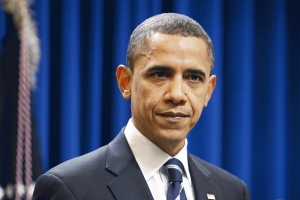
Preident Barack Obama

Preident Barack Obama
You’d never know it from cable news, but the average liberal Democrat actually likes the job the president is doing
Everyone knows that progressives have been growing increasingly disillusioned with Barack Obama since, well … even before he took office. He’s compromised too much, fought too little, sold out on one big issue after another, and fallen horribly, tragically short of the transformational goals that defined his 2008 campaign.
And now that he’s gone and cut a deal with Mitch McConnell (of all people!) to keep the Bush tax cuts in place for the wealthiest Americans for the next two years (at least), the left’s anger is louder than ever. No wonder Time’s Mark Halperin says the president’s base is “shattered.” And no wonder the media is filled with speculation about a potential challenge to the president in the 2012 Democratic primaries. Really, has there ever been a president who’s succeeded so thoroughly in taking the very people who put him in office and turning them against him?
It’s a fun topic for cable news and the blogosphere, where liberal commentators and activists routinely brand the president a Judas and threaten to support a primary challenger in 2012. And it’s a fun topic in the “mainstream media,” which takes all of this racket as confirmation that Obama is rapidly losing — or has already lost — his base.
There’s just one problem: The premise on which all of this is based is totally and completely wrong. Liberal commentators and activists and interest group leaders may be seething over Obama, but their rage has not trickled down to the Democratic voters (and, in particular, the Democratic voters who identify themselves as liberals), even though they’ve been venting their grief for the better part of two years.
As I noted earlier this week, Obama’s approval rating among Democrats has held steady at or near the 80 percent level throughout all of the turmoil of 2010. This puts him in as strong a position with his own party’s voters as any modern president has been at this same point in his presidency (with the exception of George W. Bush, whose numbers remained unusually high for well over a year after 9/11). Look closer and you’ll also find that Obama’s approval rating among Democrats is actually highest among those who call themselves liberals — an 83 percent score in the most recent round of Gallup polling, completed a few days ago. Among moderate Democrats, he clocks in at 75 percent, and among conservative Democrats, 69 percent. Again, these numbers have more or less held steady all year. To the extent Obama has a serious problem with Democrats, then, it’s with those who are on the right, not the left. This is hardly what you’d expect for a president who, according to the dominant narrative, has spent his presidency poking a stick in the left’s eye by cutting deals with conservative Democrats and Republicans.
Obama, in other words, seems to have developed his own silent majority. Rank-and-file liberal Democrats may not agree with everything he has done, but they do not share the sense of abandonment and betrayal that has defined liberal commentary throughout so much of his presidency. The party’s liberal base still very much likes him; it’s the elites who have turned on him.
The biggest reason for this disconnect, I would suggest, is that the liberal Democratic base liked Obama, both personally and ideologically, from the very beginning. Virtually from the moment he electrified the 2004 Democratic convention, liberals latched on to him as one of their own — and they haven’t (and don’t want to) let go.
This is not an unheard of phenomenon in politics, and it’s one of the reasons I’ve been so keen on comparing Obama’s political appeal to that of Ronald Reagan. Rank-and-file conservatives felt as strongly about Reagan in the 1980 campaign (and in 1976, for that matter) as liberals did about Obama in 2008. And they stayed true to him even when conservative elites concluded two years into his term that Reagan was a sellout.
Indeed, in the wake of this week’s drama over the Bush tax cuts, it’s worth recalling a similar moment in Reagan’s presidency, when congressional Democrats forced him into a tax hike in the summer of 1982. Like Obama now, Reagan had no leverage: The economy was spiraling out of control, voters were abandoning him, and Democrats were having great success (or seeming to have great success) hammering him over the exploding deficit. Thus did Reagan agree to a tax hike package that increased revenues by nearly $100 billion over the next three years — the largest tax increase in history, right-wing activists and commentators screamed. To these conservative elites, it was simply the latest act of betrayal by their one-time hero. When the GOP was drubbed in that fall’s midterms, they claimed vindication (see — not conservative enough!) and talked openly of challenging Reagan in the 1984 primaries. But rank-and-file conservative voters didn’t listen. They still liked the Gipper, still thought he was one of them, and still backed him in polling. It’s the same story today for Obama with rank-and-file liberals.
If Obama had been introduced to the Democratic base differently — that is, if they’d been suspicious and resistant to him and he’d landed in the presidency in spite of their skepticism — the objections of liberal elites might be far more damaging.
Here a parallel can be drawn to George H.W. Bush, who was introduced to the GOP’s “New Right” base in 1980 as the moderate, Gerald Ford-ish establishment Republican running against Reagan. Thus, the New Right, which essentially took control of the GOP for good with Reagan’s ’80 triumph, never really trusted Bush. Eight years of loyal service as Reagan’s V.P. was enough to win Bush the right’s benefit of the doubt in 1988, but when he “caved” as president — as he did on the S&L bailout, the 1990 tax hike, and a host of other issues — it merely brought back to the surface all of the right’s old attitudes toward him. So when the triumph of the Gulf War faded in 1991, there was room for Pat Buchanan to run to Bush’s right in the 1992 primaries. Buchanan didn’t win any states, but he did secure enough support — especially in New Hampshire — to severely embarrass the president. Obama’s history with liberals, though, is much different from Bush’s history with conservatives.
This isn’t to say that it’s impossible for Obama to lose the Democratic base; it’s just that there’s a lot more goodwill toward him among that base — and a lot more willingness to rationalize his “betrayals” as sensible pragmatism in the face of the other party’s obstructionism — than most people recognize.
At his press conference Tuesday, Obama noted that many of the “purist” liberals now blasting his tax cut deal also savaged his final healthcare compromise earlier this year, which wiped out the public option. It’s an apt comparison. And it’s worth remembering that the cries of betrayal back then did nothing to lessen rank-and-file’s assessment of Obama’s job performance — probably because the main thing they saw was that Obama, unlike every president before him, had actually gotten healthcare done.
By Steve Kornacki-Salon: Wednesday, Dec 8, 2010
Share This Blog


 Unknown Feed
- An error has occurred; the feed is probably down. Try again later.
 mykeystrokes.com

You must be logged in to post a comment.