The GOP’s Penny-wise, Pound-Foolish Spending Cuts
Let’s say that for every dollar you gave me, I gave you a crisp $10 bill in return. Good deal, right? Almost too good. But before you start to ask questions, I’ll remind you that this is my thought experiment. Perhaps I just love dollar bills. Or perhaps I just love you. At any rate, there are no strings attached, and you can take advantage of it more than once.
Now let’s say that you’re in debt and you need to get your finances in order. Do you start handing me more dollar bills? Or fewer?
If you’ve got any sense, you’ll give me more. Converting dollar bills into $10 bills is an excellent way to pay off your credit card. Except, it seems, if you’re a House Republican.
On March 1, House Republicans voted to cut $600 million from the budget of the Internal Revenue Service for the remainder of 2011, and they want even deeper cuts in 2012. Perhaps that doesn’t surprise you: Republicans don’t like spending — at least when they’re not in power — and they don’t like taxes. Why would they fund the IRS?
Well, as the Associated Press reported, “every dollar the Internal Revenue Service spends for audits, liens and seizing property from tax cheats brings in more than $10, a rate of return so good the Obama administration wants to boost the agency’s budget.” It’s an easy way to reduce the deficit: You don’t have to cut heating oil for the poor or Pell grants for students. You just have to make people pay what they owe.
But deficit reduction is not the GOP’s top priority. It’s a bit lower on the list, somewhere between “get Styrofoam cups back into Congress” — an actual push the Republicans took up to thumb their nose at Nancy Pelosi’s environmental policies — and make “Sesame Street” beg for money. In fact, if you listen to Speaker John Boehner, he’ll tell you himself. “The American people want us to focus on creating jobs and cutting spending,” he has said. And that comment wasn’t a one-off: “Our goal is to cut spending,” he said in another speech.
Cutting spending is related to, but in important ways different from, cutting deficits. For one, it rules out tax increases. That’s how Republicans can lobby to make the Bush tax cuts permanent, at a cost of $4 trillion over 10 years, and yet say they’re fulfilling their campaign promises by making much smaller cuts to non-defense discretionary spending. If you add up what Republicans have offered since the election, the policies they’ve endorsed would increase deficits but also decrease spending, at least in the short term. The IRS example shows that spending cuts don’t always reduce the deficit. But it’s worse even than that: Spending cuts don’t always reduce government spending.
There are three categories of spending in which cuts lead to more, rather than less, spending down the line, says Alice Rivlin, former director of both the Congressional Budget Office and the Office of Management and Budget. Inspection, enforcement and maintenance. The GOP is trying to cut all three.
Let’s begin with the costs of cutting inspection — for example, the Food and Drug Administration and the Agriculture Department. Together, the agencies are charged with ensuring that the nation’s food is safe. That’s increasingly crucial as our interconnected, industrialized system makes contaminated food a national crisis rather than a local problem. In recent years, we’ve seen massive recalls stemming from E. coli in spinach, salmonella in peanut butter and melamine in pet food. Each required the recall of thousands of tons of food and alerts to consumers who, in many cases, were screened or treated.
The problem was bad enough — and the people and pets sick enough— that Congress passed a bipartisan food-safety bill during last year’s lame-duck session. But now Republicans want big cuts in the agencies’ budgets, meaning fewer inspectors and a higher chance of outbreaks and food-borne illness. And those don’t come cheap. They show up in our health-care costs, disability insurance and tax revenue, not to mention in the pain and suffering and even death they cause.
Next up: enforcement. As any budget wonk will tell you, cracking down on “waste, fraud and abuse” won’t cure all our fiscal ills. But waste, fraud and abuse do happen, particularly in Medicare and Medicaid, where they can be costly. Republicans are looking for big reductions in the Department of Health and Human Services, meaning fewer agents to conduct due diligence on health-care transactions. Costs will go up, not down.
Then there’s deferred maintenance. In 2009, the Society of Civil Engineers gave America’s existing infrastructure a grade of D. They estimated that simply maintaining America’s existing stock would require up to $2.2 trillion in investment. But Republicans have been cool to Obama’s calls to increase infrastructure investment. Just “another tax-and-spend proposal,” Rep. John Mica (R-Fla.) said when the initiative was announced. But a dollar in maintenance delayed — or cut — isn’t a dollar saved. It’s a dollar that needs to be spent later. And waiting can be costly. It’s cheaper to strengthen a bridge that’s standing than repair one that’s fallen down.
And there are plenty of examples beyond that. Republicans have proposed massive cuts to the Securities and Exchange Commission, which would make another financial crisis that much likelier. They’ve proposed cuts to the National Oceanic and Atmospheric Administration, which conducts tsunami monitoring. In their zeal to cut spending, they’re also cutting the spending that’s there to prevent overspending. Just as you have to spend money to make money, you also have to spend money to save money — at least sometimes.
There are all sorts of reasons Republicans are being penny-wise and pound-foolish. Cutting $100 billion in spending in one year sounded good on the campaign trail but turned out to be tough in practice. Curtailing the IRS and cutting the Department of Health and Human Services — and, particularly, its ability to implement health-care reform — is a long-term ideological objective for Republicans.
Whatever the reason, the effect will be the same: a higher likelihood of pricey disasters, an easier time for fraudsters, and bigger price tags when we have to rebuild what we could’ve just repaired.
By: Ezra Klein, The Washington Post, March 15, 2011
What Does The Tea Party Want?….The New Litmus Test
Jim VandeHei and Mike Allen argue that the Tea Party redefined the purpose of the GOP as opposition to spending:
The Republican Party is undergoing a messy but unmistakable 20-month transformation from fanatically anti-Obama to fanatically anti-spending, providing top party officials a new and intriguing playbook for recapturing the White House in 2012.
To understand the current evolution, flash back to late spring of 2009. The GOP was disoriented and adrift, its leadership void filled by the bombastic voices of Palin, Beck and Rush Limbaugh. There was no common conservative cause, beyond fear and loathing of Obama. No wonder swing voters were so down on them.
But the tea party, treated at first by the media as exotics, forced Republicans to focus almost exclusively on the size of government. By the time the 2010 elections rolled around, tea party activists and most independent voters were completely aligned on the need to cut, cut, cut.
Midterm election results showed that this approach offers the GOP its best – and maybe only – hope of keeping the interests of independents and tea party activists aligned enough to beat Obama.
The new litmus tests for GOP presidential hopefuls are support for repealing “Obamacare” and taking a cleaver to government spending. If a presidential candidate could harness the smaller-government conservatism, temper it enough to avoid a blatant overreach and articulate a vision for a prosperous future for the country, it’s not hard to imagine swing voters finding such a person appealing.
There’s a superficial appeal to this story. But the evidence that Tea Party activists want to cut spending — at least actual spending programs — is sparse. Polls show that Tea Party supports overwhelmingly oppose cuts to Social Security and Medicare. The main thrust of Tea Party opinion is not the belief that Obama has spent too much money, but the belief that Obama has spent too much money on people unlike them:
More than half say the policies of the administration favor the poor, and 25 percent think that the administration favors blacks over whites — compared with 11 percent of the general public.
They are more likely than the general public, and Republicans, to say that too much has been made of the problems facing black people.
Here’s another cut, showing the Tea Party’s greater comfort with inequality of opportunity and stronger belief that the government devotes too many resources to minorities:
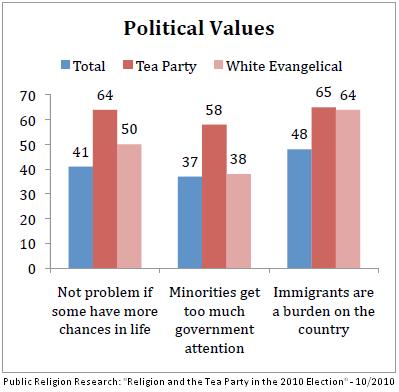
It’s a revolt against the composition of government much more than the level.
Now, it’s true that Republicans aren’t exactly translating this blueprint into action, but they’re not exactly flouting it, either. There is always a generalized antipathy toward spending amongst Republican and swing voters, but it disappears when the subject turns to actual government programs. Usually Republicans decide to just cut taxes for the rich instead. Here’s is the one part of the article proposing a defined policy change:
Even Ralph Reed, the Republican operative most tapped in to evangelicals, reflected the new GOP mindset when he gave this surprising wish list for the next presidential race: “In a perfect world, I’d like to hear the Republican nominee run on a platform that takes the capital gains tax to zero over five years.” Reed, who summoned several of the presidential candidates to Iowa for his Faith & Freedom Coalition this week, made it clear that Christian conservatives will still need to be catered to, but added that his side will understand the nominee’s need to focus on swing voters.
So an article putatively about the GOP redefining itself as an anti-spending party has one actual programmatic detail, and it’s: a zeroing out of the capital gains tax. In the name of appealing to swing voters — who, in fact, oppose tax cuts for the rich. Meet the new boss…
By: Jonathan Chait, The New Republic, March 14, 2011
Meanwhile…Washington’s Budget Folly
The Senate on Wednesday voted down the House budget bill, with its string of $61 billion in mostly political cuts through Sept. 30. That formally puts an end to the House’s grandstand play. But the Senate also rejected its Democratic leaders’ own plan to cut $6.5 billion. The government’s financing is due to run out in eight days. To prevent a shutdown, the two chambers will probably have to agree to yet another short-term financing bill.
That would be politically and fiscally irresponsible. But the House Republicans will be happy to agree, as long as Democrats agree to a vigorish of $2 billion a week in cuts to vital government programs.
Unless the White House and Democratic lawmakers start pushing back a lot harder — and do a better job of explaining the disastrous effects on the economy and everyday life — the Republicans will win the argument. If it keeps going on this way, they will get the $61 billion they demanded.
The White House again threatened on Wednesday to veto the House bill, and said it supported the Democratic bill that did not even draw a simple majority. It has been hosting what appear to be unproductive talks among legislative leaders; Vice President Joseph Biden Jr., who is nominally in charge of the talks, is now visiting Eastern Europe and tried to mediate by telephone.
President Obama has yet to take a firm public stand and make clear his bargaining limits and priorities. Understandably, he does not want the government to shut down and is hoping that quiet negotiations will produce better results than loud declarations of principle. But there is no sign that the House freshmen have an interest in compromise, or that Representative John Boehner, the House speaker, has any control of his caucus.
A brief shutdown, painful as it would be, would be far less damaging than a sudden withdrawal of tens of billions in government spending from the economy, which would lead to widespread layoffs.
Mr. Obama could well follow the example of Senator Charles Schumer of New York, the third-ranking Democrat in the Senate, who on Wednesday called for a “re-set” of the negotiating process. The only way to have a meaningful discussion of the budget, he said in a speech, is to consider all of its parts at once over the long term, not for a few weeks or months at a time. That includes all the issues the Republicans wouldn’t deal with in their bill: cuts to the entitlement programs and to the Pentagon budget and ways to raise revenues at the same time.
The Republicans, as Mr. Schumer noted, aren’t really interested in lowering the deficit. If they were, they would never have insisted on $800 billion in tax cuts for the wealthy without paying for them, or on repealing the health care law, which saves $230 billion over a decade.
They are only interested in slashing government, no matter the cost to the country. It is time for the president — and responsible Congressional leaders of both parties — to reject their tactics and their goal.
By: Editorial, The New York Times, March 9, 2011
Can Seven Reports Be Wrong About The Risks of Spending Cuts? GOP Says Yes
Could two independent economic reports, a liberal think tank and four bipartisan reports on debt reduction be wrong? They all conclude that slashing federal spending this year could cause job losses and threaten the economic recovery.
The latest report, from Mark Zandi of Moody’s Analytics, says 700,000 jobs could be lost by the end of 2012 if Republicans succeed in their quest to cut $60 billion from domestic programs this year. Cuts and tax increases are necessary to address the nation’s long-term fiscal problems, Zandi said, but “cutting too deeply before the economy is in full expansion would add unnecessary risk.” The report largely echoes earlier analyses by Alec Phillips of Goldman Sachs and the Center for American Progress.
House Speaker John Boehner famously responded, when asked about potential job losses earlier this month, “so be it.” On Monday his office pointed to a new counter argument offered by Stanford economist John Taylor – that “a credible plan to reduce the deficit” will help the economy, not hurt it, and that $60 billion – the amount the other analyses assume will be cut this year – is an inaccurate, inflated figure.
Taylor is a former Bush administration official based at the conservative Hoover Institution at Stanford; last year he received an award from the conservative Bradley Foundation. Zandi, founder and chief economist at Moody’s, was an adviser to Republican presidential nominee John McCain in 2008. However, he is a registered Democrat. (Update: Fed chairman Ben Bernanke, named by Republican George W. Bush and re-appointed by President Barack Obama, also disputes the Zandi and Phillips reports).
Boehner spokesman Michael Steel called Zandi “a relentless cheerleader for the failed ‘stimulus,'” who “refuses to understand that ending the spending binge will help the private sector.” That led the Chicago Tribune’s Mike Memoli to tweet, “Today, GOP discredits Mark Zandi. Last fall, cited his analysis in arguing against tax hikes.”
It is an article of faith among Republicans that 2009 stimulus package has “failed.” But the Obama administration, Zandi and many others disagree with that assessment. The nonpartisan Congressional Budget Office estimates that the stimulus created or saved up to 3.5 million jobs, raised the GDP and stabilized an economy that had been in free-fall.
There is no sign the stimulus will ever be anything but a partisan flashpoint. Yet there is bipartisan consensus to be found in the reports from various deficit and debt commissions. They are unanimous in suggesting either increased stimulus or steady government spending in 2011.
“Don’t disrupt the fragile recovery,” the National Commission on Fiscal Responsibility and Reform warned in December. Its plan – adopted by 11 of the 18 panel members – calls for “serious belt-tightening” to begin in 2012. A report from the Bipartisan Policy Center suggested gradually phasing in steps to reduce deficits and debt “beginning in 2012, so the economy will be strong enough to absorb them.” The 2009 Peterson-Pew Commission on Budget Reform put off cuts to the same year, as did a recent proposal from Brookings fellow Bill Galston and Maya MacGuineas, president of the Committee for a Responsible Federal Budget.
MacGuineas has mixed feelings about the GOP drive to slash spending and slash it now. “It’s good that we’re actually talking about spending reductions” instead of putting it off, she said in an interview. “On the one hand, that’s helpful. On the other hand, they are focusing on the wrong time frame — this year instead of this decade, and focusing on the wrong part of the budget — a very thin slice instead of the real problem areas” such as Medicare and Medicaid.
The ideal scenario in the view of MacGuineas and the bipartisan commissions would be for politicians serious about debt reduction to spend 2011 on a long-term plan to reduce domestic and defense spending, raise taxes, ensure long-term health for Social Security and solve the riddle of controlling Medicare and Medicaid costs. “The right model is to put in place this year a multiyear plan to get there,” MacGuineas said, adding she has high hopes for a bipartisan group of senators led by Democrat Mark Warner of Virginia and Republican Saxby Chambliss of Georgia.
The skirmishes over spending – destined to repeat themselves constantly this year as Congress confronts potential government shutdowns and loan defaults – have provided political fodder for all sides. Democrats seized on Boehner’s initial response to the prospect of job losses and now refer often to the GOP’s “so be it” jobs policy. Republicans, though they only control half of Congress, are making good on promises to the tea party movement and other voters who put a premium on cutting government spending.
If Republicans can’t secure Senate passage and Obama’s signature for their spending cuts, they will have at least made clear to their base that they tried. If by some political miracle they win the $60 billion in cuts they are seeking, and the recovery picks up, they can take credit. If the economy dips back into crisis, or even if the jobless rate is flat, they can blame Obama and bolster their case to take back the White House.
Unless of course Obama and the Democrats, equipped with who knows how many reports by then, figure out a way to blame them first.
By: Jill Lawrence, Senior Correspondent-Politics Daily, March 1, 2011
Share This Blog


 Unknown Feed
- An error has occurred; the feed is probably down. Try again later.
 mykeystrokes.com

You must be logged in to post a comment.