“Don’t Call Yourself Reagan Republicans”: Whatever You Think GOP, “Reagan” Is Not An Action Word
In all likelihood, it’s probably too late to think the political world will remember any of the details of Ronald Reagan’s actual presidency. Indeed, the mythologizing will almost certainly get worse – I half-expect “Reagan” to become a verb, to mean “to stop all foes through force of will and stern looks.”
But the Republican preoccupation with doing whatever they think Reagan might have done in any given situation occasionally gets a little silly.
A proposed U.S. aid package for Ukraine’s fledgling pro-Western government stalled Thursday amid festering Republican Party feuds over foreign policy.
Tensions erupted on the Senate floor late in the day after the chamber did not advance the measure, with Sen. John McCain (Ariz.) berating the dozen or so of his Republican colleagues who, for various reasons, objected to the legislation.
“You can call yourself Republicans. That’s fine, because that’s your voter registration. Don’t call yourself Reagan Republicans,” McCain said on the Senate floor. “Ronald Reagan would never – would never let this kind of aggression go unresponded to by the American people.”
Look, the 1980s were a while ago and the political world has a notoriously short memory, but Reagan wasn’t a comic-book character. He was a president whose record is readily available to anyone who bothers to look.
And the notion that Reagan “never let this kind of aggression go unresponded to” is wholly at odds with how the Republican icon actually governed.
Kevin Drum flagged some helpful tweets from Dan Drezner, himself a center-right scholar on international affairs, who offered a quick history lesson for those who don’t remember the Reagan era quite as well as they should.
* When Soviet-backed Polish leaders cracked down on Solidarity activists, Reagan didn’t do much of anything.
* When the Soviets shot down KAL 007, killing 269 people – including a member of the U.S. Congress – Reagan went to the United Nations, but not much else.
* When terrorists hijacked TWA Flight 847, the Reagan administration had no qualms about negotiating with them.
* When terrorists killed 241 Americans in Beirut in 1983, Reagan didn’t do much of anything except run away.
I’d just add that this terrific chart from Adam Serwer shows the number of attacks on U.S. diplomatic outposts abroad soared during Reagan’s presidency.
How is this possible? Didn’t these people realize that the U.S. president at the time could Reagan them with his Reaganness?
Russia’s moves in and around Ukraine represent a crisis, but let’s not assume Reagan had some magical leadership powers that could stop these provocative acts or prevent these kinds of developments from happening in the first place.
By: Steve Benen, The Maddow Blog, March 15, 2014
“Dark, Heartless And In No Position To Criticize”: It’s Time For Dick Cheney To Get Off The Stage
In the midst of the Crimean crisis, Dick Cheney saw fit to undermine the commander in chief. “I also think he hasn’t got any credibility with our allies,” Cheney said Sunday on a CBS News broadcast, speaking of President Obama.
That’s unseemly, to say the least, in a foreign policy crisis. A once-high official simply does not say such things about a sitting president, by protocol; George W. Bush is scrupulously silent these days. It’s just Cheney’s latest outrage; keeping track is like counting cattle.
Who asked him, anyway? Charlie Rose, hosting Bob Schieffer’s Sunday show, “Face The Nation.” Rose apparently had not heard of a famous declaration by a Republican senator, one swell Arthur Vandenberg, that “politics stops at the water’s edge.” Cozy with his Southern charm, Rose did not challenge Cheney’s bald, ugly assertion about President Obama, laced with an edge malice. Old pro Schieffer, my favorite CBS Newsman, wouldn’t let an unpatriotic line go by so easy.
Why wasn’t Cheney back home on the range in Wyoming, where the deer and the antelope play — all the better to hunt? Let him leave us in peace and spend more time with his family.
The country knew of Cheney’s glaring influence inside the Bush White House and its wars of choice. Less known is that the former president and Cabinet colleagues had grown weary of Cheney’s sharp style and he’d eventually lose his place in the power scheme. The man who ducked every chance to serve in uniform during the Vietnam War seemed to see himself leading “on the field of battle” in a dark shadowy conflict. He took the tragedy of September 11 into other spheres as well and masterminded scaring us into surrendering our civil liberties.
Yet Cheney’s star began to wane about six years into the Bush presidency, according to Peter Baker, the author of “Days of Fire.” This was about the time Bush himself fell out of public favor.
By then, the nation was weary of war, especially the empty grounds for the Iraq War. At home, Bush’s cavalier reaction to the 2005 Hurricane Katrina drowning of New Orleans awakened the nation out of a slumber. So, of course, not all the failings of his presidency had Cheney’s fingerprints on them.
But back home on the Texas ranch, Bush himself wrote in his memoir that Cheney had “become a lightning rod for criticism from the media and the left. He was seen as dark and heartless — the Darth Vader of the administration.”
Cheney has not lightened up since.
By: Jamie Stiehm, Washington Whispers, U. S. News and World Report, March 11, 2014
“One American Voice”: GOP Should Listen To Gates On Ukraine
The words of the late Sen. Arthur Vandenberg (R-Mich.) have been ringing my ears these past few days. The then-chairman of the Senate Foreign Relations Committee said in 1947 that “partisan politics [must stop] at the water’s edge.” Translation: No matter the domestic battles with the president, international crises demand we speak with one voice. Those days are long gone judging by the cacophony of ridicule of President Obama because of the actions taken in Ukraine by Russian President Vladimir Putin.
Sen. Lindsey Graham (R-S.C.) said on CNN, “We have a weak and indecisive president that invites aggression.” Sen. John McCain (R-Ariz.) slammed Obama on Monday for having “a feckless foreign policy where nobody believes in America’s strength anymore.” And Sarah Palin, the person McCain saw fit to make his 2008 vice presidential running mate said later that night, “People are looking at Putin as one who wrestles bears and drills for oil. They look at our president as one who wears mom jeans and equivocates and bloviates.”
My Post colleague David Ignatius’s column today was a needed tonic. He got former Defense Secretary Robert Gates on the phone to talk about Republican bashing of the president over Ukraine.
Gates, a Republican himself, urged the GOP senators to “tone down” their criticism and “try to be supportive of the president rather than natter at the president.”
Not only that, Gates told Ignatius that Putin “holds most of the high cards” and that “considerable care needs to be taken in terms of what is said, so that the rhetoric doesn’t threaten what policy can’t deliver.” Ah, such reasonableness from the GOP. Pity Gates, now the chancellor of the College of William and Mary, isn’t in the Senate.
In the end, even he shared my lament. “It seems to me that trying to speak with one voice — one American voice — seems to have become a quaint thing of the past,” Gates told Ignatius. “I regret that enormously.” At least I’m in good company.
By: Jonathan Capehart, Opinion Writer, The Washington Post, March 5, 2014
“Full Time Other, Part-Time American”: McCain Criticized ‘Partisan Sniping’ After Russia’s Invasion Of Georgia In 2008
Sen. John McCain (R-AZ) has been one of President Obama’s most vocal critics for his handling of the crisis in Ukraine, particularly after Russia’s invasion of Crimea this past weekend. But back in 2008, when Russia went to war with neighboring Georgia and there was a Republican in the White House, McCain criticized “partisan sniping” surrounding the issue and called on the country to be united.
“The fact is, that this is a blatant act on the part of Vladimir Putin and one that must be unacceptable to the world community. It cannot stand,” McCain said this week referring to Russia’s military incursion into Crimea. “Why do we care?” McCain asked, “Because this is ultimate result of a feckless foreign policy where nobody believes in America’s strength anymore.”
Indeed, the Arizona Republican’s attacks on Obama’s foreign policy in recent days has been relentless. “It’s time we woke up about Vladimir Putin. It’s time this administration got real,” McCain said on the Senate floor this week.
“This president does not understand Vladimir Putin. He does not understand his ambitions,” McCain said. “This president has never understood it. This president is the one who ridiculed Mitt Romney when Mitt Romney said the great enemy was Russia and its geopolitical threats.”
In August 2008, after Russian forces invaded the Georgian region of South Ossetia, McCain — who was battling Obama for the White House at the time — was a fierce advocate for the Georgian cause its then-President Mikheil Saakashvili. “We are all Georgians,” McCain famously said in support (in today’s case, “we are all Ukrainians” as well).
But back in 2008, McCain wasn’t pleased with those making the Russo-Georgian war a partisan issue. “This is no time for that,” the GOP presidential nominee said at the time, adding that Americans should be united against Russia. “The time now is for America to — the United States of America to act united on behalf of the people of the country of Georgia, and not do a lot of partisan sniping.”
“This is about hundreds, if not thousands, of innocent people whose lives are even being taken, or they’re rendered homeless, wounded,” McCain said, “Let’s devote all of America and our allies’ energy to helping resolve a situation which is froth with human tragedy.” (HT: Tommy Vietor)
By: Ben Armbruster, Think Progress, March 5, 2014
“Mad About Vlad!”: The Increasingly Awkward Conservative Crush On Putin
All the way back in 1946, with Nazi Germany defeated and the cold war commencing, George Orwell wrote a brilliant essay on James Burnham. The author of The Managerial Revolution and a leading political philosopher, Burnham was a frequent contributor to the young National Review, and, more broadly, a leading voice of postwar American conservatism.
What Orwell found in his analysis of Burnham was that this ostensible democrat and cold warrior held deep regard for–and even envied–authoritarian or totalitarian powers, including Stalin’s Russia. This is why, Orwell explained, Burnham originally predicted a Nazi victory in World War II. (Britain, typically, was considered “decadent.”) In later years, Orwell continued, Burnham would write about Stalin in “semi-mystical” terms (with a “fascinated admiration”), comparing him to heroes of the past; Burnham didn’t like Stalin’s politics, but he admired his strength. Of Burnham’s odd quasi-regard for Stalinism and its supposedly destined victory over the forces of sickly democratic regimes, Orwell added: “The huge, invincible, everlasting slave empire of which Burnham appears to dream will not be established, or, if established, will not endure, because slavery is no longer a stable basis for human society.”
Orwell, then, was not merely critical of Burnham’s pessimism (Orwell himself could be overly pessimistic.) He also saw this pessimism as reflective of a mindset that prioritized vicious power-wielding and coercion over other things that allowed states to succeed and prosper.
This variety of pessimism did not end with Burnham, unfortunately. During the nearly 50 year Cold War, Americans were informed time and again by rightwingers that the Soviet Union did not allow dissent, and could therefore pursue its desired policies without protest. While the Soviets were single-minded, we were, yes, decadent. Soviet leaders could fight wars as they pleased, but freedom-loving presidents like Ronald Reagan had to put up with what Charles Krauthammer laughably called an “imperial Congress.” (Some of the same type of commentary shows up about today’s China: look how quickly the Chinese can build bridges! And, as Thomas Friedman proves, it isn’t coming solely from the right.) But more unique among conservatives is the desire for a tough leader who will dispense with niceties and embrace power.
The reason for all this ancient history is the situation today in Ukraine, where an autocratic Russian leader who exudes manly vibes has ordered his armed forces into Crimea. It is unclear whether this move on Russia’s part will prove successful, but, amidst uncertaintly among western leaders over what to do, there has arisen a new strain of the Burnham syndrome. Conservatives don’t just see the west and President Obama as weak; they also seem envious of Putin’s bullying. “There is something odd,” Benjamin Wallace-Wells wrote in New York magazine, “about commentators who denounce Putin in the strongest terms and yet pine for a more Putin-like figure in the White House.”
Sarah Palin, for example, said this last night to Sean Hannity:
Well, yes, especially under the commander-in-chief that we have today because Obama’s — the perception of him and his potency across the world is one of such weakness. And you know, look, people are looking at Putin as one who wrestles bears and drills for oil. They look at our president as one who wears mom jeans and equivocates and bloviates. We are not exercising that peace through strength that only can be brought to you courtesy of the red, white and blue, that only a strengthened United States military can do.
Put aside the syntax for a moment and ask: is there not a bit of envy here? Isn’t Palin very clearly desirous of a tough-guy president who wrestles bears and drills for oil? (The swooning over Bush’s landing on that aircraft carrier was a telling sign.) Now read Rush Limbaugh:
In fact, Putin—ready for this?—postponed the Oscar telecast last night. He didn’t want his own population distracted. He wanted his own population knowing full well what he was doing, and he wanted them celebrating him. They weren’t distracted. We were.
If only America wasn’t distracted by silly things like the Oscars, perhaps we would have the strength to stand up to the tough Russia. (On his web page, Limbaugh has a photo of a shirtless Putin.) In case the point isn’t obvious enough, Limbaugh continues:
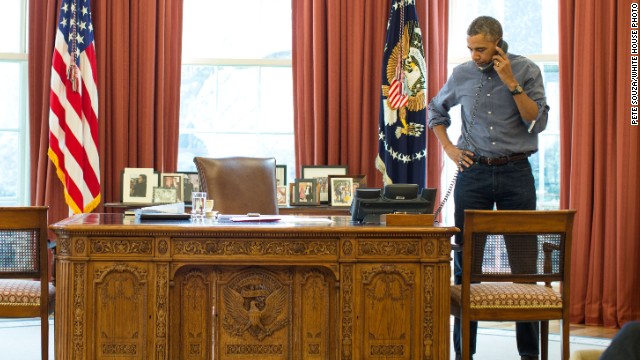
Well, did you hear that the White House put out a photo of Obama talking on the phone with Vlad, and Obama’s sleeves were rolled up? That was done to make it look like Obama was really working hard—I mean, really taking it seriously. His sleeves were rolled up while on the phone with Putin! Putin probably had his shirt off practicing Tai-Chi while he was talking to Obama.
Limbaugh quite clearly wants this kind of leader.
Also on view over the past few days is the idea that Putin must be smarter and cagier and stronger: “Putin is playing chess and I think we’re playing marbles,” said Rep. Mike Rogers, R-Mich., chairman of the House Intelligence Committee. The Russians are thus necessarily craftier than our weak and vacillating (key word) democratic leader.
The silliness inherent in all this talk is that when American presidents have generally acted above the law, or engaged in stupid and immoral wars, or bullied neighbors, or cracked down on domestic dissent, it has backfired in the worst ways on them and the country. (The examples are too obvious to list.) Moreover, I notice that conservatives seem to view some of Obama’s domestic actions–appointing czars, for example–as being the result of a vindictive, bloodthirsty, and authoritarian mindset. However absurd the particular claims may be (Cass Sunstein as Stalin), it is proof that the people who seem to secretly pine for an American Putin don’t really want one.
Orwell’s response to this sort of thinking was to write, of Burnham, “He ignores the advantages, military as well as social, enjoyed by a democratic country.” Of course this is not a guarantee that this crisis will play itself out in a way that is beneficial to American or Western (or Ukrainian) interests. But the presumption that Russia has just masterly played the Great Game, and that our weakness will doom us, is nearly automatic among large segments of the American right. (Olga Dukhnich, in The New York Times, makes the point that this crisis may backfire just as the Soviet invasion of Afghanistan did. Whether correct or not, it is a nice counter to the reigning right-wing ultra-pessimism.)
Orwell closed his essay as follows:
That a man of Burnham’s gifts should have been able for a while to think of Nazism as something rather admirable, something that could and probably would build up a workable and durable social order, shows what damage is done to the sense of reality by the cultivation of what is now called ‘realism’.
It is now Team Obama that styles itself realist, in quite a different way than Orwell was talking about. And large chunks of the American right would now also scorn the term. What they haven’t scorned is the mindset, which is the problem in the first place.
By: Isaac Chotiner, The New Republic, March 4, 2014
Share This Blog


 Unknown Feed
- An error has occurred; the feed is probably down. Try again later.
 mykeystrokes.com