Mark Pauly, Father of the Individual Mandate: “Either We Have To Have A Mandate Or Make Insurance Free For Everyone”
In 1991, economist Mark Pauly was the lead author of a Health Affairs paper attempting to persuade President George H.W. Bush and his administration to adopt a universal health-care proposal that would keep the government from eventually taking over the sector. “Our view is that excessive government intervention will make matters worse,” wrote Pauly and his co-authors. “Our strategy, therefore, is to design a scheme that limits governmental rules and incentives to the extent necessary to achieve the objectives.”At the heart of that strategy was the individual mandate, which would go on to be promoted by congressional Republicans, the Heritage Foundation, and Massachusetts Gov. Mitt Romney before being adopted by Democrats and becoming a bete noire of conservatives. I spoke to Pauly earlier this afternoon, and an edited transcript of our conversation follows.
Tell me about your involvement in the development of the individual mandate.
I was involved in developing a plan for the George H.W. Bush administration. I wasn’t a member of the administration, but part of a team of academics who believe the administration needed good proposals to look at. We did it because we were concerned about the specter of single payer insurance, which isn’t market-oriented, and we didn’t think was a good idea. One feature was the individual mandate. The purpose of it was to round up the stragglers who wouldn’t be brought in by subsidies. We weren’t focused on bringing in high risks, which is what they’re focused on now. We published the plan in Health Affairs in 1991. The Heritage Foundation was working on something similar at the time.
What was the reaction like after you released it?
There was some interest from Republicans. I don’t recall whether they formally wrote a bill or just floated it as an idea [It did make it into a bill — Ezra], but Democrats in Congress said it was “dead on arrival.” So that was the end of my 15 minutes.
Was the constitutionality of the provision a question, either in your deliberations or after it was released?
I don’t remember that being raised at all. The way it was viewed by the Congressional Budget Office in 1994 was, effectively, as a tax. You either paid the tax and got insurance that way or went and got it another way. So I’ve been surprised at that argument. But I’m not an expert on the Constitution. My fix would be to simply say raise everyone’s taxes by what a health insurance policy would cost — Congress definitely has the power to do that — and then tell people that if they obtain insurance, they’ll get a tax break of the same amount. So instead of a penalty, it’s a perfectly legal tax break. But this seems to me to angelic pinhead density arguments about whether it’s a payment to do something or not to do something.
That gets to one of the central questions in this argument, which is whether the individual mandate is a penalty for economic inactivity or whether it’s part of a broader system of regulations affecting a market for health care that we’re all participating in, whether we’re buying insurance that day or not.
I see it in the latter way. We thought it was a good idea to do everything possible to encourage people to get insurance. Subsidies will probably pick up the great bulk of the population. But the point of the mandate was that there are a few Evil Knievals who won’t buy it and this would bring them into the system. In our version, the penalty was effectively equal to the premium of a policy. You paid the penalty and you got the insurance. That’s one of my puzzlements here: In the new law, the actual level of the penalty is quite small compared to the price of a policy. It’s only about 20 percent of the cost of a policy.
Do you think the mandate is severable from the larger bill?
I think you could do that. I’d want to take some other things out of the bill, too. But the main part I favor and the part that deals with the uninsured are these subsidies for lower-middle-income people. The great bulk of them would take insurance with those breaks. That won’t go away. The mandate props up community rating, which I’m not a fan of. So I’d throw overboard both the mandate and the community rating. Then I’d add high-risk pools.
You say the mandate was developed as a way to avoid single-payer health care. As I see the evolution of this issue, Richard Nixon countered single-payer with an employer mandate, then Clinton co-opted the employer mandate and Republicans moved to an individual mandate, and then Obama co-opted the individual mandate. But there’s nowhere else to go, as far as I can tell. If the individual mandate dies, it seems to me that the eventual universal coverage solution will rely heavily on government programs — we’ll have single payer in fact even if we don’t have it in name.
I think there’s a slippery slope in that direction. I have mixed feelings about the mechanics of the current bill. Our idea was to have tax credits and very little additional government control over insurance markets, and the legislation has an awful lot of that. I believe you could achieve almost the same reduction of the uninsured with the subsidies and without the mandate. But CBO says that you leave about 40 percent of the uninsured population without coverage in that scenario. If we want to close that gap, then either we have to have a mandate or make insurance free for everyone and run by the government.
Interview By: Ezra Klein and posted in The Washington Post, February 1, 2011
Republicans Say Everything the Dems Pass Is Unconstitutional — Even Policies They’ve Championed for Decades
That Republicans are relentlessly attacking the constitutionality of what had long been one of their signature ideas for reforming the health-care system — the individual mandate requiring people to buy insurance or pay a penalty – is a testament to just how far down the rabbit-hole our discourse has gone.
Late last year, when a federal judge ruled against the mandate (two other courts disagreed, and the Supreme Court will end up deciding the question), Senator Orrin Hatch, R-Utah, rejoiced. “Today is a great day for liberty,” he said. “Congress must obey the Constitution rather than make it up as we go along.” It was an odd testament to freedom, given that Hatch himself co-sponsored a health-care reform bill built around an individual mandate in the late 1990s.
Journalist Steve Benen noted that while “the record here may be inconvenient for the right … it’s also unambiguous: the mandate Republicans currently hate was their idea.”
It was championed by the Heritage Foundation… Nixon embraced it in the 1970s, and George H.W. Bush kept it going in the 1980s. For years, it was touted by the likes of John McCain, Mitt Romney, Scott Brown, Chuck Grassley, Bob Bennett, Tommy Thompson, Lamar Alexander, Lindsey Graham, John Thune, Judd Gregg, and many other … notable GOP officials.
According to NPR, the mandate was the Right’s response to progressive proposals to establish a single-payer system. Mark Pauly, the conservative economist widely credited with the idea, explained that “a group of economists and health policy people, market-oriented, sat down and said, ‘Let’s see if we can come up with a health reform proposal that would preserve a role for markets but would also achieve universal coverage.'”
That was then, this is now. Since it was a Democratic Congress that enacted the mandate, this conservative idea for creating a business-friendly model of universal health care has become something profoundly un-American, according to many of those very same Republicans who championed it. (Asked about the GOP’s retreat from the individual mandate it had long promoted, Pauly said, “That’s not something that makes me particularly happy.”)
And as is generally the case in these heady days of Tea Party conservatism, it’s not just that the individual mandate is bad – it’s also “un-Constitutional” (just like child labor laws, federal disaster assistance, food safety standards, etc.). As Gary Epps, a legal scholar at the University of Baltimore, put it, “Conservative lawmakers increasingly claim that the ‘original intent’ of the Constitution’s framers and the views of the right wing of the Republican Party are one and the same.”
A brief filed in support of Virginia’s challenge to the Affordable Care Act by the Landmark Legal Foundation – headed by noted wing-nut radio host Mark Levin, who believes that the Tea Partiers have been “tormented and abused far more than the colonists were by the King of England” – laid out the argument, calling the erstwhile Republican approach to universal health care “evidence of congressional power run amok.”
Congress can tax interstate commerce, it can regulate interstate commerce, it can even prohibit certain types of interstate commerce, but it cannot compel an individual to enter into a legally binding private contract against the individual’s will and interests. There is nothing in the history of this nation, let alone the history of the Constitution … that endorses such a radical departure from precedent, law, and logic.
Like most of the Right’s views of the Constitution – and the Founders’ intent – this is entirely wrong; it’s historical revisionism driven by ideology.
In 1792, none other than George Washington signed the Uniform Militia Act, a law requiring every white male citizen to purchase a whole basket of items – “a good musket or firelock, a sufficient bayonet and belt, two spare flints, and a knapsack, a pouch, with a box therein” – from private companies. Bradley Latino at Seton Hall law school’s Health Reform Watch added that “this was no small thing.”
Although anywhere from 40 to 79% of American households owned a firearm of some kind, the Militia Act specifically required a military-grade musket. That particular kind of gun was useful for traditional, line-up-and-shoot 18th-century warfare, but clumsy and inaccurate compared to the single-barrel shotguns and rifles Americans were using to hunt game. A new musket, alone, could cost anywhere from $250 to $500 in today’s money. Some congressmen estimated it would cost £20 to completely outfit a man for militia service — about $2,000 today.
Some on the Right have argued that this history is irrelevant as the law was passed under the auspices of the Constitution’s militia clauses, not the Commerce Clause. That’s true, but doesn’t change the fact that it disproves the claim that Congress has never compelled citizens to purchase goods or services from private firms – that’s patently false, regardless of how the measures differed in their details.
And despite the fact that there were a number of legislators serving in that Congress who had signed the Constitution five years earlier, “not one of militia reform’s many opponents thought to argue the mandate was a government taking of property for public use. Nor did anyone argue it to be contrary to States’ rights under the Tenth Amendment.” Those who opposed the bill simply argued that it would put too great a burden on the poor.
Of course, mandating that citizens buy a gun is different than requiring them to purchase health insurance. But as Rick Ungar, an attorney and writer, pointed out, Congress did in fact pass a mandate requiring health insurance…back in 1798.
The Act for Sick and Disabled Seamen created a government-operated hospital system – socialized medicine! – and mandated that all privately employed sailors purchase health insurance in order to sail.
It’s not an exact parallel. Nobody was forced to become a merchant seaman. But as Ungar noted, “this is no different than what we are looking at today. Each of us has the option to turn down employment that would require us to purchase private health insurance under the health care reform law.”
The Act also required sea captains to withhold 1 percent of sailors’ earnings to finance the program rather then mandate that they purchase a policy themselves – it was the first payroll tax. But as Ezra Klein noted in the Washington Post, “if conservatives really do prefer a system of payroll taxes that purchase you public insurance to the private system envisioned in the Affordable Care Act, I’m sure there are a lot of liberals who would vote for a bill that repealed the Affordable Care Act and replaced it with Medicare-for-all.”
It’s an important point – the liberal approach to universal health care is not only simpler and far more cost-effective, but unlike the Right’s individual mandate, it also falls unambiguously within the federal government’s enumerated powers.
Health care is also, in the words of the Congressional Research Service, “a unique market” in that one cannot opt out of it even if one wishes to do so. That’s because, by law, we don’t allow people to simply die in the streets, untreated. The uninsured without the means to pay nonetheless get (very costly) care in emergency rooms, and the rest of us pick up the tab.
And here, again, it’s worth noting that “the 5th Congress did not really need to struggle over the intentions of the drafters of the Constitutions in creating this Act as many of its members were the drafters of the Constitution.” The bill was signed into law by none other than John Adams, considered to be among the most influential of the “Founding Fathers.” Thomas Jefferson was the president of the Senate at the time, and Jonathan Dayton, the youngest man to sign the Constitution, served as Speaker of the House.
As the current legislation stands, even the American Enterprise Institute concedes that “the majority of constitutional experts are betting that the courts will uphold the mandate” – although they’re not happy about it. And that’s because the other Constitutional arguments against the reforms are just as dubious. Conservatives have come to use the Constitution as a crutch, avoiding debates on the merits of various proposals by asserting, with a broad wave of the hand, that whatever the policy in question may be, it’s all illegitimate.
The constitutionality of the health-care mandate will ultimately be decided by an activist majority on the Supreme Court. Nobody can predict how it will rule, but the Constitution gives the Congress power to “to lay and collect Taxes, Duties, Imposts and Excises … and provide for the common Defense and general Welfare of the United States,” a power the Congressional Research Service characterizes as ”one of the broadest powers in the Constitution,” and one that forms “the basis of government health programs in the Social Security Act, including Medicare, Medicaid, and the State Children’s Health Insurance Program.”
The Supreme Court has interpreted the Commerce Clause as giving the government the authority to regulate not only interstate commercial transactions in a limited sense, but also “those activities having a substantial relation to interstate commerce.” (Our health-care system is the costliest in the world, and eats up about 18 percent of our economic output, so it’s hard to see how one can argue that it doesn’t have a “substantial relation” to our national economy.)
Then there’s the common conservative argument that the Commerce Clause only covers economic activity, but not inactivity – a claim that is also factually incorrect, but was nonetheless accepted by Henry Hudson, the federal judge who ruled against the government in the Virginia suit. But even if it were true, it’s hard to see the relevance of the argument given the Constitution’s Necessary and Proper clause, which authorizes the government to “make all Laws which shall be necessary and proper for carrying into Execution the foregoing Powers.”
So, to recap: Congress is expressly authorized to raise taxes and spend public funds to further the “general welfare” of the nation; it can regulate any area that has a “substantial relation” to interstate commerce, and it can pass any law that is “necessary and proper” to further those enumerated powers.
On its face, there’s nothing in the Constitution constraining the government from enacting its health-care scheme. But the heart of conservative rhetoric these days is that any legislation passed by Democrats is illegitimate and defies the will of the Founders, as channeled by the mystics who lead the Tea Party movement.
That’s apparently the case even when those policies are among those they’ve championed for years based on their own ideological preferences.
By: Joshua Holland, Editor and Senior Writer, AlterNet-January 28, 2011
Remember The Uninsured?
In February 2007, Deamonte Driver died of an infected tooth. But he didn’t really die of an infected tooth. He died because he didn’t have consistent insurance. If he’d had an Aetna card, a dentist would’ve removed the tooth earlier, and the bacteria that filled the abscess would never have spread to his brain.
Deamonte Driver was 12. His insurance status wasn’t his fault.
If all you knew about the Affordable Care Act was what you gleaned from watching the Republicans make their case against it, you probably would not know that the legislation means health-care coverage for more than 30 million Americans. Or, if you did know that, you’d be forgiven for not realizing it’s relevant: It almost never gets mentioned (see this congressman’s rundown of the bill’s contents, for instance), and the repeal legislation the Republicans are pushing does nothing to replace the coverage the Affordable Care Act would give to those people.
The lack of concern for how more than 30 million Americans will get their health-care coverage makes for an ugly contrast with the intense concern that Rep. Andy Harris — a proponent of repeal — found when he heard that his congressional health-care coverage wouldn’t begin until a month after he took the oath of office. “He stood up and asked the two ladies who were answering questions why it had to take so long, what he would do without 28 days of health care,” recalled one of the session’s attendees. He knows his taxpayer-subsidized insurance is important. But what about Driver’s?
We have a tendency to let the conversation over health-care reform become a bloodless, abstract discussion over cost curves and CBO models. We do that for two reasons: First, cost is important. Second, it’s important to the people who have political power, which is, by and large, not the same group who doesn’t have health-care insurance. Someone involved in the 2008 campaign once told me he’d seen numbers showing that 95 percent of Obama’s voters were insured. The numbers for McCain were, presumably, similarly high, or even higher. These are the people the political system is responsive too.
But that doesn’t make the plight of the uninsured any less wrenching. The Urban Institute estimated that 22,000 people died in 2006 because they didn’t have health-care insurance. John Ayanian, a professor of medicine and health-care policy at Harvard Medical School, testified before Congress on this issue. “Uninsured adults are 25 percent more likely to die prematurely than insured adults overall,” he said, “and with serious conditions such as heart disease, diabetes or cancer, their risk of premature death can be 40 to 50 percent higher.” And none of that takes into account the unnecessary suffering and physical damage that flourishes in the absence of effective medical care. Nor does it speak to the economic devastation that illness unleashes on uninsured families.
These numbers shouldn’t surprise us: We pay a lot of money for health-care insurance. We’ve directed the government to spend even more money subsidizing that insurance for the elderly, the disabled, some of the poor and everyone who gets health-care coverage through their employer. We value this product so highly for a reason: Most of us would agree that being able to afford to see a doctor isn’t a luxury. It’s a necessity. Rep. Harris certainly feels that way.
The same goes for the uninsured. In fact, it’s often more true for them, as many haven’t received reliable care for some time and have multiple health problems that haven’t been effectively treated. That’s why, when a temporary free clinic set up shop in Los Angeles, 3,000 people lined up for treatment. It’s why the famed RAND health insurance experiment found the people who benefited from insurance most clearly were the poor, as they were often plagued by easy-to-treat conditions like hypertension.
The Affordable Care Act covers the vast majority of the uninsured. It covers everyone who makes less than the poverty line, and almost everyone who makes less than 300 percent of the poverty line. It does all this while spending about 4 percent of what our health-care system currently spends in a year, and it offsets that spending — and more — to make sure the deficit doesn’t bear the burden of society’s compassion. Perhaps there’s a better way to achieve those goals that can pass Congress. If so, I’m open to hearing about it. But to repeal the bill without another solution for the Deamonte Drivers of the world? And to do it while barely mentioning them? We’re a better country than that. Or so I like to think.
By: Ezra Klein, The Washington Post, January 19, 2011
Be Careful What You Wish For: Repeal of the Affordable Care Act Would Be Harmful to Society and Costly for Our Country
The new Republican leadership of the House of Representatives says repeal of the recently enacted Patient Protection and Affordable Care Act is their top priority. The Republicans pushing for repeal, however, conveniently ignore the enormous step backward that repeal would represent for health care in our country, for the income security of our citizens, and for the fiscal health of our government.
The Affordable Care Act is not just a law designed to cover the majority of our nation’s uninsured, moving us into the league of industrialized nations which guarantee universal health coverage for its citizens. The law also takes the crucial first steps toward reining in our runaway health care costs. It ends discriminatory insurance practices that leave many of our citizens one bad gene, or badly timed accident, away from personal bankruptcy. It does so while introducing insurance market competition that will lead to lower health insurance premiums for some, and better coverage for others, in the so-called nongroup insurance market where workers without employer-provided health insurance turn for coverage. The Affordable Care Act does all this while significantly reducing our enormous federal budget deficit over the next 10 years.
Opponents of the new health reform law claim we can have many of the beneficial features documented above while repealing the parts they don’t like. This is a misleading and dangerous assertion. In fact, virtually none of the accomplishments of the new law are possible without the entire law’s infrastructure coming into place. That’s why all of the harms of repeal documented in this issue brief below will take place if the new law were to be scuttled.
To understand the consequences of repealing the Affordable Care Act, we can turn to two sources of objective information. The first is the careful and comprehensive effort put in by the Congressional Budget Office to evaluate the law’s impacts, including their recent report summarizing the effects of repealing the new law. The second is the closest case study we have where major elements of the new federal law are already in place—the state of Massachusetts, which passed a similar reform in early 2006. So let’s now turn to the different harms repeal of the health reform would deliver up to the American people.
Repeal means more uninsured, and worse public health
The first noticeable feature of a world without the new health reform law would be the much higher share of Americans without health insurance coverage. Absent the Affordable Care Act, CBO projects that 54 million people in our country, or almost 20 percent of our nonelderly population, will be uninsured by 2019. The new law will cover 32 million of those uninsured, according to CBO, or about 60 percent, with much of the remainder undocumented immigrants who are ineligible for coverage. This is more than a projection: It is also the same percentage share of the uninsured in Massachusetts who have been covered by that state’s health reform effort.
Clearly, repeal of the new law would have enormous negative consequences for our nation’s public health. Numerous studies document the dire health implications of uninsurance. An earlier study by the Institute of Medicine estimated that, in the year 2000 (when 38 million persons were uninsured), there were 18,000 deaths per year due to uninsurance. This suggests that repealing the Affordable Care Act could lead to 15,000 more deaths per year due to higher lack of insurance.
Repeal means increased financial risk for U.S. households alongside distorted labor markets
The impact of repeal extends well beyond those households who are uninsured. Indeed, repealing the new law would reach any household who faces the risk of losing their employer-sponsored health insurance. This is because the Affordable Care Act will fix the fundamental broken system of nongroup insurance in the United States.
Currently, individuals who do not have access to employer-provided group insurance coverage face a nongroup insurance market that is discriminatory and expensive. In most states individuals can be denied insurance coverage because they are ill or have their pre-existing illnesses excluded from coverage. Individuals who become ill can face personal bankruptcy as a result. Even when nongroup insurance is available, in most states insurance is priced according to individual health, with the oldest and sickest enrollees paying many multiples of younger and healthier enrollees.
There is a fundamental unfairness to a system under which individuals can face financial ruin because they have the wrong genes, or cross the street at the wrong time, but don’t happen to have access to insurance through their employer. Moreover, such a system significantly distorts our labor markets by forcing individuals to stay in jobs that offer health insurance rather than to move to newer and more productive positions where coverage is not available. Millions of U.S. workers are not moving to better jobs for them or starting new businesses because there is nowhere to turn for insurance coverage should they leave their jobs.
The Affordable Care Act would fix this flaw in our system. Insurance companies would no longer be allowed to price discriminate or deny coverage based on health or pre-existing conditions, and price differentials by age would be lowered. Individuals would be free to move to the job of their choice or to become entrepreneurs without fear of facing uninsurance.
Repealing the new health reform law would leave us in a world of broken nongroup insurance markets, with the attendant financial risk for individuals and the continued distortion to our labor markets. Why? Because without the comprehensive framework of the new law, it is incredibly costly to make insurance fairer in nongroup markets.
If insurance companies must charge the same price to people whether they’re sick or healthy, for example, then many healthy people will view this as a “bad deal” and not buy insurance. This results in higher prices because only the sick would buy insurance, chasing even more people out of the market. The result is a “death spiral” that leads only the sick to purchase insurance at very high prices. Several states tried such community rating reforms in their non-group markets over the past two decades, and the results were sharp rises in insurance prices and rapidly shrinking market size. The only way to make insurance market reform feasible is to pair it with large subsidies to purchase insurance and an individual requirement for coverage, as is the case with the Affordable Care Act.
Direct evidence for this point comes from Massachusetts. In the late 1990s the state moved to a nondiscriminatory nongroup market, but without the subsidies and the individual requirement that are central to the Affordable Care Act. The result was a collapse of the state’s nongroup market, so that by 2006 the state had by far the highest nongroup premiums in the nation. In 2006, the state implemented their comprehensive reform, which added to the insurance market reforms extensive low-income subsidies to purchase insurance and an individual requirement for coverage. This resulted in a 40 percent reduction in nongroup premiums in Massachusetts over a period where such premiums were rising by 14 percent nationally. That’s just one reason why the new law is called the Affordable Care Act.
Repeal means a noncompetitive and expensive nongroup insurance market
Another reason the Affordable Care Act works to bring down costs is because without it, a typical health insurance policy is much more expensive in the nongroup market than in the group market, partly because nongroup insurance markets are less competitive than group insurance markets in many states. There is no common marketplace where individuals can compare the prices of all the options that are available to them in the nongroup market. As a result, existing market participants keep prices high and new firms are unable to promote lower costs as a tool of market entry.
The Affordable Care Act addresses this problem in two important ways. The first is by introducing competitive insurance exchanges in every state. Individuals would be able to shop more effectively, comparing their nongroup options in a competitive and transparent environment. This approach has already had a notable success in Massachusetts, where the introduction of the state’s Connector health insurance exchange expanded the use of nongroup insurance and promoted the entry of a major new low-cost insurer into the state’s nongroup insurance market.
Without the Affordable Care Act states are unlikely to be able to establish transformative and competitive exchanges for the purchase of nongroup insurance. Many states have tried over the past 20 years to establish insurance exchanges and they have virtually all either failed or had little impact. This is typically because insurers were afraid that individuals would choose to buy from the exchanges only if they were sick, which meant prices in the exchange were high and demand for exchange products was low. With low demand, exchanges could not establish the economies of scale necessary for success.
The success of exchanges under the new health reform law will be due to the fact that individuals will be both required to purchase insurance and that insurance purchase will be subsidized only through the exchange. This will promote exchanges on a scale necessary to succeed in promoting competition in state insurance markets.
The second way that the Affordable Care Act addresses the high costs of nongroup insurance is through the introduction of new tax credits to make health insurance affordable through the exchange. The typical middle-class family in the United States would now be provided financial support to ensure that they would not have to spend an unfair amount for the insurance they need to protect their family.
The upshot: Repealing the new law would mean returning to an era where individuals can’t effectively compare their insurance options, guaranteeing continued noncompetitive and expensive insurance in this market. And it would mean that individuals would face the full prices in these noncompetitive markets without the necessary tax credits to make insurance affordable. Repeal, in short, would be unfair, ineffective, inefficient, and costly.
Repeal means free riders would continue to exploit the health care system
Another fundamental flaw in our current health care system before passage of the Affordable Care Act was that individuals could “free ride,” remaining uninsured until they need care and then turning to emergency rooms. Emergency rooms are required by law to provide care to all regardless of insurance coverage. The associated uncompensated care costs of treating these individuals amount to a more than $40 billion a year tax on the insured in the United States
The Affordable Care Act ends this free riding by requiring that individuals purchase insurance if it is affordable for them (which it will be for most due to the subsidies described earlier). This personal responsibility requirement, originally the brainchild of Republican experts, would end the unfairness of a system where emergency room health care providers are required to treat everyone but individuals are not in turn required to pay their fair share of the costs of treatment. Repealing the new law would mean returning to a world where individuals can simply wait until they are sick to get treated, passing the costs on to the rest of society that is paying their share.
Repeal means the continued decline of private insurance
There was an enormous erosion of private insurance coverage in the United States over the past decade. Employer-sponsored insurance fell by 15 percent and nongroup insurance has not grown to keep pace. The result today is an increase in both the ranks of the uninsured and the publicly insured.
The Affordable Care Act arrests this decline and promotes private insurance coverage. According to the CBO, the new law will lead to a small erosion in employersponsored insurance coverage, offset by a rise in nongroup insurance coverage that is almost five times as large. Overall, private insurance coverage in the United States will rise by 15 million people due to the Affordable Care Act.
Repeal would provide no cushion for our citizens to offset this rapid decline in employer-sponsored insurance coverage. Fifteen million fewer U.S. residents would have private insurance than without the law. The Affordable Care Act is not a government takeover of the U.S. health system; it is a means of using reformed private nongroup insurance markets to more effectively fight the steady decline in employer-provided group insurance. Repeal means a fundamental retreat from the promise of private health insurance coverage for our citizens.
Repeal means higher and more rapidly growing budget deficits
The Affordable Care Act delivers a unique dose of fiscal responsibility in an era of rapidly growing federal budget deficits. The new law offsets its new spending with even larger reductions in other spending and revenue increases. As a result, CBO estimates that the legislation will reduce the deficit by more than $100 billion by 2019, and by more than $1 trillion in the decade after that.
What is not widely appreciated is that deficit reduction due to the new health law will rise over time. The cuts in excessive spending and increases in revenues are back-loaded, not front-loaded as with so many other recent pieces of legislation. This is illustrated by the fact that the most recent CBO estimate shows that repeal would raise the deficit by $230 billion over the next decade. And, because the net budget savings from the new health law will grow over time, repeal would raise the deficit by much larger and ever growing amounts into the future.
Repeal would therefore mean undoing the enormous fiscal benefits of this legislation. Offsetting a more than $100 billion hole in the budget deficit by 2019 would require significant cuts elsewhere in the budget or other increases in revenues. And it seems highly unlikely that Congress would enact spending or revenue changes that would increase so rapidly over time. That means even fixes that offset the short-term costs of repealing the new law would not address the enormous long-term hole it would leave in our budget.
Repeal means a critical step backward on cost control
Reforming insurance markets and covering the uninsured are actually the relatively easy lifts for the new health reform law when compared to the more daunting and fundamental challenge—reducing the rate of growth in health care costs, which threatens to bankrupt our government and our nation. U.S. spending on health care is very high and a source of great concern but it is the growth rate of medical spending, not its level, that ultimately determines our country’s financial well-being. Absent the Affordable Care Act, if current trends persist we will be spending an unsustainable 38 percent of our GDP on health care by 2075 because the growth of health care costs would continue to outstrip the growth rate of the overall economy.
Addressing the rapidly rising costs of medical care, however, faces two daunting barriers. The first is scientific: There is tremendous uncertainty about how to lower health care costs without sacrificing health care quality. There is a broad consensus that there is significant waste in our health care system. But there is little consensus about the best way to address that waste without risking the enormous gains in population health due to health care improvements in recent decades. The second barrier is political: There are major entrenched interests that are threatened by fundamental health care reform and who will strongly oppose any such efforts.
In the face of these barriers, our political process has found it difficult to make progress on significant cost-control efforts over the past several decades. The Affordable Care Act represents the most important step forward in cost control in at least 30 years. The new law pursues many different approaches toward cost control, studying them to see which ones work best. This is through provisions that:
- Reduce consumer demand for excessive medical care through the “Cadillac tax” on high-cost insurance plans.
- Reduce health care provider payments by appointing a depoliticized board to make up-or-down recommendations to Congress on changes to Medicare’s provider payments.
- Set up dozens of health care pilot programs to test various approaches to revamping provider-payment incentives and organizational structure.
- Invest hundreds of millions of dollars in new comparative-effectiveness research.
- Launch pilot programs to assess the impact of various reorganizations of the medical malpractice process.
None of these approaches is guaranteed to work but together they represent a significant step toward fundamental cost control.
Importantly, they represent steps that are unlikely to happen if the Affordable Care Act is repealed. None of these ideas are new; most have been around for decades. But it was through the overall push for health reform that Congress was able to finally put them in place. Absent such a unifying framework, the barriers which have blocked cost-control efforts in the past will continue to stand in the way of moving forward on cost-control efforts.
Bottom line: Repeal is a dramatic step backward
The debate over repeal of the Affordable Care Act is characterized by enormous misinformation and confusion. Opponents of the legislation exploit this for political gains. A legitimate debate over the Affordable Care Act and the future of health care in America must recognize the fundamental improvements to our health care system put in place by this new law. Repealing would lead to:
- A society with poorer health and ultimately more deaths from lack of medical care
- A continued unfair and expensive nongroup insurance market that leads to economic instability, medical bankruptcy, and a less efficient job market where individuals are afraid to move to more productive job opportunities
- Continued free riding by those who pass billions of dollars in care costs onto the insured
- A massive decline in private insurance coverage
- Huge and unsustainable increases in budget deficits reaching trillions of dollars over coming decades
- A fundamental step backward in our efforts to control the health care costs which threaten to bankrupt our society
The Patient Protection and Affordable Care Act is aptly named. Repeal would mean less health care protection for more and more Americans at higher and higher costs to themselves, their families, and our nation. We simply cannot afford to repeal the new law.
By: Jonathan Gruber, Professor of Health Economics at the Massachusetts Institute of Technology and a member of the Massachusetts Health Connector Authority: January 19, 2011
When Opposition to Health-Care Reform Stops Being Polite and Starts Getting Scary
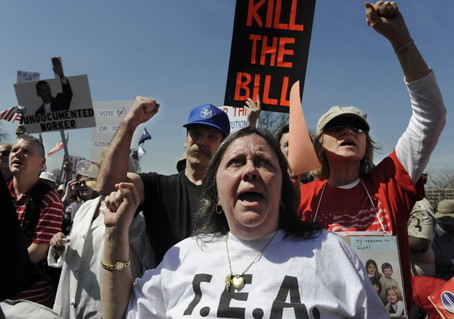
When do you cross the line?
In the Wyoming state legislature, 10 congressmen and three senators have co-sponsored “The Health Care Choice and Protection Act.” The intent? To make it a felony to implement the health-care reform law — which is, you’ll remember, the official law of the land. Here’s the relevant bit:
Enforcement of federal laws prohibited; offenses and penalties.
Any official, agent, employee or public servant of the state of Wyoming as defined in W.S. 6-5-101, who enforces or attempts to enforce an act, order, law, statute, rule or regulation of the government of the United States in violation of this article shall be guilty of a felony punishable by a fine of not more than five thousand dollars ($5,000.00), imprisonment in the county jail for not more than two (2) years, or both.
Any official, agent or employee of the United States government or any employee of a corporation providing services to the United States government that enforces or attempts to enforce an act, order, law, statute, rule or regulation of the government of the United States in violation of this article shall be guilty of a felony punishable by imprisonment for not more than five (5) years, a fine of not more than five thousand dollars ($5,000.00), or both.
There’s not much use in worrying about something like this as it wouldn’t survive two seconds in a court of law. But the sentiments are worth considering: The argument is that this legislation isn’t just policy that the authors disagree with, but rather a deeply, profoundly, un-American threat to liberty. It’s so un-American, in fact, that a plain reading of the Constitution makes clear that the Wyoming legislature, which has sworn to protect and defend the document, must “adopt and enact any and all measures as may be necessary within the borders of Wyoming to prevent the enforcement of the Patient Protection and Affordable Care Act and the Health Care and Education Reconciliation Act of 2010.”
Many of my friends on the right have legitimate technocratic differences with the Affordable Care Act. But many of the politicians they’ve stood with have not made a legitimate case against the bill. Rather, they’ve taken a bill that echoes past legislation Republicans have introduced and called it, as Sen. Jon Kyl did, “a stunning threat to liberty.” They’ve told their supporters, as Sen, Chuck Grassley did, that they’re right to fear that the health-care bill “determines if you’re going to pull the plug on grandma.” This is not merely legislation that they have some technical or philosophical disagreements with. It is, in the words of Speaker John Boehner, “a monstrosity.”
Given the extremism of the rhetoric at the top, is it any wonder that there is incredible fear trickling down to the grass roots? If those are the stakes, then of course criminalizing any implementation of the bill makes sense. Frankly, if those are the stakes, then violent resistance might be required.
Those aren’t the stakes, of course. They’re just the words. And words slip sometimes. Things come out too angry, or too quickly, or too sharply. I’ve had my share of experience with this. But words matter. And the Republican Party hasn’t been slipping up: It’s been engaged in a concerted campaign to scare the population into opposing health-care reform. That may be good politics, but it can have bad consequences.
By: Ezra Klein-Washington Post-January 7, 2011: Photo By: Melina Mara-Washington Post
Share This Blog


 Unknown Feed
- An error has occurred; the feed is probably down. Try again later.


You must be logged in to post a comment.