Iowa And Beyond: “Common Sense” Racism And The Tea Party GOP
The 2012 Republican presidential field, a hydra which self-destructively feeds on itself, had one more battle royale in Iowa. Fighting to a standstill, Romney, Gingrich, Santorum, and Paul bloodied each other. While the Tea Party GOP is still a house divided, their leading candidates share a common, uniting, go to issue: hating on the blacks makes for good politics; it pays substantial political dividends.
As Iowa demonstrated, be it Gingrich’s yearning to have lazy black and brown kids pick up mops and brooms as janitors in work houses, Romney’s nativist Klan inspired opines to keep “America America,” Santorum’s appeals to a belief that African Americans find sustenance by stealing from hardworking white people, or Ron Paul’s assertion that the Civil Rights Act (with its bringing down of Jim and Jane Crow) was an unfair intrusion on white people’s “liberty” and “freedom,” the Tea Party GOP remains addicted to the crack rock of dog whistle politics.
Decades after the founding of the Southern Strategy in the 1960s, the old school remains the true school. Ultimately for conservatives, demagoguing the negroes can still help stir up support among the white populist faithful.
Precision matters here. Research on public opinion and political behavior has demonstrated that not all conservatives are racist. However, racists are much more likely to be conservative–and to identify as Republicans.
Social scientists, historians, psychologists and others have developed an extensive vocabulary to talk about the lived politics of the color line. These terms include such notable phrases as symbolic racism, white racial resentment, the white racial frame, in-group and out-group anxiety, ethnocentrism, prejudice, realistic group conflict, colorblind racism, systems of structured inequality, racial formation, and front stage vs. backstage racism.
In thinking through the politics of race at work in the white conservative political imagination, this seemingly disparate terminology is connected by a common thread. Race and racial ideologies are ways of seeing the world, of locating people and individuals relative to one another, and are a cognitive map for making sense of social relationships. While shocking to outsiders, the type of racism played with so casually by Gingrich, Romney, Santorum, Paul and other conservatives is a type of “common sense” for their public.
For example, the audiences that cheer Romney’s speeches about a country that is lost, one led by an anti-American usurper, are not necessarily “bad people.” They are motivated by a sense of belonging, and made to feel special by virtue of being “real Americans,” part of a special tribe anointed with unique insight and wisdom by their oracles.
Likewise, those who embrace Gingrich’s habit of stereotyping “inner city blacks” as lazy, unmotivated, and criminal, probably identify as “compassionate conservatives,” or “good Christians.” There is no intended malice on their part. To them, “everyone knows” that these observations about black and brown people are “true.”
Rick Santorum’s Iowa speech on the nature of black people’s greed and degeneracy is an especially instructive example of this broader pattern:
“It just keeps expanding – I was in Indianola a few months ago and I was talking to someone who works in the department of public welfare here, and she told me that the state of Iowa is going to get fined if they don’t sign up more people under the Medicaid program,” Santorum said. “They’re just pushing harder and harder to get more and more of you dependent upon them so they can get your vote. That’s what the bottom line is.”He added: “I don’t want to make black people’s lives better by giving them somebody else’s money; I want to give them the opportunity to go out and earn the money.” “And provide for themselves and their families,” Santorum added, to applause. “The best way to do that is to get the manufacturing sector of the economy rolling again.”
“Right,” responded one audience member, as another woman can be seen nodding.
There are several elements at work here.
First, poverty in America is racialized. The image in the public imagination is of black welfare queens, or illegal aliens birthing “anchor babies” who live off of the government tit, profiting from food stamps and the generosity of the American people. The white poor rarely, if ever, enter the picture. Second, black people are in a parasitic relationship with white Americans (Santorum’s “someone” else). In sum, black people are “lazy,” and a dependent class, unable to take care of their families except for the generosity and benevolence of white people.
The most powerful part of Santorum’s appeal to his white audience in Iowa is the implication that black people are receiving some type of “reparations.” For Santorum and the Tea Party GOP, blacks are plagued by “bad culture” and are existentially prone to poverty. Therefore, in a country where labor, capitalism, and citizenship are inexorably connected, blacks are outside of the political community.
In the age of Fox News and the Right-wing echo chamber, one cannot forget how the conservative imagination is constituted as a dream world: it is a mature fulfillment of some of the most sophisticated propaganda in the post World War 2 period.
In this imagination, it does not matter that whites are the majority of America’s poor.
It does not matter that most people on public assistance and welfare in Iowa are white.
It does not matter that there is a deep history which explains how conservatives have spun a fiction about black and brown poverty while ignoring structural economic inequality, and how many of the policies endorsed by the Tea Party GOP in the name of economic austerity and punishing people of color (who are coded as “the poor” or “unproductive citizens”), also disproportionately harm the white working and middle classes.
This local type of common sense helps to explain the feelings of defense, denial, and injury that many white conservatives exhibit when challenged about the racism of the Tea Party GOP and the Right-wing establishment. While the leadership and media elites from which they take their cues skillfully play the race baiting game, rank and file Fox News conservatives simply feel aggrieved at the suggestion that anyone would take their common sense understandings of the world to be racist, bigoted, or based on false understandings about the nature of racism and white privilege in the Age of Obama.
In the same way that a fish does not know that it is wet, the politics of nativism, an authoritarian-like embrace of the politics of us and them, and a fear of the Other, are so central to contemporary white populist conservatism, that they are taken-for-granted assumptions about the nature of the world.
Moreover, politics is essentially about the creation of an imagined community. The stump speeches about evil liberals who hate America, the cheering of dying cancer patients who lack insurance, the booing of gay soldiers, and the numerous fictions about the economy, science, the Constitution, and public policy more generally are taken as divine gospel. These fictions are standing priors for contemporary conservatives which help to mark out the boundaries of their political world.
During an election year, and as a function of a highly polarized 24 hour news environment, it is a given that the incumbent president will be the target of vicious attacks by the out party. By implication, the election of Barack Obama, America’s first black president, has amplified all of these tensions. The election of a member of the racial out-group has made the stakes especially high for white conservatism. Obama is anathema to the Tea Party GOP soul, the living embodiment of a world turned upside down, for no man who looks like him could ever be leader of the free world, where whiteness is inseparable from being “American.”
By implication, there is a short line from the white racial appeals of Gingrich, Santorum, Paul, Romney and others directly to President Obama. He has been called “the food stamp president” and a “ghetto crackhead.” Obama is stained by the Birthers who say he is not an American citizen. The appeals to American exceptionalism are naked arguments that a black man like Obama cannot help but be outside of the “normal” political culture of this country. It has also been implied that President Obama is a perpetual “they,” a member of a marginalized group who by association is lazy, anti-white, unqualified, and an “affirmative action baby” that somehow managed to steal a presidential election and win the popular vote.
Many may laugh at such a formulation. However, the Tea Party GOP, Iowa voters, and others who clamor to participate in the Republican primaries, would take such claims as common sense knowledge. For people of color, the outsider, the Other, and those who are not (in their eyes) “quintessentially American” (and thus have to prove their authenticity to the white conservative gaze), this is not your country.
You people may have built and improved this country, but it is not yours. For the Tea Party GOP and the populist conservatism of the present moment, you people are just guests. They will remind you people of that fact at every moment.
Why? Because it is common sense. Didn’t you know that?
By: Chauncey DeVega, Open Salon Blog, January 4, 2012
GOP Nightmare: Obama Fixes The Economy
President Obama’s bold decision to ignore GOP obstructionism and make recess appointments at the Consumer Financial Protection Bureau and the National Labor Relations Board started off 2012 with a bang, inspiring long-deferred jubilation among liberals and paroxysms of outrage from conservatives. There’s an enormous irony here: After three ridiculous years in which conservatives unfairly and absurdly attacked Obama for impersonating a socialist tyrant, the president is suddenly acting like an actual leader — and now the right is really freaking out.
Here’s the nightmare scenario: What if Obama runs totally wild and uses his executive powers to fix the economy? He might, gasp, win reelection!
Sounds crazy, I know. But that’s exactly the sense of panic that emerges from American Enterprise Institute blogger James Pethokoukis’ excited-to-the-point-of-stark-terror post “January Surprise: Is Obama preparing a trillion-dollar, mass refinancing of mortgages?”
Citing speculation from Jaret Seiberg, an analyst at Guggenheim Securities, Pethokoukis paints a picture in which Obama recess appoints a replacement for the current acting director of the Federal Housing Finance Agency (FHFA), Bush appointee Edward DeMarco. DeMarco’s job is to oversee the giant mortgage finance agencies Fannie Mae and Freddie Mac. DeMarco has long made it clear that he believes his primary job is to improve the financial bottom line of Freddie and Fannie, rather than employ the huge power the two government-sponsored enterprises (GSEs) exert over the residential mortgage market to make it easier for homeowners to refinance their mortgages and escape the threat of foreclosure. With DeMarco out of the way, so the theory goes, the Obama administration would have a free hand to push through a much more aggressive plan to help struggling homeowners.
Seiberg:
That could lead to a mass refinancing program for agency-backed mortgages that would go well beyond the existing HARP program. That could hurt agency [mortgage-backed security] pricing and result in higher financing costs going forward. Yet it also could be a big boost for the economy and housing going into the election.
Pethokoukis:
…[S]ome $3.7 trillion of mortgages would be refinanced. That’s right, this would be the Mother of All Mortgage Refinancing Plans. It would help roughly 30 million borrowers save $75 billion to $80 billion a year. As Mayer puts it: “This plan would function like a long-lasting tax cut for these 25 or 30 million American families.” … Talk about a political and economic game changer in this presidential election year. Obama could offer a trillion-dollar stimulus — as measured over a decade — that would directly and immediately impact tens of millions of Americans suffering from the housing depression. Cash in their pockets. Imagine the electoral impact on key states, such as Florida, suffering from both high unemployment and devastated housing markets.
If only. As a Federal Reserve white paper analyzing problems in the housing sector and reviewing potential solutions noted on Wednesday, 12 million U.S. homeowners are currently underwater on their mortgages. The steady flood of newly foreclosed properties hitting the market — expected to be a million per year in both 2012 and 2013 — exerts a relentless downward pressure on home prices. There are few things the Obama administration could do that would have a bigger positive effect on the overall economy than a really large-scale program of homeowner relief.
So how realistic is the January surprise scenario? As with all good conspiracy theories, there are some grains of truth. DeMarco has definitely been obstructing the Obama administration’s efforts at housing reform. Even the usually mild-mannered Federal Reserve hints at this reality in its white paper. Sure, there would be a cost to a large-scale refinancing program, but the benefits might well outweigh the downside:
“Nonetheless, some actions that cause greater losses to be sustained by the GSEs in the near term might be in the interest of taxpayers to pursue if those actions result in a quicker and more vigorous economic recovery.
Protecting Fannie and Freddie’s balance sheet at the expense of the nation’s is penny-wise and pound-foolish, in other words. Why go to all the trouble and expense of bailing out the GSEs if not to use them to good effect?
However, that still doesn’t quite connect the dots between the appointment of Richard Cordray to run the CFPB and a possible recess appointment that would replace Edward DeMarco. First of all, the Obama administration’s efforts to reboot housing have been, at best, halfhearted, and their failure more properly should be blamed on the White House than a single agency administrator. (And late Thursday afternoon, Bloomberg News reported that the White House was denying it had any new refinancing plan in the works.) Secondly, the legal basis for shoving out DeMarco and replacing him with a recess appointment seems especially iffy. Cordray is considered an independent regulator — so, theoretically, he can’t simply be fired at will by the White House, (although his “acting” status does inject some fuzziness into the equation). According to reporting by Ezra Klein and Brad Plumer, Treasury Secretary Timothy Geithner explored the possibility of firing DeMarco, but ultimately found it unfeasible. Republicans are already threatening to sue the administration for the current batch of recess appointments; axing the existing director for the FHFA in pursuit of an election-year housing reform agenda could easily precipitate a constitutional crisis.
But then again, Republicans would only have themselves to blame for the chaos that would ensue if Obama did take the unlikely step of all-out war. In 2010, the Obama administration proposed North Carolina banking commissioner Joseph Smith as its nominee for FHFA director. But as with so many of Obama’s economic-policy-related nominations, Smith’s appointment by the Senate Finance Committee’s ranking Republican, Richard Shelby, was scuttled on the grounds that Smith was unlikely to resist Obama’s housing reform agenda.
So there is after all a direct connection between the Cordray recess appointment and the FHFA. Senate Republicans have routinely blocked Obama’s executive branch appointments, not because they have any particular problem with the quality of the people being proposed for the jobs, but because they want to block Obama’s reform agenda. It’s a travesty of government — and a made-to-order campaign platform. Want to know why the economy sucks? Because Republicans won’t let Obama appoint the people necessary to take direct action — whether that be at the Federal Reserve, or the FHFA, or anywhere else.
By: Andrew Leonard, Salon, January 5, 2012
A Misguided Appeal For A “Closeted Moderate” Mitt
Nicholas Kristof presents an argument today that I’ve heard before, but which I struggle to understand. As the NYT columnist sees it, Mitt Romney was a “moderate and pragmatic governor,” who, his metamorphoses notwithstanding, may flip “back to his old self” in 2013.
The reassuring thing about Mitt Romney is that for most of his life he probably wouldn’t have voted for today’s Mitt Romney. […]
If we do see, as I expect we will, a reversion in the direction of the Massachusetts Romney, that’s a flip we should celebrate. Until the Republican primaries sucked him into its vortex, he was a pragmatist and policy wonk rather similar to Bill Clinton and President Obama but more conservative. (Clinton described Romney to me as having done “a very good job” in Massachusetts.) Romney was much closer to George H.W. Bush than to George W. Bush.
Kristof says we should “expect” this current version of Romney to revert back to a previous version. I think this is wildly misguided.
The premise here is that the Romney we see running for president is a ridiculous phony. Sure, he’s saying reckless right-wing things, he’s making irresponsible right-wing promises, and he’s completely rejected any sensible positions he once held, but it’s just an act to get elected. Voters should simply pay no attention to what Romney is saying, doing, proposing, and promising, since none this is sincere anyway.
This isn’t a criticism levied by Romney’s detractors; this is a defense offered by Romney’s tacit supporters.
It’s also incoherent.
To accept the premise of the argument, a voter would have to believe that every word out of Romney’s mouth for the last five years — about his policy agenda, worldview, and priorities — has been a deliberate scam. As part of an elaborate scheme to mislead the American public, Romney has chosen to become a closeted moderate. The lie will end and the centrist will reemerge just as soon as the electorate has put the presidency in his hands.
What those making this argument are actually proposing is an incredible gamble with the nation’s future. Sure, Romney says he’ll take a far-right approach to everything from the economy to entitlements, foreign policy to the judiciary, but perhaps we’re witnessing a half-decade-long ruse and everything will turn out fine.
That’s quite a risk with so much on the line.
Let me give Jonathan Bernstein’s piece in the new print issue another plug. The point of the article is important: what candidates say they’ll do is generally what they will do if elected.
Someone might want to send a copy to Nicholas Kristof.
By: Steve Benen, Contributing Writer, Washington Monthly Political Animal, January 5, 2012
Did Santorum Win Iowa?: Caucus Vote Counter Says Typo Gave Mitt Romney 20 Extra Votes
An Iowa GOP caucus voter who helped count the votes at his small caucus meeting in Moulton, Iowa claims that former Gov. Mitt Romney (R-MA) accidentally received 20 extra votes than he earned — a claim which, if true, would change the winner of the unusually close caucus to former Sen. Rick Santorum (R-PA):
Edward True, 28, of Moulton, said he helped count the votes and jotted the results down on a piece of paper to post to his Facebook page. He said when he checked to make sure the Republican Party of Iowa got the count right, he said he was shocked to find they hadn’t.
“When Mitt Romney won Iowa by eight votes and I’ve got a 20-vote discrepancy here, that right there says Rick Santorum won Iowa,” True said. “Not Mitt Romney.”
True said at his 53-person caucus at the Garrett Memorial Library, Romney received two votes. According to the Iowa Republican Party’s website, True’s precinct cast 22 votes for Romney.
Des Moines TV station KCCI 8 captured an image of Moulton’s handwritten vote count:
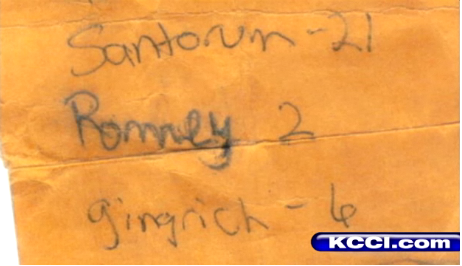
Minor counting errors such as this one are extremely common on election day, so it is perfectly plausible that Moulton is correct and Romney did receive 20 unearned votes. It is equally plausible, however, that these lost votes could be canceled out by a similar error at another caucus site. The tentative results, which showed Romney with the barest 8 vote lead, have not yet been certified.
Nevertheless, the Iowa GOP does not seem happy that True is questioning the early result. According to KCCI, a spokesperson for the Iowa GOP said that “True is not a precinct captain and he’s not a county chairperson so he has no business talking about election results.”
By: Ian Millhiser, Think Progress, January 5, 2011
Share This Blog


 Unknown Feed
- An error has occurred; the feed is probably down. Try again later.


You must be logged in to post a comment.