“Extreme Positions”: The GOP Again Goes For The 1%
Fighting contraception. Stopping domestic violence protections. Extending tax cuts for the wealthy, while hiking taxes on the middle class. Welcoming white supremacists to a conference, but banning gay conservatives. The GOP has followed its extremist fringe off the deep end, leaving the rest of us back in the reality-based world, and befuddled. Their strategists warned them not to do this, but it appears that to the GOP, unhinged fringe issues are like catnip.
It wasn’t a surprise to see Republican luminaries, including Mitt Romney, Rick Santorum, Newt Gingrich and Mitch McConnell flock to major conservative conference last week that also included a panel session featuring a white supremacist. But it was ironic that this same event, the Conservative Political Action Conference, banned a group of gay conservatives from participating, accusing them of alienating so-called “family values” groups like the Family Research Council (FRC).
The banned group, GOProud, is hardly radical, even by right-wing standards — it split from the Log Cabin Republicans because it thought the older group was too concerned with gay rights. Beyond pushing the much feared “The Gay Agenda,” now just being gay excludes you from the biggest conservative conference of the year. Being a white supremacist gets you on a panel.
This year, CPAC banned the gays to gain back the FRC — and white supremacists came as a bonus. The leaders of the GOP — including a few aspiring leaders of the free world — came along for the ride.
But CPAC was just the beginning of what has been a surreal week for a major political party. On Friday, President Obama announced a compromise with Catholic leaders who objected to religious institutions being included in the contraception coverage mandate for employee insurance. The compromise, which spared Catholic institutions from providing contraception coverage while ensuring that female employees would still have access to it, was not enough for the Catholic bishops and GOP leaders. Instead, they announced that they wanted a rule that would allow any employer to renounce any insurance coverage for any procedure they find morally objectionable.
Anyone who has ever had health insurance knows that that’s an extreme position — allowing employers to pick and choose what procedures they’ll provide insurance for? — but it’s one that Mitt Romney, Rick Santorum, Newt Gingrich and the leaders of the House and Senate GOP jumped right on.
And attacking contraception is just the beginning. Republicans in the Senate are blocking a reauthorization of the Violence Against Women Act because it includes protections for LGBT people and undocumented immigrants. The Virginia House just passed a bill that would require women seeking abortions to undergo an invasive trans-vaginal ultrasound without their consent, and another that would put access to birth control at risk. The latter, a so-called “personhood” bill, is so extreme a similar measure was rejected by Mississippi voters by double digits last year — yes, that Mississippi. Virginia Gov. Bob McDonnell, who is widely considered to be a top candidate for the GOP vice presidential nomination, has said he will sign the forced ultrasound bill and may sign the “personhood” measure.
Finally, on another issue important to millions of American families — middle class tax cuts — the GOP gave in and joined the rest of us in reality. While Republicans had been making rumblings about repeating their disastrous stunt in December where they threatened to raise payroll taxes on working Americans because the cost would be offset by a miniscule tax on the very rich, they ultimately gave in — while leaving lower-profile but equally important issues of extending unemployment benefits and fixing Medicare payments for doctors in the lurch.
Where is the mainstream of the GOP? And why aren’t they speaking up? 99 percent of American women who have ever been sexually active have used birth control. 59 percent of Americans think all employers should have to provide comprehensive health insurance to their employees — including to women. Sixty-six percent think the wealthiest should pay a bit more to help all Americans get by in a bad economy. As of last year, 56 percent said gay and lesbian relationships are “morally acceptable” — and although I haven’t seen polling, I’d bet that the “morally acceptable” number for white supremacists is significantly lower.
Polls are polls and politicians shouldn’t govern by them, but shouldn’t they notice when they’re falling off the deep end? The GOP, in pursuing the agenda of the most extreme factions of its base, has left moderates within its own party and American common sense behind. This isn’t just bad for them politically — in the long run, it’s bad for the country. There are plenty of serious issues that demand our attention — jobs, housing, the energy crisis, crumbling infrastructure. But instead of tackling these, the GOP seems determined to fixate on a parade of dangerous nonsense.
By: Michael B, Keegan, the Huffington Post, February 16, 2012
“Rmoney”: Mitt Is The Lobbyists’ Candidate
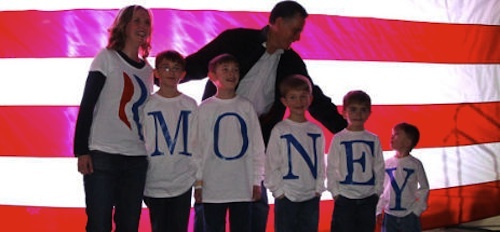
When you think of Mitt Romney, you probably think of a tall, robotic fellow with no discernible strong beliefs or stances (at least, none that can survive longer than a week at a time). That’s terribly unfair, and you should be ashamed for thinking it. He may have started out as an empty husk devoid of strong personal beliefs, but thanks to a crack team of industry insiders, he now is quite filled with opinions. Coincidentally, they happen to be the opinions of an army of top lobbyists in Washington, and the companies they lobby for. Funny how that works.
[Mitt Romney’s] kitchen cabinet includes some of the most prominent Republican lobbyists in Washington, including Charles R. Black Jr., the chairman of Prime Policy Group and a lobbyist for Walmart and AT&T; Wayne L. Berman, who is chairman of Ogilvy Government Relations and represents Pfizer, the drug manufacturer; and Vin Weber, the managing partner for Clark & Weinstock. […]Other lobbyists serve on one of Mr. Romney’s policy advisory teams, have hosted fund-raisers for his campaign or have joined the many influential Republicans whose endorsements Mr. Romney’s campaign has hailed.
Want to know what Mitt Romney’s true policies are? Well, you should have attended Mitt Romney’s $10,000-and-up policy round table, where industry lobbyists led “discussions” on what his policies towards those industries should be:
Mr. Romney’s campaign held an elaborate “policy round table” fund-raiser at a Washington hotel, featuring panel discussions run by lobbyists and former cabinet officials or members of Congress.James Talent, a former senator who runs the lobbying and public affairs firm Mercury Public Affairs, led a panel on infrastructure, according to an invitation. William Hansen, a former deputy secretary of education who is president of the lobbying firm Chartwell Education Group, led the education panel.
Wow. I can’t imagine why anyone would be cynical about American politics these days, can you?
The entertaining thing about this story is just how many large companies are represented. Among those specifically mentioned (and kudos to the three reporters for linking the lobbyists with actual clients, which is rather important information for readers) are Walmart, AT&T, Pfizer (drugs), Microsoft, Altria (tobacco), General Dynamics, Dominion (power), Barclays (finance), Allegheny (steel) and Peabody Energy (coal). Lobbyists are cutting the checks; lobbyists are bundling other people’s checks; lobbyists are holding the panel discussions about how the candidate can best serve the specific industries they represent; lobbyists make up the inner circle of “policy makers,” advising the candidate as to what his own core positions should be.
As for the candidate himself, he’s almost irrelevant at this point. You might as well nominate a bunny named Mr. Buttons: If you surround it with the exact same lobbyist-advisors, you’ll end up with the exact same policies. Sigh, if only we could teach that bunny to hold a pen—but for now we’ll have to settle for our current crop of Republican candidates, all of whom have near-identical policy prescriptions, all of which favor the exact same subset of people and the exact same handful of industries. Go figure.
I’ve given up on the notion that we can keep lobbyists from capturing our politics. I’ve also given up on the notion that we can prevent interests like the oil sector or our current handful of top financial companies from tailoring the American government specifically to serve their needs. Want more profits? Want less environmental protections? Want to crush some emerging industry that threatens to make yours less profitable? Just buy a few congressman, or a senator, or a president. At a few million here and there, it’s cheaper than advertising, and the results are far more secure.
So I’m in the Bill Maher camp on this one. Lobbyists and industries want to buy our politicians? Fine, I give up, let them. Just pass a law saying the candidate has to wear those corporate logos on their jackets whenever they appear on the campaign trail or when they are in office. The more money is contributed, the bigger the logo has to be. Top presidential candidates will look like military dictators-in-training, with badges and medals and ribbons sticking out from them in every direction, and just from looking at them we’ll be able to tell who they serve, and in what proportions. That would certainly be more educational than any rhetoric coming from the candidates themselves.
By: Hunter, Daily Kos, February 15, 2012
“Drug-Addled Wrong”: Mitt Romney Condemns The Auto-Industry Rescue
Looking back over the last three years, there’s arguably no better example of a policy Republicans got wrong than the rescue of the American auto industry.
When President Obama launched his ambitious policy in 2009, he was taking a major gamble — not only with the backbone of American manufacturing, but with his presidency and its ability to use the power of government to repair a private industry facing collapse. As First Read noted at the time, “As the GM bailout goes, so goes the Obama presidency.”
We now know the gamble paid off. Chrysler has posted its first profit in 15 years; GM is building new American facilities; and plants are operating at a capacity unseen in a long while. General Motors went from the brink of total failure to reclaiming its spot as the world’s top automaker, and as the Wall Street Journal reported earlier this month, “The auto industry hasn’t just turned the corner. It’s starting to accelerate.”
Had it not been for the Obama administration’s policy, these heartening headlines would have been impossible. And yet, Mitt Romney still isn’t happy.
In a new Detroit News op-ed, the former Massachusetts governor says he’s glad the industry still exists, but proceeds to complain anyway about the way in which Obama rescued GM and Chrysler from an imminent collapse.
Three years ago, in the midst of an economic crisis, a newly elected President Barack Obama stepped in with a bailout for the auto industry. The indisputable good news is that Chrysler and General Motors are still in business. The equally indisputable bad news is that all the defects in President Obama’s management of the American economy are evident in what he did.
Instead of doing the right thing and standing up to union bosses, Obama rewarded them…. By the spring of 2009, instead of the free market doing what it does best, we got a major taste of crony capitalism, Obama-style.
It takes a fair amount of chutzpah to face a crisis, get it wrong, then whine about the way in which the other guy got it right.
This is a subject Romney would be better off ignoring. After all, in 2009, he famously urged policymakers to “let Detroit go bankrupt.” Romney was so certain Obama’s policy would fail, he said Americans could “kiss the American automotive industry goodbye” if Obama’s policy moved forward in 2009. Indeed, at the time, Romney called the administration’s plan “tragic” and “a very sad circumstance for this country.” He wrote an April 2009 piece in which he said Obama’s plan “would make GM the living dead.”
With the benefit of hindsight, we now know all of Romney’s warnings were wrong. For him to double down today on the virtues of letting Detroit go bankrupt is just bizarre.
I’m reminded of this clip, which Democrats gleefully put together last summer.
Of particular interest is the last quote in the clip, in which a Chrysler executive responded to a Romney quote by saying, “Whoever told you that is smoking illegal material. That market had become absolutely dysfunctional in 2008 and 2009. There were attempts made by a variety of people to find strategic alliances with other car makers on a global scale and the government stepped in, as the actor of last resort. It had to do it because the consequences would have been just too large to deal with.”
In other words, Romney wasn’t just wrong; he was drug-addled wrong.
To be sure, the former governor wasn’t the only Obama critic whose predictions now look foolish, but Romney is the one who still likes to pretend he was right.
Even the complaints themselves are strange. As Marcy Wheeler explained, Romney’s “basically complaining that the bailout preserved the healthcare a bunch of 55+ year old blue collar workers were promised. He’s pissed they got to keep their healthcare. He’s also complaining that banks took a haircut.”
I haven’t talked to the White House about this, but I suspect if 2012 comes down to a debate over who was right about the auto-industry rescue, Obama likes his chances.
By: Steve Benen, The Maddow Blog, February 14, 2012
“A Detroiter In His Own Mind”: Mitt Romney And The Automobile Industry
One of Mitt Romney’s problems is that he lays it on too thick. He’s not just a conservative, he’s a “severe conservative”. He feels your pain because he too is “unemployed”. And he understands America’s car industry because he’s a Tigers-cheering motorhead, a true “son of Detroit”.
That last assertion comes in an op-ed Mr Romney wrote for the Detroit News today. And it’s not untrue, per se. The candidate was born in Detroit, though he grew up in Bloomfield Hills, one of America’s wealthiest cities. He probably cheered for the Tigers as a kid, but his position has since evolved. And cars may really be “in my bones”, as he claims, but he advocated letting Detroit go bankrupt in 2008.
The purpose of Mr Romney’s op-ed is to clarify his position on the auto bail-out ahead of Michigan’s primary on February 28th. And the piece rivals Cirque du Soleil in its display of contortions. Mr Romney seems loth to gush about the success of the bail-out, noting only the good news that “Chrysler and General Motors are still in business”. He certainly doesn’t mention that 2011 was the best year for America’s carmakers since the financial crisis, with each of the big three turning a solid profit. But he does imply that this achievement is a result of his own advice. “The course I recommended was eventually followed”, Mr Romney writes.
As with much of Mr Romney’s excessive rhetoric, there is some truth to this statement. Following the bail-outs, the president eventually forced Chrysler and GM into bankruptcy, a step Mr Romney thought should occur naturally. And the government oversaw painful restructurings at both companies, which were largely in line with Mr Romney’s broad suggestions. But the course Mr Romney recommended in 2008 began with the government stepping back, and it is unlikely things would’ve turned out so well had this happened.
Free-marketeers that we are, The Economist agreed with Mr Romney at the time. But we later apologised for that position. “Had the government not stepped in, GM might have restructured under normal bankruptcy procedures, without putting public money at risk”, we said. But “given the panic that gripped private purse-strings…it is more likely that GM would have been liquidated, sending a cascade of destruction through the supply chain on which its rivals, too, depended.” Even Ford, which avoided bankruptcy, feared the industry would collapse if GM went down. At the time that seemed like a real possibility. The credit markets were bone-dry, making the privately financed bankruptcy that Mr Romney favoured improbable. He conveniently ignores this bit of history in claiming to have been right all along.
In other areas of his op-ed Mr Romney is more accurate. Unions did win some special favours in the bail-out deals, though they are not as egregious as the candidate claims. For example, a health fund for retired workers was unfairly favoured over secured bondholders at Chrysler. But an issue like that is unlikely to resonate in Detroit. So Mr Romney must find a way to re-write history, lest he fall further behind Rick Santorum in his state of birth. Mr Santorum didn’t support the auto bail-out either, but he evinces a genuine compassion for blue-collar workers. And he didn’t pen an op-ed predicting, “If General Motors, Ford and Chrysler get the bailout that their chief executives asked for yesterday, you can kiss the American automotive industry goodbye.” That’s a difficult statement to walk back.
By: The Economist, Democracy in America, February 14, 2012
“The Pharisees”: Bishops Go Off The Deep End
Just as I was publishing my post about Catholic tribalism on Friday, predicting that the brilliant White House “accommodation” on contraception wouldn’t mollify the U.S. Conference of Bishops, the bishops released a statement that made them seem, well, mollified, at least a little. The new Health and Human Services regulations were “a step in the right direction,” their statement read, and so I softened an assertion that the bishops would continue to wage war against the compromise.
I needn’t have soft-pedaled. Only a few hours later the bishops came out, guns blazing, insisting the only solution they would accept would be for “HHS to rescind the mandate for those objectionable services.” By any employer, for any employee in the entire country — a country where the vast majority of voters, and of Catholics, support Obama’s stand. And at Sunday Mass, bishops and parish priests throughout the nation read aloud the stunningly political letters about the controversy they already had planned. Now, with the bishops’ blessing, Republican are hard at work on legislation that would force HHS to strip the contraceptive coverage requirement for all employers, not just religious employers. Sen. Roy Blunt would allow employers to decline to cover any service they deem objectionable; Sen. Marco Rubio would restrict the legislation to contraception coverage.
I have a couple of reactions to the bishops’ extremism. First of all, as someone raised Catholic, I wonder why they’ve never read letters about any of their social justice priorities: universal healthcare, increased protection for the poor, labor rights, or action to curb climate change? Why does this topic – not even the morally challenging issue of abortion, but the universally accepted practice of birth control – merit such a thundering reaction from the pulpit?
Second, as an American, I also wonder: How do they continue to demand tax-exempt status when they’re railing in their churches about blatantly political – and divisively partisan – public concerns? As the first writer on my remarkably sane Catholic tribalism letters thread remarked, their public support for the extremist GOP position makes me think they should register as a Republican political action committee rather than remain a tax-exempt religious institution outside the bounds of politics.
Even as the bishops became more shrill and extreme, the debate over contraception coverage became smarter and calmer last week. Major Catholic organizations supported Obama’s Friday move, including the Catholic Health Association, Association of Jesuit Colleges and Universities and Catholic Charities USA. Before the president’s announcement, famed attorney David Boies did the most to usher in the new tone by framing the HHS rules as a matter of labor law. Boies doesn’t believe, by the way, that HHS is in any way required to provide the exemption for churches it wrote into its regulations even before the compromise. If the church is employing people, whether co-religionists or not, it has a responsibility to comply with employment law. He proved that even the administration’s initial regulations, exempting churches, was a strong attempt at accommodating anti-contraceptive religious groups.
But maybe the best argument on behalf of the Obama administration’s position comes from a very unlikely source, as Jay Bookman points out: Supreme Court Justice Antonin Scalia. In two different decisions, the conservative Catholic Scalia has sided with the court majority in finding that religious teachings can’t justify religious employers – or employees — failing to comply with labor law. In the 1990 Employment Division v. Smith decision, regarding an employer’s ability to fire a Native American employee who used peyote, despite the employee’s claim that using the drug was a religious rite, Scalia wrote:
“We have never held that an individual’s religious beliefs excuse him from compliance with an otherwise valid law prohibiting conduct that the State is free to regulate. On the contrary, the record of more than a century of our free exercise jurisprudence contradicts that proposition.” In an even more directly relevant 1982 decision holding that Amish employers must comply with Social Security and withholding taxes, though their faith bars participation in government support programs, Scalia wrote:
Respondents urge us to hold, quite simply, that when otherwise prohibitable conduct is accompanied by religious convictions, not only the convictions but the conduct itself must be free from governmental regulation. We have never held that, and decline to do so now.
I’ve written repeatedly that my inability to quit the Catholic Church entirely comes from the fact that its social teachings formed my social conscience, and to this day some of the people doing the most good for the poor and the excluded are devout Catholics. But the bishops are impossible to defend. Today, they are working on behalf of the Republican Party. “They have become the Pharisees,” says Andrew Sullivan, a conservative practicing Catholic. “And we need Jesus.”
By: Joan Walsh, Editor at Large, Salon, February 13, 2012
Share This Blog


 Unknown Feed
- An error has occurred; the feed is probably down. Try again later.


You must be logged in to post a comment.