Remember when Mitt Romney took an Obama quote out of context and then built his national convention around it? Well, this is worse.
Here’s the campaign’s new attack line: Obama said something that shows how much he loves bureaucracy and doesn’t understand business. “[Obama] wants to create a new ‘secretary of business,’” vice-presidential nominee Paul Ryan said on the stump in Colorado yesterday. “We already have a secretary of business. It’s actually called secretary of commerce. That’s what this agency does. Let me ask you a question: Can anybody name our current secretary of commerce? You know why? We don’t have one! It’s been vacant for over four months.”
“I don’t think adding a new chair in his cabinet will help add millions of jobs on Main Street,” Romney himself added in Virginia later in the day.
Two things: First, we do have a secretary of commerce, or at least an acting secretary. Acting Secretary Rebecca Blank stepped in this summer after former Commerce Secretary John Bryson suffered a seizure while driving in California and resigned. (She’s not Senate-confirmed, but we don’t think that’s what Ryan meant.)
Second, and more to the point, the whole point of Obama’s “secretary of business idea” is to consolidate the Commerce Department with a bunch of other agencies that deal with business to make them more efficient and easier for businesses to interact with. “We should have one secretary of business, instead of nine different departments that are dealing with things like giving loans to SBA or helping companies with exports. There should be a one-stop shop,” Obama told MSNBC Monday. He actually first floated the idea in January, when it was received as a pragmatic, if not particularly inspired, reform idea.
And it’s an idea that you would think Republicans would support. Contrary to Romney’s claim, it actually would not be a new chair in the Cabinet, but merely the renaming of an existing one (though a new plaque would be required on the chair). The idea is to streamline government, cutting costs for taxpayers and making it easier for businesses to deal with government — two things Republicans really like. Instead, they went on the attack.
But wait, there’s more. Romney and Ryan are not only misrepresenting the “secretary of business” idea on the stump. They’re actually running a TV ad based on this dumb lie, which they released yesterday. The ad, titled “Secretary of Business,” claims that Obama’s “solution to everything is to add another bureaucrat.”
There’s really no honest way to read Obama’s comments and think he said he wanted to “add another bureaucrat.” His entire statement was about the need to consolidate bureaucracy, not expand it. Saying otherwise is dishonest, and maybe a bit desperate.
By: Alex Seitz-Wald, Salon, November 2, 2012
November 3, 2012
Posted by raemd95 |
Election 2012 | Mitt Romney, Paul Ryan, Politics, Rebecca Blank, Republicans, U.S. Department of Commerce |
1 Comment
While the president canceled his campaign schedule and flew northward to join the relief effort, Romney struggled for relevance. Presumably with the best intentions, he tried to transform an Ohio rally into a charitable gathering, where his campaign would collect canned food and bottled water for hurricane victims. But then his campaign workers were caught purchasing cases of food and water at a local Walmart, evidently planning to stage fake giving if necessary.
As he played his role in this flummery, Romney repeatedly refused to answer questions from reporters about his vow to dismantle FEMA as a cost-cutting measure. It would be “immoral” to spend money on federal disaster relief, as he told a debate audience in 2011, when the government is running a substantial deficit. And it is true that the budget and tax policies promoted by Romney and his running mate, Paul Ryan, would require such significant cuts in domestic spending as to decimate disaster relief.
Disbanding FEMA and discarding its skilled personnel apparently would be fine with Romney, who said “absolutely” when asked by CNN’s John King whether he would consign disaster relief to the states rather than the federal government. For that matter he would go still further, said the former Massachusetts governor; best of all would be to let the private sector assume FEMA’s responsibilities.
Nobody asked Romney how a privatized FEMA would function, but it is interesting to imagine the private-equity version of disaster management—and how that entity might squeeze profit from tragedy. Under present circumstances, the Romney campaign denies any plan to abolish FEMA, but who really knows?
In this awful moment Christie, Cuomo, Bloomberg — and every other official watching them — must have realized that should cataclysm strike their city or state, they have a reliable partner in President Obama. The Romney Republicans inspire no such confidence.
By: Joe Conason, The National Memo, November 21, 2012
November 2, 2012
Posted by raemd95 |
Election 2012 | Chris Christie, FEMA, Hurricane Sandy, Mario Cuomo, Michael Bloomberg, Mitt Romney, Paul Ryan, Politics, Republicans |
1 Comment
Although some may find it crass to speculate on the political impact of The Storm, I’m going to go ahead and do it, for two reasons. First, I’ve earned the right, and second, because complaints that things are “politicized” are almost always misconceived. Politics is important. It concerns choices that affect all our lives. And campaigns ought to be connected to the actual business of governing, so when an event occurs that implicates our government, it should be talked about. Problems sometimes arise not from the fact that something is politicized, but the way it’s politicized. For instance, when in the 2002 election, Republicans charged that Democrats were on the side of al Qaeda because those Democrats favored a different bill establishing the Department of Homeland Security than the bill Republicans favored, it was despicable not because September 11 had been “politicized,” but because of the manner in which it was politicized.
Anyhow, back to the storm. This morning, an editor at the Prospect suggested to me that if Romney loses, Republicans will say bitterly for some time to come that had it not been for the storm, his momentum would have carried him to victory. I don’t doubt they will say that (although I think that will be what the sober Republicans will say; the others will find voting conspiracies to convince them that he didn’t legitimately win). But the question is, even if they were right, what’s wrong with that?
You can look at this just as a campaign issue—perhaps the fact that Romney is losing a couple of days in which the campaign, and his persuasive arguments, would have been on the front pages instead of storm cleanup, and that might make some tiny difference in the outcome of the race. But there’s a substantive issue here too. Natural disasters offer a visible opportunity for a president to either succeed or fail, and it’s appropriate to judge Barack Obama on how this one is handled. That’s true on the level of his performance at the moment, and when it comes to the personnel and systems he put in place in preparation for this kind of event.
One also can’t help thinking back to what happened seven years ago when Hurricane Katrina hit New Orleans, and there’s nothing wrong with that either. When George W. Bush took office, he gave the FEMA directorship to his campaign manager, Joe Allbaugh, who hadn’t had that kind of experience before. Allbaugh was succeeded by “Heckuva Job” Michael Brown, who came from the nationally vital position of judging commissioner of the International Arabian Horse Association. Point is, I doubt President Bush much cared who was in charge of FEMA, and when Americans needed it, it wasn’t up to the job. When Barack Obama took office, he appointed Craig Fugate, whose last job was running Florida’s emergency management agency. Obama obviously didn’t want to repeat Bush’s mistake, and by all accounts FEMA is working far better than it did during the Bush years.
Republicans may be frustrated by the fact that just before the election, we get an event that reminds people that there are some things we need government for. And it’s more bad luck for them that this particular event will also remind people of what happened seven years ago when they were in charge. But there’s nothing unfair about it. If Mitt Romney has a case to make as to why his small-government philosophy would produce better disaster response than what we’re seeing now, let him go ahead and make it.
By: Paul Waldman, Contributing Editor, The American Prospect, November 11, 2012
November 2, 2012
Posted by raemd95 |
Election 2012 | Barack Obama, Craig Fugate, FEMA, George W. Bush, Hurricane Katrina, Michael Brown, Mitt Romney, Politics, Republicans |
Leave a comment
I decided to support Barack Obama pretty early in the Democratic primary, around spring of 2007. But unlike so many of his supporters, I never experienced a kind of emotional response to his candidacy. I never felt his election would change everything about American politics or government, that it would lead us out of the darkness. Nothing Obama did or said ever made me well up with tears.
Possibly for that same reason, I have never felt even a bit of the crushing sense of disappointment that at various times has enveloped so many Obama voters. I supported Obama because I judged him to have a keen analytical mind, grasping both the possibilities and the limits of activist government, and possessed of excellent communicative talents. I thought he would nudge government policy in an incrementally better direction. I consider his presidency an overwhelming success.
I can understand why somebody who never shared Obama’s goals would vote against his reelection. If you think the tax code already punishes the rich too heavily, that it’s not government’s role to subsidize health insurance for those who can’t obtain it, that the military shouldn’t have to let gays serve openly, and so on, then Obama’s presidency has been a disaster, but you probably didn’t vote for him last time. For anybody who voted for Obama in 2008 and had even the vaguest sense of his platform, the notion that he has fallen short of some plausible performance threshold seems to me unfathomable.
Obama’s résumé of accomplishments is broad and deep, running the gamut from economic to social to foreign policy. The general thrust of his reforms, especially in economic policy, has been a combination of politically radical and ideologically moderate. The combination has confused liberals into thinking of Obamaism as a series of sad half-measures, and conservatives to deem it socialism, but the truth is neither. Obama’s agenda has generally hewed to the consensus of mainstream economists and policy experts. What makes the agenda radical is that, historically, vast realms of policy had been shaped by special interests for their own benefit. Plans to rationalize those things, to write laws that make sense, molder on think-tank shelves for years, even generations. They are often boring. But then Obama, in a frenetic burst of activity, made many of them happen all at once.
Bipartisan panels of economists had long urged Medicare to reform its payment methods to curb perverse incentives by hospitals and doctors to run up costs as high as possible; Obama overcame fierce resistance in Congress in order to craft, as part of Obamacare, a revolution in paying for quality rather than quantity. He eliminated billions of dollars in useless subsidies to banks funneling (at no risk) government loans to college students. By dangling federal public-education grants, Obama unleashed a wave of public-school reform, over the objections of the most recalcitrant elements of the teachers union movement. And he forced Wall Street to accept financial regulations that, while weaker than ideal, were far tougher than anybody considered possible to get through Congress.
It is noteworthy that four of the best decisions that Obama made during his presidency ran against the advice of much of his own administration. Numerous Democrats in Congress and the White House urged him to throw in the towel on health-care reform, but he was one of very few voices in his administration determined to see it through. Many of his own advisers, both economists steeped in free-market models and advisers anxious about a bailout-weary public, argued against his decision to extend credit to, and restructure, the auto industry. On Libya, Obama’s staff presented him with options either to posture ineffectually or do nothing; he alone forced them to draw up an option that would prevent a massacre. And Obama overruled some cautious advisers and decided to kill Osama bin Laden.
The latter three decisions are all highly popular now, but all of them carried the risk of inflicting a mortal political wound, like Bill Clinton’s health-care failure and Jimmy Carter’s attempted raid into Iran. (George W. Bush, presented with a similar option, did not strike bin Laden.) In making these calls, Obama displayed judgment and nerve.
A year ago, I wrote about the pervasive disillusionment felt by Obama’s supporters. It is a sentiment that has shadowed every Democratic president since Franklin Roosevelt, and even Roosevelt provoked long bouts of agony and disillusionment among his supporters. All were seen by many Democrats at the time as failures, weaklings, or unprincipled deal-makers. It’s true that all of them, including Obama, have made terrible errors. What this tells us, though, is that we need some realistic baseline against which to measure them.
Obama can boast a record of accomplishment that bests any president since Roosevelt, and has fewer demerits on his record than any of them, including Roosevelt. The only president that comes close in gross positive accomplishment is Lyndon Johnson, whose successes were overwhelmed by his failures to such a degree that he abandoned his reelection campaign. The immediacy of the political moment can — and usually does — blind us. (In the aftermath of September 11, 2001, the wide and even bipartisan sentiment prevailed that George W. Bush was exactly the right sort of person we would want to have as president at that moment.)
The sense among Obama’s wavering supporters that he has failed rests upon a two-part indictment. The first and most potent is that he has presided over a weak economy. This line of attack on Obama became inevitable starting on approximately September 14, 2008, when the U.S. financial system imploded. The economists Carmen Reinhart and Kenneth Rogoff have established that financial crises wreak vastly deeper harm than regular recessions. Financial crises freak out consumers, and they freak out political elites in a way that creates a panicked stampede toward exactly the wrong sorts of policies (like reducing short-term deficits) that in turn makes the crisis even worse.
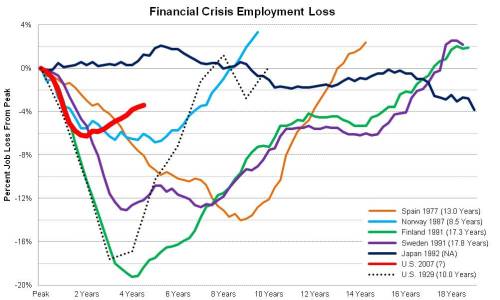
This panic has impeded Obama’s recovery measures. But the fact remains that, by the standards of a financial crisis, the United States suffered through a relatively shallow trough and has enjoyed a fairly rapid recovery. (Here is a chart laying out the comparison between the United States and other comparably afflicted economies.) Obama managed to stabilize the financial system and, through the stimulus, avert a total collapse in consumer demand.
But while America has suffered less since 2008 than other victims of a financial crisis, it has suffered. Obama’s notable success in containing the damage has not redounded to his benefit for another, even more historically durable reason: Voters tend to blame or credit incumbent politicians for the state of their lives utterly regardless of responsibility. This is not even limited to things like the economy, where politicians can affect the outcome. Voters reward or punish incumbents based on the weather or the success of local sports teams. Mitt Romney’s campaign theme attempting to assign all blame to Obama for the state of the economy is a clever manipulation of this long-standing form of irrationality. In 2004, Romney dismissed any attempt to blame George W. Bush for the decline of jobs under his watch as “poppycock.” In his most condescending tone, Romney explained that of course outside forces were to blame — those outside forces being the vastly milder 2001 recession — and that attempting to hold Bush responsible for the economic record of his term was sheer stupidity. Now Romney has made that very theme the central basis of his presidential campaign.
The second indictment of Obama is that he failed to redeem the broader vision of trans-partisan governance he campaigned on. The reason this happened is that the Republicans’ leadership in Congress grasped early on that its path to returning to power required Obama to fail, and that they could help bring this about by denying his initiatives any support. In a meeting before Obama’s inauguration reported by Time’s Michael Grunwald, the House Republican leadership instructed their members on exactly this strategy. GOP Senate Minority Leader Mitch McConnell has followed the same strategy. GOP House members and senators have admitted, some of them publicly, that their leadership prevailed upon them not to negotiate with Obama.
Partisan strife between Congress and the president has gone on for decades. In the past, members of Congress often opposed the president’s agenda, but they also believed that the voters would punish them if they failed to show accomplishments, and so they carefully balanced their substantive opposition with a sense of political self-preservation. What makes the Republican opposition different is that it rests upon a novel, and probably true, insight. Most Americans pay little attention to the details of policy. They rely upon a broad heuristic — if something has touched off an ugly and protracted battle, it is probably bad, but if both sides agree on it, it is probably good. Even many Sunday political talk-show chatterers and other blowhards use the same basic thought process. And so, as McConnell actually said out loud, “if the proponents of the bill were able to say it was bipartisan, it tended to convey to the public that this is O.K., they must have figured it out.” McConnell, in keeping with his Bond-villain habit of boasting openly about his nefarious intentions, actually announced in a prepared speech that his top political priority was to make Obama a one-term president.
The Republican strategy is perfectly clear and not even very well hidden. Yet many of us don’t accept it as a reality because it does not feel true. We instinctively hold the president, not Congress, responsible, another finding political scientists have measured. The hunger to attribute all outcomes to the president is so deep that the political elite take it on faith. Bob Woodward, who is justly famed as a reporter but whose opinions are interesting only as a barometer of Washington establishmentarianism, blamed Obama because Republicans turned down an extraordinarily favorable budget deal. “Presidents work their will — or should work their will,” Woodward declared, “on the important matters of national business.”
How can a president “work his will” in such a way as to force autonomous members of the opposite party controlling a co-equal branch of government to sacrifice their own calculated self-interest? It is a form of magical thinking, but a pervasive one. Which is exactly why the Republican strategy — making Obama’s promise to transcend partisanship fail by withholding cooperation — has worked.
Whether this strategy succeeds in its ultimate goal — returning the GOP to power in 2013 — depends on the election. In an unusual way, the success of Obama’s first term hangs in large part on his reelection bid, as a President Romney would probably kill his grandest achievement of providing health insurance to those Americans too sick or poor to acquire it in the marketplace. So any evaluation of Obama’s term before the election must be provisional.
What can be said without equivocation is that Obama has proven himself morally, intellectually, temperamentally, and strategically. In my lifetime, or my parents’, he is easily the best president. On his own terms, and not merely as a contrast to an unacceptable alternative, he overwhelmingly deserves reelection.
By: Jonathan Chait, Daily Intel, October 31, 2012
November 1, 2012
Posted by raemd95 |
Election 2012 | Barack Obama, Congress, Economic Policy, Foreign Policy, Health Reform, Mitch McConnell, Politics, Republicans, Wall Street |
5 Comments
The 2012 presidential election is fundamentally a contest between our future and our past. Barack Obama’s America is the America that will be; Mitt Romney’s is the America that was. And the distance between the two is greater, perhaps, than in any election we’ve had since the Civil War.
The demographic bases of the rival coalitions couldn’t be more different. Monday’s poll from the Pew Research Center is just the latest to show Obama with a decisive lead (in this case, 21 percentage points) among voters younger than 30. Obama’s margin declines to six points among voters ages 30 through 44, and he breaks even with Romney among voters ages 45 through 64. Romney’s home turf is voters 65 and older; among those, he leads Obama by 19 points.
Age polarization is not specific to the presidential election. On a host of issues, as diverse as gay and lesbian rights and skepticism about the merits of capitalism, polls have shown that younger voters are consistently more tolerant and well to the left of their elders.
Nor is age the only metric through which we can differentiate our future from our past. The other is race, as the nation grows more racially diverse (or, more bluntly, less white) each year. While the 2000 Census put whites’ share of the U.S. population at 69.1 percent, that share had declined to 63.7 percent in the 2010 Census, while the proportion of Hispanics rose from 12.5 percent to 16.3 percent. In raw numbers, total white population increased by just 1.2 percent during the decade, while the African American segment grew by 12.3 percent and the Hispanic share by 43 percent. Demographers predict that the white share of the U.S. population will fall beneath 50 percent in the 2050 Census.
Rather than trying to establish a foothold among America’s growing minorities, however, Romney and the Republicans have decided to forgo an appeal to Hispanic voters by opposing legislation that would grant legal status to undocumented immigrants brought here as children and by backing legislation that effectively requires Hispanics to carry documentation papers in certain states. Republicans seek a majority through winning an ever-higher share of white voters. The Washington Post reported last week that its polling showed the greatest racial gap between the Democratic and Republican presidential candidates since the 1988 election, with Romney favored by 60 percent of white voters and Obama by 80 percent of minority voters (a figure that may prove low, if three-quarters of the Hispanic vote goes to Obama, as some other polls suggest it will). The problem for Republicans, of course, is that the minority vote is a far larger share of the total vote today than it was 24 years ago.
By repeatedly estranging minorities and opposing social policies favored by the young, the Republicans have opted for a King Canute strategy: standing on the shore and commanding the tide to stop. Republicans with an eye toward the future, most notably George W. Bush and Karl Rove, have urged the party to embrace immigration reform, but the base is rabidly anti-immigrant and its antipathy is reinforced daily by talk radio hosts and Fox News chatterers who depict an America under siege by alien forces.
Should Republicans prevail in this election and seek to build a more-than-one-term plurality, they will confront a stark choice: Either Romney must persuade his party to reverse its stance on immigration, or the party must seek to extend the scope of its voter-suppression efforts. Put another way, they must try to either accommodate the future or suppress it.
Accommodation with diversity and modernity, however, is simply not part of the Republican DNA. Today’s Republican Party has largely cornered the market on religious fundamentalists, even as the number of GOP scientists has dwindled (a 2009 Pew poll of scientists found that just 6 percent self-identified as Republicans, while 55 percent said they were Democrats). Many of the largest Republican funders come from economic sectors hardly distinguished by significant productivity increases or their contributions to mass prosperity (casino gambling, Wall Street), while Silicon Valley remains more Democratic turf. (By the way, all those messages Republican CEOs have been sending their employees , predicting layoffs should Obama be reelected? Have any of them promised raises if Romney wins? Just askin’.)
Two Americas are facing off in next week’s election. By their makeup, the Democrats are bound to move, if haltingly, into the future, while the Republicans parade proudly into the pre-New Deal past — some of it mythic, lots of it ugly. The differences could not be clearer.
By: Harold Meyerson, Opinion Writer, The Washington Post, October 30, 2012
November 1, 2012
Posted by raemd95 |
Election 2012 | GOP, Hispanics, Minorities, Mitt Romney, Politics, Race and Ethnicity, Racial Inequality, Republicans, Voter Suppression |
1 Comment


 Unknown Feed
 mykeystrokes.com