“The GOP’s 20-Year War On Health Care”: Republicans Are Going To Extraordinary Lengths To See That More Americans Die
Stop the presses: John Boehner admitted Thursday that the Republican Party’s long-awaited alternative to Obamacare needs a little more time in the oven. “You know, the discussions about Obamacare and what the replacement bill would look like continue. We’re trying to build consensus around one plan,” the Speaker told Hill reporters. “Not there yet.”
As if you even needed me to tell you, rest assured: It could be six months from now, a year from now, five years from now, or the day Bibi Netanyahu and Khaled Mashal share a Nobel Peace Prize—they aren’t going to have a plan. Oh, they might have a “plan.” They had a “plan” last year, or at least Oklahoma Sen. Tom Coburn and two others did. For about two days, they were really tooting its horn. Then it dawned on people that paying for it would involve a hefty middle-class tax increase, on higher-end insurance plans. You may have noticed since then that the Coburn “plan” has not exactly become a leading Republican talking point.
As conservatives continue to hail the Halbig decision, some historical context is called for. In my last column, I wrote that conservatives and Republicans are going to extraordinary lengths to see that more Americans die. Not every reader was won over by that opinion, as you might imagine. But I think it’s beyond dispute, as a little discussion of political history should show.
The problem of millions of uninsured has existed in this country since—well, since forever. But as a running news story that the media paid attention to, for the last 25 or 30 years. I remember when the then-horrifying number was 15 million uninsured. Then 20 million, then 30 million, on up to the 46 million figure we often saw bandied about before the Affordable Health Care was enacted (10 million new Americans are insured as a result of it—a very respectable dent, for just one year). So, 30 years, a full generation, tens of millions of people adversely affected. And what, in all that time, has the Grand Old Party proposed to do about it all?
Not. One. Thing. Republican presidents had (if we go back to 1984) 16 years to pass some kind of health-insurance law. But none of the three ever even proposed one. George W. Bush did pass his Medicare law, but that was about adding prescription-drug coverage for seniors; it didn’t insure any previously uninsured citizens. What the GOP did instead, of course, was to fight tooth-and-nail to stop the two Democratic attempts to insure more people, succeeding the first time, failing the second.
And “tooth-and-nail” hardly begins to describe the demented and nearly sociopathic reality of Republican and conservative opposition to trying to make health insurance affordable for working-class people. Opposition to doing so has been one of the four grand accomplishments of the Republican Party of our time, which I would rank as follows, one scratched on each side of the obelisk: one, start disastrous wars and commit torture; two, make people despise the government; three, nearly cause a new Depression; and four, deny health insurance to as many people as possible, as aggressively and nastily as possible. It’s a grim record generally, and with regard to health care specifically, inarguably one that has promoted insalubriousness and suffering and, indeed, deaths that might have been avoided or delayed if people had had insurance.
It is true that some conservative intellectuals have offered up some ideas—as we know, the same individual mandate that the right now calumniates was a conservative idea at first. And John McCain actually had a decent-ish health-care platform plank in 2008. But if McCain had been elected, it’s very unlikely that the constellation of interests and power centers in the GOP would have permitted him ever even thinking about pursuing it. It was just something he felt he had to say to have credibility with middle-of-the-road voters. And in any case he wasn’t elected, and those conservative intellectuals’ ideas were never seriously proposed by elected Republicans, so the historical record is what it is.
The 20-year war on health care—since their 1993 defeat of the Clinton plan—has been about Republicans’ hatred of government; their view of people who don’t have insurance as lazy or flawed and not worth lifting a finger for; and their fear that if a law is passed and succeeds in bringing health care to millions, they and their whole vision of society will be discredited in the eyes of millions. Of course, these days, all that is shot through with one more element: a heavy dose of Obama hatred.
I was on Hardball Wednesday evening with David Corn, and Chris Matthews showed poll numbers during our segment that surprised even me. The topic was “rooting for failure.” Back in 2006, he said, Democrats were asked in a Fox News poll whether they wanted President Bush’s policies to succeed or fail. Answers: 40 succeed, 51 fail. Not particularly generous. But earlier this year, he said, CNN asked Republicans the same question about President Obama. Answers: 14 succeed, 73 fail.
Think about that. Three-quarters of regular Republicans want Obama to fail. And just one in seven wants him to succeed. We pundits spend most of our time blaming politicians for inaction, but maybe it’s time to start blaming the people. If regular Republicans feel like this, there’s no way the elected officials who represent them are going to do anything that looks remotely like compromise or cooperation.
And no, they’re not going to offer a real health-care plan either. They first promised that in 2010, during the campaign season, so they could say “repeal and replace” instead of just “repeal” and sound like they had a positive side. Then they dropped “and replace,” and now that it’s election time again, it’s back. But it’s not in their DNA to do anything constructive about health care. Or—the VA crisis, the border crisis, the Middle East crisis, the wage-and-inequality crisis, et cetera—about much of anything.
By: Michael Tomasky, The Daily Beast, July 25, 2014
“Soft Bigotry Of Low Expectations”: The Right’s Pathetically Low Curve; How It Got A Pass On Race And Poverty
Rep. Paul Ryan, budget-slasher, releases a paternalistic poverty plan that has one good idea. Sen. Rand Paul, Civil Rights Act skeptic, speaks to the African-American National Urban League. The Koch brothers, backers of voter suppression efforts and union busting, give $25 million to the United Negro College Fund.
And each winds up hailed, even by some liberals, as taking a big step for the Republican Party when it comes to questions of race and poverty. Why do people settle for so little when it comes to the right trying to signal a change in its damaging approach to both?
Ryan’s one good idea is expanding the earned income tax credit, originally a Republican policy that Republicans turned against because Democrats embraced it too. The EITC is one big reason for the “47 percent” of people who pay no taxes that Ryan’s running mate railed against. Now Ryan says he wants to expand it, and some other programs – which doesn’t square with his infamous budget proposals of recent years.
So MSNBC’s Chuck Todd politely asked Ryan to reconcile his poverty plan with his budget plan – which cuts $5 trillion over 10 years, and takes 69 percent of the cuts from low- and moderate-income families – and he couldn’t do it.
“Does this mean you would change your budget proposal to reflect your new poverty plan?” Todd asked.
“No,” Ryan answered. “I didn’t want to get into a debate over the funding levels of the status quo. I want to talk about how to reform the status quo.”
Todd tried again. “So we should ignore your budget proposal for these programs?”
“No, Chuck, what I’m trying to tell you is, let’s not focus on dollars and cents for these programs,” Ryan replied, a little peevishly. “Let’s focus on reforming these programs so they work more effectively.”
Paul Ryan: a profile in equivocation.
Then there’s Rand Paul, continuing his “outreach” to African-Americans with his visit to the Urban League annual convention. Paul actually deserves credit for trying to tackle issues of criminal justice reform with Sen. Cory Booker. But in his Friday speech he also seemed to decry voter suppression laws, insisting his goal is to “help more people vote,” in the words of the Louisville Courier-Journal.
“We have to be together to defend the rights of all minorities,” Paul said.
But Paul flip-flops on this issue every chance he gets. “I don’t think there is objective evidence that we’re precluding African-Americans from voting any longer,” he said last year, after the Supreme Court curtailed the Voting Rights Act. But a few months later, he seemed to have second thoughts.
“Everybody’s gone completely crazy on this voter-ID thing,” Paul the New York Times. “I think it’s wrong for Republicans to go too crazy on this issue because it’s offending people.”
That was big news. But then, confronted by his friends at Fox, he lurched into reverse. Paul assured Sean Hannity he was fully on board with the Republican voter ID strategy. “No, I agree there’s nothing wrong with it. To see Eric Holder you’ve got to show your driver’s license to get in the building. So I don’t really object to having some rules for how we vote. I show my driver’s license every time I vote in Kentucky … and I don’t feel like it is a great burden. So it’s funny that it got reported that way.”
“It’s funny it got reported that way,” when that’s what Paul said. Maybe that’s where Paul Ryan learned how to equivocate.
Then there are the Koch brothers. I said everything I needed to in this story. I’m sympathetic to the UNCF wanting more scholarship funding. But “Koch scholars”? A no-strings gift would be one thing, but scholarships Koch foundation appointees help award, based on a student’s affinity for “entrepreneurship” and the free market is something else entirely.
Liberals who applaud UNCF taking the money, and decry AFSCME’s parting ways with the group, insist it’s possible to separate the principle of education for black children from the Kochs’ funding of efforts to break unions in the public sector – which disproportionately employ their parents – and suppress their voting rights.
But it’s true that all of these moves are preferable to outright race baiting and demonizing black people and the poor, so liberals give them extra credit. Applauding minimal GOP gestures toward decency reflects the soft bigotry of low expectations once again.
By: Joan Walsh, Editor at Large, Salon, July 25, 2014
“Bizarre Looking-Glass Ideology”: Deficit Scolds Are The Most Crazed Ideologues In America
A new Congressional Budget Office report shows that the projected increase in the national debt has slowed dramatically. Good news for deficit scolds, right? Not for Ron Fournier, who still thinks the nation is on its last legs:
Only in Washington, the place where you land when you fall through the looking glass, could this be hailed as good news… Our deficit levels (annual totals of red ink) are stalled at breathtakingly high levels — and are projected to soar again in a few years… Scary news, right? Not according to many media outlets and a cynical leadership class in Washington. Some news organizations focused on the sugar-high of good news — the (temporary) dip in deficits.
Think of a reporter covering a shooting. The police tell him the victim is dying of blood loss. Is the headline “Shooting Victim Expected to Die” or “Blood Flow Slows for Shooting Victim”? [National Journal]
Fournier’s economic analysis, if it may be so dignified with the phrase, is comprehensively wretched. As I’ve argued, the real problem with the deficit is that it’s coming down way too fast. Premature austerity has crippled the economic recovery and kept millions out of work. The biggest economic problem facing the nation is unemployment, which outweighs the stupid deficit by Graham’s Number levels of importance.
But the main problem is that his scold case is weak even on its own terms. Fournier understands neither what is driving the increase in the national debt nor why that might be a problem — all of which betrays a bizarre ideology that holds that pain must be inflicted before any gains can be made.
The huge increase in the annual deficit in 2008-09 was driven by two things: first, the economic collapse, which caused revenues to fall and spending to increase as people drew on safety net programs like unemployment insurance. Second, the Recovery Act, aka the stimulus, which provided a one-time surge of spending to restore aggregate demand and get people back to work. Though the stimulus was not nearly large enough to fill the hole in demand, this is what macroeconomic policy is supposed to do in a recession (a fact that Republicans were happy to accept when they were in power).
The long-term debt and deficit projections, on the other hand, are entirely about health-care spending. As Peter Fisher once said, the government is basically an insurance company with an army, and for many years the price of health care increased much faster than the rate of economic growth. This made government spending on health care (mostly Medicare and Medicaid) consume an ever-greater portion of the federal budget. Past CBO projections just assumed this trend would continue, which accounts for past reports predicting that the national debt would eventually eat the whole budget.
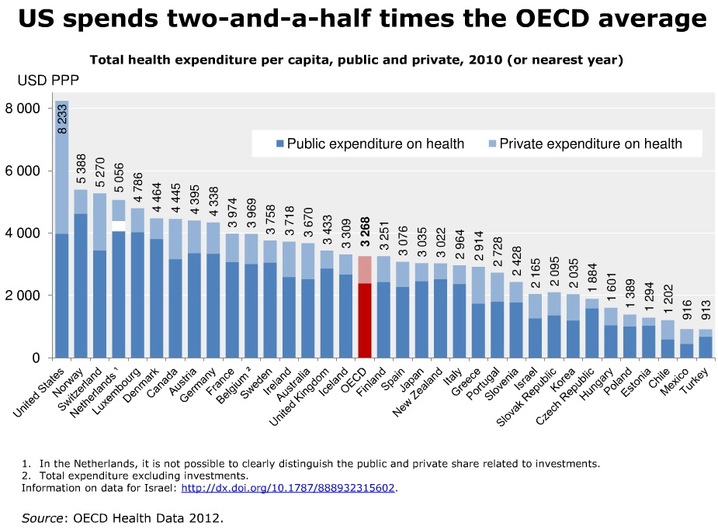
What this means is that Fournier’s preferred solution for dealing with this trend — higher taxes, fewer entitlements — is completely pointless. We have to fix the problem of rising prices, otherwise eventually a single tablet of aspirin will consume the entire federal budget. And the price problem is driven by awful policy design, not excessive generosity. America manages the rare trick of having very patchy and stingy social insurance that is simultaneously incredibly expensive. We spend more government money per person than Canada does — and the Canadians have universal single-payer coverage.
Fewer entitlements or higher taxes will get you a few years of breathing room before price increases eat up all the savings — and the whole point of Fournier’s column is that a couple decades of breathing room is still grounds for hair-on-fire panic.
Luckily, since the passage of ObamaCare, price increases have indeed slowed dramatically. That, plus a new projection that interest rates will stay low for a long time, accounts for the new CBO analysis showing slower debt growth. Just why this is happening is a matter of some dispute; I suspect it is partly the result of several programs in ObamaCare designed to bring prices down, and partly that health-care prices are already so high they’re running into resource constraints.
I think the fact that Fournier is patently uninterested in any of these things, and favors a policy that would accomplish nothing whatsoever on the deficit by his own standards, reveals that the pro-austerity school of punditry isn’t about the deficit at all. Instead, he says that his entitlement-cutting agenda is “going to happen sooner or later, painfully or more painfully.” As with David Gregory, the pain is the operative concept. The centrist definition of responsible politics holds that the American people must suffer a little more to keep the nation healthy. It’s only the “hateful partisans” who are keeping the wise, reasonable moderates from making those tough bipartisan compromises to slash social insurance and inflict pain.
But make no mistake: This has nothing to do with economics, and everything to do with the bizarre looking-glass ideology of “serious people” in Washington, D.C.
By: Ryan Cooper, The Week, July 24, 2014
“When Will You Stop Beating Your Ally?”: Ted Cruz On Protecting And Promoting Israel’s Tourism Industry
I really thought the peculiar use of the Israeli-Palestinian conflict as a political weapon against Barack Obama had reached its point of diminishing returns back in the 2012 presidential cycle, when the entire field (with the exception, obviously, of Ron Paul) competed to express how abjectly each as president would defer to Israel’s wishes in using American resources and commitments, in sharp contrast to the faithless Muslim-lover in the White House. I mean, seriously, wouldn’t the tribunes of American Exceptionalism eventually see something wrong with their political representatives demanding that the U.S. outsource its foreign policy to another country?
Leave it to Ted Cruz to take it all to another level, accusing the administration of telling the FAA to ban flights into Tel Aviv as part of a pro-Hamas conspiracy:
“Given that some 2,000 rockets have been fired into Israel over the last six weeks, many of them at Tel Aviv, it seems curious to choose yesterday at noon to announce a flight ban, especially as the Obama Administration had to be aware of the punitive nature of this action.
“Tourism is an $11 billion industry for Israel, which is in the middle of a summer high season already seriously diminished by the conflict initiated by Hamas. Group tours have been cancelling at a 30% rate. This FAA flight ban may well represent a crippling blow to a key economic sector through both security concerns and worries that additional bans will down more flights and strand more passengers. It hardly matters if or when the ban is lifted. At this point, the damage may already be done….
Secretary of State John Kerry issued a veiled threat last February when he encouraged boycotts of Israel [sic] and said that absent serious Israeli concessions at the negotiating table, Israel’s economic prosperity was ‘not sustainable’ and ‘illusory.’ Secretary Kerry unfortunately reprised this theme just this April, when he threatened that Israel risked becoming an ‘apartheid state’ if Israel did not submit to his chosen solution to the Israel-Palestinian crisis.
“Taken in the context of Secretary Kerry’s comments, yesterday’s action by the FAA raises some serious questions.
So apparently the United States has an obligation, at the potential expense of the safety of its own citizens, to promote the security claims of another country in order to protect said country’s tourism industry. Anything less than that is to side with Israel’s enemies, whose bloody hands Obama is already shaking by continuing humanitarian assistance to Gaza.
How much further can Republicans move the goal posts here? Should we become more militantly pro-Israel than the Israelis themselves?
I know this is a sweet spot for conservatives because it pleases a certain type of evangelical Christian activist and projects bloody-minded “strength” without risking a commitment of U.S. troops, since the Israelis really can take care of themselves from a military point of view. And the Palestinians, of course, are the overseas equivalent of those people here, somehow still held to be responsible for 9/11. But if there is a Republican president any time soon, the GOP isn’t doing him or her any favors by mortgaging half its foreign policy to the interests of a single foreign state, however admirable.
By: Ed Kilgore, Contributing Writer, Washington Monthly Political Animal, July 24, 2014
“The Koch-Tested, Koch-Approved Version”: Paul Ryan’s Faux Populism Isn’t Going To End Poverty Or Reduce Inequality
Paul Ryan’s fellow Republicans are quick to dismiss Elizabeth Warren as too radical, too progressive, too populist.
But Ryan is trying—a bit clumsily, but trying all the same—to borrow a page from the Massachusetts senator as he seeks to remake himself in anticipation of a potential 2016 run for the Republican presidential nomination. He’s talking about poverty, about inequality, about shifting the focus away from meeting the demands of corporations and toward meeting the needs of Americans.
Mitt Romney’s running mate is abandoning Romneyism for populism—or what former Secretary of Labor Robert Reich has referred to as “Paul Ryan’s Faux Populism.”
Instead of repeating the Mittnomers of 2012—“Corporations are people, my friend”—Ryan is suddenly informing fellow conservatives, “There’s another fallacy popular among our ranks. Just as some think anything government does is wrong, others think anything business does is right. But in fact they’re two sides of the same coin. Both big government and big business like to stack the deck in their favor. And though they are sometimes adversaries, they are far too often allies.”
It is hard to argue with Ryan’s reasoning. Populists and progressives have warned for more than a century that corporations are “boldly marching, not for economic conquests only, but for political power.” The author of those words, former Wisconsin Supreme Court Justice Edward Ryan , asked in 1873: “Which shall rule—wealth or man; which shall lead—money or intellect; who shall fill public stations—educated and patriotic free men, or the feudal serfs of corporate capital?” Elizabeth Warren confirmed Ryan’s worst fears when she addressed Netroots Nation last week and declared, “The game is rigged and the rich and the powerful have lobbyists and lawyers and plenty of friends in Congress. Everybody else, not so much.”
And now, Paul Ryan is on-message, announcing as only a career politician can, that “our country has had enough of politics.” He’s proposing to “reconceive the federal government’s role in the fight against poverty.” And he is even ripping corporations, decrying the way in which big government has become “a willing accomplice” of big business.
Ryan explained last week at Hillsdale College’s Center for Constitutional Studies and Citizenship session that “crony capitalism isn’t a side effect; it’s a direct result of big government.”
Grab the pitchforks!
But don’t look for Paul Ryan on the front lines of actual fights to reduce inequality or address injustice.
The House Budget Committee chairman, who on Thursday released an “anti-poverty proposal” that rehashed decades-old schemes to scale back anti-poverty initiatives and regulatory protections for low-income Americans, offers scant evidence of a serious determination to solve the problems that have got Americans up in arms. If Ryan was serious, he wouldn’t be proposing, as his “Opportunity Grant” plan does, to “consolidate” existing federal programs to aid the poor into block grants to the states—an approach that would allow Republican governors who have already shown a penchant for undermining healthcare, food-stamp and education initiatives the “flexibility” to do even more harm.
Congressman Chris Van Hollen, a Maryland Democrat who serves with Ryan on the Budget Committee, nails it when he warns about a proposal that “uses the sunny language of ‘reform’ as a guise to cut vital safety-net programs.”
So if the congressman is not worried about developing a serious response to the problem of inequality, what is on his mind?
Ryan is worried about solving his own problem: an association in the public’s mind with the failed messages of the 2012 Romney-Ryan campaign.
Last week’s populist speech at the Center for Constitutional Studies and Citizenship and this week’s poverty speech at the American Enterprise Institute begin the roll-out of Paul Ryan Version 2.0. Next comes the August publication of Ryan’s 2016 campaign book, The Way Forward: Renewing the American Idea, complete with its epic cover shot of Americans reaching out to touch a triumphal Ryan. Then there’s the bus tour.
Yes, the bus tour.
So Ryan is campaigning. To the extent that it is possible he will do so in populist style and with populist rhetoric about crony capitalism and fighting poverty.
But don’t be confused.
This is still the same Paul Ryan who went to the floor of the House in 2008 and rallied Republicans to support the Wall Street bailout. This is still the same Paul Ryan who opposed regulation of the big banks. This is still the same Paul Ryan who supported and continues to support) the free trade deals demanded by multinational corporations. This is still the same Paul Ryan who has peddled Social Security, Medicaid and Medicare “reforms” that would turn sound programs into vehicles for steering federal funds into the accounts of Wall Street speculators and health-insurance corporations.
This is still the same Paul Ryan who during the current election cycle has padded his campaign committee and “leadership PAC” accounts with almost $9 million in donations—with Wall Street securities and investment interests and the health-insurance industry giving most generously. And this is the same Paul Ryan who, when Congress took its August break in 2013 jetted home to Wisconsin via Arizona—where he was a featured speaker at the annual retreat for billionaire donors organized by the Koch brothers.
The other featured speaker was then–House majority leader Eric Cantor, for whom the ensuing months did not go well. Cantor’s Republican primary defeat—at the hands of a critic of “crony capitalism”—provided an indication that the American people are increasingly agitated. And increasingly disinclined toward the sort of insider politics practiced by career politicians such as Ryan.
Ryan got the signal.
He is rebranding himself.
He has downloaded some populist rhetoric to go with his “kinder, gentler” talk about poverty.
But Paul Ryan’s populism is not the real thing. It’s the Koch-tested, Koch-approved version.
By: John Nichols, The Nation, July 24, 2014
Share This Blog


 Unknown Feed
- An error has occurred; the feed is probably down. Try again later.