“Hell Bent On Destroying The Health Care System”: Mitch McConnell Has A Secret Plan For Obamacare
Republicans promised voters in 2012 that with public support, they would repeal the Affordable Care Act. Voters responded by electing Democrats, seemingly ending the debate.
Indeed, as recently as two months ago, there wasn’t much left to fight about. President Obama had won re-election; the health care law’s implementation would continue apace; many Republican governors started accepting the law’s provisions; House Speaker John Boehner called the Affordable Care Act “the law of the land”; and Larry Jacobs, director of the Center for the Study of Politics and Governance at the University of Minnesota, said, “The arc of partisan fever is beginning to recede, and pragmatism is beginning to come to the fore.”
That was late January. Now, congressional Republicans seem to vote uncontrollably on “Obamacare” repeal and National Journal reports that Senate Minority Leader Mitch McConnell (R-Ky.) has a “secret Republican plan” to destroy the law.
By Election Day, Senate Republicans were ready to, as McConnell put it, “take this monstrosity down.”
“We were prepared to do that had we had the votes to do it after the election. Well, the election didn’t turn out the way we wanted it to,” McConnell told National Journal in an interview. “The monstrosity has … begun to be implemented and we’re not giving up the fight.”
Sure, those darned voters got in the way of McConnell’s dreams, but the Republican senator apparently only sees that as a minor inconvenience that simply delays his plans.
The “secret Republican plan” really isn’t much of a secret. Hell, it’s not really much of a plan, either. McConnell’s idea is apparently to have Republicans win a bunch of elections and then destroy the law through the reconciliation process so Democrats can’t filibuster the GOP’s anti-Obamacare crusade.
That’s roughly the same plan Republicans came up with last year, right before the electorate re-elected President Obama and expanded the Democratic majority in the Senate.
But as is the case with so many issues — taxes, deficit reduction, Planned Parenthood, Paul Ryan’s budget, etc. — GOP officials are determined to pretend 2012 didn’t happen and the will of the voters is irrelevant.
What’s less clear is whether McConnell has actually thought through the consequences, or whether he’s so deep into his post-policy vision that he simply no longer cares.
How will he pay for Obamacare repeal, which would cost over $100 billion in the coming decade? What will he do for the millions of Americans who would lose the ability to see a doctor if Obamacare were destroyed? How will he reconcile eliminating Obamacare and Republican plans to rely on Obamacare to balance the federal budget?
McConnell doesn’t seem to have answers for any of this. In fact, I’m not altogether sure why, exactly, McConnell hates the Affordable Care Act as much as he thinks he does, or whether this posturing is intended to placate the far-right wing of his party in advance of his 2014 campaign.
But the bottom line remains effectively the same: whereas Republicans were prepared two months ago to move on to other fights, GOP leaders are now back to their preoccupation with, in Paul Ryan’s words, “destroying the health care system for the American people.”
By: Steve Benen, The Maddow Blog, March 28, 2013
Discrediting the Legislative Process Itself
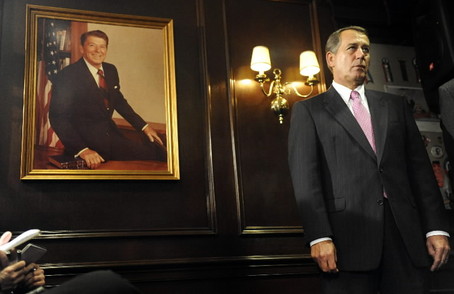
John Boehner-House Minority Leader of "No"
So far in the health-care debate, Republicans have attacked the legitimacy of private negotiations, parochial dealmaking, the budget reconciliation process, self-executing rules, the Congressional Budget Office’s analyses, and even the constitutionality of the legislation. It’s a good theory: Make people hate Washington and mistrust the legislative process and you’ll make people hate and mistrust what emerges from that process.
But it’s also dangerous. As Republicans well know, private negotiations between lawmakers, deals that advantage a state or a district, and a base level of respect for the CBO’s scores have long been central to the lawmaking progress. As the parties have polarized, reconciliation and self-executing rules (like deem and pass) have become more common — and the GOP’s own record, which includes dozens of reconciliation bills and self-executing rules, proves it.
The GOP’s answer to this is that health-care reform is important. Stopping the bill is worth pulling out all the stops. And I’m actually quite sympathetic to this view. Outcomes are, in fact, more important than process. But once you’ve taken the stops out, it’s hard to put them back in. Democrats will launch the very same attacks when they’re consigned to the minority, and maybe think up a few new ones of their own.
The result of this constant assault on how a bill becomes a law — a process that has never before been subject to such 24/7 scrutiny from cable news and blogs and talk radio — will be ever more public cynicism. Evan Bayh put it well in his New York Times op-ed. “Power is constantly sought through the use of means which render its effective use, once acquired, impossible,” he wrote. Republicans, who’re likely to return to power with a majority that’s well below 60 seats in the Senate and a 40-vote margin in the House, will soon find themselves on the wrong end of that calculus.
Photo credit: Melina Mara/Washington Post.
By Ezra Klein | March 19, 2010
What Failure Would Cost the Democrats-A Cold Analysis of This Weeks Vote
Disgruntled (if not former) Democrats Pat Caddell and Doug Schoen are the latest to join in offering advice to President Obama and Congressional Democrats to abandon their health reform quest before it causes catastrophic damage to the party. Caddell and Schoen close their Washington Post article with the following warning: “Unless the Democrats fundamentally change their approach, they will produce not just a march of folly but also run the risk of unmitigated disaster in November.”
The case Caddell and Schoen make parallels the one made the previous day by Karl Rove in the Wall Street Journal, and that is made daily by a parade of Republican pollsters and lawmakers: The Democrats’ health reform plan is wildly and deeply unpopular, mirroring the unpopularity of Washington and big government. If it passes, it will result in a huge political backlash, especially if Democrats use reconciliation, which Caddell and Schoen call manipulation and liken to the “nuclear option” that Senate Republicans threatened during the Bush administration. For Rove, the use of reconciliation will open the way for Republicans to use the same technique to repeal health plan when they recapture the majority.
We fundamentally disagree; the surest path to political debacle for Democrats is to fail to enact health reform, and the best way to avoid a rout in November is to show that the party in charge can actually govern. The reconciliation process is entirely appropriate for amending the Senate-passed bill; in any case, the public will judge the Democrats on the basis of the results, not the inside-baseball process. In fact, the Democrats most reluctant to support health reform–those from more conservative, Republican-leaning districts and states–are the ones most likely to lose in November if health reform is defeated.
The obvious first antecedent to examine is 1994. Democrats went into the midterm elections after a presidential contest in which they grasped the full reins of power in Washington for the first time in a dozen years. Early momentum disappeared when first President Bill Clinton’s modest stimulus proposal went down in the Senate and then his deficit-reduction package staggered to the finish line after eight long months and without a single Republican vote in either house. It looked more like a setback than a victory. This was followed the next year by a lengthy struggle to enact sweeping health care reform that ended in a complete collapse, without even a vote on the Clinton plan. A shocking loss in the House on a crime bill, though ultimately reversed, reinforced the image of a president and party that could not govern competently.
What followed was a disastrous midterm for Democrats—losses of 54 seats in the House and eight in the Senate. Heading into that election season, House Minority Whip Newt Gingrich, described the Democrats’ condition bluntly: “Imagine it’s October, and the Democrats are going to get up and make the following case: ‘We’ve run the House for 40 years, we’ve run the Senate for eight years, we have the White House, and the Republicans are so much more clever than we are that they’ve obstructed us. We need you to elect more dumb Democrats so we can overcome those clever Republicans.’” Conservative Democratic Senator John Breaux, of Louisiana, echoed that point on health policy, saying, “We can blame the Republicans for filibustering, but we have the responsibility to govern.”
To be sure, there were many reasons for Democrats’ massive losses in 1994, including scandals and angry gun owners. But the failure to fulfill their responsibility for governing contributed mightily to the debacle. That was the conclusion of pollsters from both parties in the aftermath of the November contests. Two weeks after the election, Republican pollster Bill McInturff found that “one of the most important predicates for Republican success was not having health care pass.” He noted that the collapse of the plan reinforced voters’ belief that Washington was in a dysfunctional state of gridlock. At the same time, Democratic pollster Mike Donilon, who worked on the losing campaign of Pennsylvania Senator Harris Wofford, said he believed that Wofford would have won had health reform passed.
It is undeniably true that a Washington plan to reform health care is not overwhelmingly popular. But that’s mostly because Washington is unpopular these days. When the component parts of the Democrats’ plan are parsed out, surveys show high approval for nearly all of them, including removing preexisting conditions, ending lifetime benefit caps, providing tax credits to small business to get them to cover employees, subsidizing low- and middle-income families to enable them to buy insurance, and creating a health-insurance exchange to shop for policies.
We also know that voters are warming somewhat to the idea of a reform plan, in part because the president has ramped up his efforts on its behalf beginning with the State of the Union and the health-reform summit—letting voters know what is actually in the bills. The actions of insurance companies like Anthem and Wellpoint, raising premiums sharply before enactment of reform, has also contributed to a public receptiveness to change. And we know that there was a noticeable bump in public approval when bills passed the House and the Senate—voters like action, and like success. Even where we are skeptical about the benefits of government programs, we want government to work.
It is also true that the health-reform plan, contrary to conventional wisdom, will not simply frontload the costs and backload the benefits. The plan will move quickly to erase the unpopular “doughnut hole” that results in a costly jolt for many seniors buying prescription drugs, to end discrimination based on preexisting conditions for children, to ease the insurance burden on those losing or leaving their jobs, and to enable parents to carry children up to the age of 26 on their family policies. Many House and Senate Democrats are understandably nervous about voting to enact health reform. We are convinced that the political damage will be far, far worse if they fail to do so.
By: Norman J. Ornstein and Thomas E. Mann. They are co-authors of The Broken Branch: How Congress is Failing America and How to Get It Back On Track. March 15, 2010-The New Republic
How to Make Something Controversial
People say the media is more viscerally sympathetic to Democrats than Republicans. But working in the other direction is the fact that Republicans understand the media much better than Democrats do. Take the reconciliation process. The media is giving blanket coverage to this “controversial” procedure being used by the Democrats. But using reconciliation for a few fixes and tweaks isn’t controversial historically, and it’s not controversial procedurally. It’s only controversial because Republicans are saying it is. Which is good enough, as it turns out. In our political system, if Democrats and Republicans are yelling at each other over something, then for the media, that is, by definition, controversy. This is something Democrats did not understand when George W. Bush was in power.
The Senate reconciliation vote occurred on May 23, 2003. In the month of May, only one New York Times article so much as mentioned the use of reconciliation for the tax cuts — a May 13, 2003, article that devoted a few paragraphs to wrangling over whether Senate Republicans could assign the bill number they wanted (S.2) to a bill approved via reconciliation. The Times also used the word “reconciliation” in a May 9, 2003, editorial, but gave no indication whatsoever of what it meant.
And that’s more attention than most news outlets gave to the use of reconciliation that month. The Washington Post didn’t run a single article, column, editorial, or letter to the editor that used the words “reconciliation” and “senate.” Not one. USA Today, the Los Angeles Times, and the Associated Press were similarly silent.
Cable news didn’t care, either. CNN ran a quote by Republican Sen. Chuck Grassley about the substance of the tax cuts in which he used the word “reconciliation” in passing — but that was it. Fox News aired two interviews in which Republican members of Congress referred to the reconciliation process in order to explain why the tax cuts would be temporary, but neither they nor the reporters interviewing them treated reconciliation as a controversial tactic.
And ABC, CBS, NBC? Nothing, nothing, nothing.
And why was there nothing? Because Democrats weren’t complaining. The tax cuts might have been controversial, but they weren’t creative enough to polarize the procedure the Bush administration was using to pass them.
But some of the credit for that has to go to the Bush administration, which took seriously the need to institutionalize reconciliation when they were strong and popular rather than weakened. When Bush came into office, he used reconciliation for his first tax cuts. That was a sharp break with precedent: Reconciliation had never been used to increase the deficit, and the process was so poorly suited to the purpose that the Bush administration had to let all of them sunset after 10 years. It was a bizarre, bizarre bill. But by using it for his popular first round of tax cuts, Bush normalized it such that Democrats couldn’t really complain when he used it for his much more controversial second round of tax cuts.
By Ezra Klein | March 5, 2010; 9:53 AM ET
The GOP’s Astonishing Hypocrisy on Health Care and ‘reconciliation’
For those who feared that Barack Obama did not have any Lyndon Johnson in him, the president’s determination to press ahead and get health-care reform done in the face of Republican intransigence came as something of a relief.
Obama’s critics have regularly accused him of not being as tough or wily or forceful as LBJ was in pushing through civil rights and the social programs of his Great Society. Obama seemed willing to let Congress go its own way and was so anxious to look bipartisan that he wouldn’t even take his own side in arguments with Republicans.
Those days are over. On Wednesday, the president made clear what he wants in a health care bill, and he urged Congress to pass it by the most expeditious means available.
He was also clear on what bipartisanship should mean — and what it can’t mean. Democrats, who happen to be in the majority, have already added Republican ideas to their proposals. Obama said he was open to four more that came up during the health-care summit.
What he’s unwilling to do, and rightly, is to give the minority veto power over a bill that has deliberately and painfully worked its way through the regular legislative process.
Republicans, however, don’t want to talk much about the substance of health care. They want to discuss process, turn “reconciliation” into a four-letter word, and maintain that Democrats are just “ramming through” a health bill.
It is all, I am sorry to say, one big lie — or, if you’re sensitive, an astonishing exercise in hypocrisy.
All of the Republican claims were helpfully gathered in one place by Sen. Orrin Hatch, R-Utah, in an op-ed in Tuesday’s Washington Post. Right off, the piece was wrong on a core fact. Hatch accused the Democrats of trying to, yes, “ram through the Senate a multitrillion-dollar health-care bill.”
No. The health-care bill passed the Senate last December with 60 votes under the normal process. The only thing that would pass under a simple majority vote would be a series of amendments that fit comfortably under the “reconciliation” rules established to deal with money issues.
Near the very end of his article, Hatch concedes that reconciliation would be used for “only parts” of the bill. But then why didn’t he say that in the first place?
Hatch grandly cites “America’s Founders” as wanting the Senate to be about “deliberation.” But the Founders said nothing in the Constitution about the filibuster, let alone “reconciliation.” Judging from what they put in the actual document, the Founders would be appalled at the idea that every major bill should need the votes of three-fifths of the Senate to pass.
Hatch quotes Sens. Robert Byrd and Kent Conrad, both Democrats, as opposing the use of reconciliation on health care. What he doesn’t say is that Byrd’s comment from a year ago was about passing the entire bill under reconciliation, which no one is proposing to do. As for Conrad, he made clear to The Washington Post’s Ezra Klein this week that it’s perfectly appropriate to use reconciliation “to improve or perfect the package,” which is exactly what Obama is suggesting.
Hatch said that reconciliation should not be used for “substantive legislation” unless the legislation has “significant bipartisan support.”
But surely the 2001 and 2003 Bush tax cuts, which were passed under reconciliation and increased the deficit by $1.7 trillion during his presidency, were “substantive legislation.” The 2003 dividends tax cut could muster only 50 votes. Vice President Dick Cheney had to break the tie. Talk about “ramming through.”
The underlying “principle” here seems to be that it’s fine to pass tax cuts for the wealthy on narrow votes but an outrage to use reconciliation to help middle-income and poor people get health insurance.
I’m disappointed in Hatch, co-sponsor of two of my favorite bills in recent years. One created the State Children’s Health Insurance Program. The other, signed last year by Obama, broadly expanded service opportunities. Hatch worked on both with his dear friend, the late Edward M. Kennedy, after whom the service bill was named.
It was Kennedy, you’ll recall, who insisted that health care was “a fundamental right and not a privilege.” That’s why it’s not just legitimate to use reconciliation to complete the work on health reform. It would be immoral to do otherwise and thereby let a phony argument about process get in the way of health coverage for 30 million Americans.
E. J. Dionne, Jr-Syndicated Columnist-March 4, 2010
Share This Blog


 Unknown Feed
- An error has occurred; the feed is probably down. Try again later.
 mykeystrokes.com
You must be logged in to post a comment.