The Impact of Health Reform on Health System Spending
The health reform legislation passed in March 2010 will introduce a range of payment and delivery system changes designed to achieve a significant slowing of health care cost growth. Most assessments of the new reform law have focused only on the federal budgetary impact. This updated analysis projects the effect of national reform on total national health expenditures and the insurance premiums that American families would likely pay. We estimate that, on net, the combination of provisions in the new law will reduce health care spending by $590 billion over 2010–2019 and lower premiums by nearly $2,000 per family. Moreover, the annual growth rate in national health expenditures could be slowed from 6.3 percent to 5.7 percent.
Overview
To judge the merit of the comprehensive health reform legislation recently signed into law by President Obama, it is essential to understand its impact on the affordability of insurance coverage and overall health care spending. Most assessments of the new law consider the federal budget only. For example, the Congressional Budget Office “scored” the federal budget impact of the Patient Protection and Affordable Care Act, as modified by the Reconciliation Act (Affordable Care Act), finding a modest deficit reduction in the first 10 years of implementation.
But the federal budget impact is not the same as the health system impact. A portion of the federal funds would be used to reduce costs for people who already have health insurance coverage but struggle to afford it, while very small businesses would receive help in paying insurance premiums. To estimate health spending accurately, we need to separate out the costs into new health care spending and transfers of existing spending from the private sector to the government. Furthermore, CBO assigned very little savings to system reform efforts, rendering its overall analysis incomplete.
The Office of the Actuary within the Centers for Medicare and Medicaid Services, meanwhile, estimated the health system impacts of the Affordable Care Act and determined there would be a small increase in medical spending as a result of the reform. But, again, this analysis is limited, since it gives almost no weight to proposals for improving the information available to providers and modifying the financial incentives in the current system.
This study considers the new law, as enacted in March 2010, to project the impact of major health reform on national health expenditures and the insurance premiums that families will likely pay, accounting for the full range of impacts the legislation is likely to induce. As part of our analysis, we provide estimates of the effect of key provisions on health spending by government, employers, and households. We build on our earlier analysis of the draft legislation, taking account of the provisions in the final law.
Impact of reform on national health expenditures
Health care reform will affect national health expenditures through five major channels.
Impact of new coverage
Extending health insurance coverage to essentially all Americans will increase medical spending, at least in the short run. (Some argue that increased coverage will lower spending over time by making it possible to pursue more-aggressive cost-containment policies without risking access to care for the uninsured, but in this analysis we do not consider such effects.) From previous studies, data are available to estimate the magnitude of the increase in spending. Hadley and colleagues, for example, estimated that each uninsured individual who gains coverage will incur annually an additional $1,600 of medical care expenses—an increase of 70 percent. The Congressional Budget Office estimated that spending for uninsured individuals, if they become insured, will increase by 25 percent to 60 percent. The actual increase will depend in part on the rates that are paid to health care providers for treating currently uninsured patients.
For our estimates, we increase the $1,600 figure over time with expected increases in medical costs. We then multiply the revised amounts by the number of newly insured resulting from health reform to produce a total estimate. Fully phased in, incremental coverage costs about $75 billion per year to cover 60 percent of the uninsured, or 2 percent of total health care spending. This is comparable to Davis and Schoen’s projection that covering all of the uninsured would add 3 percent to medical spending, and Schoen, Davis, and Collins’s finding that covering all of the uninsured would add 2 percent to medical spending. This methodology suggests that the new law will lead to a 10-year cumulative medical spending increase of $415 billion over the period 2010–2019. This estimate is shown in the first row of Exhibit 1.
Savings in public programs
The new health reform law contains a number of changes to Medicare and Medicaid payments. Many of these are traditional payment changes—for example, reductions in the amount paid to Medicare Advantage managed care plans to a level comparable with the cost of covering beneficiaries under traditional Medicare, or smaller increases in Medicare inpatient payments to account for a likely increase in productivity and to reduce bad debts. Our estimates of the medical spending impact of these changes come from CBO. While this is a good place to begin, it should be noted that CBO has often misestimated, or failed to estimate, the behavioral consequences of such changes in the past.
We consider all such changes, with a few exceptions: 1) we exempt the net savings associated with health care modernization (Section 1104 and Title III, subtitle A, of the reform bill), which is treated separately; 2) we omit the sections associated with coverage expansions, which are accounted for above; and 3) we omit savings from the Community Living Assistance Services and Supports (CLASS) Act, which are a collection of premiums in anticipation of future spending. CBO estimates that the net impact of the remaining proposals in the reform law is to reduce Medicare and Medicaid spending by $416 billion over the 2010–2019 period. This estimate is depicted in the second row of Exhibit 1.
The reduction in Medicare and Medicaid spending is approximately on par with the increase in medical costs associated with covering the uninsured. The net impact of covering the uninsured and reducing traditional program payments (and other taxes from outside the health care system) is a decrease in spending of $1 billion over 2010–2019. This roughly parallels the analysis from the Office of the Actuary, which estimated that national medical expenditures under the new law will increase by $311 billion over 2010–2019. The difference of about $30 billion per year is very small on the scale of health expenditures (less than 1 percent per year), and it indicates that our analysis matches that of the actuary when no other cost changes are considered.
Our analysis assumes that a reduction in Medicare and Medicaid payments will not be offset by higher prices to private payers and, equivalently, that fewer uninsured patients will not yield savings to existing payers because of the reduced need of payers to shift costs onto covered patients. This assumption is common to other estimators and is consistent with empirical research.
Insurance exchanges
Currently, nearly 13 percent of insurance premiums are accounted for by administrative costs. These costs range from about 5 percent in large firms and firms that are self-insured to 30 percent for individuals. Higher costs for marketing, underwriting, churning, benefit complexity, and brokers’ fees explain the bulk of the difference.
The new reform law establishes insurance exchanges that will group individuals and small firms into larger entities and thus drive down those administrative costs. The exchanges also will minimize marketing costs through more transparent posting of premiums, facilitated enrollment (assistance with the application process and screening for eligibility), and stronger oversight of industry practices.
If all individuals and small firms were to receive the same premiums as large firms or self-insured firms do, the costs of insurance administration would decline to less than 10 percent. In analyzing the experience of other countries, The Commonwealth Fund estimated that administrative costs could fall to 8 percent or lower under a robust exchange system. We assume more modest savings, such that administrative costs fall to 10 percent of total premiums—a rate also assumed to remain constant over time, even though this implies administrative costs increase along with national health spending. We assume such savings begin in 2014, the year the exchanges will become operational, and are phased in over three years. The reduction in health spending associated with reduced insurer administration is $211 billion over 2010–2019.
CBO estimates $27 billion in administrative savings owing to insurance exchanges over 10 years. CBO assumes premium reductions of between 1 percent and 4 percent for small groups in the exchanges, and no savings for large groups, for an average of about 0.4 percent. We assume additional savings above this amount, totaling $184 billion over 2010–2019 (see third line of Exhibit 1).
Health system modernization
The reform law includes numerous provisions intended to improve the information available to patients and providers and the incentives facing medical care providers, and thus make medical care more efficient. The Commonwealth Fund has summarized these provisions. Within the Medicare and Medicaid programs, these include:
- Payment innovations, including higher reimbursement for preventive care services and patient-centered primary care, bundled payment for hospital, physician, and other services provided for a single episode of care, shared savings or capitation payments for accountable provider groups that assume responsibility for the continuum of a patient’s care, and pay-for-performance incentives for Medicare providers
- An Independent Payment Advisory Board, with the authority to make recommendations that reduce cost growth and improve quality in both the Medicare program and the health system as a whole
- A new Innovation Center within the Center for Medicare and Medicaid Services, charged with streamlining the testing of demonstration and pilot projects in Medicare and rapidly expanding successful models across the program
- Profiling medical care providers on the basis of cost and quality, making that data available to consumers and insurance plans, and providing relatively low-quality, high-cost providers with financial incentives to improve their care
- Increased funding for comparative effectiveness research
- Increased emphasis on wellness and prevention.
The exact amount that will be saved from these provisions collectively is uncertain. Partly as a result of this uncertainty, CBO and the Office of the Actuary assume only minor savings. For example, CBO estimated that the major parts of the law including these provisions will cost $10 billion over the 2010–2019 period, while the Office of the Actuary determined savings of only $2 billion.
Other estimates, however, suggest that an aggressive approach to health care modernization could result in significantly greater cost reductions. Beeuwkes-Buntin and Cutler estimated a 1.5-percentage-point reduction in cost increases annually from significant health care reform, or more than $700 billion in the 10-year window. These savings would come from two primary sources. First, administrative expenses incurred by provider groups would decline as electronic medical records, and incentives to use them appropriately, are widely disseminated. The potential for administrative savings has been stressed by both provider groups and insurers, and they are distinct from the reduction in insurance administration noted above. Second, reform would lead to fewer and less-costly acute care episodes. Potentially substantial savings could be had by preventing certain illnesses from recurring through better coordination of care and by rationalizing what is done when a person becomes sick by bundling payments, paying more for quality care, and sharing savings with accountable provider organizations.
Similarly, Hussey, Eibner, Ridgely et al. estimate that savings of more than 10 percent are possible, largely from payment reforms like bundled-payment systems. Realizing these savings over a decade implies cost reductions of nearly 1.5 percentage points annually. A more conservative mid-range set of assumptions suggests that such reforms could reduce growth in national health expenditures by about one percentage point per year.
The combination of provisions in the new law will achieve substantial savings in total health spending. A Commonwealth Fund report indicates that similar provisions will slow annual growth in national health expenditures from 6.5 percent to 5.6 percent over the period 2010–2020. Thus, cost reductions on the order of 1.0 percentage points are realistic. We assume such savings are first realized in 2014, to allow time for payment changes to be designed and implemented and exchanges to become operational.
The public and private savings from health system modernization are $406 billion over the 10 years (see fourth line of Exhibit 1). These savings are smaller in the early years but increase over time.
Taking account of these different factors, on net the new law will reduce health care spending by $590 billion over 2010–2019. Exhibit 2 shows the changes by year, highlighting significant savings potential as payment and system reforms are fully phased in.
We find that the annual rate of growth in national health expenditures falls from 6.1 percent before reform to 5.7 percent after reform. When the current projection is corrected to reflect underutilization of services by the uninsured, the reform package lowers the annual rate of growth from 6.3 percent to 5.7 percent, a reduction of 0.6 percentage points per year (Exhibit 3).
The savings we estimate are comparable to the reports by CBO and the Office of the Actuary, with the exception that we also include reasonable impacts of system modernization incentives and efforts to streamline sales of insurance.
Impact on the federal budget
The Congressional Budget Office estimates that the reform law will reduce the federal deficit by $143 billion over the 10 years, 2010–2019. Our estimates of the federal deficit impact differ from CBO’s in two ways. First, we include savings to Medicare and Medicaid resulting from health system modernization. In addition, reductions in employer spending for health insurance lead to increases in wage and salary payments, which are taxed by the federal government. While CBO accounted for some of this effect in recent estimates, further reductions in employer spending for health insurance can be expected from modernization and lower administrative costs. We assume that 90 percent of private health insurance savings are passed on to employees through increased wages, which are taxed at an average marginal rate of 28 percent.
The net effect is a federal deficit reduction of $400 billion over 2010–2019 (Exhibit 4). This reduction results from several factors. As estimated by CBO, the federal cost of insurance coverage expansion is $788 billion. Savings from payment and system reform provisions are projected to generate $682 billion—more than is estimated by CBO, owing to the reasonable estimates of health system modernization provisions. Our federal tax revenue projection mirrors that of CBO’s, though we also add in the additional revenue from employer savings and increased wages from modernization and lower administrative costs—projected to raise $86 billion over the 10-year, 2010–2019 period.
Impact on Medicare
Prior to reform, Medicare expenditures were projected to grow by 6.8 percent annually from 2010 to 2019 (Exhibit 5). The payment and system reform savings estimated by CBO total $397 billion when CLASS and non-Medicare provisions are removed. Applying these net Medicare savings bends the Medicare spending curve and reduces the projected annual growth rate to 5.5 percent. When additional savings from health system modernization are accounted for, the annual growth rate is reduced to 4.9 percent and total 10-year savings reach $524 billion.
Impact on premiums for private coverage
Reducing insurer administration and modernizing the delivery of health care services will each result in reductions in private insurance premiums. Private premiums might be affected by other provisions as well. For example, an excise tax on high-premium health insurance plans, set to take effect in 2018, will introduce a strong financial incentive for insurers to trim benefits and reduce costs below a tax-free threshold of $10,200 for individual coverage and $27,500 for family coverage. Indexing this cap to the overall rate of inflation in the economy plus one percentage point will encourage insurers to seek out value and efficiency continually, thus placing downward pressure on premiums over time.
Health reform might also alter the generosity of the average insurance benefits offered, which may raise premiums for certain groups. In the current market, many people have coverage that is extremely limited, with deductibles totaling many thousands of dollars and entire classes of services that are excluded. Such people will face premium increases under reform, although the quality of the coverage will be significantly improved and out-of-pocket expenses reduced.
The Congressional Budget Office estimates that such changes will increase nongroup premiums. For purposes of this analysis, we exclude changes in premiums associated with better coverage, since one would need to consider the impacts of the enhanced coverage and correspondingly lower out-of-pocket spending to be able to gauge the impact of the changes accurately.
In addition, health reform might change the risk pool and thus affect the average cost of enrollees. Limiting age-based underwriting without providing offsetting subsidies to young adults would drive many within this population out of the insurance market. Close-to-universal coverage, in contrast, might bring more young people into the market, thus lowering premiums. Because of the issues associated with changes in out-of-pocket spending when people move in and out of coverage, this effect is, again, omitted.
We estimate the impact of insurance exchanges and system reform on average premiums using a method analogous to the one proposed above. In particular, we consider how reductions in administrative loads and more-efficient care delivery will affect average market premiums. The basis for the premium estimates is the average employer premium in 2006, as determined by the Medical Expenditure Panel Survey. This premium is then trended forward using the projected growth of premiums under the different scenarios.
Exhibit 6 shows the premium estimates. Without reform, premiums are expected to increase from $13,305 in 2010 to $21,458 in 2019. Relative to this increase, premiums under reform increase only three-quarters as much. By 2019, family premiums are nearly $2,000 lower. Adding reductions in out-of-pocket costs and lower taxes for Medicare and Medicaid will result in estimated savings for the typical family of over $2,500 that year. Again, these are conservative estimates: a recent analysis by the Business Roundtable prepared by Hewitt, for example, found that such legislative reforms could potentially reduce the trend line in employment-based health care spending by about $3,000 per employee by 2019.22
Explaining the difference with other estimates
The estimated health system savings we present are larger than those forecast by the Congressional Budget Office and the Centers for Medicare and Medicaid Services Office of the Actuary, which are similar to each other. The common assessments of CBO and the CMS actuary are not surprising, since most of the evidence upon which they are based comprises peer-reviewed studies that utilize carefully controlled comparison groups (either randomized trials or the natural equivalent). Within that genre, the dominant published themes are the inexorable nature of technology-led medical care cost increases, and the resulting need for unalterable demand- or supply-side constraints to confront that trend.
Although there is significant evidence in the literature that medical care providers are responsive to financial incentives, there is not much evidence in the published literature on policy reforms short of severe constraints that save large amounts of money. And for every study that shows savings from baseline, there is another study that does not. Thus, the common assessment is that there is little efficacious that can be done.
There is, however, a less formal, but no less important, literature that sees the world very differently. Business scholars, including Michael Porter and Elizabeth Teisberg, and Clay Christenson, Jerome Grossman, and Jason Hwang, all note the enormous inefficiency in health care relative to other industries: excessive administrative spending, wasted time and money, and resources spent not reducing costs but simply passing them along to others. These scholars highlight the enormous potential for productivity improvement that reform can drive if it makes health care operate more like other industries.
Through their experiences, health care practitioners reach a similar conclusion. Physicians on the frontlines of medicine, including Guy Clifton, Arthur Garson, Atul Gawande, and Arnold Relman, see the waste that exists and hold a common view on why it exists—principally, misaligned incentives. They show how health care would be better and cheaper were it not for a health care system that discourages such improvements. Echoing the story of misaligned incentives are journalistic accounts showing how the health system fails patients, physicians, and society as a payer. Each case cries out for reforms that would change the underlying perverse incentives.
A number of case studies lend support for the potential of reform. The experiences of Geisinger Health System, HealthPartners, Denver Health, and other health care delivery organizations demonstrate that health can be improved and costs lowered. They also point to the components that are most critical for system improvement. While these studies are often published in the professional literature, their authors do not employ the careful comparison groups that would make the results compelling to the most skeptical reviewers. Thus, case study findings are not given as much emphasis as they otherwise might.
While views differ as to appropriate evidence standards, the situation we analyze is one where there are essentially no clinical trials and where effects of multiple large policy changes may differ substantially from the effects of small trials of single interventions. In such a situation, it is imperative to cast a wider net than traditional evidence standards do. Our decision to be more inclusive in the use of evidence is the primary reason why our results diverge from those of CBO and the CMS Office of the Actuary.
Conclusion
The new health reform law introduces a range of payment and delivery system changes likely to result in a significant slowing of health care cost growth. First, the law calls for the creation of health insurance exchanges that offer a choice of plans and the ability, for the first time, to truly compare plan premiums. The exchanges will have authority to reject plans with excessive premium increases and to set caps on insurance profits and overhead of no more than 15 percent of premiums for large firms and 20 percent of the premiums for small firms and individuals, producing savings to employers and workers that might reach 15 percent to 20 percent by 2019.
The law also begins to change how providers are paid and care is delivered, so that they are rewarded not for the volume of services they provide but for the value they offer. It accelerates the testing, adoption, and spread of innovative payment methods to control growth in volume of services. The law also includes extensive provisions to report data on quality and cost and to enhance choice. Finally, the law directs investments in primary and preventive care, among other changes, that have the potential to yield substantial savings.
In addition to significant payment and delivery system reform, the Affordable Care Act will extend coverage to an estimated 32 million previously uninsured Americans by 2019. Improving access to care should return substantial improvement in overall population health, increase workforce productivity, and reduce the significant financial risk uninsured and underinsured individuals and families now face in the unreformed market.
Even with these improvements in coverage, we estimate that the combination of provisions in the new law will save $590 billion or more in national health spending over 2010–2019 and lower premiums by nearly $2,000 per family. The annual growth rate in national health expenditures will be slowed from 6.3 percent to 5.7 percent.
Congress and the President have enacted a historic health care reform law that will help ensure that all families are able to get the care they need, as well as financial security and relief from rising premiums. The legislation is a significant first step toward bending the health care cost curve for the federal government and families, and it will yield real economic benefits.
By David M. Cutler, Karen Davis, Kristof Stremikis | May 21, 2010-Center for American Progress
“We the People” are Bald-Faced Hypocrites

Let me get this straight…. First, we want to reduce the size, scope and power of government at all levels, and on all issues, AND oppose increasing the size, scope and power of government at any level AND for any purpose. When asked, “What is the role of government”, we respond “No role”. We say that government that governs least, governs best. We want the government to keep its hands off our Medicare and Medicaid. We want the federal government to keep its boot heels off the throats of Big Banks and Wall Street. We say “Drill Baby Drill”. We say that our freedom and liberty are seriously threatened or has even been abolished in some cases. We want everything under the sun but we don’t want to pay for anything. What raise my taxes? Forget it. We feel that if only I can portray myself as being more angry or can just shout louder than the other guy, either through distortion or just outright lying, no matter the circumstance, I win. For those in the media, you circle the wagons whenever one of your colleagues is questioned or chastised when they are called out for endorsing or propagating half truths or capitalizing on individual’s personal pains, sufferings and tragedies.
Now there is a massive oil leak corrupting the waters of the Gulf of Mexico. This leak is a catastrophic event that will cause devastating results for generations to come. And now, you say that the government’s response to this Deep Water Horizon Oil Spill has been too slow. Others say that the response has been completely non-existent. The federal government has not solved this problem. All I hear now is “I want the government to end my nightmare”. All of a sudden, we want “Big Government”, that same government that many of you have been hell-bent on abolishing. I have heard criticism from Ed Schultz, Chris Matthews, Keith Olbermann, James Carville and Donna Brazille on the Left, and Billy Nungesser, Bobby Jindal, Haley Barbour to wackoo’s Glen Beck, Bill O’Reilly, Sarah Palin and Rush Limbaugh on the Right. Many of these criticisms have been outright lies and distortions. I say “We the People” are bald-faced hypocrites.
For anyone who has an interest, fact based information is readily available and can easily be obtained. Any media outlet worth its weight, could have and should have set the record straight on the time-line of the government’s response to this disaster. No. Instead, none of these people really want to recognize the fact that a major disaster has occurred and all forces must be brought to bear to resolve the problem. Some have suggested that the government kick BP aside and take over all aspects of the operation. So much for “freedom” from the government…. and exactly what do you think that would accomplish? Someone even suggested that we just send divers down and plug the hole. This one has to be my favorite. Unless you are a Sperm of Bluenose whale, good luck with that stupid idea. For anyone to suggest that the federal government, our federal government, is not taking this catastrophe seriously or is not bringing all forces to bear to completely resolve and recover from this event is terribly misguided and obviously has their own agenda.
Until the leak is stopped, we are all in this oil-slicked boat together. Posturing and playing politics is not helping nor is it going to help….not one iota. So for all of you, who still believe that you can stake out a long term position for furthering your political agenda, padding your wallet or trying to increase your ratings, strap on your life-vest and jump out of the boat. Once you start gulping oil and gasping for breath, it’s going to be very difficult and quite slippery trying to get back in, if you survive that long. I’m betting that you won’t make it. When it comes to having “freedom” without government or even “freedom” from government, small or large, be careful what you wish for….you can’t have your cake and eat it too.
In our efforts to develop solutions, we should strive not to become part of the problem. If nothing else, we should realize that we are not in a position today or in the foreseeable future to continue to pursue off-shore oil drilling.
Historic Achievement For A More Perfect Union
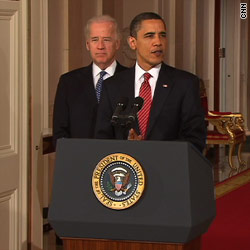
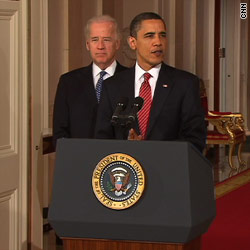
President Obama speaking on passage of Historic Health Reform Bill
“Mr. Speaker, I ask unanimous consent to revise and extend my remarks in opposition to this flawed health care bill”….We heard this canned statement over and over and over again tonight. We heard about the “Cornhusker kickback, the Louisiana Purchase, the Gator aid. We heard that this bill, if it passes, will make Americans less free. We heard that members of the military would loose their health coverage, that abortions would be paid for, that Medicare would be slashed. We heard from John Boehner that this was not the time to create bureaucracies, that there was no transparency, that there was not time to read the bill, that the people do not want this bill. His remarks continued to accent his distress over the process. If I had not been watching and only listening to his remarks over the radio, one would certainly have gotten the distinct impression that he was a very, very angry man. The tone and inflections in his voice gave one to believe that John Boehner just might be a little bit concerned that history was about to pass him by.
Health reform has been talked about and debated dating back to Theodore Roosevelt’s Bull Moose party which called for health insurance for industry. In his first term, President Roosevelt appointed a committee which was to report a program that addressed old-age and unemployment issues, medical care and health insurance. President Truman proposed a single insurance system that would cover all Americans with public subsidies to pay for the poor.
During nearly every Presidential election cycle since those days, every candidate has campaigned on the slogan of “health care for all”. At the end of that cycle, nothing gets done and the cycle continues. We immediately resort back to the status quo. The numbers of uninsured rise, the cost of insurance premiums skyrocket, rescissions continue, out of pocket expenses increase, denials for pre-existing conditions fall off the scales and even children are dropped from coverage.
Well, the time for change is long overdue. Republicans, for too long, have played politics with the lives of all Americans. At every turn, they have denied, delayed, obstructed, lied outright and instilled fear in the hearts and minds of the populace. As Speaker Pelosi said tonight, “all politics are personal”. After tonight, there will be no more politics of fear, no more politics of intimidation, no more threats of personal destruction. All of the talk about process, and all of the whining from republicans with bruised egos, don’t mean a heck of a lot now. What matters to those with no insurance, to those who are uninsured and those who have been bankrupted or lost their homes because of medical bills, simply stated, are results.
Many had given up on health reform with the Senate election results in Massachusetts earlier this year. Many have talked wildly about the upcoming November elections. The insurance companies became emboldened and Sen. Mitch McConnell and Rep. John Boehner actually began to believe their own words. Their repeated echo’s of “No” with the brazen 30-60% premium increases by Anthem and other insurers, re-awakened a cautious Democratic party. I want to personally thank Sen McConnell, Rep. Boehner and the insurance companies for their inadvertent contributions to the cause of health care reform.
In November 2008, America elected a President who said that he would get health reform done. For this President, it was not just a “slogan”. He took flack from all sides…Republicans and Democrats alike. With a determined Speaker of the House in Nancy Pelosi, President Obama and the U.S. House of Representatives delivered for the good of the American people.
When the sun rises in the east tomorrow, the earth will still be turning on it‘s axis, the American economy will not have collapsed, America will still be free, and there will be no Waterloo….the only thing that will be different tomorrow is that historic health reform for all Americans was passed tonight. History is now on the side of the American people.
“Bound To Be True”: President Obama Addresses House Democratic Caucus On Eve of Historic Vote
THE PRESIDENT: Thank you. Thank you. Thank you. Thank you. Thank you. Thank you, everybody. Thank you. Thank you very much. Thank you. Everybody, please have a set.
To Leader Reid, to Steny Hoyer, John Larson, Xavier Becerra, Jim Clyburn, Chris Van Hollen, to an extraordinary leader and extraordinary Speaker of the House, Nancy Pelosi, and to all the members here today, thank you very much for having me. (Applause.) Thanks for having me and thanks for your tireless efforts waged on behalf of health insurance reform in this country.
I have the great pleasure of having a really nice library at the White House. And I was tooling through some of the writings of some previous Presidents and I came upon this quote by Abraham Lincoln: “I am not bound to win, but I’m bound to be true. I’m not bound to succeed, but I’m bound to live up to what light I have.”
This debate has been a difficult debate. This process has been a difficult process. And this year has been a difficult year for the American people. When I was sworn in, we were in the midst of the worst recession since the Great Depression. Eight hundred thousand people per month were losing their jobs. Millions of people were losing their health insurance. And the financial system was on the verge of collapse.
And this body has taken on some of the toughest votes and some of the toughest decisions in the history of Congress. Not because you were bound to win, but because you were bound to be true. Because each and every one of you made a decision that at a moment of such urgency, it was less important to measure what the polls said than to measure what was right.
A year later, we’re in different circumstances. Because of the actions that you’ve taken, the financial system has stabilized. The stock market has stabilized. Businesses are starting to invest again. The economy, instead of contracting, is now growing again. There are signs that people are going to start hiring again. There’s still tremendous hardship all across the country, but there is a sense that we are making progress — because of you.
But even before this crisis, each and every one of us knew that there were millions of people across America who were living their own quiet crises. Maybe because they had a child who had a preexisting condition and no matter how desperate they were, no matter what insurance company they called, they couldn’t get coverage for that child. Maybe it was somebody who had been forced into early retirement, in their 50s not yet eligible for Medicare, and they couldn’t find a job and they couldn’t find health insurance, despite the fact that they had some sort of chronic condition that had to be tended to.
Every single one of you at some point before you arrived in Congress and after you arrived in Congress have met constituents with heart-breaking stories. And you’ve looked them in the eye and you’ve said, we’re going to do something about it — that’s why I want to go to Congress.
And now, we’re on the threshold of doing something about it. We’re a day away. After a year of debate, after every argument has been made, by just about everybody, we’re 24 hours away.
As some of you know, I’m not somebody who spends a lot of time surfing the cable channels, but I’m not completely in the bubble. I have a sense of what the coverage has been, and mostly it’s an obsession with “What will this mean for the Democratic Party? What will this mean for the President’s polls? How will this play out in November? Is this good or is this bad for the Democratic majority? What does it mean for those swing districts?”
And I noticed that there’s been a lot of friendly advice offered all across town. (Laughter.) Mitch McConnell, John Boehner, Karl Rove — they’re all warning you of the horrendous impact if you support this legislation. Now, it could be that they are suddenly having a change of heart and they are deeply concerned about their Democratic friends. (Laughter.) They are giving you the best possible advice in order to assure that Nancy Pelosi remains Speaker and Harry Reid remains Leader and that all of you keep your seats. That’s a possibility. (Laughter.)
But it may also be possible that they realize after health reform passes and I sign that legislation into law, that it’s going to be a little harder to mischaracterize what this effort has been all about.
Because this year, small businesses will start getting tax credits so that they can offer health insurance to employees who currently don’t have it. (Applause.) Because this year, those same parents who are worried about getting coverage for their children with preexisting conditions now are assured that insurance companies have to give them coverage — this year. (Applause.)
Because this year, insurance companies won’t suddenly be able to drop your coverage when you get sick — (applause) — or impose lifetime limits or restrictive limits on the coverage that you have. Maybe they know that this year, for the first time, young people will be able to stay on their parents’ health insurance until they’re 26 years old and they’re thinking that just might be popular all across the country. (Applause.)
And what they also know is what won’t happen. They know that after this legislation passes and after I sign this bill, lo and behold nobody is pulling the plug on Granny. (Laughter.) It turns out that in fact people who like their health insurance are going to be able to keep their health insurance; that there’s no government takeover. People will discover that if they like their doctor, they’ll be keeping their doctor. In fact, they’re more likely to keep their doctor because of a stronger system.
It’ll turn out that this piece of historic legislation is built on the private insurance system that we have now and runs straight down the center of American political thought. It turns out this is a bill that tracks the recommendations not just of Democrat Tom Daschle, but also Republicans Bob Dole and Howard Baker; that this is a middle-of-the-road bill that is designed to help the American people in an area of their lives where they urgently need help.
Now, there are some who wanted a single-payer government-run system. That’s not this bill. The Republicans wanted what I called the “foxes guard the henhouse approach” in which we further deregulate the insurance companies and let them run wild, the notion being somehow that that was going to lower costs for the American people. I don’t know a serious health care economist who buys that idea, but that was their concept. And we rejected that, because what we said was we want to create a system in which health care is working not for insurance companies but it’s working for the American people, it’s working for middle class families.
So what did we do? What is the essence of this legislation? Number one, this is the toughest insurance reforms in history. (Applause.) We are making sure that the system of private insurance works for ordinary families. A prescription — this is a patient’s bill of rights on steroids. So many of you individually have worked on these insurance reforms — they are in this package — to make sure that families are getting a fair deal; that if they’re paying a premium, that they’re getting a good service in return; making sure that employers, if they are paying premiums for their employees, that their employees are getting the coverage that they expect; that insurance companies are not going to game the system with fine print and rescissions and dropping people when they need it most, but instead are going to have to abide by some basic rules of the road that exemplify a sense of fairness and good value. That’s number one.
The second thing this does is it creates a pool, a marketplace, where individuals and small businesses, who right now are having a terrible time out there getting health insurance, are going to be able to purchase health insurance as part of a big group — just like federal employees, just like members of Congress. They are now going to be part of a pool that can negotiate for better rates, better quality, more competition.
And that’s why the Congressional Budget Office says this will lower people’s rates for comparable plans by 14 to 20 percent. That’s not my numbers — that’s the Congressional Budget Office’s numbers. So that people will have choice and competition just like members of Congress have choice and competition.
Number three, if people still can’t afford it we’re going to provide them some tax credits — the biggest tax cut for small businesses and working families when it comes to health care in history. (Applause.)
And number four, this is the biggest reduction in our deficit since the Budget Balance Act — one of the biggest deficit reduction measures in history — over $1.3 trillion that will help put us on the path of fiscal responsibility. (Applause.)
And that’s before we count all the game-changing measures that are going to assure, for example, that instead of having five tests when you go to the doctor you just get one; that the delivery system is working for patients, not just working for billings. And everybody who’s looked at it says that every single good idea to bend the cost curve and start actually reducing health care costs are in this bill.
So that’s what this effort is all about. Toughest insurance reforms in history. A marketplace so people have choice and competition who right now don’t have it and are seeing their premiums go up 20, 30, 40, 50 percent. Reductions in the cost of health care for millions of American families, including those who have health insurance. The Business Roundtable did their own study and said that this would potentially save employers $3,000 per employee on their health care because of the measures in this legislation.
And by the way, not only does it reduce the deficit — we pay for it responsibly in ways that the other side of the aisle that talks a lot about fiscal responsibility but doesn’t seem to be able to walk the walk can’t claim when it comes to their prescription drug bill. We are actually doing it. (Applause.) This is paid for and will not add a dime to the deficit — it will reduce the deficit. (Applause.)
Now, is this bill perfect? Of course not. Will this solve every single problem in our health care system right away? No. There are all kinds of ideas that many of you have that aren’t included in this legislation. I know that there has been discussion, for example, of how we’re going to deal with regional disparities and I know that there was a meeting with Secretary Sebelius to assure that we can continue to try to make sure that we’ve got a system that gives people the best bang for their buck. (Applause.)
So this is not — there are all kinds of things that many of you would like to see that isn’t in this legislation. There are some things I’d like to see that’s not in this legislation. But is this the single most important step that we have taken on health care since Medicare? Absolutely. Is this the most important piece of domestic legislation in terms of giving a break to hardworking middle class families out there since Medicare? Absolutely. Is this a vast improvement over the status quo? Absolutely.
Now, I still know this is a tough vote, though. I know this is a tough vote. I’ve talked to many of you individually. And I have to say that if you honestly believe in your heart of hearts, in your conscience, that this is not an improvement over the status quo; if despite all the information that’s out there that says that without serious reform efforts like this one people’s premiums are going to double over the next five or 10 years, that folks are going to keep on getting letters from their insurance companies saying that their premium just went up 40 or 50 percent; if you think that somehow it’s okay that we have millions of hardworking Americans who can’t get health care and that it’s all right, it’s acceptable, in the wealthiest nation on Earth that there are children with chronic illnesses that can’t get the care that they need — if you think that the system is working for ordinary Americans rather than the insurance companies, then you should vote no on this bill. If you can honestly say that, then you shouldn’t support it. You’re here to represent your constituencies and if you think your constituencies honestly wouldn’t be helped, you shouldn’t vote for this.
But if you agree that the system is not working for ordinary families, if you’ve heard the same stories that I’ve heard everywhere, all across the country, then help us fix this system. Don’t do it for me. Don’t do it for Nancy Pelosi or Harry Reid. Do it for all those people out there who are struggling.
Some of you know I get 10 letters a day that I read out of the 40,000 that we receive. Started reading some of the ones that I got this morning. “Dear President Obama, my daughter, a wonderful person, lost her job. She has no health insurance. She had a blood clot in her brain. She’s now disabled, can’t get care.” “Dear President Obama, I don’t yet qualify for Medicare. COBRA is about to run out. I am desperate, don’t know what to do.”
Do it for them. Do it for people who are really scared right now through no fault of their own, who’ve played by the rules, who’ve done all the right things, and have suddenly found out that because of an accident, because of an ailment, they’re about to lose their house; or they can’t provide the help to their kids that they need; or they’re a small business who up until now has always taken pride in providing care for their workers and it turns out that they just can’t afford to do it anymore and they’ve having to make a decision about do I keep providing health insurance for my workers or do I just drop their coverage or do I not hire some people because I simply can’t afford it — it’s all being gobbled up by the insurance companies.
Don’t do it for me. Don’t do it for the Democratic Party. Do it for the American people. They’re the ones who are looking for action right now. (Applause.)
I know this is a tough vote. And I am actually confident — I’ve talked to some of you individually — that it will end up being the smart thing to do politically because I believe that good policy is good politics. (Applause.) I am convinced that when you go out there and you are standing tall and you are saying I believe that this is the right thing to do for my constituents and the right thing to do for America, that ultimately the truth will out.
I had a wonderful conversation with Betsy Markey. I don’t know if Betsy is around here. There she is right there. (Applause.) Betsy is in a tough district. The biggest newspaper is somewhat conservative, as Betsy described. They weren’t real happy with health care reform. They were opposed to it. Betsy, despite the pressure, announced that she was in favor of this bill. And lo and behold, the next day that same newspaper runs an editorial saying, you know what, we’ve considered this, we’ve looked at the legislation, and we actually are pleased that Congresswoman Markey is supporting the legislation. (Applause.)
When I see John Boccieri stand up proud with a whole bunch of his constituencies — (applause) — in as tough a district as there is and stand up with a bunch of folks from his district with preexisting conditions and saying, you know, I don’t know what is going on Washington but I know what’s going on with these families — I look at him with pride.
Now, I can’t guarantee that this is good politics. Every one of you know your districts better than I do. You talk to folks. You’re under enormous pressure. You’re getting robocalls. You’re getting e-mails that are tying up the communications system. I know the pressure you’re under. I get a few comments made about me. I don’t know if you’ve noticed. (Laughter.) I’ve been in your shoes. I know what it’s like to take a tough vote.
But what did Lincoln say? “I am not bound to win, but I am bound to be true.” Two generations ago, folks who were sitting in your position, they made a decision — we are going to make sure that seniors and the poor have health care coverage that they can count on. And they did the right thing.
And I’m sure at the time they were making that vote, they weren’t sure how the politics were either, any more than the people who made the decision to make sure that Social Security was in place knew how the politics would play out, or folks who passed the civil rights acts knew how the politics were going to play out. They were not bound to win, but they were bound to be true.
And now we’ve got middle class Americans, don’t have Medicare, don’t have Medicaid, watching the employer-based system fray along the edges or being caught in terrible situations. And the question is, are we going to be true to them?
Sometimes I think about how I got involved in politics. I didn’t think of myself as a potential politician when I get out of college. I went to work in neighborhoods, working with Catholic churches in poor neighborhoods in Chicago, trying to figure out how people could get a little bit of help. And I was skeptical about politics and politicians, just like a lot of Americans are skeptical about politics and politicians are right now. Because my working assumption was when push comes to shove, all too often folks in elected office, they’re looking for themselves and not looking out for the folks who put them there; that there are too many compromises; that the special interests have too much power; they just got too much clout; there’s too much big money washing around.
And I decided finally to get involved because I realized if I wasn’t willing to step up and be true to the things I believe in, then the system wouldn’t change. Every single one of you had that same kind of moment at the beginning of your careers. Maybe it was just listening to stories in your neighborhood about what was happening to people who’d been laid off of work. Maybe it was your own family experience, somebody got sick and didn’t have health care and you said something should change.
Something inspired you to get involved, and something inspired you to be a Democrat instead of running as a Republican. Because somewhere deep in your heart you said to yourself, I believe in an America in which we don’t just look out for ourselves, that we don’t just tell people you’re on your own, that we are proud of our individualism, we are proud of our liberty, but we also have a sense of neighborliness and a sense of community — (applause) — and we are willing to look out for one another and help people who are vulnerable and help people who are down on their luck and give them a pathway to success and give them a ladder into the middle class. That’s why you decided to run. (Applause.)
And now a lot of us have been here a while and everybody here has taken their lumps and their bruises. And it turns out people have had to make compromises, and you’ve been away from families for a long time and you’ve missed special events for your kids sometimes. And maybe there have been times where you asked yourself, why did I ever get involved in politics in the first place? And maybe things can’t change after all. And when you do something courageous, it turns out sometimes you may be attacked. And sometimes the very people you thought you were trying to help may be angry at you and shout at you. And you say to yourself, maybe that thing that I started with has been lost.
But you know what? Every once in a while, every once in a while a moment comes where you have a chance to vindicate all those best hopes that you had about yourself, about this country, where you have a chance to make good on those promises that you made in all those town meetings and all those constituency breakfasts and all that traveling through the district, all those people who you looked in the eye and you said, you know what, you’re right, the system is not working for you and I’m going to make it a little bit better.
And this is one of those moments. This is one of those times where you can honestly say to yourself, doggone it, this is exactly why I came here. This is why I got into politics. This is why I got into public service. This is why I’ve made those sacrifices. Because I believe so deeply in this country and I believe so deeply in this democracy and I’m willing to stand up even when it’s hard, even when it’s tough.
Every single one of you have made that promise not just to your constituents but to yourself. And this is the time to make true on that promise. We are not bound to win, but we are bound to be true. We are not bound to succeed, but we are bound to let whatever light we have shine. We have been debating health care for decades. It has now been debated for a year. It is in your hands. It is time to pass health care reform for America, and I am confident that you are going to do it tomorrow.
Thank you very much, House of Representatives. Let’s get this done. (Applause.)
President Barack Obama-March 20, 2010
Obama To GOP: It’s Over
Obama listened politely for six hours, with occasional flashes of temper, but in the end, the message was clear: It’s over. We’re moving forward without Republicans.
Whether Obama and Dems will succeed in passing reform on their own is anything but assured, to put it mildly. But there’s virtually no doubt anymore that they are going to try — starting as early as tomorrow.
That was the subtle but unmistakable message of Obama’s closing argument. After hours of hearing Republicans repeat again and again that only an incremental approach to reform is acceptable to them, Obama rejected that out of hand.
Here’s the key bit from Obama:
I’d like Republicans to do a little soul searching to find out if there are some things that you’d be willling to embrace that get to this core problem of 30 million people without health insurance, and dealing seriously with the pre-existing conditions issue. I don’t know frankly whether we can close that gap.
And if we can’t close that gap, then I suspect Mitch McConnell, Harry Reid, Nancy Pelosi and John Boehner are going to have a lot of arguments about procedures in Congress about moving forward.
Unless I’m misreading that, Obama is saying that unless Republicans support comprehensive reform as Obama and Dems have defined it — dealing with the problem of 30 million uninsured and, by extension, seriously tackling the preexisting condition problem — they will almost certainly move forward with reconciliation.
What’s more, Obama also essentially accused Republicans of approaching today’s summit in bad faith — after they had sat there with him for six hours. He said that even after the public option was taken off the table, Republicans continued to use the same “government takeover” slur.
“Even after the public option wasn’t available, we still hear the same rhetoric,” Obama said. “We have a concept of an exchange which previously has been an idea that was embraced by Republicans before I embraced it. Somehow, suddenly it became less of a good idea.”
This accusation, combined with his assertion that Repubicans need to do some “soul-searching” on whether they wanted to join Dems in tackling reform as they have defined it, amount to an unmistakable vow to move foward without them.
Democratic aides are already interpreting Obama’s remarks along these lines. As one senior aide emailed: “We may make one last effort to try to get a Senate Republican.”
In terms of who “won” today’s debate, I tend to think Republicans actually accomplished much of what they needed to do today. It seems likely that some Congressional Dems will be just as skittish tomorrow as they were yesterday about moving forward alone via reconciliation. That means Dems still have an enormously difficult task ahead.
But Obama’s message to Dems and Republicans alike today was that barring some kind of major change on the GOP side, this is exactly what he and Dem leaders are about to attempt.
Update: To clarify, this was a call to Dems, perhaps more than anyone else, that the time has come for them to stiffen their spines and move forward with reconciliation, which Republicans, and even some nonpartisan observers, have repeatedly characterized as akin to marching off a cliff.
Also: This summit was always about laying the groundwork for Dems to go forward alone, barring a major capitulation from Republicans. As noted here repeatedly, Dems will find themselves in exactly the same position tomorrow as they did yesterday: Confronting the enormously difficult task of passing ambitious reform on their own.
Update II: A GOP aide emails the Republican take: “They badly needed a win today and they didn’t get it. Not even close. Republicans were prepared. The President was pedantic and peeved.”
Greg Sargent-The Plum Line Feb 25, 2010
Contrary to Greg’s take on who won today, my take is that the American people won. Delay, deny and obstruct was on full display by the GOP today. That was transparency that even Stevie Wonder could see!
Raemd95
Share This Blog


 Unknown Feed
- An error has occurred; the feed is probably down. Try again later.
 mykeystrokes.com


You must be logged in to post a comment.