Clearly Constitutional: A Primer on the Constitutionality of the Affordable Care Act
Nearly three dozen judges have now considered challenges to the landmark Affordable Care Act and the overwhelming majority of these cases have been dismissed. Nevertheless, a single outlier judge in Virginia has embraced the meritless arguments against the new health care law and another judge in Florida also appears poised to break with the overwhelming consensus of his colleagues.
With only a few exceptions, these lawsuits principally challenge the Affordable Care Act’s minimum coverage provision—the provision requiring most Americans to either carry health insurance or pay slightly more income taxes—falsely arguing that Congress lacks the constitutional authority to enact such a provision. It is true that Congress’s authority is limited to an itemized list of powers contained in the text of the Constitution itself, but while Congress’s powers are not unlimited, they are still quite sweeping. There is no doubt that the Affordable Care Act fits within these enumerated powers in three ways, as this issue brief will demonstrate.
Congress has broad power to regulate the national economy
A provision of the Constitution known as the “commerce clause” gives Congress power to “regulate commerce … among the several states.” And there is a long line of Supreme Court decisions holding that Congress has broad power to enact laws that substantially affect prices, marketplaces, or other economic transactions. Because health care comprises approximately 17 percent of the national economy, it is impossible to argue that a bill regulating the national health care market does not fit within Congress’s power to regulate commerce.
Nevertheless, opponents of the Affordable Care Act claim that a person who does not buy health insurance is not engaged in any economic “activity” and therefore cannot be compelled to perform an undesired act. Even if these opponents were correct that the uninsured are not active participants in the health care market— and they are active, of course, every time they become ill and seek medical care—nothing in the Constitution supports this novel theory. Indeed, this theory appears to have been invented solely for the purpose of this litigation. Congress has enacted countless laws which would be forbidden under this extra-constitutional theory:
- Guns: President George Washington signed a law that required much of the country to purchase a firearm, ammunition, and other equipment in case they needed to be called up for militia service. Many of the members of Congress who voted for this mandate were members of the Philadelphia Convention that wrote the Constitution.
- Civil rights: The Civil Rights Act of 1964 compelled business owners to engage in transactions they considered undesirable—hiring and otherwise doing business with African Americans.
- Insurance mandates: The Affordable Care Act is not even the only federal law requiring someone to carry insurance. The Price-Anderson Act of 1957 requires nuclear power plants to purchase liability insurance and the Flood Disaster Protection Act requires many homeowners to carry flood insurance.
- Other mandates: Other laws require individuals to perform jury service, file tax returns, and register for selective service.
The minimum coverage provision is the keystone that holds the Affordable Care Act together
The Constitution also gives Congress the power “[t]o make all laws which shall be necessary and proper for carrying into execution” its power to regulate interstate commerce. As Supreme Court Justice Antonin Scalia explains, this means that “where Congress has the authority to enact a regulation of interstate commerce, it possesses every power needed to make that regulation effective.”
The act eliminates one of the insurance industry’s most abusive practices—denying coverage to patients with pre-existing conditions. This ban cannot function if patients are free to enter and exit the insurance market at will. If patients can wait until they get sick to buy insurance, they will drain all the money out of an insurance plan that they have not previously paid into, leaving nothing left for the rest of the plan’s consumers.
Seven states enacted a pre-existing conditions law without also passing an insurance coverage requirement, and all seven states saw health insurance premiums spiral out of control. In some of these states, the individual insurance market collapsed.There is a way out of this trap, however. Massachusetts enacted a minimum coverage provision in 2006 to go along with its pre-existing conditions provision and the results were both striking and immediate. Massachusetts’ premiums rapidly dropped by 40 percent.
In other words, because the only way to make the pre-existing conditions law effective is to also require individuals to carry insurance, that requirement easily passes Scalia’s test.
The link between the minimum coverage provision and the Affordable Care Act’s insurance regulations also sets this law aside from other hypothetical laws requiring individuals to purchase other goods or services. The national market for vegetables will not collapse if Congress does not require people to purchase broccoli, nor will Americans cease to be able to obtain automobiles absent a law requiring the purchase of cars from General Motors. Accordingly, a court decision upholding the Affordable Care Act would not provide a precedent enabling Congress to compel all Americans to purchase broccoli or cars, despite the law’s opponents’ claims to the contrary.
Congress has broad leeway in how it raises money
Congress also has the authority to “lay and collect taxes” under the Constitution. This power to tax also supports the minimum coverage provision, which works by requiring individuals who do not carry health insurance to pay slightly more income taxes. Taxpayers who refuse insurance must pay more in taxes while those who do carry insurance are exempt from this new tax. For this reason, the law is no different than dozens of longstanding tax exemptions, including the mortgage interest tax deduction, which allows people who take out home mortgages to pay lower taxes than people who do not.
Opponents of the Affordable Care Act respond that the minimum coverage provision somehow ceases to be a tax because the new law does not use the word “tax” to describe it, but this distinction is utterly meaningless. Nothing in the Constitution requires Congress to use certain magic words to invoke its enumerated powers. And no precedent exists suggesting that a fully valid law somehow ceases to be constitutional because Congress gave it the wrong name.
By Ian Millhiser, Policy Analyst and Blogger for the Center for American Progress where his work focuses on the Constitution and the Judiciary-January 18, 2011
Pool Fools: Republicans Denounce Republican Health Care Plan
As pointed out by Jonathan Chait in his recent article in The New Republic on January 12, 2011, “When you combine the GOP’s intense opposition to Obama with its very weak commitment to any alternative policy architecture, you get this kind of wild, opportunistic flip-flopping”. Reference the following enlightening article by Timothy Noah:
Of all the arguments Republicans have been waging against Obamacare as the House of Representatives prepares to vote for its repeal, none is harder to take than their criticism of the federally subsidized high-risk pools the law created to provide immediate relief to the uninsured. In May, the House Republican Conference complained that these high-risk pools would be unfair to people currently enrolled in existing state-run risk pools because the latter group was paying higher premiums. In July, the House Republican Conference complained that implementation of this unfair federal program was being delayed. By January, the House Republican leadership was grousing (in a report titled Obamacare: A Budget-Busting, Job-Killing Health Care Law) that costs for this unfair-but-wrongly-delayed program were higher than expected even as participation in this unfair-but-wrongly-delayed-but-too-costly program was lower than it should be.
Republican health care policies, I noted not quite one year ago (“Pool Party“), typically segregate the healthy majority from the unhealthy minority in order to lower insurance premiums for the healthy. Never mind that that raises insurance premiums sky-high for the unhealthy. High-risk pools are the most efficient way to achieve such segregation and about the least efficient way to pay medical bills here on planet Earth. A health insurance pool consisting entirely of people too sick to qualify for private insurance is like a fire-insurance pool consisting entirely of pyromaniacs. The best that can be said for such groupings is that the hospitalizations (or the fires) probably won’t all happen in the same month. Health insurance high-risk-pool premiums are typically 125 percent to 200 percent above normal premiums, but even so, a government subsidy is typically required to cover costs.
Conservatives claim the problem is not the inherent contradiction in insurance pools consisting entirely of people who need lots and lots of health care, but rather in poor management by the Obama administration. The American Enterprise Institute’s Thomas P. Miller and the Ethics and Public Policy Center’s James Capretta have argued that the administration ought to narrow eligibility; increase the subsidy; and introduce “more effective incentives and tools for both patients and providers to make higher-value health care decisions,” i.e., pressure doctors and hospitals to lower costs and eliminate unnecessary procedures. But the first solution is preposterous in light of weak enrollment (in fairness, Miller and Capretta wrote before that became apparent); the second solution is perhaps necessary but expensive; and the third is a laudable goal that’s much more difficult to achieve with a sick population than with a healthy one. Taken together, these three solutions betray an extreme myopia about the inherent limitations on high-risk pools to begin with.
The poor performance of Obamacare’s high-risk pools aren’t an argument against Obamacare. They’re an argument in favor of it. High-risk pools are a Band-Aid to stanch a hemorrhage. Democrats don’t kid themselves that the Band-Aid will do much to stop the bleeding, which is why they don’t embrace it as a long-term solution. Republicans ought to stop pretending it can be one.
Original Article By: Timothy Noah-Slate, January 11, 2011
Health Reform at Work Today and Tomorrow: Improvements That Began Last Year Will Continue
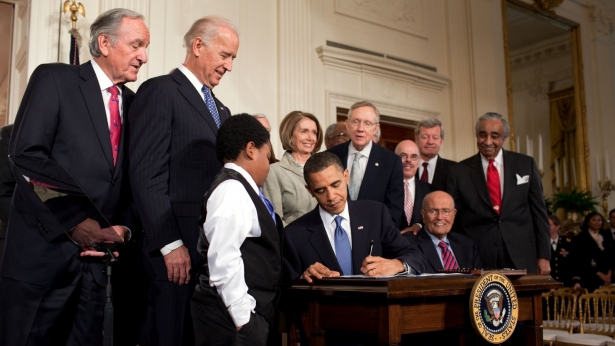
President Barack Obama is applauded as he signs the health care reform bill, on March 23, 2010, in the East Room of the White House in Washington. The bill includes many benefits for Americans who have health insurance today and those who have struggled to find and maintain health coverage.
2010 was a momentous year for the American health care system. In March, Congress passed—and President Barack Obama signed—landmark legislation that reforms the health insurance market, provides all Americans with affordable access to health coverage, and reduces the growth of health care costs.
The Department of Health and Human Services and other parts of the executive branch have begun to implement the new law in the subsequent 10 months. The Affordable Care Act, or ACA, includes many benefits for Americans who have health insurance today and those who have struggled to find and maintain health coverage. Many of these benefits came on-line in 2010.
Signature achievements include:
- Establishing pre-existing condition insurance plans in every state so that individuals with health problems who cannot find coverage in the regular market have a reliable source of coverage
- Requiring employer-sponsored health plans to offer coverage to the young-adult children of policyholders
- Helping employers with unpredictable health care spending for retired workers
- Providing more than 1 million rebate checks to Medicare enrollees who incurred high out-of-pocket prescription drug spending in 2010
- Prohibiting health insurance plans from denying coverage to children with pre-existing conditions
- Protecting individuals with high health care costs from the financial risk of absurdly low annual and lifetime limits on their benefits
- Prohibiting health insurance plans from rescinding coverage when a policyholder gets sick
These changes bring a new degree of stability and security to millions of Americans’ health coverage. And even more improvements are around the corner. Beginning this month, seniors will enjoy meaningful new benefits and significant improvements in their prescription drug coverage, while individuals and businesses will receive premium rebates from their insurance company when the insurers incur excessive administrative costs.
Specific improvements in 2011 include:
- Closing the Medicare prescription drug coverage gap. Seniors and people with disabilities who obtain prescription drug coverage through Medicare Part D will enjoy a new discount on brand-name and generic prescription drugs when they hit the so-called “doughnut hole” in their Part D benefits. Since the beginning of the program, enrollees have hit a gap in coverage when their total drug spending—including out-of-pocket costs and expenses covered by their Medicare Part D plan—exceeds a preset limit (currently $2,830). Patients then pay the total cost of their prescription drugs, without help from their drug plan, until their total drug expenses hit an upper limit and coverage kicks in again. With the new discount, people with drug spending high enough to hit the coverage gap will save almost $500 on average this year, while people with very high drug costs will save more than $1,500.
- Launching new prevention benefits for Medicare enrollees. Good coverage of preventive services helps seniors and other Medicare enrollees better manage their health. New benefits include coverage without cost-sharing for recommended preventive services (those that receive an “A” or “B” rating from the U.S. Preventive Services Task Force) and new coverage for a personal prevention plan.
- Increasing access to primary care. Medicare will pay primary care providers a 10 percent bonus payment, which offers a new incentive for physicians, nurses, and others to provide primary care services.
- Requiring insurers to provide high value for premium dollars. Beginning in 2011, insurers will pay rebates to policyholders—individuals and employers—when plan spending on clinical services falls below 80 percent of premium revenue in the individual and small group market, and 85 percent of premium revenue in the large group market.
Looking ahead, ACA provisions that will touch real people every day will continue coming on-line through 2011. These include providing more consumer information on healthy food choices by requiring chain restaurants and vending machines to provide nutritional data no later than March, and improving long-term care by sending enhanced federal Medicaid payments to support new state investments in community-based long-term care services starting in October. Tangible improvements will continue beyond this year, such as fully closing the coverage gap in Medicare Part D and improving Medicaid coverage for preventive care.
The Affordable Care Act’s most striking impact will come in 2014 when new health insurance exchanges launch, premium subsidies become available, and Medicaid coverage expands to include all low-income individuals regardless of family composition, age, or disability status.
These headline-grabbing changes in our health care system may be a few years down the road. But millions of Americans are already benefiting from the Affordable Care Act—and millions more will receive better care in the near future thanks to the changes in the new law.
By Karen Davenport | January 13, 2011-Center For American Progress. Photo: AP/Charles Dharapak
Share This Blog


 Unknown Feed
- An error has occurred; the feed is probably down. Try again later.
 mykeystrokes.com
You must be logged in to post a comment.