“Beyond Pelvic Politics”: Choosing Between Bishops’ Sensibilities And Women’s Health
I may not be as theologically sophisticated as American bishops, but I had thought that Jesus talked more about helping the poor than about banning contraceptives.
The debates about pelvic politics over the last week sometimes had a patronizing tone, as if birth control amounted to a chivalrous handout to women of dubious morals. On the contrary, few areas have more impact on more people than birth control — and few are more central to efforts to chip away at poverty.
My well-heeled readers will be furrowing their brows at this point. Birth control is cheap, you’re thinking, and far less expensive than a baby (or an abortion). But for many Americans living on the edge, it’s a borderline luxury.
A 2009 study looked at sexually active American women of modest means, ages 18 to 34, whose economic circumstances had deteriorated. Three-quarters said that they could not afford a baby then. Yet 30 percent had put off a gynecological or family-planning visit to save money. More horrifying, of those using the pill, one-quarter said that they economized by not taking it every day. (My data is from the Guttmacher Institute, a nonpartisan research organization on issues of sexual health.)
One-third of women in another survey said they would switch birth control methods if not for the cost. Nearly half of those women were relying on condoms, and others on nothing more than withdrawal.
The cost of birth control is one reason poor women are more than three times as likely to end up pregnant unintentionally as middle-class women.
In short, birth control is not a frill that can be lightly dropped to avoid offending bishops. Coverage for contraception should be a pillar of our public health policy — and, it seems to me, of any faith-based effort to be our brother’s keeper, or our sister’s.
To understand the centrality of birth control, consider that every dollar that the United States government spends on family planning reduces Medicaid expenditures by $3.74, according to Guttmacher. Likewise, the National Business Group on Health estimated that it costs employers at least an extra 15 percent if they don’t cover contraception in their health plans.
And of course birth control isn’t just a women’s issue: men can use contraceptives too, and unwanted pregnancies affect not only mothers but also fathers.
This is the backdrop for the uproar over President Obama’s requirement that Catholic universities and hospitals include birth control in their health insurance plans. On Friday, the White House backed off a bit — forging a compromise so that unwilling religious employers would not pay for contraception, while women would still get the coverage — but many administration critics weren’t mollified.
Look, there’s a genuine conflict here. Many religious believers were sincerely offended that Catholic institutions would have to provide coverage for health interventions that the church hierarchy opposed. That counts in my book: it’s best to avoid forcing people to do things that breach their ethical standards.
Then again, it’s not clear how many people actually are offended. A national survey found that 98 percent of sexually active Catholic women use birth control at some point in their lives. Moreover, a survey by the Public Religion Research Institute reported that even among Catholics, 52 percent back the Obama policy: they believe that religiously affiliated universities and hospitals should be obliged to include birth control coverage in insurance plans.
So, does America’s national health policy really need to make a far-reaching exception for Catholic institutions when a majority of Catholics oppose that exception?
I wondered what other religiously affiliated organizations do in this situation. Christian Science traditionally opposed medical care. Does The Christian Science Monitor deny health insurance to employees?
“We offer a standard health insurance package,” John Yemma, the editor, told me.
That makes sense. After all, do we really want to make accommodations across the range of faith? What if organizations affiliated with Jehovah’s Witnesses insisted on health insurance that did not cover blood transfusions? What if ultraconservative Muslim or Jewish organizations objected to health care except at sex-segregated clinics?
The basic principle of American life is that we try to respect religious beliefs, and accommodate them where we can. But we ban polygamy, for example, even for the pious. Your freedom to believe does not always give you a freedom to act.
In this case, we should make a good-faith effort to avoid offending Catholic bishops who passionately oppose birth control. I’m glad that Obama sought a compromise. But let’s remember that there are also other interests at stake. If we have to choose between bishops’ sensibilities and women’s health, our national priority must be the female half of our population.
By: Nicholas Kristof, Op-Ed Columnist, The New York Times, February 11, 2012
“The Tin Man”: Mitt Romney, The Rich And The Rest
No one should be surprised that the Tin Man has a tin ear.
After all, Mitt Romney is the same multimillionaire who joked that he was “unemployed” while he was “earning” more in one day than most Americans earn in a year and paying a lower rate on those earnings than most Americans do.
This is the same man who bragged last month that he liked to fire people at a time when nearly 13 million people are out of work and who accepted the endorsement this week of Donald Trump, who has made “You’re Fired!” his television catchphrase.
This is the same man who in November claimed that federal employees are making “a lot more money than we are.” What?! We? What we? Please direct me to the federal employees with the $20 million paychecks. In fact, The Washington Post pointed out in November that federal employees on average “are underpaid by 26.3 percent when compared with similar nonfederal jobs, a ‘pay gap’ that increased by about 2 percentage points over the last year while federal salary rates were frozen.”
And who could forget his remark that “corporations are people.” Classic.
But this week when Romney said that he wasn’t concerned about the very poor in this country, he jumped in the pickle barrel and went over the waterfall.
First, his statement:
“I’m not concerned about the very poor. We have a safety net there. If it needs repair, I’ll fix it. I’m not concerned about the very rich. They’re doing just fine. I’m concerned about the very heart of America — the 90-95 percent of Americans who right now are struggling.”
Romney went on to say that his campaign was focused on “middle-income Americans” and that “we have a very ample safety net” for the poor.
He later tried to clarify, saying that his comments needed context. Then he said that the comments were a “misstatement” and that he had “misspoke.” Yeah, right.
Where to begin?
First, a report from the Center on Budget and Policy Priorities last month pointed out that Romney’s budget proposals would take a chainsaw to that safety net. The report points out that cuts proposed by Romney would be even more draconian than a plan from Representative Paul Ryan: “Governor Romney’s budget proposals would require far deeper cuts in nondefense programs than the House-passed budget resolution authored by Budget Committee Chairman Paul Ryan: $94 billion to $219 billion deeper in 2016 and $303 billion to $819 billion deeper in 2021.”
What does this mean for specific programs? Let’s take the Supplemental Nutrition Assistance Program, since “food stamps” have been such a talking point in the Republican debates. The report says the Romney plan “would throw 10 million low-income people off the benefit rolls, cut benefits by thousands of dollars a year, or some combination of the two. These cuts would primarily affect very-low-income families with children, seniors and people with disabilities.”
Does that sound like a man trying to “fix” our social safety nets? Absolutely not. Romney is so far up the beanstalk that he can no longer see the ground.
Then let’s take the fact that a report last month by the Tax Policy Center found that his tax plan would increase after-tax income for millionaires by 14.5 percent while increasing the after-tax income of those making less than $20,000 by less than 1 percent and of those making between $30,000 and $40,000 by less than 3 percent.
For a man who’s not worried about the rich, he sure seems to want them to rake in more cash.
This has nothing to do with context. This has everything to do with a caviar candidate’s inability to relate to a chicken-soup citizenry.
Then there is the “ample safety net” nonsense. No one who has ever been on the low end of the income spectrum believes this, not even Republicans. According to a Pew Research Center survey conducted in October, even most Republicans and Republican-leaning independents who make less than $30,000 a year, which accounts for about a quarter of all Republicans, say that the government doesn’t do enough to help the poor. Only a man who has never felt the sting of poverty or seen its ravages would say such a thing.
But perhaps the most pernicious part of his statement was the underestimating of the rich and poor and the elasticized expansion of the term “middle income” or middle class. Romney suggests that 95 percent of Americans are in this group. Not true.
According to the Census Bureau, the official poverty rate in 2010 was 15.1 percent.
And that’s the income poor. It doesn’t even count the “asset poor.” A report issued this week by the Corporation for Enterprise Development found that 27 percent of U.S. households live in “asset poverty.” According to the report, “These families do not have the savings or other assets to cover basic expenses (equivalent to what could be purchased with a poverty level income) for three months if a layoff or other emergency leads to loss of income.”
On the other hand, the definition of “rich” is more nebulous. However, according to a December Gallup report, Americans set the rich threshold at $150,000 in annual income. And according to the U.S. Census Bureau 8.4 percent of households had an income of $150,000 or more in 2010.
So at the very least, nearly a fourth of all Americans are either poor or rich.
That would leave about three-fourths somewhere in the middle, but not all middle class. Tricking the poor to believe they’re in it, and allowing the wealthy to hide in it, is one of the great modern political deceptions and how we’ve arrived at our current predicament.
According to a New York Times/CBS News poll conducted last month, nearly a fifth of families making less than $15,000 said that they were middle class and nearly two-fifths of those making more than $100,000 said that they were middle class.
Romney is not only cold and clumsy, he’s disastrously out of touch, and when talking about real people, out of sorts. If only he had a heart, and if only that heart was connected to his brain.
By: Charles M. Blow, Op-Ed Columnist, The New York Times, February 3, 2012
“Empathy Gap”: Mitt Romney Rejects Concern For The “Very Poor”
Just two weeks ago, Mitt Romney told voters in South Carolina, “I’m concerned about the poor in this country.” This morning, Romney reversed course and said the exact opposite.
“I’m not concerned about the very poor. We have a safety net there. If it needs repair, I’ll fix it. I’m not concerned about the very rich, they’re doing just fine. I’m concerned about the very heart of America, the 90%, 95% of Americans right now who are struggling and I’ll continue to take that message across the nation. […]
“You can focus on the rich, that’s not my focus. You can focus on the very poor, that’s not my focus. My focus is on middle-income Americans.”
The Republican frontrunner added, “We will hear from the Democrat Party, the plight of the poor.”
When Romney’s rivals were hammering him on Bain Capital — and the fact that he got extremely rich by firing American workers and leading a vulture-capitalist firm — he shifted rhetorical gears in order to seem sympathetic towards those struggling most.
With his new “I’m not concerned about the very poor” line, it appears Romney has abandoned this tack altogether.
Regardless, as a matter of substance, Romney’s line this morning is just a mess.
For one thing, it’s tone-deaf to a breathtaking degree. When a hyper-wealthy politician boasts about taking pleasure in firing people, he probably shouldn’t tell national television audiences he’s “not concerned about the very poor.”
For another, Romney’s candid admission underscores a larger policy problem: he’s not only unconcerned with the plight of the very poor, he also pursuing an agenda that would make their lives considerably more difficult. If elected, a Romney administration intends to slash public investments that benefit working families, while raising taxes on those at the bottom of the income scale.
Let’s also not forget that while Romney insisted this morning that he’s “not concerned about the very rich,” either, there’s ample evidence to the contrary. Indeed, the presidential hopeful has already presented a plan to give the very wealthy yet another massive tax break.
And as for Romney’s purported concern for the middle class, what the former governor neglected to mention this morning is that his tax plan largely ignores the middle class. By his own admission, Romney doesn’t plan to do much of anything for middle-income earners.
Taken together, in one interview, Romney managed to sound callous towards those struggling, lie about his agenda’s focus on the wealthy, and ignore the relevant details of his disregard for the middle class.
Not bad for a morning’s work.
By: Steve Benen, The Maddow Blog, February, 1, 2012
“Compassion Deficit”: Mitt Romney, His Own Worst Enemy
If Mitt Romney has a big problem in the Republican primary, it’s himself. The former Massachusetts governor can’t seem to keep his foot out of his mouth, and has—through misstatements—portrayed himself as a cold and heartless shill for the 1 percent. Here are some of the greatest hits:
- “Corporations are people, my friend.”
- “I’m running for office for Pete’s sake!”
- “I like being able to fire people.”
- “I should tell my story. I’m also unemployed.”
When heard in their full context, most of these aren’t as bad as they sound. But, as John Kerry learned in 2004, voters aren’t that attuned to the context of politicians, especially when they say things that leave a bad first impression.
On CNN last night, Romney deepened this problem with another tone deaf comment which, fairly or not, will reinforce the image that he is a defender of the wealthy:
“I’m not concerned with the very poor. We have a safety net there. If it needs repair, I’ll fix it. I’m not concerned about the very rich, they’re doing just fine. I’m concerned about the very heart of the America, the 90 percent, 95 percent of Americans who right now are struggling.” [Emphasis mine]
It’s clear that Romney isn’t dismissing the “very poor” as much as he’s expressing confidence in the existing safety net for those mired in poverty. If that net isn’t strong enough, Romney notes, he’ll fix it as president. But the phrasing is incredibly awkward, and when voters hear this, they’ll latch on to the first sentence to the exclusion of the rest. And of course, Democrats are certain to use this in attack ads throughout the general election. Though, given Romney’s relationship with truth in advertising, that isn’t as unfair as it sounds.
It should be said that, if we go by his proposed policies, Romney doesn’t actually care much about the poor. The former Massachusetts governor has consistently voiced support for the draconian budget cuts of Rep. Paul Ryan, which would cripple the safety net and deprive low-income Americans of valuable assistance. What’s more, he plans deep cuts to taxes on capital gains geared toward the rich, who are most likely to collect income on investment. Like many on the right, his preferred economic policies would redistribute income to the wealthy, and destroy our fiscal future with a massive long-term deficit.
By: Jamelle Bouie, The American Prospect, February 1, 2012
Remembering Dr. King
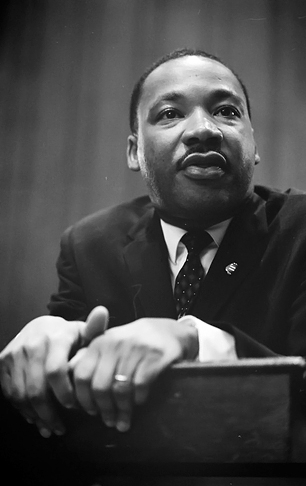
Dr. Martin Luther King, Jr (BuyenLarge/Getty Images)
I was surprised by his assassination. I didn’t see the Poor People’s Campaign as the threat to Washington and the Establishment that I now see it was. We feared for Dr. King’s life more in the early Sixties, through 1963, than we did by 1968. Up through 1965, there was a civil-rights-related death every couple of months, though most of them didn’t make headlines. By the end of ’65, there was a lull in the killings, and I thought perhaps we were finally beyond all that.
In his last year, we worried about Dr. King’s health. He was working eighteen to twenty hours a day. He would stay up all night reading, talking, clowning – whatever he felt like doing – and then wake up at five-thirty raring to go. His wife used to say that he had a war on sleep.
We would tell him that it looked like he was going to be around for a long time, and he couldn’t possibly keep this pace up, because he was close to forty. But if you said anything, he’d brush you off. I could never argue with him anyway. He was a preacher. And whenever we argued, he’d get to preaching. You never won an argument because he would take off on flights of oratory, and you’d forget your point trying to listen to him.
The year he died was the year he felt he had to establish the agenda for America’s future. For fifteen years he’d been struggling with the issues of racism, poverty and war. He refused to be just a civil rights leader. He was a sensitive lover of people who saw his primary responsibility in the black community. By 1968, though, it was clear to him that the black community could not concern itself with civil rights issues alone. The country was spending billions of dollars in Vietnam, and he saw racism and war becoming ever more tied up into one big problem for this country.
It was a time of increasing desperation for him. The SCLC had a fraction of the budget it should have had, about $700,000, and a small staff of fifty people, trying to take on the problems of the urban North, as well as the South, which still had large pockets of resistance. Not only weren’t we getting any aid from the federal government, but we had legions of FBI agents tracking us down, harassing us, trying to disrupt the work we were doing – work which I thought was the only thing that was giving America a fighting chance to survive.
The dangerous times when we were together were always the times he was most humorous. For years we couldn’t go anywhere without FBI men following us around. Dr. King was philosophical about it and very friendly toward them. Every now and then, we would leave a meeting through another entrance – not to escape the car that trailed us, but to sneak up on them. Dr. King would say hello, introduce us and (we always gave them the benefit of the doubt) thank them for the “protection” they were giving us.
I think he would have been quite content to be pastor of the Riverside Church, maybe teach at a university or a seminary. He wanted to teach the philosophy of religion, which was the subject of his Ph.D. He turned down a chance for the presidency of the NAACP when he first came to Montgomery in 1954, because he wasn’t sure he wanted to become that involved in the growing civil rights movement.
But when the bus boycott came in ’55, he was pressed into action. He had to respond. He was just twenty-six, and he never had the time to be the fun-loving man that he really was. He made the cover of Time magazine only a couple of years after he finished his degree, and then he was a celebrity.
From that time on he felt the burden of the country, his people and the world on his shoulders. He accepted it, but he always said he would have liked to do something else. He felt responsible for America’s future and its survival because he said that nobody understands nonviolence except black Americans, and if America was going to learn to live with the rest of the world, we’d have to help her find a nonmilitary course. In his Nobel Peace Prize speech, in fact, Dr. King said that the choice was nonviolence or nonexistence. I think back sometimes to what this country would have been like without Dr. King. The South was an armed camp in the Forties and Fifties. The GI bill and better job opportunities had created the beginnings of a black middle class, and they were not going to tolerate oppression any further. The white forces of reaction were trying to resist the advance of this new black middle class.
Every black family in the South had a gun. My father was probably the least violent man I know, and yet there were at least four guns in our household. Had there been no Martin Luther King Jr., the southern part of the United States would have looked like Northern Ireland or Lebanon.
And yet Martin saw that blacks and whites did not hate each other. They were being forced down through history on a collision course. Martin Luther King straightened out that course. He made it possible for blacks and whites to move in a parallel course of development and work together by using the tactic and methodology of nonviolence. He did not blame the white man for the problems that blacks were having. He saw blacks and whites caught up in a situation that they didn’t create, that they inherited. He saw nonviolence as a means for bringing people to realize that they could work their way together out of the situation.
Dr. King never understood why J. Edgar Hoover couldn’t comprehend what he was doing. If you read Hoover’s FBI reports on the March on Washington speech, you realize that he never saw Dr. King’s vision of a New America. He saw a powerful, radical political voice trying to destroy the nation.
I didn’t know then, but I now think that there lies the indirect responsibility for his assassination. I don’t know if it can ever be pinned down, but there are so many client groups that did dirty jobs around and for official people. I think now that Dr. King’s assassination was directly related to the fear that officialdom had of his bringing large numbers of poor people to the nation’s capital, setting up tents, demanding some response from them.
By: Andrew Young, Rolling Stone, January 13, 2012. (This story is from the December 1, 1977 issue of Rolling Stone). Writing in 1977, the famed civil rights activist Andrew Young reflects on the life and legacy of Martin Luther King.
Share This Blog


 Unknown Feed
- An error has occurred; the feed is probably down. Try again later.
 mykeystrokes.com
You must be logged in to post a comment.