“Nickel And Dimed”: The Very Real Scourge Of Wage Theft
Last week, the owner of a chain of Papa John’s was ordered to pay $800,000 in back pay to workers he’d shortchanged by rounding down to the nearest hour on their time cards and failing to pay overtime properly. “I didn’t realize if you work 10 hours per day, you are supposed to pay overtime for two hours,” the owner, Emmanuel Onuaguluchi, told the New York Post.
A couple hours of overtime there may not seem like a lot of money, but those amounts could mean everything to workers struggling to get by on minimum wage and, as the judgment shows, it all adds up over the years. This latest judgment is part of a big push by New York’s attorney general, Eric Schneiderman, who has also sued local McDonald’s and Domino’s franchises.
Cases of wage theft—or, at least, the cases officials are pursuing—have been up in California and across the country, too, according to The New York Times. Business interests told the Times that politicians like Schneider are just pursuing these cases to curry favor with unions, but the unions aren’t really behind the legal actions.
If restaurants and other companies in the service industry—where workers are paid by the hour, have hours that change from week-to-week, and are especially vulnerable to wage theft—are complaining that the wage theft cases are coming from people who, in general, want to be paid more, they’re right. The fight for higher minimum wages across the country has highlighted the problems low-wage workers face in their workplaces, and wage theft is one of the most common ways they’re denied even the measly current minimum wage of $7.25 an hour.
Wage theft is old, but before now workers might have been too scared to complain or go to an attorney on their own. “I think one reason why it’s coming up more now is that it’s tied to a real organizing campaign where fast food workers are demanding and protesting,” says Tsedeye Gebreselassie, a senior staff attorney for the National Employment Law Project, which is not directly involved in any of these cases.
By law, companies have to pay their employees minimum wage, and overtime pay should kick in once an employee works past an eight-hour shift in a day. Five years ago, in a survey funded by the Russell Sage Foundation and conducted by researchers from the National Employment Law Project, UCLA, Cornell University, and the University of Illinois, Chicago, a quarter of low-wage employees reported they hadn’t been paid the minimum wage in the prior week, and three-quarters said they were denied overtime.
As someone who has spent the past three years reporting from low-income communities across the country and grew up in working-class family in a poor part of Arkansas, I hear stories of wage theft all the time. Onuaguluchi’s view about overtime is common—I’ve known people who have worked in fast-food restaurants and routinely pulled several double shifts in a week, but as long as their hours did not total more than 80 in a two-week pay period their bosses did not pay overtime.
I’ve also heard of bosses who don’t pay correctly, and paychecks come with hours missing. Those mistakes are harder for workers to figure out than you would think because they need to keep records on exactly when they worked and how many hours it was, and compare it to what their paychecks say when they arrive a week or two later. But at the end of the day, these cases are relatively easy to prove because records of time sheets will show how many hours each employee worked and whether they were paid properly. Rounding down, as Onuaguluchi did, would be evident.
Many stories about wage theft, though, offer more insidious examples that are harder to fight. I know of people who’ve had to run errands on behalf of their workplaces before they even show up for work, and are expected to arrive every morning with said errand completed. I know people who’ve had to clock out for breaks they can’t take. Sometimes, workers are expected to have a certain amount of work done before they clock in at the official start of their shifts, or are asked to or expected to finish a task once they’re already gone, according to their time sheets. It would be harder to tackle cases like that in court because these practices might not be codified or routine, but the basic idea is that bosses at companies like this don’t rank their employees’ time as valuable.
In fairness, the direct bosses like Onuaguluchi are often squeezed themselves. While three-quarters of these kinds of stores are owned by franchisees who own multiple units and are often making quite a profit, their profits rely on running their operations as cheaply as possible. The small-business man or woman who owns one or two might struggle to pay their employees properly, although I have little sympathy for those who break the law. That’s because franchise fees are expensive: even a franchise fee considered relatively affordable, like 7/11, takes $31,000 to start up. McDonald’s requires $45,000 and that the owners have $300,000 in cash or other funds available to them.
Companies like these also require other licensing fees to be paid, and sometimes franchisees even pay rent because the parent company owns the physical location of the store.
So, people like Schneiderman have promised to go after Papa John’s, and other big companies that franchise stores as well. What Papa John’s and their ilk say is that they’re not responsible for the ways their franchisees pay people. Yet they intensely manage their brands, which often includes monitoring time sheets that franchisees send in, quality control tests that could influence hiring and firing decisions, and other fine-grained aspects of their operations. Even more directly, attorneys could argue that these companies charge their franchisees so much in fees that they know, or should know, that the only way for them to make a profit is to shortchange their employees.
In July, the National Labor Relations Board ruled McDonald’s was a joint employer in a similar case, and that pay complaints could be made against them. If suits against the parent companies succeed, it might actually start to end the practice of robbing low-income workers of the little money they have. “At the end of the day, you want to recover the unpaid wages, but you also want to correct the behavior,” Gebreselassie says. “One of the best ways to do that is to reach to the corporate parent.”
By: Monica Potts, The Daily Beast, February 15, 2015
“Hurting A Large Number Of Their Own”: Republican Refusal To Expand Medicaid Could Come Back To Haunt Them
Republican legislatures in state after state, from Tennessee to Wyoming, are rejecting the Medicaid expansion of the Affordable Care Act for no other reason than pure spite against poor people:
On Friday, the Wyoming Senate shot down Gov. Matt Mead’s expansion plan, and a House committee then pulled its bill. The double whammy effectively killed the state’s chances of enacting the Obamacare option this year.
Lawmakers there acted just days after the Tennessee Legislature shot down an expansion proposal by Gov. Bill Haslam. Together, the two rejections diminish the momentum that Medicaid expansion supporters were enjoying last month, when Indiana Gov. Mike Pence won federal approval of his particular plan and Arkansas Gov. Asa Hutchinson agreed to extend that state’s “private option” program for 18 months. Both Pence and Hutchinson are also Republicans.
There’s simply no good reason for any of it, even within the confines of conservative economic orthodoxy. The money for the Medicaid expansion comes from the federal government; the states themselves are at no risk of further expense for many years to come if at all. Republican governors are trying to get the funding for the healthcare of their citizens. Better access to healthcare means fewer illnesses, better productivity, and more money in the pockets of the sorts of consumers most likely to spend in the economy. More money for Medicaid creates a virtuous economic circle at no cost to the states.
No doubt there is a great deal of racism in the motivation of conservative state legislators to deny healthcare to their poorest residents. But in fact, the majority of those on Medicaid are not minorities–and poor whites are overwhelmingly Republicans. So even from the jaundiced view of a bigot these GOP legislators are hurting a huge number of their own.
And it’s starting to cause problems for them. Republicans in Kentucky are doing backflips to pretend to their constituents that there’s some big difference between Kynect, Kentucky’s state exchange, and Obamacare. And even now some Republicans are defecting over it:
Former Republican state Sen. Tim Johnson on Wednesday announced he’s switching parties and challenging incumbent Republican Lt. Gov. Tate Reeves this year.
But the noted Elvis impersonator said he won’t be appearing as the King on the campaign trail.
“Why join the Democratic Party and run for lieutenant governor?” Johnson said before a cheering throng of supporters at a Capitol press conference. “I’ll tell you: We are all Mississippians first. Elected officials should be in the business of helping all Mississippians, not picking out who to hurt.”
The Republican Party has relied for decades on cultural and racial resentment to keep them afloat. But there’s only so long a political party can only abuse the entirety its own people without even an eye toward sowing cultural division, without it coming back to haunt them.
By: David Atkins, Political Animal, The Washington Monthly, February 7, 2015
“More Worried About Their Reputation”: Republicans Don’t Really Care About Inequality
The Republican Party appears to accept that poverty and the inequities of wealth and political power that have prevailed over the last 15 years are issues it can no longer ignore. Not without paying a price. After all, Mitt Romney’s cool indifference to the everyday struggles of working Americans went a long way toward sinking his 2012 campaign.
But expressing concern about inequality is one thing. Doing something about it is another. The GOP so far appears more worried about its reputation as being the party of the very, very rich, than the empirical reality of its being the party of the very, very rich.
At a recent Republican gathering, Senator Ted Cruz of Texas gave voice to the party’s incongruity of perception and reality. “I think Republicans are and should be the party of the 47 percent,” he said. Later at that same event, billionaire brothers Charles and David Koch announced plans to spend nearly $1 billion through their political network in the next race for the White House, with virtually all of it going to the Republican Party’s nominee.
If the GOP were truly troubled by historic rates of income and wealth inequality, it would rubber-stamp President Barack Obama’s plan to raise taxes on the wealthy and use the proceeds to fund infrastructure projects like roads, bridges, waterways, and sewer systems. Public investments like these have historically garnered broad support, because they are neutral vehicles for achieving the goals of statecraft. Such expenditures would not only create hundreds of thousands of seasonal jobs, as well as many thousands of permanent jobs, but also stimulate economic activity on a national scale. And they’d pay for themselves over time.
The president’s $4 trillion fiscal budget would tap into offshore accounts and Wall Street transactions that only the very, very rich possess and thus care about. In addition to public works, which Obama has been calling for since his took office, increased revenues would be used for free community college and universal child care.
This, or something like it, is what serious people talk about if they are serious about combating inequality. Progressive redistribution, however bitter-tasting the phrase may be, must be on the table. But all we are likely to hear, especially from Republicans aiming high, are platitudes steeped in conservative morality, homilies to the power of private enterprise freed from the bonds of bureaucratic red tape, or the benefits of cutting taxes. Really. Anything. Anything at all to avoid tax hikes even on the treasonous few who hide their money offshore.
All one needs to do to see the difference between what Republicans are saying and Republicans are doing is look at the current session of Congress. The very first item on Senate Majority Leader Mitch McConnell’s to-do list was passing a bill authorizing the construction of the Keystone XL Pipeline. That project would indeed create thousands of seasonal jobs, but only about 40 permanent ones. It would have virtually no impact on the U.S. economy. Moreover, the public would get nothing in return, unless you count greater levels of global warming.
That’s not to mention other items being pushed which have nothing to do with serving the greater good. A short list: House Republicans have introduced legislation to restrict abortion (the melodramatically titled “fetal-pain bill”), to dismantle part of the Dodd-Frank financial reform law, and to starve to death the president’s modest executive action on illegal immigration.
Even if the Republicans really did believe, as Jeb Bush is trying to convince us, that addressing inequality is the right thing to do, don’t bet on any action. Doing the right thing had rarely been an incentive, because this is a party now committed to total warfare against Obama and the Democratic agenda. The only way the Republicans will take action on inequality is if they are forced to, but even then, they’ll likely do everything short of raising taxes on the very, very rich.
That’s why we should keep our eyes on the minimum wage and paid sick leave. House Speaker John Boehner has said he’d rather kill himself than raise the minimum wage. Conservatives are poised to attack Republicans entertaining mandated sick days. But in terms of inequality, these are the easiest ways to say you’ve done something without raising taxes on the very, very rich.
So yes, inequality is emerging as a major issue in the 2016 presidential race, and Jeb Bush, Ted Cruz and others are going to try hard to convince us that the Republican Party cares, really cares, about the plight of the poor and an ever-shrinking middle class. But remember the last time a major candidate talked about such “compassionate conservatism.” By the end of his second term, the greatest beneficiaries of that compassion were the very, very wealthy.
By: John Stoehr, Managing Editor of The Washington Spectator; The National Memo, February 6, 2015
“Same Conservative Talking Points”: Jeb Bush Won’t Win the GOP Primary If He Keeps Giving Bland Speeches Like This One
On Wednesday, Jeb Bush delivered the biggest speech of his young campaign in Detroit, Michigan, where he promised to lay out a positive agenda in the months ahead. “I will offer a new vision,” the former Florida governor said. “A plan of action that is different than what we have been hearing in Washington D.C.” Political analysts quickly tried to parse Bush’s words to discern any hints about that plan of action.
Those hints are hard to find. Read the transcript; it’s an utterly ordinary speech, filled with bromides against liberalism and big government. Bush cited rising income inequality, stagnant wages, and slow growth as problems that demand big solutions. He talked about the opportunity gap and mentioned Uber and deregulation. And he used the downfall of Detroit as a warning sign for the rest of country. Nothing new, in other words.
Bush did try to spin conservative talking points in a more positive, wonky manner. His most notable comments came about halfway through, when he criticized Washington, D.C.—as in, the Obama administration—for “recklessly degrading the value of work, the incentive to work, and the rewards of work.”
We have seen them cut the definition of a full-time job from 40 to 30 hours, slashing the ability of paycheck earners to make ends meet. We have seen them create welfare programs and tax rules that punish people with lost benefits and higher taxes for moving up those first few rungs of the economic ladder.
In the first sentence, Bush is referring to the provision under the Affordable Care Act that requires employers with more than 50 workers to offer health insurance to any employee that works more than 30 hours. Republicans have criticized the rule as incentivizing employers to reduce their workers’ hours below that threshold. They have suggested changing the definition of a full-time employee to 40 hours per week—a change that the Congressional Budget Office says would increase the deficit and lower the number of Americans with health insurance. Even some conservatives like Yuval Levin, the editor of National Affairs, have come out against it. But it’s a good sound bite—one that shows Bush is aware of ongoing policy arguments in Washington—so he jumped on it.
“Instead of a safety net to cushion our occasional falls,” he added, “they have built a spider web that traps people in perpetual dependence. We have seen them waive the rules that helped so many people escape welfare.”
I had not heard any politician compare the safety net to a “spider web” before, and based on a quick Google search, Bush has not made the comparison before either. It’s reminiscent of Representative Paul Ryan’s analogy of the safety net as a “hammock” that traps the poor in poverty, an analogy that has been harshly criticized. But while a hammock evokes images of laziness and gives agency to the poor, a spider web suggests that the poor are trapped. With many Americans believing that Republicans don’t care enough for the poor, you can understand why Bush settled on the “spider web” analogy.
But does Bush actually reject the “maker and taker” rhetoric? At the Washington Post, Greg Sargent argues yes—or at least that Bush will do so rhetorically. “Message: Jeb Bush will not be 47-percent-ed. He will not be Mitt-ed,” Sargent writes. “He will present a conservative pro-economic-freedom case without committing the fatal political misstep of showing contempt for those who currently depend on government in any form.” That seems broadly right, at least insofar as we can determine Bush’s rhetorical strategy from one speech. Yet, it’s always a tight line to blame government for making the poor dependent without actually blaming the poor themselves.
And when Bush argues that Obama tried to “waive the rules that helped so many people escape welfare,” he’s harkening back to an old, disproven conservative meme against the administration. During the 2012 election, Mitt Romney argued that Obama was undoing welfare reform by offering states waivers allowing them to forego the welfare work requirements, as long as they accomplished the goal of the law— moving welfare recipients to work. In fact, Republican governors had requested the waivers. The Washington Post fact checker gave Romney four Pinnochios for the baseless assertion. But Bush has brought the attack line back.
Overall, Bush seemed to be trying to use the same conservative talking points and attacks, with a more positive spin. Yet, it’s still hard to look at this speech and see what part of the Republican Party it appeals to, at least compared to his competitors. Florida Senator Marco Rubio has a far more comprehensive agenda at this point. Wisconsin Governor Scott Walker offers a very conservative governing record and has won three statewide races in four years. Many Republican candidates have switched their economic message to focus on wages and inequality, if only to find a new attack against the president as the recovery strengthens.
Granted, this is just one speech. Bush has plenty of time to deliver concrete policy proposals. But there’s something telling about the ordinariness of his speech, of its generic GOP talking points. There’s no natural constituency for his candidacy, at least in the primary. Bush has said that the GOP nominee must be willing to “lose the primary to win the general.” In other words, to avoid taking far-right positions that doom the candidate in the general election.
Thought about in that light, Bush’s speech makes more sense. Spinning conservative talking points in a positive light, while promising a new agenda, is a campaign platform that could appeal to the full electorate. If he somehow emerged as the Republican nominee, he could be a very credible challenger to Hillary Clinton. Yet, the underlying problem remains: He has to win the nomination. His willingness to lose the primary will, in all likelihood, prove self-fulfilling.
This isn’t just his problem, though; it’s the Republican Party’s. The primary electorate makes it hard for a candidate like Bush, who despite being extremely conservative is nonetheless moderate compared to the other candidates, to win. It forces the eventual nominee to move to the right, eventually putting himself in an almost impossible position to win the general election. The complete blandness of Bush’s speech Wednesday only underlines this dynamic.
By: Danny Vinik, The New Republic, February 5, 2015
“Keeping Desperation As High As Possible”: Why The Greedy Upper Class Loves The GOP
Last week, Reihan Salam took a whack at America’s upper class in Slate. His charge? That the upper class uses its considerable political clout to protect itself from competition and keep its own incomes high, thus making life harder on everyone else further down the economic ladder. And he’s not wrong!
But Salam is also a conservative, with a conservative’s standard desire for low taxes, few regulations, and a skimpy social safety net. And what he conveniently leaves out of his screed is the fact that these preferences are themselves the ultimate expression of upper-class greed and self-dealing.
Let’s start with what Salam gets right. He points out that licensing and accreditation laws protect professions like dentists, lawyers, electricians, hairstylists, and the like from competition, which raises the costs of services they provide and prevents other workers from breaking into the market. The local land-use restrictions and zoning regulations that many in the upper class favor drive up housing prices, which makes it harder for the lower class to live in good neighborhoods with good schools, or to benefit from the economic development that comes with gentrification. The upper class seems implicitly content with an immigration status quo that maximizes competition in working-class jobs while minimizing it among high-skill professions. And of course there was the recent collapse of President Obama’s proposal to raise new tax revenue from 529 college savings accounts, a self-interested revolt of the upper class if ever there was one.
However, if you read between the lines, Salam isn’t really talking about the upper class writ large here. He’s talking about the liberal upper class. The issues he cites are mainly a big deal in cities, where liberals cluster. And conservative commentary in general these days has a tendency to talk about the American upper class as if it’s populated entirely by liberal yuppies who love yoga, organic food, Neil deGrasse Tyson, and abortions, and who think that guns are barbaric and that religion is backwards.
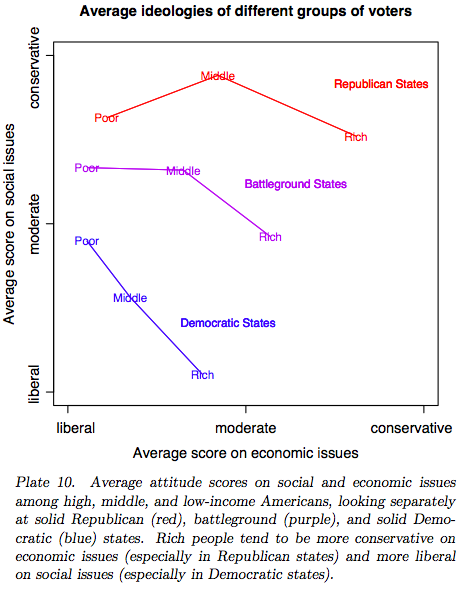
As it happens, however, the GOP relies on the upper class even more than Democrats. Median household income in the United States is $52,250, and if you look at the 2012 election, voters below that mark broke hard for Obama, with those above going for Mitt Romney by lesser margins. This trend of the Democrats getting way more votes below the median income level has roughly held for decades. These days, strong support for Republicans really doesn’t kick in until you get close to $75,000, or roughly the top third of the income ladder.
The difference between the parties is not that one relies on the wealthy and one doesn’t. Both parties lean heavily on those voters and divvy them up in various ways. (Mainly through cultural and social issues.) But the Democrats’ coalition also includes a fair portion that’s lower and working class, that’s still fighting for attention in the party, and that occasionally gets it. Conversely, lower- and working-class voters are mostly just absent from the GOP.
This matters because the upper class also has a pretty distinctive set of economic policy preferences. According to a recent study by Pew, the most financially secure Americans — roughly a fourth to a third of the population, by Pew’s definition — disproportionately say that government can’t afford to do more to help the needy, and that poor people “have it easy” thanks to government benefits. The less financially secure think the opposite. Large majorities of those making below $75,000 say the thing that bothers them the most about taxes is that the wealthy don’t pay their fair share. Large majorities of Americans oppose cuts to everything from Social Security and Medicare to aid for the poor. They support making union organizing easier and more federal spending on education.
Hell, 57 percent of the Republican or Republican-leaning voters who do make less than $30,000 think government doesn’t do enough to support poor people.
The reason the GOP can get away with being on the opposite side on all these matters is the fact that the voting population skews upper class: Even Democrats in the top third of the income distribution are noticeably more economically right-wing than poorer Democrats or Republicans, and Republicans in the top third are really economically right-wing.
There’s a pretty straightforward argument for why the upper class tilts in this direction. As Salam notes, the policy preferences of the upper class that really stick in his craw boil down to protecting their incomes and thus making the goods and services they provide more expensive for everyone else. But the flip side of that is making sure the goods and services everyone else provides — and thus their incomes — come cheap. That’s where the GOP comes in.
The essence of worker bargaining power is the ability to tell an employer “no.” That forces business owners to offer a better deal, driving up wages and benefits. A broad and generous welfare state gives workers leverage in that regard. It also helps boost aggregate demand, getting us closer to the full employment that really gives workers an edge. In short, the income of the working class is inversely proportional to its level of economic desperation. The effect of conservatives’ preferred economic policies — from slashing spending to imposing work requirements for aid — is to keep that desperation as high as possible. And of course, the upper class certainly doesn’t want to shoulder the taxes necessary to make such a system work.
The thing to remember is that, when it comes to what to do with the working class, the interests of the upper class and the super-rich cohere. Whether you’re a corporate CEO, a small-business owner, or just a well-heeled professional who consumes a lot of high-end goods and services, it benefits you to keep the labor of everyday Americans as cheap, compliant, and disposable as possible. It’s true, as Salam notes, that the truly rich aren’t quite as desperate to defend their interests as the upper class is; if you’ve got Mitt Romney’s dough, you can put up with more taxes, regulations, and workers demanding dignified pay and good benefits.
But that just bolsters the point that the fervent bastion of the economic right is the upper class. They’ve got the most to gain by slashing taxes, cutting regulations, scrapping government aid programs, and busting unions.
As Salam acknowledges, he doesn’t want high taxes on the wealthy, or for America to go down the road of the big European welfare states. His fellow reform conservatives and the Republican Party agree with him in this regard. Salam then says of the upper class: “I sensed that their gut political instincts were all about protecting what they had and scratching out the eyeballs of anyone who dared to suggest taking it away from them.”
But aren’t conservative economic policies the perfect expression of that exact impulse?
By: Jeff Spross, The Week, February 3, 2015
Share This Blog


 Unknown Feed
- An error has occurred; the feed is probably down. Try again later.
 mykeystrokes.com