Texas-Style Tort Reform: Rick Perry’s Texas Health Care Hoax
In his quest to win the Republican presidential nomination, Texas Gov. Rick Perry is perpetuating a convincing hoax: that implementing Texas-style tort reformwould go a long way toward curing what ails the U.S. health care system.
Like his fellow GOP contenders, Perry consistently denounces “Obamacare” as “a budget-busting, government takeover of healthcare” and “the greatest intrusion on individual freedom in a generation.” He promises to repeal the law if elected.
Unlike those in the “repeal-and-replace” wing of the Republican Party, however, Perry has emerged as leader of the “repeal-and-let-the-states-figure-it-out” wing that believes the federal government has no legitimate role in fixing America’s health care system.
“To hear federal officials tell it, they’ve got all the answers on health care and it’s up to the rest of us to sit, wait and embrace whatever solution — if any — they may eventually provide,” Perry wrote in a newspaper commentary in 2009. “I find this troubling, since states have shown they know a thing or two about solving problems that affect their citizens.”
Even as he points with pride to the alleged benefits of malpractice and other tort reforms that have been enacted during his tenure as governor of Texas, Perry says he is opposed to tort reform at the federal level. He cites the 10th Amendment to the Constitution, which states-rights advocates say limits the role of the federal government.
But if Perry had his way, all the states would do as Texas did in 2003 when lawmakers enacted legislation, which he championed, limiting the amount of money juries can award patients who win malpractice lawsuits against doctors and hospitals. The legislation capped non-economic (pain and suffering) damages at $250,000 in lawsuits against doctors and $750,000 against hospitals. A few months after he signed the bill into law, the state’s voters narrowly passed a constitutional amendment, also endorsed by Perry, which had the same effect. Proponents of the amendment wanted to be sure the new law would be constitutional.
Texas, he wrote in that 2009 commentary “stands as a good example of how smart, responsible policy can help us take major steps toward fixing a damaged medical system, starting with legal reforms.”
As a result of the 2003 tort reform law, malpractice liability insurers reduced their rates in Texas and, according to Perry, the number of doctors applying to practice medicine in the state “skyrocketed.”
He says that in the first five years after tort reform was enacted, 14,498 doctors either returned to practice in Texas or began practicing there for the first time.
Tort Reform Backfires in Texas
That certainly sounds impressive — so long as you look at that number in isolation. But when you look at how Texas stacks up with the rest of the country in terms of physician growth in direct patient care, tort reform appears to have given Texas no leg up in competition with others states for doctors. In fact, according to statistics compiled by the American Medical Association and other physician organizations, Texas has actually lost ground when it comes to the number of doctors practicing in the state since tort reform was enacted. Big time.
In 2008, the number of physicians in patient care per 10,000 civilian population in the United States was 25.7. At just 20.2 doctors per 10,000 people, Texas ranked near the bottom of the 50 states. In fact, only nine states fared worse. In 2000, three years before tort reform, Texas was still bringing up the rear, but not as badly. Back then, 11 states fared worse than the Lone Star state.
Even more revealing, the number of doctors in patient care increased 13.2 percent nationwide from 2000 to 2008. It increased only 12.8 percent in Texas. The rate of growth was actually greater in 41 other states and in Washington, D.C. than it was in the Lone Star state.
It is true that malpractice insurance rates dropped in Texas after tort reform was enacted, but Texans would be hard pressed to claim any direct benefit from that drop — except, that is, Texans who are doctors.
The Dallas Morning News published a chart earlier this year showing that the average malpractice rate charged ob/gyns in Texas by the state’s largest domestic insurer of physicians fell from $53,752 in 2003 to $33,881 in 2011. The paper reported drops of similar percentages for doctors in family practice and general surgery.
Advocates of tort reform have long claimed that one of the reasons for escalating health care costs is the “defensive medicine” doctors practice, such as over-treating and prescribing more medications and diagnostic tests than necessary, out of fear of being sued. Well, if Texans believed their own health insurance rates would go down once tort reform made defensive medicine less prevalent, they have by now been disabused of that notion. The chances of a Texas family saving a few bucks on premiums would actually be greater if they moved to another state.
In 2010, the average premium for family coverage in Texas was $14,526. That’s $655 higher than the U.S. average. Those numbers seem to indicate that doctors have not passed on their own insurance savings to their patients and that they are not practicing medicine any less defensively than before tort reform was enacted.
Not only are Texans paying more for their own insurance while doctors are paying less for theirs, their chances of getting employer-subsidized coverage is less than it would be if they lived in another state. The Dallas Morning News, citing statistics from the Agency for Healthcare Research and Quality and other sources, reported that a smaller percentage of employers in Texas offered coverage to their workers last year than in the U.S. as a whole (51 percent and 53.8 percent, respectively). And the Texans who do have coverage through the workplace are contributing far more out of their own pockets for that coverage than people who live in most other states. In Texas last year, the average employee contribution toward company-sponsored coverage was $4,500. The U.S. average was much lower: $3,721.
Another statistic Perry is not likely to mention when he talks about the benefits of tort reform is the number of Texans who are uninsured. The U.S. Census Bureau reports that Texas continues to be the state with the highest percentage of its residents without coverage, a whopping 25 percent last year, compared to about 16 percent nationwide. It was dead last in 2003 and it is dead last now.
All this should leave us wondering what “thing or two” states have come up with to solve the problems that affect their citizens. Considering the dismal state of health care in Texas, perhaps Perry had Massachusetts in mind.
By: Wendell Potter, Center for Media and Democracy, September 1, 2011
The Deeply Crazy In Virginia’s Obamacare Lawsuit
As my Philadelphia Phillies idled through a two-hour rain delay Thursday night, I curled up with some light reading: a Texas Review of Law & Politics article by the legal team, led by Virginia Attorney General Ken Cuccinelli, that’s challenging the new healthcare individual mandate in the U.S. Court of Appeals for the Fourth Circuit.
It’s fascinating stuff.
Cuccinelli and co. follow a long trail from the 18th century British jurist William Blackstone to the Dred Scott case to the New Deal to the present day. The conservative team, at first, makes a tight, prudential case against the Obamacare mandate that I, in my nonprofessional capacity, happen to favor.
In their words:
No existing case needs to be overruled and no existing doctrine needs to be curtailed or expanded for Virginia to prevail on the merits. Nor does Virginia remotely suggest that the United States lacks the power to erect a system of national healthcare. Virginia expressly pled that Congress has the authority to act under the taxing and spending powers as it did with respect to Social Security and Medicare, but that Congress in this instance lacked the political capital and will to do so. No challenge has been mounted by Virginia to the vast sweep and scope of the Patient Protection and Affordable Care Act (PPACA). Instead, only the mandate and penalty were challenged because the claimed power is tantamount to a national police power inasmuch as it lacks principled limits.
In plainer, get-to-the-point English: We grant you the social safety net established under the “Roosevelt Settlement.” We recognize Congress’s power to regulate interstate commerce. We even grant that this power could conceivably deliver universal healthcare. But for Pete’s sake, don’t try to include “inactivity”—that is, not buying a health insurance plan on the private market—under its purview.
Because, once you regulate the act of doing nothing, what’s left to regulate?
Er, nothing.
Thus, does the state’s power to tax and police become theoretically unlimited?
But, later in the body of the piece, Team Cuccinelli begins to play other, more presently familiar cards. Glenn Beck fans will recognize the faces in the rogue’s gallery: Justice Oliver Wendell Holmes, progressive philosopher John Dewey, and others who, this argument goes, created the post-New Deal legal and philosophical edifice.
Wouldn’t you know it, this welfare-state stuff constitutes a violation of natural law—which, ipso facto, means economic laissez-faire—and a lurch into moral chaos. Echoing the newly popular Hayek, Cuccinelli’s article asserts the primacy of economic rights while characterizing as relativistic the not-exclusively-liberal jurisprudential argument that personhood and dignity precede the marketplace. (Last I checked, I’ve never seen an unborn baby sign a contract.)
Come conclusion time, the piece sounds eerily like it’s not merely advocating the curtailment of an otherwise defensible attempt to advance the national interest, but rather like a full-throated libertarian manifesto:
The Progressive Meliorists had argued that they should be accorded constitutional space in which to make a social experiment, agreeing in turn to be judged by the results. The New Dealers carried the experiment forward. Seventy years later, results are in suggesting that the experiment is living beyond its means. The statist heirs to the experiment say that it cannot and must not be curtailed, so now they claim this new power.
Social Security and Medicare—an experiment! Just a temporary, 70-year blip on the radar!
So, in 46 pages, we proceed from modest and reasonable to deeply crazy.
It behooves us to ask, what’s Cuccinelli’s endgame?
I think we’ve seen this movie before.
By: Scott Galupo, U. S. News and World Report, August 18, 2011
What Does The Tea Party Want?….The New Litmus Test
Jim VandeHei and Mike Allen argue that the Tea Party redefined the purpose of the GOP as opposition to spending:
The Republican Party is undergoing a messy but unmistakable 20-month transformation from fanatically anti-Obama to fanatically anti-spending, providing top party officials a new and intriguing playbook for recapturing the White House in 2012.
To understand the current evolution, flash back to late spring of 2009. The GOP was disoriented and adrift, its leadership void filled by the bombastic voices of Palin, Beck and Rush Limbaugh. There was no common conservative cause, beyond fear and loathing of Obama. No wonder swing voters were so down on them.
But the tea party, treated at first by the media as exotics, forced Republicans to focus almost exclusively on the size of government. By the time the 2010 elections rolled around, tea party activists and most independent voters were completely aligned on the need to cut, cut, cut.
Midterm election results showed that this approach offers the GOP its best – and maybe only – hope of keeping the interests of independents and tea party activists aligned enough to beat Obama.
The new litmus tests for GOP presidential hopefuls are support for repealing “Obamacare” and taking a cleaver to government spending. If a presidential candidate could harness the smaller-government conservatism, temper it enough to avoid a blatant overreach and articulate a vision for a prosperous future for the country, it’s not hard to imagine swing voters finding such a person appealing.
There’s a superficial appeal to this story. But the evidence that Tea Party activists want to cut spending — at least actual spending programs — is sparse. Polls show that Tea Party supports overwhelmingly oppose cuts to Social Security and Medicare. The main thrust of Tea Party opinion is not the belief that Obama has spent too much money, but the belief that Obama has spent too much money on people unlike them:
More than half say the policies of the administration favor the poor, and 25 percent think that the administration favors blacks over whites — compared with 11 percent of the general public.
They are more likely than the general public, and Republicans, to say that too much has been made of the problems facing black people.
Here’s another cut, showing the Tea Party’s greater comfort with inequality of opportunity and stronger belief that the government devotes too many resources to minorities:
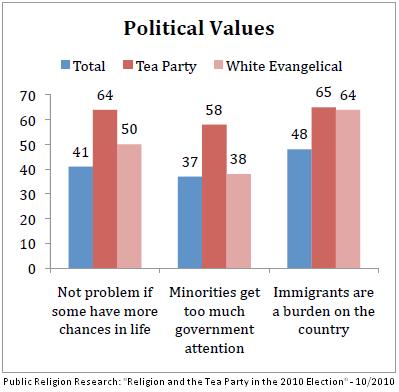
It’s a revolt against the composition of government much more than the level.
Now, it’s true that Republicans aren’t exactly translating this blueprint into action, but they’re not exactly flouting it, either. There is always a generalized antipathy toward spending amongst Republican and swing voters, but it disappears when the subject turns to actual government programs. Usually Republicans decide to just cut taxes for the rich instead. Here’s is the one part of the article proposing a defined policy change:
Even Ralph Reed, the Republican operative most tapped in to evangelicals, reflected the new GOP mindset when he gave this surprising wish list for the next presidential race: “In a perfect world, I’d like to hear the Republican nominee run on a platform that takes the capital gains tax to zero over five years.” Reed, who summoned several of the presidential candidates to Iowa for his Faith & Freedom Coalition this week, made it clear that Christian conservatives will still need to be catered to, but added that his side will understand the nominee’s need to focus on swing voters.
So an article putatively about the GOP redefining itself as an anti-spending party has one actual programmatic detail, and it’s: a zeroing out of the capital gains tax. In the name of appealing to swing voters — who, in fact, oppose tax cuts for the rich. Meet the new boss…
By: Jonathan Chait, The New Republic, March 14, 2011
The GOP’s Health Policy Cynics
The health care community is discovering to its shock and dismay that it’s not simply traditional Republican conservatives who have taken control of the House of Representatives, it’s a new group of cynics.
Conservatives, like liberals, have a more-or-less coherent set of ideas. They use political power to push preferred policies, whether related to health care, housing or a hundred other possible issues. William F. Buckley Jr., one of the fathers of modern American conservatism, “had a way of … making conservatism a holistic view of life not narrowed to the playing fields of ideology alone,” as one admirer put it.
Although cynics may claim conservative credentials, their view of government is really nothing more than a quarrel about its cost. It brings to mind Oscar Wilde’s immortal phrase, “The cynic knows the price of everything and the value of nothing.”
The contrast between the two viewpoints was on stark display at two recent marquée meetings, AcademyHealth’s yearly policy conference and the sprawling Health Information and Management Systems Society — HIMSS – Health IT Conference and Exhibition.
AcademyHealth’s “Running of the Wonks” (my term, not theirs) is a magnet for researchers and policy mavens who are inured by long experience to most political rhetoric. Yet at the general session featuring a bipartisan dialogue among congressional staffers, the harsh rhetoric from the GOP participants stunned the crowd. The new federal health law, it seemed, was evil incarnate, and the rhetoric of “repeal and replace” was wielded with a fundamentalist zeal.
“The bureaucracies that administer ObamaCare” must be cut, declared one aide to a powerful congressional leader, setting the tone. And in case anyone didn’t get the point, the word “ObamaCare” was deliberately repeated every few syllables in a tone of disdain combined with wonder at how such a monstrosity had ever come to be. (AcademyHealth meeting rules said the staffers could not be quoted by name.)
The audience of wonks quailed, then quietly queued up for the question-and-answer period. They knew, after all, that the health law’s fine print incorporates a generous helping of initiatives championed by both conservatives, and those on the left. Besides, these were staffers speaking, not politicians playing to the press. Surely, gentle reason would triumph. Alas, it was not to be.
The Prevention and Public Health Fund? “You mean, the prevention health slush fund, as we like to refer to it?” replied a GOP staffer.
The Innovation Center at the Centers for Medicare & Medicaid Services? “An innovation center at CMS is an oxymoron,” responded a Republican aide, before adding a personal barb aimed at the attendees: “Though it’s great for PhDs who come to Washington on the government tab.”
There was also no reason the government should pay for “so-called comparative effectiveness research,” another said.
“Everything’s on the chopping block,” said yet another.
Everything? At HIMSS, where GOP staffers also spoke, attendees were chagrined to learn that “everything” applied to them, too. The subsidies for health information technology that were part of the American Recovery and Reinvestment Act were targeted in legislation introduced in late January by Rep. Jim Jordan, R-Ohio, chairman of the Republican Study Group. His bill would repeal this funding and eliminate all remaining stimulus spending, including about $45 billion in unspent health IT funds.
Those focused on the substance of health policy might be forgiven for feeling blindsided. After all, the McCain-Palin health policy platform in the 2008 presidential election called for coordinated care, greater use of health information technology and a focus on Medicare payment for value, not volume. Once-and-future Republican presidential candidates such as former governors Mike Huckabee (Ark.), Mitt Romney (Mass.) and Tim Pawlenty (Minn.), as well as ex-Speaker of the House Newt Gingrich, have long promoted disease prevention, a more innovative federal government and increased use of information technology. Indeed, federal health IT “meaningful use” requirements can even be seen as a direct consequence of Gingrich’s popularization of the phrase, “Paper kills.”
Ah, but that was back before the Republican cynics swept into power. It was back before traditional GOP conservatives — worried that any suggestions outside a single-minded focus on slashing spending would be seen as disloyal — eschewed ideas in favor of ideological declarations.
This column was filed just days after a two-week compromise was signed into law to avoid a federal government shutdown. It allowed funding for health reform to continue, but instituted other budget cuts. Obviously, the cynics yielded a bit, at least for the moment, to the conservatives, and the liberals and centrists have given ground to both.
Still, one wonders what the urbane Buckley would think of a movement that seems intent on ignoring the real-world context of its actions. Buckley launched his lifetime crusade against liberalism with God and Man at Yale, a book that took aim at the academics who’d taught him as an Ivy League undergraduate. Alas, the GOP cynics are cocooned instead in an underground bunker of their own design, as impervious to realities they’d prefer to ignore as the ivory tower academics they’ve come to scorn.
By: Michael Millenson, The Health Care Blog, March 9, 2011. Post Originally appeared in Kaiser Health News.
Pool Fools: Republicans Denounce Republican Health Care Plan
As pointed out by Jonathan Chait in his recent article in The New Republic on January 12, 2011, “When you combine the GOP’s intense opposition to Obama with its very weak commitment to any alternative policy architecture, you get this kind of wild, opportunistic flip-flopping”. Reference the following enlightening article by Timothy Noah:
Of all the arguments Republicans have been waging against Obamacare as the House of Representatives prepares to vote for its repeal, none is harder to take than their criticism of the federally subsidized high-risk pools the law created to provide immediate relief to the uninsured. In May, the House Republican Conference complained that these high-risk pools would be unfair to people currently enrolled in existing state-run risk pools because the latter group was paying higher premiums. In July, the House Republican Conference complained that implementation of this unfair federal program was being delayed. By January, the House Republican leadership was grousing (in a report titled Obamacare: A Budget-Busting, Job-Killing Health Care Law) that costs for this unfair-but-wrongly-delayed program were higher than expected even as participation in this unfair-but-wrongly-delayed-but-too-costly program was lower than it should be.
Republican health care policies, I noted not quite one year ago (“Pool Party“), typically segregate the healthy majority from the unhealthy minority in order to lower insurance premiums for the healthy. Never mind that that raises insurance premiums sky-high for the unhealthy. High-risk pools are the most efficient way to achieve such segregation and about the least efficient way to pay medical bills here on planet Earth. A health insurance pool consisting entirely of people too sick to qualify for private insurance is like a fire-insurance pool consisting entirely of pyromaniacs. The best that can be said for such groupings is that the hospitalizations (or the fires) probably won’t all happen in the same month. Health insurance high-risk-pool premiums are typically 125 percent to 200 percent above normal premiums, but even so, a government subsidy is typically required to cover costs.
Conservatives claim the problem is not the inherent contradiction in insurance pools consisting entirely of people who need lots and lots of health care, but rather in poor management by the Obama administration. The American Enterprise Institute’s Thomas P. Miller and the Ethics and Public Policy Center’s James Capretta have argued that the administration ought to narrow eligibility; increase the subsidy; and introduce “more effective incentives and tools for both patients and providers to make higher-value health care decisions,” i.e., pressure doctors and hospitals to lower costs and eliminate unnecessary procedures. But the first solution is preposterous in light of weak enrollment (in fairness, Miller and Capretta wrote before that became apparent); the second solution is perhaps necessary but expensive; and the third is a laudable goal that’s much more difficult to achieve with a sick population than with a healthy one. Taken together, these three solutions betray an extreme myopia about the inherent limitations on high-risk pools to begin with.
The poor performance of Obamacare’s high-risk pools aren’t an argument against Obamacare. They’re an argument in favor of it. High-risk pools are a Band-Aid to stanch a hemorrhage. Democrats don’t kid themselves that the Band-Aid will do much to stop the bleeding, which is why they don’t embrace it as a long-term solution. Republicans ought to stop pretending it can be one.
Original Article By: Timothy Noah-Slate, January 11, 2011
Share This Blog


 Unknown Feed
- An error has occurred; the feed is probably down. Try again later.


You must be logged in to post a comment.