“Enormous Power” Used Badly: Olympia Snowe’s Strange Martyrdom
The retirement of Olympia Snowe, at the young (by senatorial standards) age of 65, has again dramatized the perilous condition of the Senate moderates. They have been scorned, marginalized, and hunted close to extinction. Yet the striking fact about Snowe’s career is that, far from being shunted to the sidelines, she has wielded, or been given the opportunity to wield, enormous power. She has used it, on the whole, quite badly.
When George W. Bush proposed a huge, regressive tax cut in 2001, Snowe, sitting at the heart of a decisive block of centrists, used her leverage to support the passage of a modestly smaller and less regressive version. When Barack Obama proposed a large fiscal stimulus in 2009, Snowe (citing fears of deficits that she had helped create) decided to shave a nice round $100 billion off his figure and call it a day. If a Gingrich administration proposed spending a trillion dollars to erect a 100- foot-tall solid-gold Winston Churchill statue on Mars, Snowe would no doubt decide, after careful deliberation, that the wise course was to trim the height down to 90 feet and perhaps use a cheaper bronze alloy in the base.
The characteristic Snowe episode came during the health care fight. The Obama administration, desperate to win her vote, wooed her with endless meetings and pleas, affording her a once-in-a-generation chance to not only help pass health care reform but make it smarter, more efficient, and more compassionate. Instead, Snowe tormented the administration by dangling an elusive and ever-changing criteria before their noses. She at first centered her objections around the inclusion of a public option. Democrats removed it, and she voted for the bill in the Finance Committee, only to turn against it when it reached the decisive vote on the Senate floor. Snowe complained that the process was happening too fast, and that it was too partisan, which seemed to be her way of saying she wouldn’t vote for it unless other Republicans joined her.
This may sound sensible, even admirable, if you subscribe to the notion that securing bipartisan support for major bills is inherently valuable. But it’s worth noting that moderates like Snowe and their fans worship bipartisanship for reasons that have nothing to do with good government. A Republican representing a blue state, or a Democrat representing a red state, faces an inherently precarious situation. Often she will find the demands of her party’s national base pitted against those of her home state electorate. Olympia Snowe’s worst nightmare is to have to choose between infuriating Republicans in Washington and moderate voters in Maine. Creating legislation that passes by wide margins is not done out of a desire to bring bills closer into alignment with any abstract standard of good government, but to ensure her vote sits comfortably in the middle of a wide swath of support from both sides. In a farewell op-ed in the Washington Post, Snowe complains that centrism offers no electoral rewards. For her, though, such careful positioning was a matter of political self-preservation.
The New York Times report on her departure cast the central tension of her career as pitting “her own views as a Republican centrist against pressure from fellow Republicans to support the party position.” This is a common way people think about it – there are two poles, one representing the moderate’s principled convictions, and the other representing party loyalty. The negation of one implies the presence of the other. Snowe’s career proved that it’s entirely possible to steer clear of the party line without upholding any particular notion of the public good.
By: Jonathan Chait, Daily Intel, March 2, 2012
How Olympia Snowe’s “Moderation” Hurt The Economy
One of the big stories of this recession is the massive decline in public-sector employment. In order to weather the economic storm, states and localities have cut jobs for teachers, firefighters, police, and other public servants. As The New York Times reports, this has also trickled down to higher education, where public colleges have cut training for valuable jobs and professions:
Technical, engineering and health care expertise are among the few skills in huge demand even in today’s lackluster job market. They are also, unfortunately, some of the most expensive subjects to teach. As a result, state colleges in Nebraska, Nevada, South Dakota, Colorado, Michigan, Florida and Texas have eliminated entire engineering and computer science departments. […]
This squeeze is one result of the states’ 25-year withdrawal from higher education. During and immediately after the last few recessions, states slashed financing for colleges. Then when the economy recovered, most states never fully restored the money that had been cut. The recent recession has amplified the problem.
You might remember that in 2009, Maine Senator Olympia Snowe pressed for Democrats to reduce the size of the bill by $100 billion as a condition for securing her support. There was no particular reason for shaving that much off of the bill—it was just a nice, round number that she liked. And because she occupied the important pivot point in the Senate, Democrats couldn’t do much to limit her cuts.
The problem, besides the fact that the smaller the stimulus the less effective it would be, is that her cuts came directly from aid for states and localities. Aid that could have saved public jobs as the recession continued, and aid that might have kept colleges from cutting valuable training.
In a lot of ways, this sums up the problem with Snowe’s vaunted moderation—it had no point. It was moderation for the sake of moderation, and more often than not (as with the Bush tax cuts, for example), it resulted in bad policy. Her retirement might be bad for Senate comity, but as far as actual lawmaking is concerned, it strikes me as a good thing.
By: Jamelle Bouie, The American Prospect, March 2, 2012
Susan “Lucy” Collins: The Tragic Death Of “Centrism” In Washington
As I’ve been noting here, one of the key things to watch for in today’s vote on the Blunt amendment is how many Republicans defect from the party’s support for it. On the Senate floor just now, one of the key “centrists” that Dems were watching, Susan Collins, announced she will vote for it.
“I feel that I have to vote for Senator Blunt’s amendment, with the hope that its scope will be further narrowed and refined as the legislative process proceeds,” Collins said, vaguely accusing both sides of “playing politics” with the issue.
Collins had been undecided, and the reason she offered for supporting the Blunt measure is that she had asked the Obama administration for further clarification on how Obama’s contraception mandate compromise — which would be undone by Blunt — would impact self-insured religious organizations. She claimed the answer provided by the administration was insufficient.
The question, of course, is whether any answer would have been sufficient. Given Collins’ repeated role as Lucy to the Dems’ Charlie Brown, it’s fair to ask whether this was merely an excuse to cast the Yes vote on Blunt that she would have cast no matter what reassurances the administration offered.
And this goes to the heart of another debate that’s been raging of late. Olympia Snowe’s announced retirement has prompted a great deal of hand-wringing about how supposed “centrist” politicians no longer have any meaningful role to play in Washington. The demands for ideological purity on both sides, we’re told, have grown so strident that the possibility of bipartisan compromise has vanished.
But here you have a case where one of these “centrists” decided not to opt for the compromise position, and instead is going with the extreme one. Obama’s compromise is supported by six in 10 Americans, including 62 percent of independents, according to a new Kaiser poll. The Blunt position, by contrast, is the ideologically rigid one.
If there is no longer any “center” in Washington, it’s because “centrist” Republicans are not embracing solutions that are actually centrist. If bipartisan compromise is no longer possible in Washington, it’s because “centrist” Republicans are embracing the uncompromising positions, rather than the ones that represent genuine compromise.
By: Greg Sargent, The Washington Post Plum Line, March 1, 2012
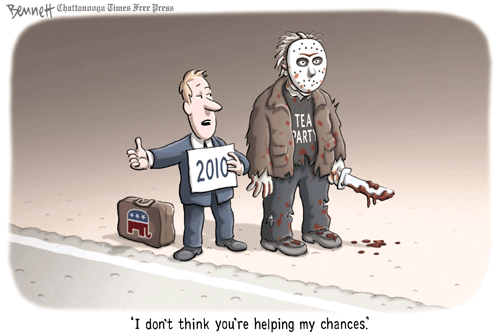
The Cleansing of the GOP

"Ditto" or the Highway: Republican Democracy
The purification process — hard-core and uncompromising partisans driving heretics from their ranks — has been going on for a long time. Saturday’s Republican convention in Utah, the one in which conservative Senator Robert Bennett was defeated for being not conservative enough (despite an 84 percent approval rating from the American Conservative Union), is just one more step in a decades-long effort to drive independent thought from the political decisionmaking process.
This year, of course, attention has been focused primarily on Marco Rubio’s success in driving Florida Governor Charlie Crist out of the Republican Party (he’s now running for the Senate as an Independent) and former Congressman Pat Toomey’s success in converting Republican Senator Arlen Specter into a Democrat. But in both of those cases one can argue that the targeted incumbent was simply too far out of step with his own party. The same ACU ratings index on which Bennett scored an 84 gave Specter a 40. The ratings only measure members of Congress but Crist had more than once angered party members with his support of initiatives that were fiercely opposed by most Republicans. But given Bennett’s long embrace of conservative positions, with relatively few departures from the party-line script over a period of nearly two decades, what happened in Utah was something of a very different and disturbing nature. It was checklist politics, a demand for suspension of judgment and lockstep adherence to an ideological instruction manual that would brook no deviation.
That is important in assessing what is happening in the political wars. When Jeff Bell, a member of the American Conservative Union’s board of directors, took on and defeated incumbent Republican Senator Clifford Case in a party primary in 1978, it was because Bell’s views were, in Republican terms, more mainstream than those of the liberal Case. It was not a matter of the extremes knocking off the middle but of a traditional conservative ousting a Republican who was, for all practical purposes, not a Republican at all. Similarly, two years later, Alfonse D’Amato knocked off incumbent Republican Senator Jacob Javits, another liberal, in a New York primary.
When Ned Lamont defeated incumbent Senator Joseph Lieberman in Connecticut’s Democratic Senate primary — after Lieberman had been his party’s vice presidential nominee — it was because one overriding issue — war — was of sufficient weight to overshadow the rest of Lieberman’s record and his Democratic credentials. War is a trump card; absent Lieberman’s support for the invasion of Iraq, it is unlikely that he would have been challenged by a fellow Democrat, much less be defeated, even though he had long been known for speaking his own mind (as witnessed by his forceful condemnation of Bill Clinton in the wake of the Lewinsky affair).
To be clear, Bennett’s defeat in Utah was not an unprecedented challenge of an incumbent who was just not as conservative as his opponent. Ronald Reagan almost defeated the generally conservative Gerald Ford in 1976 when Ford was seeking the Republican nomination to succeed himself in the White House. But for the most part, parties have been willing to allow some departure from the party line if a legislator’s overall record has been sufficiently on key.
Signs that this is changing were seen recently within the governing ranks of the GOP, with local party leaders attempting to force National Chairman Michael Steele to adopt a “purity” test to determine which Republican candidates would receive the party’s financial support. Steele refused to go along but it is the same sentiment that has now ended Robert Bennett’s Senate career.
When the voters send a man or woman to write the laws, in Washington or a state capitol, that legislator is obligated to weigh seriously the views of his or her constituents, to examine thoroughly the important issues of the day and the proposals to deal with them, and to consult the relevant constitution (federal or state) and then act accordingly. Increasingly, the last two items on that list — intelligent assessment and constitutional constraint — are being driven from the process. One is expected to listen — and to obey — the preferences, indeed the demands, not of “constituents” but of that small band of constituents who dominate party primaries and party conventions.
Ironically, those who demand such mindless conformity cry out a demand for adherence to the Constitution, even as they undermine the most important principles of rational constitutional self-government.
Original post by Mickey Edwards-The Cleansing: The Atlantic-May 10, 2010
Share This Blog


 Unknown Feed
- An error has occurred; the feed is probably down. Try again later.
 mykeystrokes.com
You must be logged in to post a comment.